

theladyviola
New member
Well, I've reviewed my electrical needs over the last couple years as it relates to my tiny teardrop camper trailer. The original builder only wired it for AC power--it basically has one outlet and one light inside. I've never been interested in adding DC because I don't want to tear into interior or the exterior when I know I'll upgrade down the road. On our trip to the Outer Banks last year, there were numerous situations where we could only run our camping generator until a certain time and shore power was not available. I do have a couple of those small battery packs you can charge your cell phone with and it worked good for the little 12v usb fans, but I'd like MORE POWER available. I toyed with installing a dual battery setup in the T4R, but after installing the Northstar 31M in place of my starting battery, I don't feel I need anything else directly in the vehicle. My 12V fridge runs fine and I have adequate room to add more accessories. I didn't like the idea of the camper being tethered to the truck either because we often divide and conquer which means one person is running errands while the other is at camp. So, portability made sense.
I've seen what's available portably, including: jump packs, ArkPak, National Luna Power Pak, battery boxes with external terminals and sockets, etc, etc, etc. With all of these options, I had problems with price or function or reviews. So, what's left to do? Build it myself. I don't particularly feel like having another project right now, but let's face it, making stuff is cool and rewarding. Whatever, I'm seriously saving money. I have hoarded my eBay gift cards and I have a small Lowe's gift card, so my out of pocket expense will be limited to the storage box and the batteries to get the unit up and running.
THIS IS MY PLAN. It will happen in stages for the sake of time, money, and a trip I'd like to use this on next month.
STORAGE
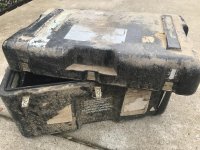
I looked at Lowe's, Home Depot, Academy Sports, Wal-Hell, and online for a "box" I felt would meet my needs at a frugal price (anyone who has looked at the beginnings of my build knows I'm going to by thrifty). I really didn't love the options. I'd love to stumble across a free Pelican case, but that's not going to happen. I narrowed by choices down to a Plano Sportsman trunk and a Kobalt tool box. Neither as sturdy as I'd prefer, but the price and size was generally right. Lucky Facebook Marketplace saved me. Today, I picked up a old 26x15x16 military shipping container for $35. So basically, I got my pseudo-pelican case. I plan to add some more one way valves for ventilation.
BATTERIES
I ran my options for one 12v AGM and I want more aH for the money. So I've looked at golf cart batteries with the intent of wiring two 6v batteries in series. I can get 200aH+ this way. These batteries are also designed for the rigors of life. I'd love to find two free Trojan T-105's, but again, not going to happen, and AGM just became outside my budget. These are the contenders right now:
Duracell SLIGC110
http://www.batteriesplus.com/productdetails/sligc110
Duracell SLIGC115
http://www.batteriesplus.com/productdetails/sligc115
RURAL KING (Excide) GC115G
http://www.ruralking.com/exide-golf-cart-battery-6volt-gc115g.html
Feel free to throw other ideas at me. Mind you, those ideas need to be limited to around $100/battery for 6v and the comparable for 12v
INVERTER
I've researched inverters more than I ever dreamed. I'd love to find a pure sine wave inverter for free, but the free fairy hasn't visited lately. My needs don't seem to dictate having a pure sine wave inverter at this time so I can safely say I won't be spending the money on one just yet. If I charge the fridge off the box, then I'll use the 12v socket. One of my preferences is that the inverter have a wired remote so I can mount it on the outside of the box while the inverter is inside the box. I would like to minimize the need for taking the lid off the box. I've kind of narrowed down to this 1100w inverter from Krieger:
http://www.amazon.com/Inverter-Installation-included-Automotive-according/dp/B00T564EIY
I'm a little disturbed by the number of smoking ones in the reviews, but unless I find another feasible alternative, I'm willing to roll the dice. I'll connect the inverter to a wet location outlet on the outside of the box.
OTHER STUFF
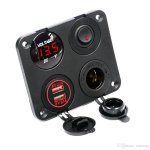
I'll be wiring up the series of batteries with 2/0 marine cable (found a deal) with 100a MEGA FUSE. I may buy a Blue Sea 5030 Fuse Block with Negative Bus just to make future expansion easier. I'll be mounting one of these so I'll have a volt meter, socket, USB charger, power switch:
I also plan to mount a Anderson connector to the outside of the box to charge while driving. I already have a Battery Doctor smart isolator, so I'll hook it up in the engine compartment and then run cable with a Anderson connector to the cargo area of the T4R to attach to the box while driving. I'll also make an exterior connector to quickly connect my Noco G7200 charger.
SOLAR
This will all eventually be maintained with a 100w solar setup. I won't be able to get this going before my Sept trip, so I'll have to rely on the battery charger when I have shore power and the alternator when traveling. For the money, I'm looking at the 100 watt Renogy bundle with the Wanderer controller for around $190. I'll have a solar panel hookup on the outside of the box and the controller will mount inside the box.
https://www.amazon.com/Renogy-Watts-Volts-Monocrystalline-Starter/dp/B00BFCNFRM
INCIDENTALS
I'll probably end up installing some temp controlled 12v case fans to keep things cool. Haven't decided on exactly what yet. May install a cheap temp probe and LED display. I also may, down the road, mount a digital energy display.
OK, I know I've forgotten to list stuff, so be gentle. But please give me feedback, suggestions, opinions, etc. Keep in mind, this is a budget build which is why I've chosen the particular items listed. However, I'm up for hearing your thoughts!
I've seen what's available portably, including: jump packs, ArkPak, National Luna Power Pak, battery boxes with external terminals and sockets, etc, etc, etc. With all of these options, I had problems with price or function or reviews. So, what's left to do? Build it myself. I don't particularly feel like having another project right now, but let's face it, making stuff is cool and rewarding. Whatever, I'm seriously saving money. I have hoarded my eBay gift cards and I have a small Lowe's gift card, so my out of pocket expense will be limited to the storage box and the batteries to get the unit up and running.
THIS IS MY PLAN. It will happen in stages for the sake of time, money, and a trip I'd like to use this on next month.
STORAGE
I looked at Lowe's, Home Depot, Academy Sports, Wal-Hell, and online for a "box" I felt would meet my needs at a frugal price (anyone who has looked at the beginnings of my build knows I'm going to by thrifty). I really didn't love the options. I'd love to stumble across a free Pelican case, but that's not going to happen. I narrowed by choices down to a Plano Sportsman trunk and a Kobalt tool box. Neither as sturdy as I'd prefer, but the price and size was generally right. Lucky Facebook Marketplace saved me. Today, I picked up a old 26x15x16 military shipping container for $35. So basically, I got my pseudo-pelican case. I plan to add some more one way valves for ventilation.
BATTERIES
I ran my options for one 12v AGM and I want more aH for the money. So I've looked at golf cart batteries with the intent of wiring two 6v batteries in series. I can get 200aH+ this way. These batteries are also designed for the rigors of life. I'd love to find two free Trojan T-105's, but again, not going to happen, and AGM just became outside my budget. These are the contenders right now:
Duracell SLIGC110
http://www.batteriesplus.com/productdetails/sligc110
Duracell SLIGC115
http://www.batteriesplus.com/productdetails/sligc115
RURAL KING (Excide) GC115G
http://www.ruralking.com/exide-golf-cart-battery-6volt-gc115g.html
Feel free to throw other ideas at me. Mind you, those ideas need to be limited to around $100/battery for 6v and the comparable for 12v
INVERTER
I've researched inverters more than I ever dreamed. I'd love to find a pure sine wave inverter for free, but the free fairy hasn't visited lately. My needs don't seem to dictate having a pure sine wave inverter at this time so I can safely say I won't be spending the money on one just yet. If I charge the fridge off the box, then I'll use the 12v socket. One of my preferences is that the inverter have a wired remote so I can mount it on the outside of the box while the inverter is inside the box. I would like to minimize the need for taking the lid off the box. I've kind of narrowed down to this 1100w inverter from Krieger:
http://www.amazon.com/Inverter-Installation-included-Automotive-according/dp/B00T564EIY
I'm a little disturbed by the number of smoking ones in the reviews, but unless I find another feasible alternative, I'm willing to roll the dice. I'll connect the inverter to a wet location outlet on the outside of the box.
OTHER STUFF
I'll be wiring up the series of batteries with 2/0 marine cable (found a deal) with 100a MEGA FUSE. I may buy a Blue Sea 5030 Fuse Block with Negative Bus just to make future expansion easier. I'll be mounting one of these so I'll have a volt meter, socket, USB charger, power switch:
I also plan to mount a Anderson connector to the outside of the box to charge while driving. I already have a Battery Doctor smart isolator, so I'll hook it up in the engine compartment and then run cable with a Anderson connector to the cargo area of the T4R to attach to the box while driving. I'll also make an exterior connector to quickly connect my Noco G7200 charger.
SOLAR
This will all eventually be maintained with a 100w solar setup. I won't be able to get this going before my Sept trip, so I'll have to rely on the battery charger when I have shore power and the alternator when traveling. For the money, I'm looking at the 100 watt Renogy bundle with the Wanderer controller for around $190. I'll have a solar panel hookup on the outside of the box and the controller will mount inside the box.
https://www.amazon.com/Renogy-Watts-Volts-Monocrystalline-Starter/dp/B00BFCNFRM
INCIDENTALS
I'll probably end up installing some temp controlled 12v case fans to keep things cool. Haven't decided on exactly what yet. May install a cheap temp probe and LED display. I also may, down the road, mount a digital energy display.
OK, I know I've forgotten to list stuff, so be gentle. But please give me feedback, suggestions, opinions, etc. Keep in mind, this is a budget build which is why I've chosen the particular items listed. However, I'm up for hearing your thoughts!
Attachments


Last edited:


