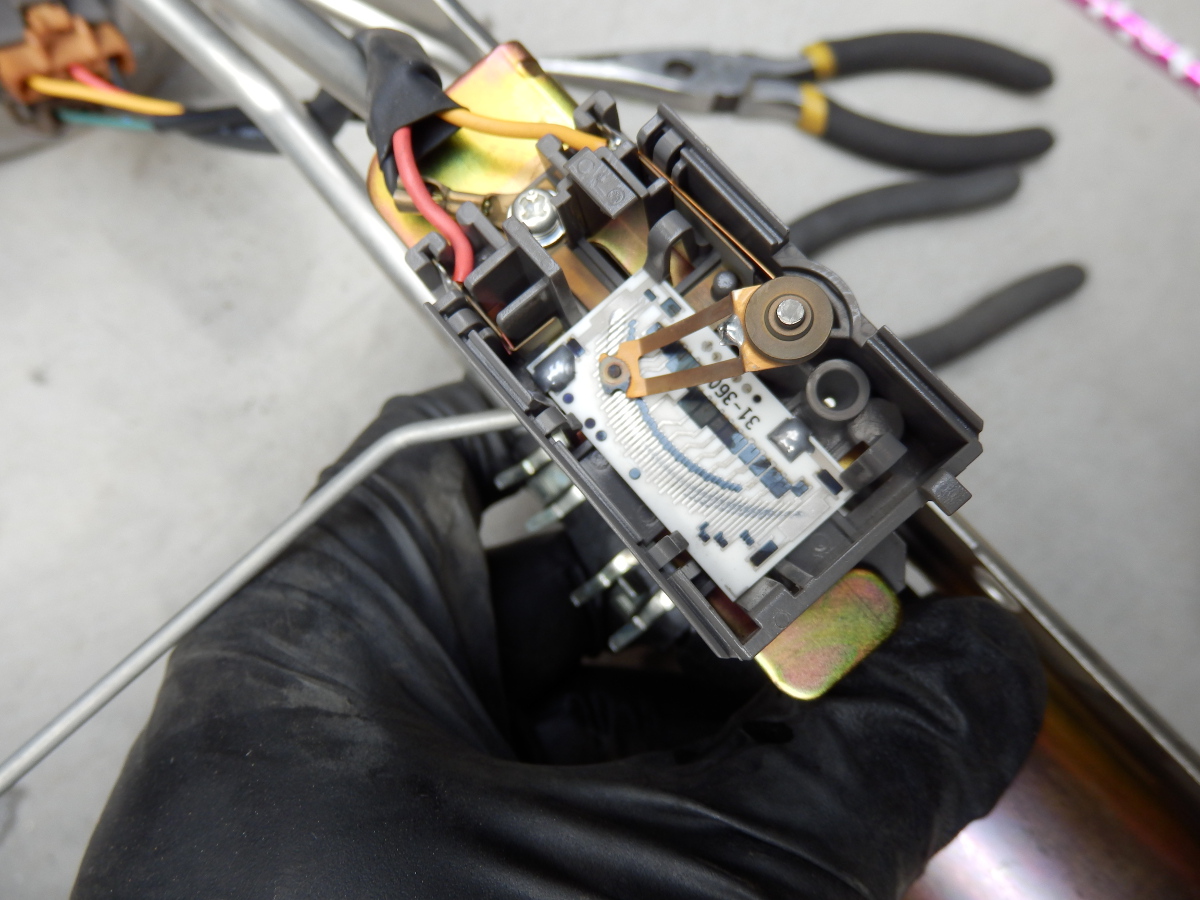
Position of low fuel light pin on fuel tank connector

Hi guys

I think the only thing on my truck which doesn't work is the low fuel light.

I'm pretty sure the problem is not the bulb, which certainly looks fine (though I have not actually tested it). The light does not come on when I turn the ignition on (without starting the engine). I have unplugged the connector to the fuel tank from under the rear seat, and I'm wondering how to test that the low fuel light works? I assume I need to ground one of the connectors with the ignition on, but I don't want to short the feed for the fuel pump and blow a fuse.

Can anyone tell me how I can test it from the plug. My fuel is not low at present.

Thanks

EO
 
Register to hide this ad
The low fuel light is turned on a by a thermistor in the fuel level sender. I only have the '97 US (gas) diagrams, but maybe it will cross over to the '96 euro model.

At the fuel tank: Black-Red is the positive connection to the thermistor, Brown is the ground connection

At the gauge cluster: Same colors. Black-Red on Pin 10 of the brown connector, Brown on Pin 12 of the largest connection (white, probably?) or any bare metal.

You will also want to check that the bulb in the cluster is still in good shape.

The circuit works like this: The thermistor is high resistance while cooled by the fuel, so it carries most of the voltage drop and the bulb stays off. When the thermistor comes out of the fuel, it heats up and its resistance drops and the light bulb lights up. That's why it slowly turns on and off - the thermistor resistance changes somewhat slowly as it heats and cools (fuel on or off the thermistor). This is also why the light is guaranteed to be off if the fuel level sender is unplugged - the low-fuel light is 'grounded' through the thermistor in the sender.

-Charlie
 
The low fuel light is turned on a by a thermistor in the fuel level sender. I only have the '97 US (gas) diagrams, but maybe it will cross over to the '96 euro model.

At the fuel tank: Black-Red is the positive connection to the thermistor, Brown is the ground connection

At the gauge cluster: Same colors. Black-Red on Pin 10 of the brown connector, Brown on Pin 12 of the largest connection (white, probably?) or any bare metal.

You will also want to check that the bulb in the cluster is still in good shape.

The circuit works like this: The thermistor is high resistance while cooled by the fuel, so it carries most of the voltage drop and the bulb stays off. When the thermistor comes out of the fuel, it heats up and its resistance drops and the light bulb lights up. That's why it slowly turns on and off - the thermistor resistance changes somewhat slowly as it heats and cools (fuel on or off the thermistor). This is also why the light is guaranteed to be off if the fuel level sender is unplugged - the low-fuel light is 'grounded' through the thermistor in the sender.

-Charlie

Great, thank you!

I have a Japanese 2.7 petrol and in most ways it's the same as the US market models.

So if I ground the low-fuel light pin in the connector, I should get the light on in the dash?

Is it really a thermistor? When I had the sender unit out, it looked like a little float switch to me. Assuming your fuel has equilibriated to ambient temperature after you have filled the car, the laws of thermodynamics state that the fuel and the ambient air will be the same temperature. The fuel only 'feels' colder because of the effect of evaporation, which should not happen in the tank if it is sealed, and even if it was open, would only cool the sensor momentarily while the film of fuel on it evaporates.
 
I just measured infinite resistance between b-r and br pins on the tank. If it were a thermistor I guess that would condemn it, but if it is a switch, the jury is still out.

Connecting the two pins (I am not certain I got a good connection) with the ignition on did not illuminate the light, though it would be easier to do this with an assistant, so I'll try that next.

EO
 
Great, thank you!

I have a Japanese 2.7 petrol and in most ways it's the same as the US market models.

So if I ground the low-fuel light pin in the connector, I should get the light on in the dash?

Is it really a thermistor? When I had the sender unit out, it looked like a little float switch to me. Assuming your fuel has equilibriated to ambient temperature after you have filled the car, the laws of thermodynamics state that the fuel and the ambient air will be the same temperature. The fuel only 'feels' colder because of the effect of evaporation, which should not happen in the tank if it is sealed, and even if it was open, would only cool the sensor momentarily while the film of fuel on it evaporates.
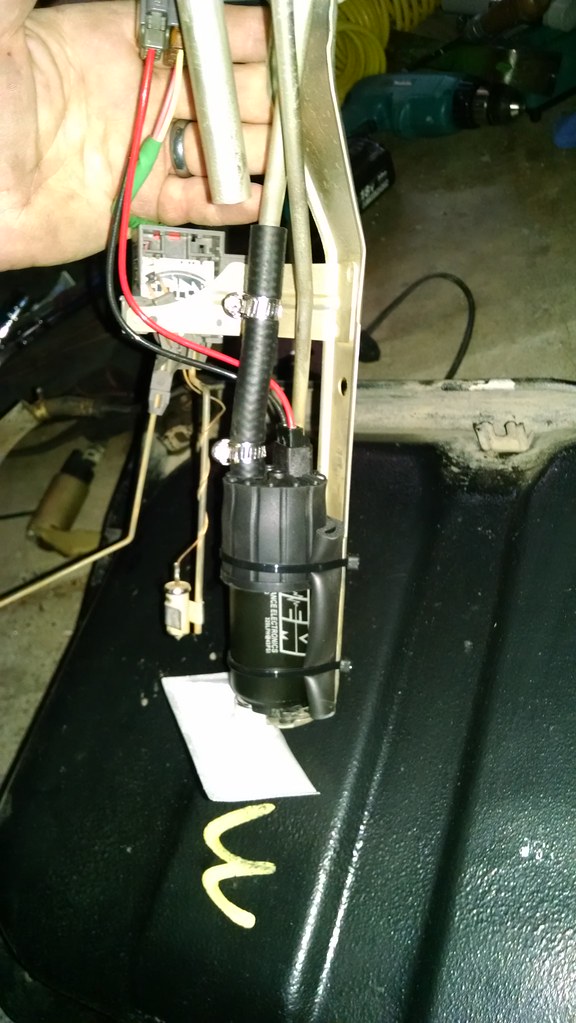
You know, the early model diagrams show Toyota's old way of doing the low fuel light... And here is a picture of what is listed as a '97 sender:

15346740065_6a5f7d5224_b.jpg


The thermister is there, hanging down near the fuel pump.

Here is a picture of an 01/02 fuel sender:

FP21.JPG


It looks like it is a switch on the later units (and later diagrams show an empty box for the sender, no thermistor shown).

Grounding the low fuel light wire should light the low fuel light.

As for the thermistor operation - while the truck is on, it is constantly fed 12V through the low-fuel light bulb. It is constantly trying to heat up, but the fuel acts as a heat sink. As soon as it is only exposed to air, it heats up and the resistance drops, lighting the low fuel light. If/when it get re-immersed in fuel, it cools off (causing resistance to go up) and turns off the bulb. It has nothing to do with fuel evaporation (it works opposite the way you suggest above - cool in the fuel, hot out of the fuel).

-Charlie
 
Hi Charlie

Awesome reply - thanks. The way you explain it now - with the fuel acting as a heat sink - makes perfect sense, thanks for that. After I suggested it might be a float switch, I realised this would be a bad idea, as it would risk sparking I suppose.

I'll try with an assistant to get the bulb to light by shorting the two pins, but I guess the fact there is infinite resistance between them means the thermistor, or wire leading to it, is defective. Time to get a replacement sender unit, and wait for the day I need to swap the fuel pump to put it in.

Thanks again

EO
 
Hi Charlie

Awesome reply - thanks. The way you explain it now - with the fuel acting as a heat sink - makes perfect sense, thanks for that. After I suggested it might be a float switch, I realised this would be a bad idea, as it would risk sparking I suppose.

I'll try with an assistant to get the bulb to light by shorting the two pins, but I guess the fact there is infinite resistance between them means the thermistor, or wire leading to it, is defective. Time to get a replacement sender unit, and wait for the day I need to swap the fuel pump to put it in.

Thanks again

EO
I would expect a few hundred ohms on that thermistor, assuming it exists on your setup. I haven't seen a spec on it in the wiring diagrams though.

And you are right, they probably did the thermistor thing to avoid a switch exposed to fuel. But then, you have a hot thermistor in there! :madgrin: Either option seems a bit scary!

-Charlie
 
OK, so I was jumping the wrong pins (of the three connected to the level sender).

Jumping Pins 1 and 3 puts the low fuel light on thye dash, but the corresponding pins on the top of the tank have infinite resistance. Pins 1 and 2 have 320Ω and must be for the sender (which works fine).

So conclusion - new sender unit required. Thanks for your help in diagnosis.

Now the only problem is the fact that the unit is out of production (the JDM 96-98 version is different from the US Market version) and the only place I can see one for sale is in Novosibirsk in the middle of Siberia. Luckily I have a friend there....

EO
 

Members online

Forum statistics

Threads
278,315
Messages
3,554,125
Members
248,016
Latest member
Advally Service

Trending content

Back
Top