
Redarc BCDC1225D, Fuse Placement

Farzad_K

Member
Hello.

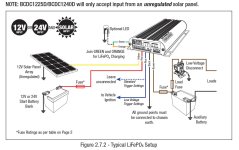
I am working on my dual battery setup centered around a 25A Redarc. I am following their wiring diagram (attached) and am not sure if the fuses they show should be near the batteries or if all that matters is if the line is fused and therefore they can be sitting near the BCDC1225D.


Thanks for any input.

Farzad
 

Attachments

  • REDARCCC.jpg
    REDARCCC.jpg
    116.6 KB · Views: 1,536
Register to hide this ad
i installed all my fuses near the redarc with my portable dual battery since it's more accessible there. they recommend one is installed near the car battery and one near the redarc. i guess in the end, for as long as it's fused, you are okay whether it's far or near the car battery or the auxiliary battery.

Hello.

I am working on my dual battery setup centered around a 25A Redarc. I am following their wiring diagram (attached) and am not sure if the fuses they show should be near the batteries or if all that matters is if the line is fused and therefore they can be sitting near the BCDC1225D.


Thanks for any input.

Farzad
 
Last edited:
typically you would want your fuses as close to the battery as possible

I would personally invest in bluesea circuit breakers as they mitigate the need to carry (and sometimes find) spare fuses plus a few other advantages...but fuses work just fine
 
Last edited:
i installed all my fuses near the redarc with my portable dual battery since it's more accessible there. they recommend one is installed near the car battery and one near the redarc. i guess in the end, for as long as it's fused, you are okay whether it's far or near the car battery or the auxiliary battery.

Thanks for sharing.

The problem is they over-estimate the needs of the system. For the 25A system I am putting together, knowing I am using a LiFePo as the auxiliary, and that a BMS is involved, they recommend their 100A low voltage cut off at the auxiliary battery to protect it from being overdrawn by the eventual load.

Also might be interesting to note they require more robust fuses when the 40A Redarc is being used implying it is the Redarc that needs to be limited to how how many amps it gets to play with and not the batteries at either end of it because those are the same batteries in the 25A system and would be the same for a 15A system if one existed.

Leave it up to them and the system will be twice as thick!!!
 
Hello.

I am working on my dual battery setup centered around a 25A Redarc. I am following their wiring diagram (attached) and am not sure if the fuses they show should be near the batteries or if all that matters is if the line is fused and therefore they can be sitting near the BCDC1225D.


Thanks for any input.

Farzad

Fuses should always be placed as close to the electrical source as reasonably possible. So on a DC to DC charger place a fuse close to what you pull from the alternator/ main battery, a fuse close to (under) the solar panels, and a fuse on all positive battery connections depending on your application.


You want to give the fuse every chance to do its job. If you have a short before that wire is fused then the fuse will do nothing.
 
Last edited:
typically you would want your fuses as close to the battery as possible

I would personally invest in bluesea circuit breakers as they mitigate the need to carry (and sometimes find) spare fuses plus a few other advantages...but fuses work just fine

From the name of it sounds like a circuit breaker might be better to consider. Can you share a link please to the model you recommend? I did a little research and it looks like they might be sensitive to heat. Are you sure they are good for under the hood?

Thanks a lot.

Farzad
 
Last edited:
Fuses should always be placed as close to the electrical source as reasonably possible. So on a DC to DC charger place a fuse close to what you pull from the alternator/ main battery, a fuse close to (under) the solar panels, and a fuse on all positive battery connections depending on your application.


You want to give the fuse every chance to do its job. If you have a short before that wire is fused then the fuse will do nothing.

Thanks. So you are in agreement with their diagram.
 
Personally, I have 2 mounted under the hood and havent had any issues thus far.

285-Series - Blue Sea Systems

187-Series - Blue Sea Systems

Thanks for the links.

You said you prefer these circuit breakers as opposed to fuses because once a fuse is "spent" you have to replace it, but for the same event that will "spend" a fuse, the circuit breaker will trip and the circuit will simply open, protecting whatever it was there to protect. I am thinking what that event might be. If the circuit was overloaded, or it was about to be overloaded, it is important to protect it, but then we have to mitigate the cause of the circuit having become overloaded, won't we?

The fuse blows because something went wrong and I am out of fuses, I am now dead in the water. The circuit breaker trips because something went wrong and I can reset the breaker but it will trip again unless I fix the cause of the issue.

Am I overthinking this?
 
Thanks for the links.

You said you prefer these circuit breakers as opposed to fuses because once a fuse is "spent" you have to replace it, but for the same event that will "spend" a fuse, the circuit breaker will trip and the circuit will simply open, protecting whatever it was there to protect. I am thinking what that event might be. If the circuit was overloaded, or it was about to be overloaded, it is important to protect it, but then we have to mitigate the cause of the circuit having become overloaded, won't we?

The fuse blows because something went wrong and I am out of fuses, I am now dead in the water. The circuit breaker trips because something went wrong and I can reset the breaker but it will trip again unless I fix the cause of the issue.

Am I overthinking this?

Nope, you’re absolutely correct.

Also, I don’t remember if I read it in the previous posts and I’m sure you’re already aware, but be sure to run properly sized gauge wire
 
Nope, you’re absolutely correct.

Also, I don’t remember if I read it in the previous posts and I’m sure you’re already aware, but be sure to run properly sized gauge wire

Yes, 6 gage from startup battery to the charger, 0.20v drop at 10 feet and 25A, then 8 gage from the charger to auxiliary, 0.16v drop at 5 feet and 25A when bulk charging.
 
i used 8 gauge wire from the startup battery to the back, maximum length of 16 feet for the 25A dc-dc charger. further than 16 feet, you have to use the 6 gauge wire. i did not see any drop in voltage when i measured it.

Yes, 6 gage from startup battery to the charger, 0.20v drop at 10 feet and 25A, then 8 gage from the charger to auxiliary, 0.16v drop at 5 feet and 25A when bulk charging.
 
i used 8 gauge wire from the startup battery to the back, maximum length of 16 feet for the 25A dc-dc charger. further than 16 feet, you have to use the 6 gauge wire. i did not see any drop in voltage when i measured it.

Redarc says 6 and 8, and according to calculations, the Vd will be as I indicated. It is good that you are not experiencing any voltage drop. The other issue, aside from Vd, is heat. You won't be pulling 25A steadily for long enough period of time to generate enough heat to cause damage to the insulation and surrounding of it, but, it doesn't hurt to be careful with fire :)
 
i only use it for my fridge and a few items to charge devices. besides the existing insulation of the wire, i used a separate wire spiral wrap protection for the positive wire. i also upgraded my fridge connection to use a powerpole connector for everything. see this video. Smittybilt Tire Pump and Fridge mods using a powerpole connector instead of the cigarette outlet - YouTube


Redarc says 6 and 8, and according to calculations, the Vd will be as I indicated. It is good that you are not experiencing any voltage drop. The other issue, aside from Vd, is heat. You won't be pulling 25A steadily for long enough period of time to generate enough heat to cause damage to the insulation and surrounding of it, but, it doesn't hurt to be careful with fire :)
 
i only use it for my fridge and a few items to charge devices. besides the existing insulation of the wire, i used a separate wire spiral wrap protection for the positive wire. i also upgraded my fridge connection to use a powerpole connector for everything. see this video. Smittybilt Tire Pump and Fridge mods using a powerpole connector instead of the cigarette outlet - YouTube

I am using Anderson Powerpole everywhere and anywhere that I can as well.

For compressor, I have VIAIR - 40045 400P in my Amazon cart, but I think I might just install an ARB Twin under the hood, but I am some ways away from needing that.
 

Members online

No members online now.

Forum statistics

Threads
278,312
Messages
3,554,083
Members
248,016
Latest member
Advally Service

Trending content

Back
Top