Repeated fuel filter clog, failing fuel pump, or ?

hour

New member
TL; DR Changed fuel filter, instant mind blowing positive change, 1.75 tanks / a week later all symptoms return identically. Ideas greatly appreciated as I want to solve this correctly, not by throwing a new filter on it every week.

Spitballing potential causes
  • A ton of sediment or rust is in the tank and reclogged the filter as I ran the second tank down. This would almost suggest that the fuel filters are technically uncloggable, as the old filter would have been completely plugged otherwise.
  • There are normal levels of sediment in the tank, and neither the old filter nor the new one are significantly clogged, but my fuel pump is failing can't handle back pressure from anything but a pristine fuel filter

I don't think an injector is clogged because any vibration seem uniform, like everything is suffering equally. I also don't see how changing the fuel filter would have instantly cured an injector for 2 weeks. I also don't think it's related to air intake, sensors, plugs, wires, etc. as sensors are clean, filters and plugs+wires range from new to very new. All I can think of is pump or wicked tank sediment.

Blabbing story

The performance of my 99 3.4L auto had steadily decreased since purchasing 3 years / 14,000 miles ago to the point of being an absolute stress filled chore to drive. I attributed this to the evolution of the vehicle: take a heaping dump on aerodynamics via lift and roof rack, hanging hundreds of pounds of steel up front, running oversized knobby tires, etc...

I changed the fuel filter with an OEM Toyota one like two weeks ago and every symptom I had with the vehicle was immediately resolved. This lasted for ~400 miles / 1.75 tanks of gas / about a week. The first 325 miles occurred the day after the filter change, towing 1,500 lbs on the interstate and up high elevation mountain trails. It performed flawlessly doing this and felt better than it EVER had. It also raked in +4.6mpg on the first tank of the trip than I had seen in 2 years, unloaded. Unloaded 100% highway tanks had literally been around 13.

Anyway, the second tank got me home and I continued my week driving the 4runner in absolute bliss in the city and on the highway (75 miles - fuel gauge now at 1/4). Then the other afternoon in stop and go traffic, I come to a stop maybe 5 minutes after the engine reached operating temp, and notice the dreaded idle vibration was back. The rest of the drive home revealed all symptoms were back identical as before.

Symptoms prior to, and 1 week after fuel filter change
  • Cold idle sounds fine for ~45 secs, then tinny and almost sputtery after rpms drop
  • Idle at operating temperature also sounds bad, with consistent vibration. The noise and vibration are much more prominenant after it has been at operating temperature for several minutes and had the engine worked
  • Engine RPM and noise never change when pressing gas at city or highway speeds. You have to keep pushing until the transmission is forced to downshift. The sputtery tinny noise does increase though. Maybe that's better called lugging the engine?
  • Gutless even after you force it to downshift if not rolling downhill
  • Cannot maintain even 55mph going up the mountains as other 3.4L armored Tacomas/4Runners blow by me
  • Transmission heats up ascending because it won't downshift on its own appropriately, and turning OD off basically means 'knock 20mph off current speed instantly and still have no power'
  • <13.5 mpg unloaded on a 100% highway tank at 65-70mph - no mountains

Immediate changes with new filter
  • Cold, warm, hot, and HOT idle sounds healthy and throaty, no sputtering or vibration
  • Every gear has something to give in the city or highway when pushing the gas to accelerate. Engine roars smoothly as engine rpm increases and I gain speed. No tinny sputtering noise, no sound of rocks in a can. Pedal feels perfectly responsive, transmission downshifts if it needs to without me pushing the pedal to force it
  • Can keep up with traffic even while towing
  • Everything ran cooler and smoother, even while towing, because it was able to shift seamlessly when it needed to, not when I forced it to
 
Register to hide this ad
Where are you getting your gas??

Typically Shell, and seek out the non-run down gas stations. A habit that I first developed in my days of turbo car ownership. If I have sediment trapped in the tank I don't think I've contributed to it in the 3 years I've owned it by purchasing low quality gas, but that'd also mean that 3 years of quality gas hasn't flushed the tank of gunk. This of course assuming that the problem isn't due to a failing fuel pump..
 
If changing the fuel filter corrected your issues I would suspect that either you have a good amount of debris in the tank or your fuel pump is putting out minimal pressure . Drive it until you are low on gas, buy a new pump and drop the tank. If debris is obviously your problem you can return the pump. If debris is not the problem I would replace the pump just to be sure.
 
Do you have a CEL? if so, get it checked (AutoZone/Advance Auto will do it for free) and report back the DTC(s).

Buckaroo
 
Like [MENTION=84643]JBurt[/MENTION] said, check your pressure. Also pull the vacuum line off the FPR to check for gas or at least the presence of it.

At least it isn't coolant mixing with the oil.
 
Did you cut open the old filter to see what's inside? I suspect weak fuel pump or mega crud in tank, if the filters are being clogged.
 
Checking the fuel pressure in the engine compartment will not tell if it is a bad fuel pump or debris/clog in the tank. Cutting open the recently put in filter and replacing as suggested will tell you if it is being clogged. I would still go through the effort of dropping the tank and making sure.
 
Thanks for input all. I forgot to include in my original post that the vehicle has never thrown a check engine light during any of this, not when sputtering up hills at 20mph tops nor when vibrating wildly at idle afterwards.

I didn't cut open the old fuel filter as I figured whatever approach I took short of a hack saw would have a high potential for sparks. Now that the old filter has sat for two weeks I might give it a whirl. I have a bunch of cheapo generic filters on the way from Rock Auto so I'll also cut open the new one when I replace it... pending that I can get a generic filter on without leaks.

JBurt, I can see if that info is available on my Torque app.. but I think if so, it'll be one of the many sensors in torque that's all over the place, as in no consistent reading. Will check out.

But yea St Runner, I think I'll go through the motions of fuel pump replacement and do some inspecting while I'm in there, and return the pump if need be.
 
A lot of times when a fuel pump is failing you can hit the tank and it will get that pump going. Old hammer trick. Works on stuck starters also.
 
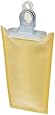
Don't forget there is an in-tank filter before the pump. This puppy:

41P45uCLqQL._AC_UL115_.jpg


If there really is a pantload of gunk in the tank, that will be clogging up and starving your pump. For the record, I just changed mine (along with the pump) at 17+ years and 180k because I had the tank out, and it was pristine as was the tank (inside).
 
Last edited:
A lot of times when a fuel pump is failing you can hit the tank and it will get that pump going. Old hammer trick. Works on stuck starters also.

Hah thanks, I'll remember that should it leave me stranded.

Don't forget there is an in-tank filter before the pump. This puppy:

41P45uCLqQL._AC_UL115_.jpg


If there really is a pantload of gunk in the tank, that will be clogging up and starving your pump. For the record, I just changed mine (along with the pump) at 17+ years and 180k because I had the tank out, and it was pristine as was the tank (inside).

Yeah, I've read about those. Also not the only higher-mileage owner to say their tank was clean inside. Leaves me completely baffled, I know the fuel filter had an immediate and enormous benefit but I can't imagine changing something downstream of the fuel tank would have helped if the pump itself was starving over a clogged filter sock. And if the tank isn't starving for fuel and the original filter was clogged, how did it clog again so quickly?

I will say that I've probably run the tank low a lot.. I was under the assumption that inaccurate gas gauge and crappy tank venting caused me to fill up with a few gallons left in the tank after riding the gas light for a ways, always. Further reading just the other week suggested that the tank vent tube is too long and there's likely very little gas left when I'm filling ~14 gallons.

I've never taken my 4runner anywhere to be serviced, short of Discount Tire and Firestone for alignments, but I'd happily pay for a pro to get to the bottom of this. I had a brief taste of what a properly running 4runner feels like and it'd be so worth the bill to have that consistently, but I don't know what kind of troubleshooting a pro would do that I can't, just out of ideas.
 
That pre-filter only filters larger stuff. It's not likely to cause your pump to starve for fuel, but protects the pump from big pieces that could damage the pump's impellers. Pieces of smaller sizes, or microns are what clog filters and that sock doesn't catch those little pieces.

The answer lies in dropping the tank and physically inspecting it. All of the "what if's" in the world aren't going to change that.

The check engine light didn't come on because there weren't any symptoms that would throw the fuel and/or emissions systems out of whack. The sensors did their job as calibrated, despite the lack of fuel flow.
 
Last edited:
Maybe a small tubing cutter would be a fairly safe way to cut the filter apart. Use gloves and keep a fire extinguisher at hand.
 
I had a thought...

Timeline of the fix the other week went as such, as I had just acquired a few parts and stuff:

OEM Air filter
MAF cleaning
OEM Fuel Filter

Two days before I did the fuel filter I changed my ~5,000 mile clean air filter with an OEM one. While I was at it I liberally sprayed my MAF sensor from a distance and let it drip dry. I didn't disconnect the battery and drove 7 miles the next day to and from work at <40mph.. not looking, expecting, or experiencing any difference.

Then I did the fuel filter, 7 miles after MAF cleaning. Couldn't get it started after the fuel filter change only to realize it was leaking :doh: Tightened that up and it cranked a few times, but sounded better than it had in years when it did fire.

Started the next morning off towing, 2 miles at <40mph to the interstate. Almost immediately after getting on that interstate @ 65mph is where I noticed that my 4runner felt better than ever despite the load behind it. So I naturally linked that to the fuel filter, fuel flow under load finally being adequate, got awesome fuel economy, blabla.

another TL; DR: I've ordered a new Denso MAF sensor (197-6020), and an upstream o2 sensor just because.

Theory is that cleaning MAF helped, but it's fubared. I've read on TW and here that people have cleaned MAFs and experienced brief improvement only to have it run crappy again - solved by replacing.

Since I didn't yank the battery cable after cleaning MAF, drove in-city for < 10 miles at low speed, and wasn't trying to romp on it to see if it responded differently, something hadn't learned - be it me or the ECU? And making it merge with 1,500 lbs behind it up to 65mph made it learn, once again be it me or the ECU? Fuel filter simply coincidental? Ancient aliens?

I noticed when I cleaned the MAF that it had a remanufactured sticker on it. It didn't say the date, and I don't recall if it had any part number printed. The housing for the MAF sensor states:

22204-00030
TN197400-2120
TOYOTA
Denso - B


There's only once instance of those part numbers on this entire site and it was someone posting an ebay link. Google returns 90% ebay results. Ebay results say 4Runner 4.0L, Tundras, Celicas.. no 3.4L anything. Denso's website has no record.

So F that sensor, I don't even know if it's right for the vehicle, it's already reman'd, and it almost makes more sense than this fuel filter ish. The air box does have that typical "STOP - This vehicle is equipped with a reusable filter" or whatever by K&N, so who knows if this sensor has seen oiled filters in its lifetime. A check engine light would be appreciated but I'll take my chances at $70 on Amazon
 
Hah thanks, I'll remember that should it leave me stranded.


Yeah, I've read about those. Also not the only higher-mileage owner to say their tank was clean inside. Leaves me completely baffled, I know the fuel filter had an immediate and enormous benefit but I can't imagine changing something downstream of the fuel tank would have helped if the pump itself was starving over a clogged filter sock. And if the tank isn't starving for fuel and the original filter was clogged, how did it clog again so quickly?

I will say that I've probably run the tank low a lot.. I was under the assumption that inaccurate gas gauge and crappy tank venting caused me to fill up with a few gallons left in the tank after riding the gas light for a ways, always. Further reading just the other week suggested that the tank vent tube is too long and there's likely very little gas left when I'm filling ~14 gallons.

I've never taken my 4runner anywhere to be serviced, short of Discount Tire and Firestone for alignments, but I'd happily pay for a pro to get to the bottom of this. I had a brief taste of what a properly running 4runner feels like and it'd be so worth the bill to have that consistently, but I don't know what kind of troubleshooting a pro would do that I can't, just out of ideas.

It was more to tell you for testing the pump. When running rough smack the tank. You can also lift the driver rest seat. Take off access and smack the pump assemble cover. If car starts to run better you know it's the pump. I had same symptoms as you and pump eventually died. Good luck.

To add I'm pretty positive is not sedative. I've been in many tanks and they are always clean. Unless you drive with gas cap off for many years.
 
Last edited:
Edit: See my new post below - the vehicle is once again fixed for a little bit

First... anyone know if this style of PCV valve should have the bottom of the brown part flush with the valve cover grommet?

61CpMeFWGbL._SL320_.jpg~original


I did some wrenching today and noticed mine was not. I tried to push it in more but it wasn't having it. I replaced this almost 2 years ago when I did valve cover gaskets - made by Beck Arnley.

0498F31E-E1CF-4285-81D9-68EB27216AA9_zpsnclcspnv.jpg~original


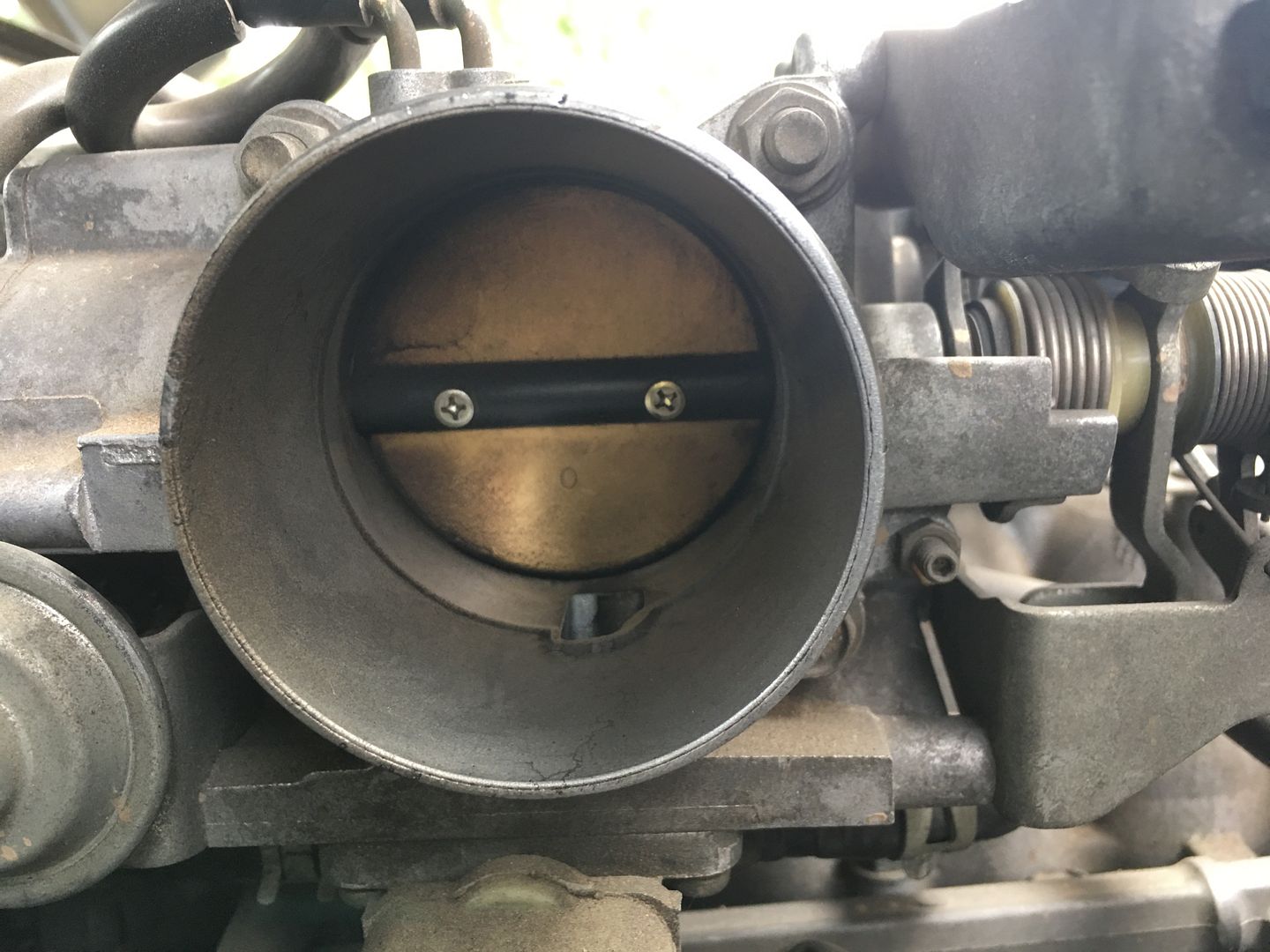
Moving on... I inspected the throttle valve for carbon deposits. Didn't find much of anything but cleaned it up. Before pics:

A214450E-362A-448A-9423-F68A41348772_zpsmbpw2tn2.jpg~original


74153439-6591-46F1-A92C-36CFADCDB26C_zpsqj5xztrk.jpg~original


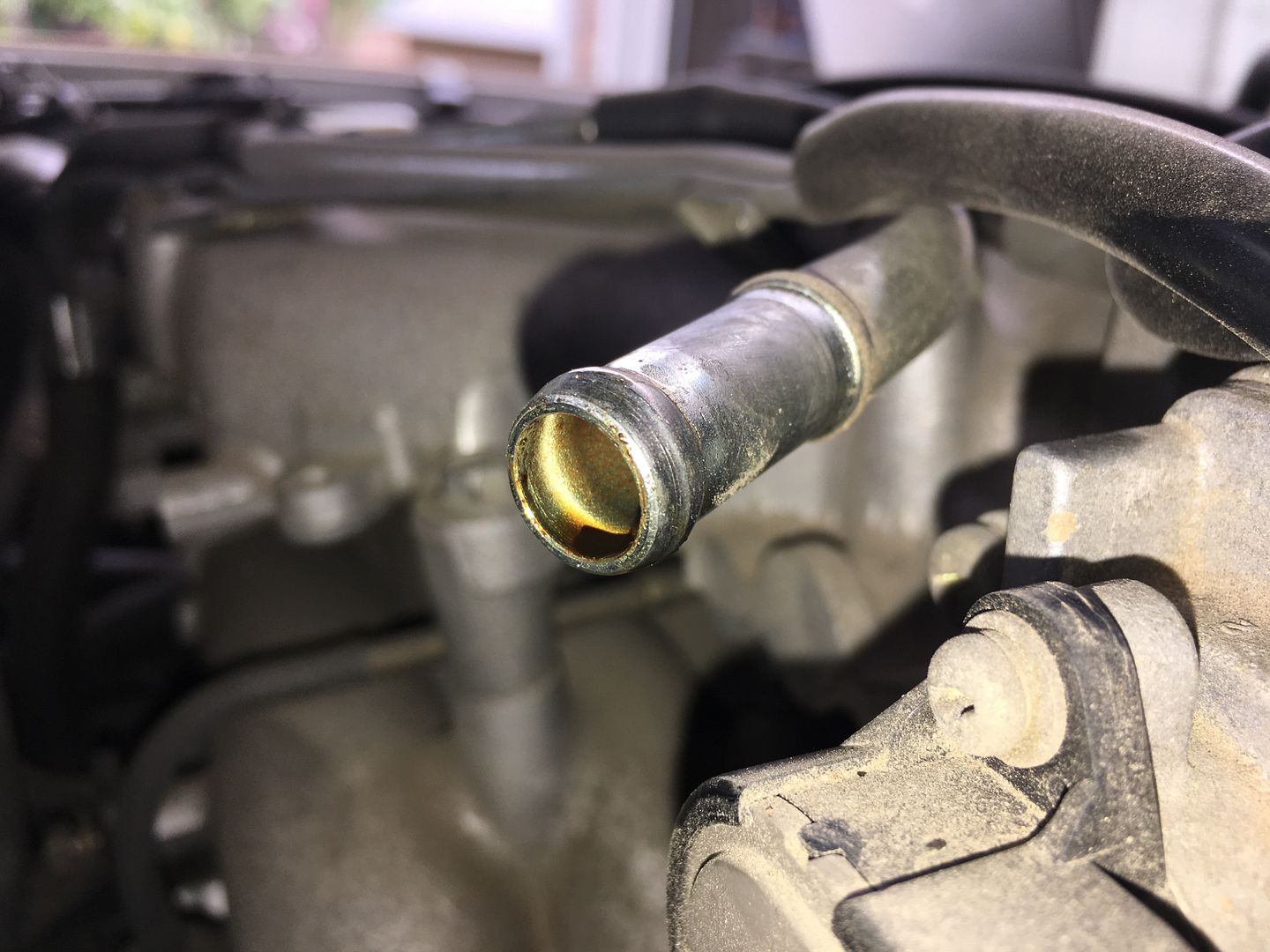
The PCV hose that feeds in to the air intake tube had the littlest shiny spot, but no residue that I could even see on the end of my finger. The tube to the intake manifold did have a tiny amount of oil on it. I wiped it off before I took this picture, oops

6E007F22-F9DE-42EB-9A18-34385A27795E_zpsve9fxmwd.jpg~original


I double checked my spark plug wire routing and found that one (that goes to cyl 1-passenger side) was under the other two wires when it should go over. Took off cyl 1 coil pack to fix that because I didn't want to break the plug retaining clip thing. The smell of burnt oil wafted out of the spark plug tube.

MAF is not the culprit. Installed it yesterday, disconnected battery for a few hours, and have since driven about an hour. There was no difference at all. I should mention now that my 4runner is the 49 state emissions or whatever, confirmed by sticker under the hood and single cat converter.

So since I had a new Denso front o2 sensor, I decided to install that and see if there was any difference. I have read of some relation between MAF and upstream o2 sensor so I thought maybe my cleaning of the old MAF just before the 4runner ran well for a week, played on the upstream o2 sensor. Unfortunately the previous owner had rounded the bolts for the sensor, so I couldn't install it.. not sure how I ever will.

So back to the beginning: 3 things changed on 4runner before it ran well for a week: cleaned MAF, replaced air filter, and then replaced fuel filter.

MAF isn't it, but I thought MAYBE I bumped some plug wires and alleviated a grounding issue or something whacky. I'll go ahead and rule that out now too. As it was roughly chugging in idle in my driveway, I also sprayed a TON of carb cleaner/starting fluid. No change in idle. I visually inspected all vacuum hoses, most of which are <2 years old from when I upgraded to silicone hoses. No pinches, no tears, nothing.

My idle does not fluctuate. It sits at 590-610 idling in drive, and 650-700 in park. It does idle smoother at 650 though.

This problem is very audible, but hard to describe. At idle, I can hear it going 'luglugluglugluglugluglug' consistently.. it did not do this for the week it was fixed. Under load if I accelerate very gently off the line, it sounds normal. That lasts all of a second before I need to put my foot in to it more in order to keep up with a grandmother on her walker. As I push the gas harder, the luglugluglug noise appears and I veryveryvery slowly gain RPMs and speed

Off to install another fuel filter. If that has no effect then I'll have to find someone to install my new o2 sensor. Ideas always appreciated. Hate this ish...

Pics for reference as well. Old MAF sensor wires were bent. New ones were not. I really thought I'd be solving the problem when I saw this :|

Old:
6AF849EB-335D-4614-8EB5-1319420DF97C_zps14cf2ro2.jpg~original


New:
2A0F0873-491E-4050-A5D8-A9C3778E68BC_zpsl9xsyrqz.jpg~original
 
Last edited:
The OEM one will fit flush. They are less than $10 on the Web. That is why you may have a little oil in the manifold.

Any access to a scanner that can read live data (O2 streams for instance)? It may be a TPS problem. But that is just being an armchair mechanic....
 
PSA: MOTORCRAFT FG1099 is a properly fitting fuel filter for our vehicles and costs $1.37. It also did not leak a drop after installation, where the Toyota fuel filter I got 3 weeks ago required crazy tightening

That said, Idunno what it's filtration ratings are and how they match up to our vehicles, and the quality likely isn't that spectacular for $1.37. You reuse your old fuel filter hanger/clamp. Glad I got 6 of them last week for diagnostic purposes...

Anyway, the vehicle is fixed once again, though presumedly not for that long immediately following another fuel filter change. I wish I had received my Rock Auto order before I got the stupid thought to buy a brand new express shipped MAF and o2 sensor.

I had been screwing with the car all damn day mind you, doing the tb cleaning, spraying starter fluid to try and find vac leaks, listening for leaks, taps, misfires, etc... so this was an immediate noticed difference the second it turned on.

Sequence of events is identical to what I did 3 weeks ago with the Toyota OEM filter... however none of the fuel that dripped during tonights process had any color, all clear. The fuel that came out of the filter I took off the other week (unknown age, installed by previous owner) was slightly tinted.

  1. Open gas cap
  2. Begin to unscrew the rear-facing connection to the fuel filter (having forgotten to purge the gas lines AGAIN), get sprayed by gasoline.
  3. Fully remove rear bolt after most of the spray has been caught, observe clear gas dripping this time
  4. Undo front bolt and catch a little dribble
  5. Install new filter
  6. Turn key on for 10 seconds and then off 3 x, pretending as if it's priming something
  7. Attempt to start the vehicle - it cranked maybe 10 times 3 weeks ago before firing, required two sets of almost 10 to get started tonight
  8. Listen to 3 seconds of engine stumbling before it begins to purr

So yeah, the engine immediately sounded 100% better. After a brief higher idle it dropped down to the same RPM as I was seeing all day, with no shaking, a richer sound with a way less pronounced 'lugluglug'... money.

Took it for a test drive and was once again happy as hell. The engine accelerates instead of feeling like it has nothing to give and forcing me to mash the gas pedal until it downshifts. Previously, I wouldn't have even gained speed (nor engine RPM) to press the gas pedal with the same pressure. Now it either gains speed or downshifts seamlessly for me.

So wtf?

I guess it could be: fuel filter re-clogged because the tank is filthy, something reset as I struggled to start the engine while lines primed or whatever, or I have clogged injectors and dry firing them until it started did something good.

I can't figure out how to determine which cylinder is running rough because I never throw a CEL, have zero stored codes, and Torque app doesn't seem to log misfires, cylinder roughness, total misfire count, nada. I've also never had any reason to feel as though a single cylinder is suffering... just thought it felt crappy across the board. ALSO, I've run this thing SO hard, wheeling, towing up steep grades at two miles in elevation, yadaya... Surely I would have thrown a CEL doing that if individual cylinders were boofing hundreds of thousands of times per trip, right? Or does the ECU just think the cycle went as planned not knowing that little or potentially no fuel made it in?

Looks like I'm between dropping the tank and inspecting, and replacing the fuel pump sock and fuel pump while I was in there, or sending all of my injectors off to Witch Hunter. What would you do next?
 
Last edited:

Members online

Forum statistics

Threads
278,316
Messages
3,554,120
Members
248,016
Latest member
Advally Service

Trending content

Back
Top