Roofing question

KidVermicious

New member
I'm redoing the garage with roll shingle. I've replaced the rotten joists and thrown all new sheathing up, and I'm confused about the order of what comes next. I think I need drip edge along the lower edges (where I'll put gutters later) and flashing in the valleys, then water/ice dam, then drip edge along the gable edges, then shingles, right?

Or does all the drip edge go on first, then the underlayment?
 
Register to hide this ad
I'm redoing the garage with roll shingle. I've replaced the rotten joists and thrown all new sheathing up, and I'm confused about the order of what comes next. I think I need drip edge along the lower edges (where I'll put gutters later) and flashing in the valleys, then water/ice dam, then drip edge along the gable edges, then shingles, right?

Or does all the drip edge go on first, then the underlayment?

When you say underlayment are you referring to the roll of black tar paper ...if so that goes down first then your flashing ...then drip edge then your shingles
 
If you are doing ice and water on the eaves (I would recommend doing this- especially in climates like Utah) put the underlayment/tar paper down first then the drip edge then the ice and water shield on top of the drip edge.

If no I&W do the drip edge first and then the underlayment/tar paper on top.

At the rakes you want the tar paper (And I&W if you plan to use) underneath the drip edge.

Make sure and start at the eave with the tar paper and overlap it as you install it going up the pitch of the roof. If you do it starting from the top it is overlapped the incorrect way and water can makes it's way underneath (I've seen installs from roofers this way and it's always a problem given enough time!)

You have to think like water here and how it moves. Important to do it right if you want a long lasting roof.

Then you do your base sheet and then your cap sheet.

May I ask why are you doing rolled roofing? Is the pitch under 2:12 on your garage? Or is that what you want- either for ease of install or just your personal preference?

Rolled roofing is very tempting for a lot of folks due to it's ease of install, but it is inferior in many ways on pitches 2:12 and greater versus a composition shingle.

As far as the valley flashing is concerned, you want tar paper first, then I&W (If utilizing) and then valley metal. Don't skimp on valley metal if you go this route- at least 18" width. You buy rolled metal which typically come sin 36" widths, cut 10' sections and trim down the center to get 18" wide X 10' long section to work with. Then you install your shingle/roofing 4" on each side from the center line of the valley metal.


But really, you can do closed valleys and just do I&W without valley metal, and that is a better method. You just overlap one side 12" on the other side of the valley.

I prefer closed valleys- with tar paper, then metal flashing, then ice and water then the shingle. This is the best method to mitigate possible water intrusion.

If you provide greater detail I can help you out more. I've run a roofing company as a side business for the last 5 years.
 
Last edited:
Thanks for the insight, fellas.

The supply house sold me a roll of synthetic stuff called Ready Roof and some plastic head nails which is supposed to be better than felt underlayment. I thought it was the same thing as ice and water shield? If not then oh well.

I'm using rolled roof because it is a 2:12 pitch or close enough as makes no difference, and also because I give NO F*CKS - I'm pissed enough to be putting a roof over this craptastic garage anyway, I'd much rather be tearing it down and building my forever shop, but that's not in the budget this year and the old roof was cooked. This only needs to last four or five years max, so the roll shingle was the logical choice. Faster, cheaper, and easier for this amateur.

So. Drip edge on the eaves, then underlayment, then drip edge on the rake. Got it. This is the valley that I'm concerned about, the rest is a nice easy rectangle - you're saying underlayment first, then the flashing? And don't completely cover the flashing with shingle? Because I was going to put the metal first, against the sheathing, and then roll underlayment and shingle right over it.

20161011_174558_zpsiigi9aot.jpg~original


I guess that does bring up one more question - at the uphill side of the sloping piece in the above picture, I want drip edge over the shingle on that specific edge, right? Or do I still want it under the shingle?

edit - ok, two more questions. I was going to run underlayment and roll shingle up to the edge of the existing shingle on the house, and then insert metal flashing under the house shingle and nail it down over the roll shingle. Is there a better way to do that without tearing up and redoing the house shingles?

 
Last edited:
Thanks for the insight, fellas.

The supply house sold me a roll of synthetic stuff called Ready Roof and some plastic head nails which is supposed to be better than felt underlayment. I thought it was the same thing as ice and water shield? If not then oh well.

I'm using rolled roof because it is a 2:12 pitch or close enough as makes no difference, and also because I give NO F*CKS - I'm pissed enough to be putting a roof over this craptastic garage anyway, I'd much rather be tearing it down and building my forever shop, but that's not in the budget this year and the old roof was cooked. This only needs to last four or five years max, so the roll shingle was the logical choice. Faster, cheaper, and easier for this amateur.

So. Drip edge on the eaves, then underlayment, then drip edge on the rake. Got it. This is the valley that I'm concerned about, the rest is a nice easy rectangle - you're saying underlayment first, then the flashing? And don't completely cover the flashing with shingle? Because I was going to put the metal first, against the sheathing, and then roll underlayment and shingle right over it.

20161011_174558_zpsiigi9aot.jpg~original


I guess that does bring up one more question - at the uphill side of the sloping piece in the above picture, I want drip edge over the shingle on that specific edge, right? Or do I still want it under the shingle?

edit - ok, two more questions. I was going to run underlayment and roll shingle up to the edge of the existing shingle on the house, and then insert metal flashing under the house shingle and nail it down over the roll shingle. Is there a better way to do that without tearing up and redoing the house shingles?

1st question ....stay under

2nd question ...under house and under roll, then run a bead of roof tar along the edge and under the roll roofing and flashing overlap and the same for the house as well all along where you lifted up the shingles to insert the flashing ... Henry's Roof Tar/sealant Tube ( apply with caulking gun large or small)
 
That's an awful shallow valley. I would leave the metal exposed as it seems to aid in the transports of leaves and pine needles off with a rain storm. For roofs 2:12 and shallower is is a good idea to stay away from traditional 3tab or architecture shingles. Those tend to be better on 3:12 or steeper. Also a lot depends on your area. What is called for in one climate is different in another. Wear knee pads and take Advil. Good luck


Sent from my iPhone using Tapatalk
 
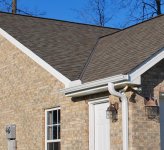
What [MENTION=140960]Thefishguy77[/MENTION] said. We had a tree fall on my garage and ended up getting a new roof over the whole house. They left the metal valleys exposed. It looks a lot cleaner and leaves don't bunch up in the valleys like they did before. Under the metal valleys, the roofer installed butyl rubber liners to prevent any chance of leaking in those areas.
 

Attachments

  • DSC_3257.jpg
    DSC_3257.jpg
    138.1 KB · Views: 254

Members online

Forum statistics

Threads
278,304
Messages
3,554,041
Members
248,016
Latest member
Advally Service

Trending content

Back
Top