Running cable to aux battery in the back - is 0 gauge total overkill?

Seymore Butts

New member
I'll have to run about 25 feet of cable to the ACR and an auxiliary battery. Everyone seems to use 0 gauge welding cable, but I'm wondering if this is total overkill. Any electrical experts here care to weigh in?
 
Register to hide this ad
Depends on what current you expect to flow between the batteries. If you're expecting the aux battery to help start the truck if the main battery is weak, then yes, you need some pretty heavy cable. On the other hand, if that connection is there only for charging the aux battery and powering up your fridge, etc. while moving, 20 amps is enough and a 10 gauge wire will do fine.

Main thing is to put a properly sized resettable circuit breaker in the line on each end so that if the cable shorts to ground you don't start a fire. For a 10 gauge wire, use a 30 amp breaker. The reason for two breakers is that you have a high-current source (a battery) on each end of the line. You need to protect the line from both batteries.
 
Good advice, Ron, thanks! If I want to be able to combine the batteries to start the truck, what gauge wire and fuses should I use between the batteries and my Blue Sea ACR?
 
25 feet is pretty long for a power cable, but with that length, thicker is better. remember cable is only able to supply a certain amount of amps through it.

like for 4 gauge , anything under 20 can handle about 150 amps of current.

this will also depends on the cable manufacturing.

make sure to use ofc type cable, not cca.

I run knukonceptz kolossus fleks, the 4 gauge will handle up to 150 amps at 20 feet.
there 0 gauge can handle 375 amps at 20 feet.

not all cables are the same, some 1 gauge on the outside is the same, but the inside is more like 4 gauge only or worse.
 
Good advice, Ron, thanks! If I want to be able to combine the batteries to start the truck, what gauge wire and fuses should I use between the batteries and my Blue Sea ACR?

I personally would not permanently wire it up to provide starting power from the aux battery. It should be a rare case where you need that capability, and I just carry a set of jumper cables for that purpose. (Those are handy for helping out others, anyway.)

It's just too hard to adequately protect a long high-amperage run. It takes 150-200 amps to turn your starter, more if it's cold. If you put in a 300 amp circuit breaker, you can still cause serious damage or start a fire before that thing will blow.

Note that automobile manufacturers do not fuse the main cable to the starter, because it doesn't make sense. They just rely on good routing, short run lengths, and robust insulation to prevent problems. Running that same kind of cable back through the passenger compartment or under the floor board requires either running it in conduit or a protective sleeve the whole way, or becomes a hazard I'm not willing to accept.
 
Excellent info there Ron, thank you!

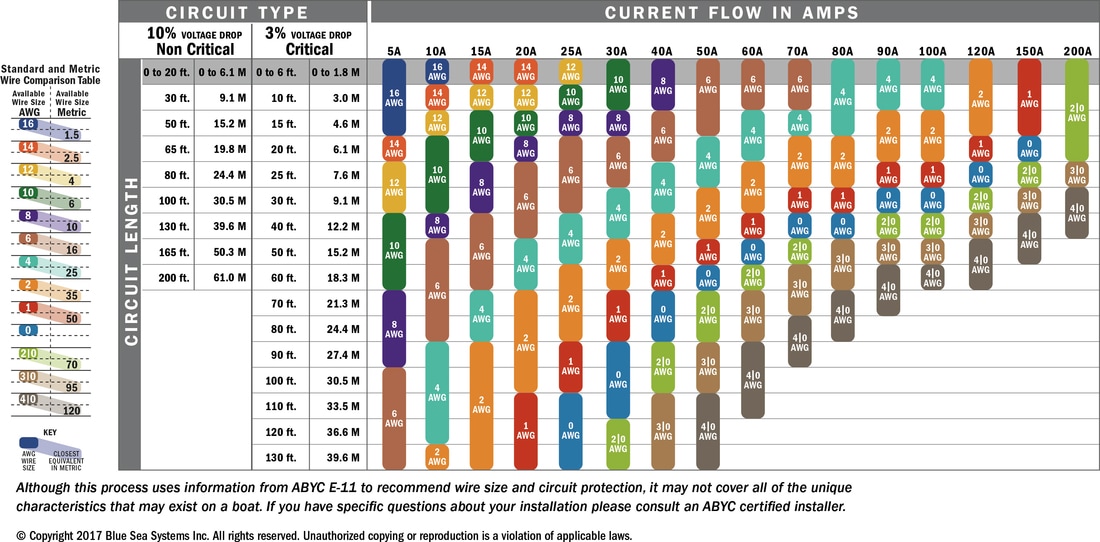
I came across this handy dandy wiring guide recently.

dcwireselectionchart_orig.jpg
 
25'? how are you routing it that you will use 25' in a 4runner?

I was thinking the same thing. I have 1/0 gauge running from my house battery (behind the air intake against the firewall), along my frame, up through one of the plugs in the cargo area, into the passenger cubby. Probably less than 15 feet with room to spare.
 
I'll have to run about 25 feet of cable to the ACR and an auxiliary battery. Everyone seems to use 0 gauge welding cable, but I'm wondering if this is total overkill. Any electrical experts here care to weigh in?

Are you putting the battery in the back? Do you have a V6 or V8? If you have a V6 I have a battery box that will fit right behind the headlight sitting in my garage. If you are just running power for accesories 0 gauge is way overkill. Even a very high power car audio amp does not need that much. If your battery is in the back then you will have to use pretty heavy cables I guess. especially if you are cramking the truck
 
I'll have to run about 25 feet of cable to the ACR and an auxiliary battery. Everyone seems to use 0 gauge welding cable, but I'm wondering if this is total overkill. Any electrical experts here care to weigh in?

Are you planning on parking the 4runner and using the Aux battery to power stuff while "camping"?

Great Article about how to set dual batteries:
http://https://expeditionportal.com/forum/threads/how-to-make-a-cheap-isolated-dual-battery-setup-for-50.77503/page-28
 
I ran 1/0 gauge for 10-15 feet. any longer i’d go up in size depending if you ever plan on linking batteries for starting/jumping or winching. You can check out my build thread for my lower budget dual battery setup. Try to stay away from cooper plated aluminum stuff


Sent from my iPhone using Tapatalk
 
I have a rear winch with a 400A fuse which uses 00 cable from the battery to the winch. I'm not sure that I would go with anything smaller if I was going to use that cable for anything useful (like welding or jump starting another truck) If you do not plan on doing starting from the second battery I would not get cable that large. But if you are, then expect several hundred amps to flow down that cable to start the truck.
 

Members online

Forum statistics

Threads
278,317
Messages
3,554,129
Members
248,016
Latest member
Advally Service

Trending content

Back
Top