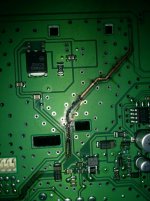
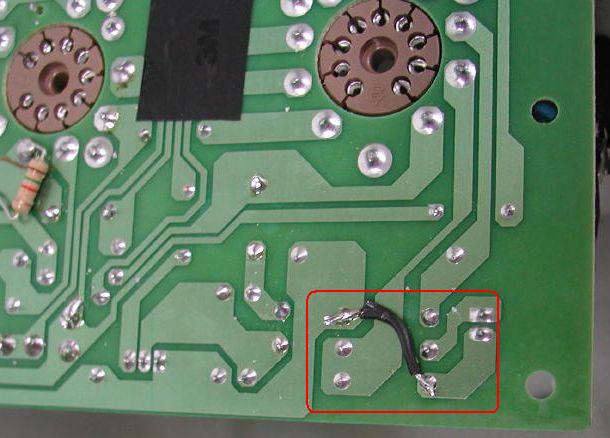
without actually seeing the entire circuit board and understanding what is going on. In Theory yes.
I would first start with clipping the loose copper trace with a pair of side cutters as cleanly as possible. Then take an old tooth brush, some isopropyl alcohol (perf 99% stuff), and scrub the entire area where there was a burst trace and area you will be working on.
let it sit for a few mins for the alcohol to evaporate.
Find a 20watt or so soldering iron with a fine tip. Use tweezers to hold the wire as you work with it (soldering).
Find 18 or 22ga copper stranded wire. Snip maybe 1cm or so of insulation jacketing from both ends after you figure out roughly how long you need. Route is cleanly (hopefully following the bends and such of the blown trace).
On the same side as you show in your photo (it's kinda dark on the top right corner of photo). Presolder a dab onto a through hole where the trace goes through that is blown. Add a bit of solder to the pad of surface mount inductor that is labeled 14|18| at the top leg where the strip is.
Tin your wire you just prepared (by adding a touch of solder to the exposed conductor). Do this for both ends.
Take your soldering iron and heat the thru hole presolder you did earlier, insert 1 tined end of the wire you prepared into this thru hole you are heating.
Remember don't let your iron sit continuously anywhere. You should be able to do any soldering step in less than 5 sec count. Else you will burn out wires, pcb, and/or components.
Now the tricky part is adding the wire onto the presoldered pad of the surface mount inductor 14|18... You will want to heat this presoldered pad quickly by touching the tip of your iron quickly and touching the other end of your tin'd wire to the area.
A good solder joint is shinny. If it is cloudy and matt, (looks like bird shit), the joint is shit.
Once you have this done, just use a glue gun and add some dabs of hot melt glue to secure the floppy wire to the circuit board.
If all that is broken is a blown trace than your circuit board is repaired. If more things got damaged from the short, then all bets are off. Without actually studying a schematic and or putting the board onto an oscilliscope there is nothing more to be done.
You might be able to pay off a local collage electrical engineering student say $50 bucks or a case of beer for him/her to help you fix it. I've fixed many guitar amps when I was in school for exchange of cases of beer.