Snatch recovery, sand & transminssions?

jjdbike

New member
Hi folks

The more I drive on the sand the more people I see stuck or in touble in some way. I always try to help; think what if this happened to me, & how could it have been avoided. This has driven me to build a pretty extensive sand recovery kit and be even more hyper vigilant w/ vehicle maintance.

That being said, I’ve had many fellow surf fishers warn me to never hook up to another vehicle to pull them out. Specificlly warning me that it puts my transmission at great risk. I’ve heard several stories of blown transmission.

In general how does pulling someone out from being framed harm ones transmission (i.e. 2011 SR5)?

Are there specific types of trannies that are better or worse suited for this?

Are there ways to do it safely for the recovery vehicle (trans etc)?

I have a quality kinetic recovery rope (oversized), designed for a snatch type recovery, damper, soft shackles etc.. Is snatch safer or riskier than a slow steady tug? I'm guessing slow & steady would be safer all around but w/ the kinetic rope snatching seems easier & more effective to pop someone out of the hole they dug themselves into. Also, slow pull would put the revovery vehicle at risk of digging in themselves.

I've watched a bunch of YouTube vids on how to & how not to recover in sand including some epic failures (mostly people who rushed in,didn't think it through or did really dumb stuff).

I'm guessing it has a good bit to do w/ the size / power of the recovery vehicle in comparason to what's being recovererd & how bad the vehicle is burried. I'm thinking one should clear as much sand away and create as easy of a path possible in the direction it will be recovered. I also know the vechile being recovered should have wheels turning slowly.

Just as I hope someone would help me, I'd like to help others. On the other-hand I would feel terrible if some helping me damaged their vehicle & I can not afford to replace my transmission if I trashed it pulling someone out.

Basically, what are there dos, don'ts & cautions about recovering another vehicle from being framed?

Is it worth the risk or should the $$$ be spent on an off-road two. For where I fish it starts at $200.

Thanks!
JD
 
Register to hide this ad
Dynamic recoveries are always more risky and put more stress on both vehicles than static recovery. Even with a snatch strap/rope you should try a slow steady static recovery first before trying a dynamic recovery.

When it comes to dynamic recovery rope/straps, oversized isn't always better because if its too big you won't get any stretch

If someone is buried to the frame you need to dig before attempting a recovery, you need to dig a lot. That's why if you spend time on soft sand you want a full size shovel in your recovery gear.

In regards to wheels turning you actually don't want that, at least not until the very moment the strap/rope gets taught and applies force. If their wheels are turning at any point before that they are burying themselves more and undoing your digging.

Also, before you recover them check their air pressure and reduce it if necessary, I bet they never dropped their pressure.

As far as transmission, never recover in reverse and then just keep an eye on your transmission temps (get a scangauge or OBD2 BT adapter paired with a phone app like torque to monitor)

Of the vehicles I've seen that have transmission failures, or catch on fire because of transmission failures, its mostly just jeeps
 
JD
Here are my thoughts on your post. Keep in mind that I have only been driving on the beaches of the OBX for 20 years (since my first T4R) and I am sure that those with more experience (like Salvo Jimmy and others) will provide better info.
I do not believe that when using some common sense and with the slippage of the tires on sand that you should hurt your transmission by pulling a mid sized SUV/truck out. I have seen it done many times will no issues. However, I do not think that you will not pull a full size diesel truck that is on the frame.
I carry a snatch recovery rope, shackles ,onboard air, etc. and I also carry recovery boards (that I have not used).
I have never been stuck but if/when I do I will 1) try to shovel out 2) try boards or 3) hope that someone will come along and give me a pull. As light as our trucks are they tend to do very well in the sand.
My 2 big concerns with getting stuck are 1) “golden quick sand” and 2) high centered from deep ruts. If you hit a pocket of the golden quick sand you are going down to the frame…I don’t care how high you are lifted. The more you are lifted the further you will fall. That is why I don’t run along the water’s edge unless absolutely necessary. The high centered is the closest I come to getting stuck. There are some folks that have big trucks with 37”+ MUD tires that like to throw the largest rooster tail they can (some throw rooster tails that would make Miss Budweiser proud) and this creates ruts deep enough that will cause a high center if you fall into the ruts. At high tide and with smaller beach area sometimes this is hard to avoid (and hopefully where the recovery boards would help).
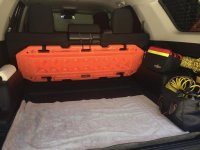
I carry my recovery boards behind and against the back seat. They fit great there and I leave them there as they are not in the way.
 

Attachments

  • IMG_5600.jpg
    IMG_5600.jpg
    127.7 KB · Views: 1,024
Too many people are scared to use 4 Low, the gear reduction helps reduce stress on the transmission.

Anyone I've ever pulled out, it's always just involved a short tug with a strap. That being said, it involves the intelligence of the person driving the stuck vehicle as well: How well they've dug it out, how much throttle they are giving it assist, etc.
 
Could you explain about not recovering in reverse?

Thanks.


Dynamic recoveries are always more risky and put more stress on both vehicles than static recovery. Even with a snatch strap/rope you should try a slow steady static recovery first before trying a dynamic recovery.

When it comes to dynamic recovery rope/straps, oversized isn't always better because if its too big you won't get any stretch

If someone is buried to the frame you need to dig before attempting a recovery, you need to dig a lot. That's why if you spend time on soft sand you want a full size shovel in your recovery gear.

In regards to wheels turning you actually don't want that, at least not until the very moment the strap/rope gets taught and applies force. If their wheels are turning at any point before that they are burying themselves more and undoing your digging.

Also, before you recover them check their air pressure and reduce it if necessary, I bet they never dropped their pressure.

As far as transmission, never recover in reverse and then just keep an eye on your transmission temps (get a scangauge or OBD2 BT adapter paired with a phone app like torque to monitor)

Of the vehicles I've seen that have transmission failures, or catch on fire because of transmission failures, its mostly just jeeps
 
Could you explain about not recovering in reverse?

Thanks.

in non-technical terms you are pulling against the weak side of the transmission

you can apply some common sense, if you are on a tight trail and the vehicle in front just needs a slight tug to get traction or something your transmission isn't going to explode, but its something to avoid. on a beach with plenty of room you should always turn around and pull from the rear.
 
Could you explain about not recovering in reverse?

Thanks.

To add to this - In my experience the biggest risk in revers is the front differential. The 8" front differential isn't super strong. It's also a reverse rotation design - meaning the pinion rotates such that in forward drive direction it's pushing against the top of the ring gear. This is stronger in forward direction. (The rear is a standard rotation and pushes against the bottom to go forward). What that means is that in reverse the pinion is pulling against the top of the ring gear. And that's a significantly weaker direction for the front differential. It's often referred to as the "coast side". In reverse you have a much higher risk of breaking the front differential.

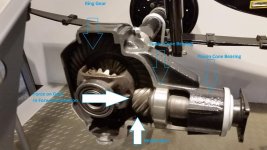
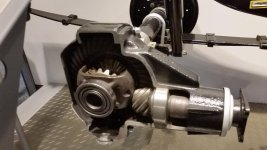
The pic below is a cut-away of a Toyota 9.5" rear LC70 differential. It's larger physically and a rear axle design - you'll notice how the pinion is on the lower side of the gear. However the overall design is very similar to both the front and rear differentials in your 4runner. What's important to note here is that the pinion is supported by two bearings. They are cone bearings. In forward direction the force on the pinion is primarily pushing it into the first bearing. In reverse it's pulling against the far bearing. The reason this matters is that under compression into the first bearing near the gear end it's far less prone to deflect (bend). The metal used is very hard - and brittle. Bending = breaking. So running on the strong side (which is forward) is a much better idea. (Older toyotas used standard rotation R&P sets front and rear - so for example in my FJ40 it's no different at all to pull in forward or reverse. The front differential is probably about 100% stronger than the one used in a 4runner, so it's not even a consideration.

Personally I do not think the transmission is at any meaningful risk. Toyota uses very strong and well engineered transmissions in its trucks and suvs. They are completely different from a GM or Ford automatic that is almost always marginally sized for the application and poorly manufactured.
 

Attachments

  • 20170311_135139b (1024x576).jpg
    20170311_135139b (1024x576).jpg
    65.7 KB · Views: 773
  • 20170311_135139 (1024x576).jpg
    20170311_135139 (1024x576).jpg
    59.5 KB · Views: 756
Last edited:
To add to this - In my experience the biggest risk in revers is the front differential. The 8" front differential isn't super strong. It's also a reverse rotation design - meaning the pinion rotates such that in forward drive direction it's pushing against the top of the ring gear. This is stronger in forward direction. (The rear is a standard rotation and pushes against the bottom to go forward). What that means is that in reverse the pinion is pulling against the top of the ring gear. And that's a significantly weaker direction for the front differential. It's often referred to as the "coast side". In reverse you have a much higher risk of breaking the front differential.

The pic below is a cut-away of a Toyota 9.5" rear LC70 differential. It's larger physically and a rear axle design - you'll notice how the pinion is on the lower side of the gear. However the overall design is very similar to both the front and rear differentials in your 4runner. What's important to note here is that the pinion is supported by two bearings. They are cone bearings. In forward direction the force on the pinion is primarily pushing it into the first bearing. In reverse it's pulling against the far bearing. The reason this matters is that under compression into the first bearing near the gear end it's far less prone to deflect (bend). The metal used is very hard - and brittle. Bending = breaking. So running on the strong side (which is forward) is a much better idea. (Older toyotas used standard rotation R&P sets front and rear - so for example in my FJ40 it's no different at all to pull in forward or reverse. The front differential is probably about 100% stronger than the one used in a 4runner, so it's not even a consideration.

Personally I do not think the transmission is at any meaningful risk. Toyota uses very strong and well engineered transmissions in its trucks and suvs. They are completely different from a GM or Ford automatic that is almost always marginally sized for the application and poorly manufactured.


:bravo: Excellent information and explanation! :bravo:
 
Wow great explanations, I was thinking about that narrow trail scenario.

Thanks to all from a noob !

It's not the end of the world to pull backward. Just be gentle if you can. The front diff isn't super strong - but it's not made of glass either. It is a lot stronger than the older 7.5" front diffs. And the OEM gearing has a relatively thick strong pinion. As you start to install lower gear ratios in the axles part of the result is that you make the pinion weaker because the gear portion has to be smaller in diameter and have less teeth. It also has different angle of mesh with the ring gear. The result is more deflection and a weaker differential - especially on the coast side. So you're a lot more likely to break something if you're running 35" tires in reverse with 4.88 gears than you would be in reverse with stock tires and stock 3.73 gears.

Most or all of the ones I've ever seen broken had big tires, low air pressure (lots of traction), and low gears. I've broken a Toyota 8" pinion with 35" tires and 5.29 gear ratio. With stock gears and stock size tires - I'd be impressed if you could break a front pinion.
 
Wow great explanations, I was thinking about that narrow trail scenario.

Thanks to all from a noob !

Great info guys. Yea I once saw this lifted chebby kept playing hero and pulled stuck people in reverse....until all of sudden you heard him high revving and going nowhere. Likely overheated tranny and cooked diff. I also saw a lifted dodge doing donuts in 20 inch rims...whole wheel and axle flew off because it collected so much mud. So thats why you want bigger tires and not big rimssss LOL
 
Sometimes that is when a warn winch comes in handy. Just park the truck facing the other from a distance, pull the winch line and connect to his with shackles, and a towel or coat over the line to weight it down in case it snaps. No stress on the vehicle, the winch does it all at a slow steady pace.
 
Sometimes that is when a warn winch comes in handy. Just park the truck facing the other from a distance, pull the winch line and connect to his with shackles, and a towel or coat over the line to weight it down in case it snaps. No stress on the vehicle, the winch does it all at a slow steady pace.

It seems there is a whole art to the endeavor of pulling someone (or yourself) safely and effectively. I guess I need to go to school.
 
Sometimes that is when a warn winch comes in handy. Just park the truck facing the other from a distance, pull the winch line and connect to his with shackles, and a towel or coat over the line to weight it down in case it snaps. No stress on the vehicle, the winch does it all at a slow steady pace.

Except that approach often has no chance of pulling someone stuck to the rails out...You will just pull yourself towards them (unless you link up some additional anchors....)...A snatch/dynamic recovery is sometimes the only option and often much more effective.
 
Most or all of the ones I've ever seen broken had big tires, low air pressure (lots of traction), and low gears. I've broken a Toyota 8" pinion with 35" tires and 5.29 gear ratio. With stock gears and stock size tires - I'd be impressed if you could break a front pinion.

This argument is somewhat bogus in my mind.

First, sure you will never break anything with no traction.. Because you won't be going anywhere LOL...

Second. for those that run small tires as a way to keep things together, but then have to use tons of momentum and wheel spin... to get up anything... They break way more often than the guy who can just crawl... Same goes for lockers. Lockers don't make anything weaker when you know how to use them properly. Yes, bigger tires, better gearing, lockers, and more traction all have the potential to break more via greater loads, but they also allow you to break less when used properly. They key is knowing how to use it... Shock loads break stuff. Simple as that. You get tires spinning and bouncing... and the chances of breakage go way up... Sometimes it is required, but the old "slow as possible fast as necessary" is you best bet.

For a snatch recovery, get up some ground speed on your own and let the kinetic energy do all the work.
 
This argument is somewhat bogus in my mind.

First, sure you will never break anything with no traction.. Because you won't be going anywhere LOL...

Second. for those that run small tires as a way to keep things together, but then have to use tons of momentum and wheel spin... to get up anything... They break way more often than the guy who can just crawl... Same goes for lockers. Lockers don't make anything weaker when you know how to use them properly. Yes, bigger tires, better gearing, lockers, and more traction all have the potential to break more via greater loads, but they also allow you to break less when used properly. They key is knowing how to use it... Shock loads break stuff. Simple as that. You get tires spinning and bouncing... and the chances of breakage go way up... Sometimes it is required, but the old "slow as possible fast as necessary" is you best bet.

For a snatch recovery, get up some ground speed on your own and let the kinetic energy do all the work.


More traction = more force applied to the components all the way upstream. The limit of applied force is the engine's power, the friction of the tire on the surface, or motion of the vehicle, whichever is lower. Locking differentials significantly increase the possible traction in nearly all scenarios. Larger tires do the same. And larger tires also increase torque required for vehicle motion. The combination can easily increase the torque on the final drive by 2 or 3 times. If these items didn't increase traction - we wouldn't use them.

Lower gears are also weaker. That's just a physical property of the gears. Specifically the pinion on a 4.88 gear set is significantly weaker than that of a 3.73. It has a smaller pinion gear and fewer engaged teeth. Additionally the gear angles and the contact area per tooth are lower. The result is more force per area on the pinion and more deflection. Then bang...
Here's a 4.10 vs a 4.88 pinion
pic6.JPG


The larger tires and lockers are the primary culprits, but the weaker gears don't help either. And running in reverse definitely doesn't help.

It's also pretty obvious empirically. Try to snap a pinion on a stock tire size vehicle. I'm not sure it's possible short of something very extreme. Doing so on big tires is pretty easy.
 
Last edited:
More traction = more force applied to the components all the way upstream. The limit of applied force is the engine's power, the friction of the tire on the surface, or motion of the vehicle, whichever is lower. Locking differentials significantly increase the possible traction in nearly all scenarios. Larger tires do the same. And larger tires also increase torque required for vehicle motion. The combination can easily increase the torque on the final drive by 2 or 3 times. If these items didn't increase traction - we wouldn't use them.

Lower gears are also weaker. That's just a physical property of the gears. Specifically the pinion on a 4.88 gear set is significantly weaker than that of a 3.73. It has a smaller pinion gear and fewer engaged teeth. Additionally the gear angles and the contact area per tooth are lower. The result is more force per area on the pinion and more deflection. Then bang...
Here's a 4.10 vs a 4.88 pinion
pic6.JPG


The larger tires and lockers are the primary culprits, but the weaker gears don't help either. And running in reverse definitely doesn't help.

It's also pretty obvious empirically. Try to snap a pinion on a stock tire size vehicle. I'm not sure it's possible short of something very extreme. Doing so on big tires is pretty easy.

Yes, no doubt you can break more, but that is mainly because you can push it so much harder....

My point is that outside of the theoretical world... shock loads are what typically breaks stuff offroading. I've seen guys without lockers completely explode cv axles on obstacles that can be walked with lockers. I agree that all these traction aids... larger tires, better gearing, lockers, sticky compounds.. greatly increase the potential for stress and breakage.. but in the right hands they can decrease the potential for damage in a difficult situation by requiring much less thrashing and throttle. It comes down to the user and the terrain. When I see atrac causing the vehicle to bounce and lunge... It make me cringe... Maybe my instinct is wrong... but I'm sticking with my approach for now.
 
Except that approach often has no chance of pulling someone stuck to the rails out...You will just pull yourself towards them (unless you link up some additional anchors....)...A snatch/dynamic recovery is sometimes the only option and often much more effective.

Someone stuck to the rails needs to start digging their butt out first. Unless time is a serious, no-joke factor (i.e. - dummie got stuck at the beach and high tide is rolling in NOW).

And yeah. Someone stuck that bad, a winch will just drag you (the recovery vehicle) towards the stuck vehicle. Anchors are a good idea, and can be simple (we've used e-tools to help anchor - use multiple, bury them good, and tie off to them).

In my experience, dynamic recovery is a mixed bag. Sometimes it is the only way though..... like when you get a F350 based box ambulance stuck in a river. Not that I would know anything about that...... :yo:
 

Forum statistics

Threads
278,312
Messages
3,554,089
Members
248,016
Latest member
Advally Service

Trending content

Back
Top