Snow Driving ?'s

Airing down actually reduces traction. Same amount of weight on more surface area = less pounds on each square inch.

As far as driving in slick conditions, just do everything more gradually. I also highly recommend the "practice in an open area" to get a feel for how your vehicle responds (and for the fun of it).

When I bought my T4R a year ago it had a brand new set of BFG ATs and I will most likely never own another type of tire (in part because these may last forever, as far as I can tell). I'd always owned cars with highway tires and a set of winter tires. No need with ATs. On my long, steep, icy, rural Montana driveway I most times don't even need to put it in 4wd.
 
Several people have mentioned downshifting when slowing down. BE VERY CAREFUL DOING THIS!
If you downshift too early, the new speed your wheels want to be at will be too slow and you will risk breaking traction and spinning out. It will produce the same effect has slamming on the brakes. I learned this lesson the hard way and nearly killed a poor fence.

My rules for snow driving are;
Test the conditions as soon and as safely as possible. Just how slick is it? Do I need 4wd? Do I need to lock the center diff? Do I really need to be on the roads?
All driving inputs are slow and controlled. No sudden movements.
Read the conditions. What are other drivers experiencing around me?
Plan ahead and look for 'outs' or escape options.
 
Airing down actually reduces traction. Same amount of weight on more surface area = less pounds on each square inch.

As far as driving in slick conditions, just do everything more gradually. I also highly recommend the "practice in an open area" to get a feel for how your vehicle responds (and for the fun of it).

When I bought my T4R a year ago it had a brand new set of BFG ATs and I will most likely never own another type of tire (in part because these may last forever, as far as I can tell). I'd always owned cars with highway tires and a set of winter tires. No need with ATs. On my long, steep, icy, rural Montana driveway I most times don't even need to put it in 4wd.

Negative batman. I hate when people come in and try to spew math and dont know what they are saying.

The added tread and surface area will give you a lot more traction. Has been proven billions of times on the trail. Also will help in sand because it aids in flotation.
 
Several people have mentioned downshifting when slowing down. BE VERY CAREFUL DOING THIS!
If you downshift too early, the new speed your wheels want to be at will be too slow and you will risk breaking traction and spinning out. It will produce the same effect has slamming on the brakes. I learned this lesson the hard way and nearly killed a poor fence.

My rules for snow driving are;
Test the conditions as soon and as safely as possible. Just how slick is it? Do I need 4wd? Do I need to lock the center diff? Do I really need to be on the roads?
All driving inputs are slow and controlled. No sudden movements.
Read the conditions. What are other drivers experiencing around me?
Plan ahead and look for 'outs' or escape options.

I wouldn't recommend downshifting in an auto, especially a primitive trans like a 3rd gen has. But for those of us with manuals, just heel-toe. Perfectly safe.
 
For shallow powder, you want high pressure & narrow contact patch to cut through to the pavement. For deep powder (deep enough that you can't get to the bottom) you want to air down to float on top.

Don't air down on public roads, insurance can deny your claim in the event of an accident.

I run skinny Blizzak DM-V1s in winter (design has been updated now to DM-V2.) They're phenomenal.
 
The four most important things to know about driving in winter conditions.

1. Plan ahead, leave early.
2. Keep your distance, at least 4 car lengths minimum.
3. Slow down, Slow down and Slow down.
4. be prepared with a 72 hour kit, including extra dry socks and cold weather gear, sleeping bag, food and water. I have a weeks worth of dehydrated food, vitamins and water that I can stretch to two weeks if need be while I work my snares.

An added note, UPS and Fed-Ex and other milk run drivers have great knowledge of the road and expected conditions, and great driving records; on the freeway I try to get behind then and follow them because if they slow down, I need to as well.
 
Last edited:
My rules for snow driving are;

Test the conditions as soon and as safely as possible. Just how slick is it? Do I need 4wd? Do I need to lock the center diff? Do I really need to be on the roads?

All driving inputs are slow and controlled. No sudden movements.

Read the conditions. What are other drivers experiencing around me?

Plan ahead and look for 'outs' or escape options.


This needs to be framed.
 
It doesn't look like your question was actually answered to your satisfaction. I have a 2001 4Runner and like you do not have an elocker. Here are the various modes we have:

2WD
Left Lever in H and shifter in D,2,L

When to Use: Daily driver all the time

4WD H
Left Shift Lever in H, button pushed in and shifter in D,2,L

When to use: Anytime you want or all the time if you want. Shift in and out of 4WD on the fly up to 62mph. This will more than likely be sufficient for most snow applications as long as you don't need to go up or down any steep hills. To answer your question, yes it's similar to AWD except you actually engage the 4WD.

4WD L
Left Shift Lever in L4, button pushed in and shifter in D,2,L

When to use: Steep hill climbs and decents in snow. You must stop and place your transmission in neutral before shifting to L4. Not to be used on dry pavement or in any conditions where you need TRAC or VSC.

In snow conditions I use L4 when decending a steep hill. This allows me to let my 4runner take me down the hill without the need to continually apply the brakes to slow down. I may use it to take me up a steep hill, however, you want to be careful you don't max out your gears. Often times H in 2 or L will suffice.

Center Differential in either L4 or H

Using the center diff will give you TRUE 4WD where you need traction applied to both the front and rear axles, if one wheel is spinning. I think the perentage is around 60/40 or 50/50 per axle. The center diff mode is applied when pushing the button in to the left of your steering wheel below the instrument panel AND the button on the 4WD shifter pushed in. This mode is used predominantly for off road applications where you are susceptible to isolating one wheel or getting stuck in the mud or on slick rocks.

Only used on straight paths where traction is needed in a slippery or stuck condition. don't use your center diff if you plan on making a lot of turns. It's not designed for that. You'll destroy it.

I've never had to use the center diff in any snow conditions on road. Off road when playin in the snow, yes I've used it. I've also used chains on road in sketch conditions just to be on the safe side. I use them in the front with 4WD engaged. Your users manual will tell you to use them in the rear.

In our year vehicles you have pretty good 4WD with the A-TRAC and VSC system. It's as close to a true OEM E-Locker as your going to get without having one or an air locker like the ARB.

I'm sure there's a ton of information on this in our own forum and on you-tube etc. If I were you I would get familiar with the above link in another post on the T-case differences, VSC and TRAC. Hope this helps a bit. Others will chime in if there's something important I've left out. I'm just speaking from 15 years of ownership experience and driving in the snow with my 4Runner. I couldn't tell you all the differences in each of the 3rd gens.

this is exactly what I was looking for, thank you.

Also, I thought I was going to be fine in terms of tires for this winter, but after doing some research on the tires that came on the car (BFG Rugged Trail T/A's), it looks like what i have isn't great in wet weather or snow, and there isn't even a ton of tread left. So, i'm looking for some tire recommendations with these qualifications:

1) I won't be doing any off-roading, all driving will be on the streets
2) tires need to be good in the snow as well as regular wet conditions
3) not looking for any studded/studdable tires

I'm gonna keep doing research on tires but I wanted to get some first hand input from you guys as well
 
this is exactly what I was looking for, thank you.

Also, I thought I was going to be fine in terms of tires for this winter, but after doing some research on the tires that came on the car (BFG Rugged Trail T/A's), it looks like what i have isn't great in wet weather or snow, and there isn't even a ton of tread left. So, i'm looking for some tire recommendations with these qualifications:

1) I won't be doing any off-roading, all driving will be on the streets
2) tires need to be good in the snow as well as regular wet conditions
3) not looking for any studded/studdable tires

I'm gonna keep doing research on tires but I wanted to get some first hand input from you guys as well

Blizzaks have been rated one of the best overall winter tires available. They perform really well on ice and snow pack. I had them on an AWD Turbo Talon making 400+whp and it would rip off the line in ice. Ice Lake Racing is awesome!!
 
Negative batman. I hate when people come in and try to spew math and dont know what they are saying.

The added tread and surface area will give you a lot more traction. Has been proven billions of times on the trail. Also will help in sand because it aids in flotation.

For shallow powder, you want high pressure & narrow contact patch to cut through to the pavement. For deep powder (deep enough that you can't get to the bottom) you want to air down to float on top.

Don't air down on public roads, insurance can deny your claim in the event of an accident.

I run skinny Blizzak DM-V1s in winter (design has been updated now to DM-V2.) They're phenomenal.

This is what I was thinking of; answering the on-road side of OPs question. Same idea in shallow mud. The train wheel concept. Otherwise, yeah, you want to have as many of your tread lugs pushing as you can. I've been plenty stuck both ways, though. Sorry for the misunderstanding; didn't mean to ruin your day! :tea:
 
Blizzaks have been rated one of the best overall winter tires available. They perform really well on ice and snow pack. I had them on an AWD Turbo Talon making 400+whp and it would rip off the line in ice. Ice Lake Racing is awesome!!

how are they in the rain? I'm also looking into possibly doing all-seasons, because I don't think i'm going to want to change the tires out during the summer, as this won't even be my primary car.
 
how are they in the rain? I'm also looking into possibly doing all-seasons, because I don't think i'm going to want to change the tires out during the summer, as this won't even be my primary car.

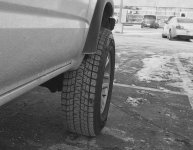
They're really fantastic. If all you drive in is REALLY deep powder, you won't see an advantage over an A/T, but for every other cold weather scenario, Blizzaks shine. Cold dry pavement, rain, snow, ice, salt, etc. They're considerably softer than an A/T and soak up potholes wonderfully. Just look at those sipes!
 

Attachments

  • File_000.jpg
    File_000.jpg
    136.2 KB · Views: 1,474
how are they in the rain? I'm also looking into possibly doing all-seasons, because I don't think i'm going to want to change the tires out during the summer, as this won't even be my primary car.
The tires you see on my avatar on the 265/16 wheels are Goodyear Forteras. They were an awesome all weather tire for me. I'm not sure if they make them anymore. Very quiet and I still have about 20 left on them after at least 60k. I just pulled out of discount tire with my 2010 Camry and had Michelin Premier A/S all weathers installed. Good reviews. Only time will tell. A lot of guys love the Duratracs. It's a great looking tire. Not sure if it's a good all season tire for you.
 
Last edited:
They're really fantastic. If all you drive in is REALLY deep powder, you won't see an advantage over an A/T, but for every other cold weather scenario, Blizzaks shine. Cold dry pavement, rain, snow, ice, salt, etc. They're considerably softer than an A/T and soak up potholes wonderfully. Just look at those sipes!

What size do you run with? My current tires are 265/70/16, but i'm not sure if that's the normal tire size for these cars (with the 16'' wheel option).
 
What size do you run with? My current tires are 265/70/16, but i'm not sure if that's the normal tire size for these cars (with the 16'' wheel option).

That's the OEM size. My blizzaks are a step narrower and a step taller - 255/75/16, although actual diameter is about the same as stock. Blizzaks are limited on options, but this size has worked well for me.
 
Yeah the best I've seen (only looked on tirerack.com so far) has been 245/70/16. Gotta keep looking though. Simply from their website, the tires I've found to be possible choices are:

General Grabber HTS (love the name haha! also got good reviews)

Michelin Latitude X-Ice XI2

Continental CrossContact LX20 with EcoPlus Technology

Michelin Defender LTX M/S

Bridgestone Blizzak DM-V1 (also DM-V2)
 
You don't want to run Blizzaks or any dedicated snow tire all year. The rubber compound is so soft they don't wear worth a crap!

IMO jakemarsh7 you should run what you have. They probably aren't as bad as you think. Look around at how many people (especially with 4WD) actually run a dedicated snow only tire or swap tires based on their snow performance. No need to make a mountain out of a molehill.

I've been driving for 35 years and have never had a real snow tire, even on RWD vehicles living in Durango CO and working at a ski area.
 
You don't want to run Blizzaks or any dedicated snow tire all year. The rubber compound is so soft they don't wear worth a crap!

IMO jakemarsh7 you should run what you have. They probably aren't as bad as you think. Look around at how many people (especially with 4WD) actually run a dedicated snow only tire or swap tires based on their snow performance. No need to make a mountain out of a molehill.

I've been driving for 35 years and have never had a real snow tire, even on RWD vehicles living in Durango CO and working at a ski area.

The problem with the ones I have right now is that there really isn't much tread left (probably not enough for snow) and I don't need A/T tires since I won't be doing any off-roading. I figure with these tires on their last legs, I might as well replace them and have new tires for the upcoming snow.

I agree that I probably don't need dedicated snow tires, especially if I'll be running them all year. I just wanted to get some thoughts from you guys before I completely decided against them. I'm probably going to go with a set of all-seasons.
 

Members online

Forum statistics

Threads
278,309
Messages
3,554,068
Members
248,016
Latest member
Advally Service

Trending content

Back
Top