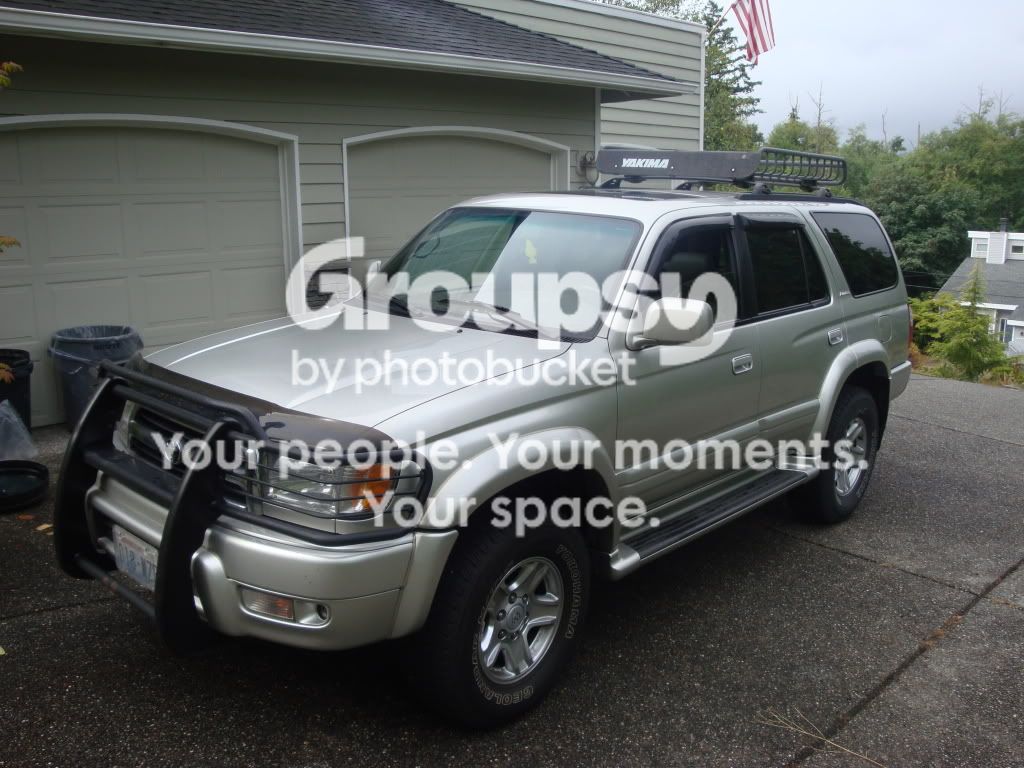
So I bought a brush guard.....

Wile.E.Coyote

New member
I bought a brush guard (aka grille guard) the other day from Craigslist, cheap. I liked the idea of being able to mount some aux driving lights easily and I liked the way they looked and I never thought about approach angles because here in Chicago I'd be doing mud more than anything. But........

Then I decided to go to Moab this year..... So now I'm wondering why most of you guys who seem to take off roading seriously don't run brush guards? Is it just the front approach angle? How much does a brush guard really hurt? I'm not going to be purchasing a front bumper any time soon, but what I see with a brush guard is a trade off between protection from forward obstacles and reduced approach angle.
 
Register to hide this ad
A brush guard is going to offer little to no protection from the obstacles you'll see in Moab, or any obstacles on trails that those who take off roaring seriously will run. They're often referred to on this forum as "damage multipliers", because if you run into anything bigger than a small bush with one of those, all it will do is crumple back and put a nice dent in your hood and fenders.

If you want more protection, get a steel bumper. If you want something just for looks and to easily mount some lights, stick with the brush guard.
 
A brush guard is going to offer little to no protection from the obstacles you'll see in Moab, or any obstacles on trails that those who take off roaring seriously will run. They're often referred to on this forum as "damage multipliers", because if you run into anything bigger than a small bush with one of those, all it will do is crumple back and put a nice dent in your hood and fenders.

If you want more protection, get a steel bumper. If you want something just for looks and to easily mount some lights, stick with the brush guard.

^This...

Brush guards mount low and have very little in the way of protection. For instance, let's say you tap another vehicle from behind. No brush guard would likely mean no damage or you made your bumper tilt down slightly. With a brush guard, you upper bar and side mounts lean back and bump your hood, fenders and side market light.. Which of the two do you think is worse?

We do call them damage multipliers for a reason, there is only two reasons to run a brush guard, if you like the looks or you want to run lights..
 
You guys are telling me in an accident, a brush guard doesn't absorb the damage, rather pushes it backwards? [MENTION=96377]AZ_Trails[/MENTION]

DSC00961-1.jpg~original
 
When I say front protection I'm talking about scrape protection not impact protection. Like a front approach on a rock scraping against the low bars of the guard instead of my plastic bumper. If I hit something at speed I'm not worried about "damage multiplication" it's all getting fixed by insurance anyway.
 
You guys are telling me in an accident, a brush guard doesn't absorb the damage, rather pushes it backwards? [MENTION=96377]AZ_Trails[/MENTION]

DSC00961-1.jpg~original

We're saying that in a typical fender bender that might just scuff up your bumper, that brush guard is going to be folded into the grill, hood, and headlights. They multiple the damage of a minor collision because they typically mount on the bottom of the frame with very poorly designed brackets and have no real strength to them, add in leveraging forces and they just bend into the front of the vehicle.

Couple example pictures in this old thread:
http://www.toyota-4runner.org/4th-gen-t4rs/179202-push-bar.html#post1812702
 
Last edited:
We're saying that in a typical fender bender that might just scuff up your bumper, that brush guard is going to be folded into the grill, hood, and headlights. They multiple the damage of a minor collision because they typically mount on the bottom of the frame with very poorly designed brackets and have no real strength to them, add in leveraging forces and they just bend into the front of the vehicle.

Couple example pictures in this old thread:
http://www.toyota-4runner.org/4th-gen-t4rs/179202-push-bar.html#post1812702
Dang

Looks like I need a front steel bumper then, thx for the info

I had a brush guard that rusted out through damage that trapped water and debris. Took it off and trashed it.
 
When I say front protection I'm talking about scrape protection not impact protection. Like a front approach on a rock scraping against the low bars of the guard instead of my plastic bumper. If I hit something at speed I'm not worried about "damage multiplication" it's all getting fixed by insurance anyway.

Even is just a scraping situation as you mentioned, because of the way these things mount, it is likey it will still cause more damage. They sit very close to parts of the bumper and body, so any upward or inward force at all will move them. Test it for yourself, put a jack under the brush guard and jack up a little, see it move toward your body. No imagine a heavyweight bump off road making the brush guard love tap all over the front of your truck.

A brush guard can also interfere with the air bag sensors. As in, they don't deploy when they should.

This happenes to be false. A myth from the dawn of German airbags.
When airbags were impact sensors 20-25 years ago it could apply. However, now days (post 1993 in toyotas I believe) it is a g-force and centriffical sensors that require zero actual sensor impact to deploy. ARB would have you believe that they have the only airbag safe bumpers ever, but truth is, it don't matter if you have a dozen 2x4s taped up there, airbags deploy when the sense roll or rapid deceleration.
 
Even is just a scraping situation as you mentioned, because of the way these things mount, it is likey it will still cause more damage. They sit very close to parts of the bumper and body, so any upward or inward force at all will move them. Test it for yourself, put a jack under the brush guard and jack up a little, see it move toward your body. No imagine a heavyweight bump off road making the brush guard love tap all over the front of your truck.


This happenes to be false. A myth from the dawn of German airbags.
When airbags were impact sensors 20-25 years ago it could apply. However, now days (post 1993 in toyotas I believe) it is a g-force and centriffical sensors that require zero actual sensor impact to deploy. ARB would have you believe that they have the only airbag safe bumpers ever, but truth is, it don't matter if you have a dozen 2x4s taped up there, airbags deploy when the sense roll or rapid deceleration.

I know you meant centrifugal, but that's ok I get it. Any foreign object that undergoes impact before your bumpers do affects the point in which the sensors deploy the bags. The sensors are engineered to deploy when a certain force is achieved. If your brush bars are collapsing they absorb some of that force, and the force sensed by the air bag sensors is reduced. In the right circumstance it will prevent air bag deployment. The sensors are "tuned" to the force when it passes through the bumpers, not dimensional lumber or brush bars.
 
Last edited:
This bring up a good point. I haven't looked into it and I'm sure it's been covered, but a short answer would be appreciated. Guys with steel bumpers, would this affect deployment of your bags? I'm not sure where the G sensors are.
 
I know you meant centrifugal, but that's ok I get it. Any foreign object that undergoes impact before your bumpers do affects the point in which the sensors deploy the bags. The sensors are engineered to deploy when a certain force is achieved. If your brush bars are collapsing they absorb some of that force, and the force sensed by the air bag sensors is reduced. In the right circumstance it will prevent air bag deployment. The sensors are "tuned" to the force when it passes through the bumpers, not dimensional lumber or brush bars.

I did in fact mean centrifugal, but I did not pay attention to what it changed to when I clearly spelled it wrong. However, you are still mistaken, the sensors do not even sit near the bumpers on these vehicles now. They are back behind the front body mount. It detects sudden deceleration and or roll over. It has nothing to do with what is hanging off the front of your vehicle. Your airbag on a modern vehicle will deploy under the same circumstances weather you have factory bumper skins, lumber, brush guard or snow plow attached. Provided all other parameters are met, the airbag sensors only have one job. Because air bags are SRS (supplemental restraint system) they do not act independently, you must be over a certain speed and also in most systems (if not all) have your primary restraint system (seat belt) engaged.

Your point about the brush guard absorbing the force (or dissipation of kinetic energy) is valid except the simple fact the airbags still deploy at the same parameters regardless of what it hits first. If your airbags require 2.6G to deploy, it does not matter how much force is applied, weather it's 100 newtons or 10,000 newtons of force. If auto manufactures had to create sensors that deployed off of force, they would have to be able to assume they know exactly what you are going to impact. For instance: what's the difference between you hitting a Jeep Liberty in stock form vs a Jeep Liberty with a winch bumper?? As far as your airbags are concerned....nothing. Simply put airbags do not work from linker force applied and they certainly do not account for the transfer of kinetic energy through multiple mediums. They are a simple accelerometer, not a super computer able to calculate what (and how much) material lies in front of your vehicle.

Sorry OP for the hijack.

This bring up a good point. I haven't looked into it and I'm sure it's been covered, but a short answer would be appreciated. Guys with steel bumpers, would this affect deployment of your bags? I'm not sure where the G sensors are.

G-Sensors detect sudden acceleration and deceleration. Steel bumpers (or any add on to the front of the vehicle) can change the damage caused in an accident, but it will not change the operation of the air bag. If your airbags deploy at 2G (two times earth gravity) they will deploy at 2G no matter what they are coming into contact with. There are other possible drawbacks to aftermarket bumpers such as the possible lack of crumple zone, but that has nothing to do with the air bags deployment.
 
G-Sensors detect sudden acceleration and deceleration. Steel bumpers (or any add on to the front of the vehicle) can change the damage caused in an accident, but it will not change the operation of the air bag. If your airbags deploy at 2G (two times earth gravity) they will deploy at 2G no matter what they are coming into contact with. There are other possible drawbacks to aftermarket bumpers such as the possible lack of crumple zone, but that has nothing to do with the air bags deployment.

No, bumper mods can change your airbag operation. They can trick the system into deploying the airbags during a lower speed collision compared to stock.
Vehicles are designed to absorb energy in a collision. They do this by deforming parts of the structure and slowing down the deceleration. However, if the deceleration is high enough then the airbags inflate. Aftermarket bumpers strengthen the front and reduce the ability to deform and absorb energy, thereby increasing the deceleration and potentially causing the airbags to deploy when they otherwise might not have. Only ARB bumpers have been tested and proven to be compatible with airbag systems.
In reality, with any other brand bumper the change is probably small enough to not be a real concern.
 
No, bumper mods can change your airbag operation. They can trick the system into deploying the airbags during a lower speed collision compared to stock.
Vehicles are designed to absorb energy in a collision. They do this by deforming parts of the structure and slowing down the deceleration. However, if the deceleration is high enough then the airbags inflate. Aftermarket bumpers strengthen the front and reduce the ability to deform and absorb energy, thereby increasing the deceleration and potentially causing the airbags to deploy when they otherwise might not have. Only ARB bumpers have been tested and proven to be compatible with airbag systems.
In reality, with any other brand bumper the change is probably small enough to not be a real concern.

The airbags will go off at what ever the deceleration threshold that is set, regardless of what you have glued to the front of your vehicle.

you have been tricked by ARB to think the sensors are smarter than they really are.

The only thing ARB has is a bolt on crumple zone that replaces the factory bolt on crumple zone. Most aftermarket bumpers delete this crumple zone and mount to the frame. Your vehicle has no less than 8 crumple zones in front of the drivers compartment, the largest being the inward bend of the frame just aft of the upper A Arm. So when you delete this front crumple zone
45138d1306451561-aftermarket-bumpers-airbags-crumple.jpg


This replacement zone has two pre-bent waves in it, spanning nearly 2 inches and allowing for nearly an inch of "crumple" or deflection. So in the 40+ inches of your front crumple zone, you would be expecting the the sensors to detect less than an inceh of deflect and respond differently than if the deflection was not present.

This has all be discussed before HERE

The difference between impact absorption over that 1 inch is so negligible it like would be impossible to calculate give the other variables in any head on collision. And at the end of the day, the air bags will still deploy under the correct set of parameters. If there was a measurable difference I would long ago have been a addressed by the IIHS and HDLI. Instead their concern is for the people who collide with one of these bumpers.
 
I gotta disagree, Nathan. Modern airbags are designed to go off when they detect a threshold rate of deceleration. The "crumple zone" helps absorb the velocity change in an impact, spreading it out over a longer period of time and slowing the rate of deceleration. Take away part of that crumple zone and you'll decelerate faster, thus more likely to set off the airbags in a collision.

OP, that brush guard is intended to keep brush and small trees away from your radiator, or it was when such things were a concern. Now it's purely ornamental, and maybe a place to put lights. It's of no use at all offroad, but it won't hurt you much either, just lose a little approach angle is all.
 
Last edited:
Of course the system will activate within it's parameters. A bumper doesn't change those, but it does change how the vehicle behaves. It can produce the activation parameters at a time other than intended by the manufacturer. Until you can prove it doesn't then the buyer should beware of the potential.

I know all about ARB's chassis brackets, I worked there for many years. Both Toyota Australia and Nissan Australia use ARB bullbars as OE equipment and they are required to be compatible with the SRS system. Testing proved that without the ripples or other design features that the system did not operate as intended. I witnessed that testing several times.

And the IIHS has looked into the issue and proven that structural modification do effect crash performance. They even helped produce a standard for aftermarket suppliers to follow, CAPA 501.
 
Of course the system will activate within it's parameters. A bumper doesn't change those, but it does change how the vehicle behaves. It can produce the activation parameters at a time other than intended by the manufacturer. Until you can prove it doesn't then the buyer should beware of the potential.

I know all about ARB's chassis brackets, I worked there for many years. Both Toyota Australia and Nissan Australia use ARB bullbars as OE equipment and they are required to be compatible with the SRS system. Testing proved that without the ripples or other design features that the system did not operate as intended. I witnessed that testing several times.

And the IIHS has looked into the issue and proven that structural modification do effect crash performance. They even helped produce a standard for aftermarket suppliers to follow, CAPA 501.

So what errors occurred prior to the ARB brackets? Was deployment threshold moved up from say 35mph to 38mph? or was it lowered? Does the SRS interpret the data as a more severe impact and pop the airbags vs. just popping the pre-tensioners in lower speed collisions?

I've never understood what the ARB's crumple brackets actually did that was significant enough that the SRS system was unable to compensate for? I'm not picking on you, but rather I want to pick your brain since you seem to have experience here. This has been something that has been thrown around a lot, but not a whole lot of data really shows what ARB's crumple brackets actually do beside have an over all thinner bumper with a crumple zone that mitigates it's need for strength off-road.
 
I left ARB in 2005 so I'm going off 10 year old memory here and I can't give you any detailed data. Like I said earlier, structural strength improvements to the front of the vehicle can, but not always, cause higher deceleration forces during an impact. Steel replacement bumpers effectively remove crumple zones and other deformable materials that absorb energy and reduce deceleration. The differences can range from none to significant, but cause the airbag to deploy when they would normally not be needed for an occupant wearing a seatbelt. The SRS system cannot compensate for a bullbar because it doesn't know it's there. As far as it knows, there is still 10 inches thick of deformable stuff to slow the vehicle down first before it has to spring into action.
Every model of vehicle was different, and factors included the vehicle mass, chassis geometry, sensor style and location etc. I think the Suzuki Jimny bullbar had no 'ripples' in the mounting brackets and bigger vehicles needed three.
ARB bullbars are very well engineered and suit most offroading needs very well, but I dont think they are the best choice for serious rock crawling and majorly technical type stuff. They're primarily designed to protect the vital parts of a vehicle in an animal strike, provide protection to body parts from low speed offroad hits on trees and the like, and to provide platforms for fitting other accessories like winches and lights.
 

Members online

No members online now.

Forum statistics

Threads
278,311
Messages
3,554,082
Members
248,016
Latest member
Advally Service

Trending content

Back
Top