So, NGK says NO anti-sieze

sakoluvr

New member
I just did wires/plugs in my wife's 2001 and did not use anti-seize. Torqued to 13 ft lbs. I don't think I have never used anti-seize on plugs before.

Going to do my 2002 this weekend. Did my son's '97 a few weeks ago when we replaced valve cover gaskets.

Who here does not use anti-seize and did it bite you in the ass? Supposedly the plug threads are coated already.

https://www.youtube.com/watch?v=xZ-KOL4gZzw
 
Register to hide this ad
In the video the big dude claims that the torque can be as much as 20% higher due to the anti-seize. So, for a spark plug torqued to 14 ft/lb that amounts to 3 extra ft/lb. Really, not significant in my opinion. I've had issue, more times than I can count, of plugs not wanting to be removed and galling the threads in the head. When It's my own vehicle or equipment (using anti-seize) I've not had this problem, and never stripped out a hole.

The video shows a really liberal application of anti-seize on the plug. That's waaaaay too much. A thin film is all that's needed.

My $0.02
 
This is an ongoing debate you'll find in many forums.

My personal opinion is to still use a light film of anti-seize. Never had a problem from using it this way. Would rather never have to deal with a stuck plug from not using it.
 
I've been using only NGKs since 1999. I probably stopped using anti-seize about ten years ago figuring NGK knows what they are talking about. They do. I have never had a problem. I do torque to spec and change spot on 30k intervals.
 
Never used antiseize on plugs. Use a piece of tube to start the plug so there's no possibility of cross-threading then torque to spec.
 
Yeah, I think sometimes we try to be smarter than the engineers that designed stuff. A lot of what I do is a carry over from growing up and doing what our parents did and what their parents did.
 
On my old cars I never used it. But I do now on my 4runners. Especially on the 5vz because it's deep in the block.
 
In the video the big dude claims that the torque can be as much as 20% higher due to the anti-seize. So, for a spark plug torqued to 14 ft/lb that amounts to 3 extra ft/lb. Really, not significant in my opinion. I've had issue, more times than I can count, of plugs not wanting to be removed and galling the threads in the head. When It's my own vehicle or equipment (using anti-seize) I've not had this problem, and never stripped out a hole.

The video shows a really liberal application of anti-seize on the plug. That's waaaaay too much. A thin film is all that's needed.

My $0.02

I also stopped using anti-seize one I learned "the touch". Beginner DIY'ers tend to overtorque the plugs so they are extremely hard to get back out without anti-seize, so you're exactly right.

If you do your own work and are confident, skip the anti-seize. If you've never done your own work or a shop is doing it, anti-seize is great.

My last Toyota I owned a shop had torqued one down ridiculously hard and had another shop try and take the spark plug out. They heat cycled the engine for 6 hours with penetrating oil and it FINALLY came out. If it had not worked, they would have had to pull the head and do a helicoil. So the risk is definitely there if some newbie mechanic changes your plugs.
 
Now I'm scared. I did mine 20k km ago without anti seize and didn't torque to spec, I just did them "tight".
 
I've been working on cars for 20 years now, and never have I used any of that stuff on plugs, it's completely unnecessary. The factory doesn't put any on and modern engines have 100k mile replacement intervals, never had a single issue with one being stuck.
 
On the other hand, after 45 years of wrenching on cars, boats and both indoor and outdoor industrial equipment I've never once said to myself

"I wish I hadn't used anti-seize on this thing"
 
I don't think I've seen any spark plug manufacturer that recommends anti-seize as they are all nickel coated. Using anti-seize on plugs is an old wives tale that might have made sense on some specific applications (eg. Ford 5.4). Not only does it affect the torque, but anti-seize can act as as thermal/electrical insulator which may affect the heat range because plugs are designed to dissipate a certain amount of heat through conduction. Why second guess the engineers?
 
I don't think I've seen any spark plug manufacturer that recommends anti-seize as they are all nickel coated. Using anti-seize on plugs is an old wives tale that might have made sense on some specific applications (eg. Ford 5.4). Not only does it affect the torque, but anti-seize can act as as thermal/electrical insulator which may affect the heat range because plugs are designed to dissipate a certain amount of heat through conduction. Why second guess the engineers?
I'm glad somebody else mentioned the Ford 5.4... but yeah, I have never used it on plugs and have never had a problem (probably 600k miles travelled on the engines I have taken care of in the last 15-20 years).

You can feel the crush washer finish crushing as the torque ramps up quickly. Stop at that point and that should be just right. If you don't have the touch, use a torque wrench...

-Charlie
 
Get some Champion or Tempest anti-seize specifically designed for aircraft engines/plugs. A very thin coat is all that's needed. And proper procedure is more critical in the aviation world so you know it's not a bad idea in an automotive engine.
 
Always used it on my )1 and did them about every 30K so about 5 times. Never had an issue getting out - always used a torque wrench to tighten.
 
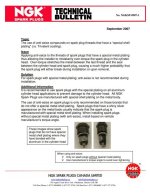
I've never been clear. Here's what NGK said once upon a time
 

Attachments

  • ngk_plugs.jpg
    ngk_plugs.jpg
    85 KB · Views: 200

Members online

Forum statistics

Threads
278,316
Messages
3,554,111
Members
248,016
Latest member
Advally Service

Trending content

Back
Top