stiff steering when turning right: help on diagnosis? (1999 4Runner)

KauriJ

New member
Hi folks!

My 1999 4Runner (SR5 4WD) has had a puzzling steering issue I’ve been trying to diagnose. It has just over 288,000 miles.

A few months ago, the steering started to get a little stiffer, mainly noticeable at slower speeds (under 25mph), and it’s slowly gotten worse. Recently, it’s required considerable effort to turn to the right at slower speeds (under 25mph), and also after turning to the left the wheel requires a lot of effort to return to straight (i.e., it’s hard to turn the wheel to the right to return the direction of travel of the vehicle to straight).

I put it on jack-stands to try to do some diagnosis today, and here are my results.

- With key in “on” position and turning steering wheel:

- - Get same behavior as observed when driving. In particular, the steering wheel requires considerable effort to rotate to the right (both when starting from straight ahead position and when already turned to the left and trying to return to straight-ahead direction). Turning to the left requires much less effort (seems relatively “normal,” but not entirely sure).

- - When turning to the right, the effort is non-uniform, i.e. with some steering wheel angles it’s considerably harder and with other steering wheel angles it’s not as hard. Roughly, moving through the first 90 degrees from straight seems to be harder than moving through the 90-180 degree angles, but it was still hard. Then it got harder again, and I could not get it to turn past 270 degrees to the right.

- - The resistance feels “rubbery.” Not sure how else to describe it, other than it feels like something is binding. No metallic scraping sounds or anything like that.

- Checking other possibly related items:

- - No play when rocking the wheel in and out (I’ve read this should indicate the wheel bearings are okay)

- - Some play when rocking the wheel side to side (holding at 9 o’clock and 3 o’clock positions) but no more than the steering wheel free-play so I believe this is normal (I’ve read this should indicate the tie rod ends are okay)

- - Tie rods have no movement when I yank on them (I’ve read this should indicate the tie rod ends are okay)

- - Identical faint clicking noise from wheel side of CV axle on both front wheels when rotate them (not sure whether this is normal)

- - When key is in the “on” position and turning steering wheel, I did not see any abnormal movement in the steering shaft, tie rods, or steering rack (though since I am a complete novice at this it’s entirely possible I could have missed something)

I have all the maintenance records (the 4Runner was bought new by my mom). In particular:

- The steering rack and power steering pump are original.

- Power steering belt was last replaced in July 2021. Power steering fluid was flushed in February 2022 and has been changed regularly.

- Outer tie rod ends were replaced in July 2020. Inner tie rod ends are original. I’m assuming the shop checked the alignment when they replaced the inner tie rod ends (but an alignment was not billed on the invoice so I’m not 100% sure—though all the work was done by a local reputable 4WD shop).

- CV axles are original, but one of the boots tore and was replaced many years ago.

- I have no record of the wheel bearings ever having been serviced.

I have a PDF of the factory service manual for the 3rd gen 4Runners (specifically it says it’s for a 2002), and I have the Haynes manual.

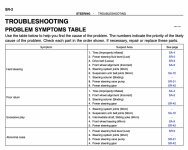
I’ve attached some screenshots from the factory service manual.

Based on the troubleshooting page and what I’ve checked, it looks like it’s most likely “steering column (binding)” or “power steering gear.”

Within the steering column section, I read there’s a bushing and a bearing (screenshots attached). I’m not sure whether there’s anything else that could be binding in the steering column (I don’t know much about working on cars but I definitely want to learn).

Also not sure if it could be something inside the steering rack. Or another part entirely.

Any experience/advice on this will be greatly appreciated!

Thank you!
 

Attachments

  • 4RunnerFSMSteeringTroubleshooting.jpg
    4RunnerFSMSteeringTroubleshooting.jpg
    97.9 KB · Views: 1,453
  • 4RunnerFSMSteeringBushing.jpg
    4RunnerFSMSteeringBushing.jpg
    96.9 KB · Views: 1,809
  • 4RunnerFSMSteeringBearing.jpg
    4RunnerFSMSteeringBearing.jpg
    112.1 KB · Views: 1,506
Register to hide this ad
Disconnect the steering rag joint at the rack and separate it. Turn the wheel one rotation in each direction from center. Does it feel okay? If yes, then you have a problem in the rack. If no, then you have a problem in the steering column.

Make sure you remember where you started so you can reattach everything and not damage the clock spring next time you turn all the way to the steering stop.

Edit: This is assuming you are engine off during the diagnosis you listed above. You stated key on but didn’t say if the engine was on or off.
 
Last edited:
Have you checked the power steering fluid level? looked inside for bubbles? kinda sounds low fluid to me. Mine leaks and when it gets low it starts getting hard to turn the wheel. Others have had fluid level fine but hose was sucking in air and gave simular results.
 
Hi folks!

My 1999 4Runner (SR5 4WD) has had a puzzling steering issue I’ve been trying to diagnose. It has just over 288,000 miles.

A few months ago, the steering started to get a little stiffer, mainly noticeable at slower speeds (under 25mph), and it’s slowly gotten worse. Recently, it’s required considerable effort to turn to the right at slower speeds (under 25mph), and also after turning to the left the wheel requires a lot of effort to return to straight (i.e., it’s hard to turn the wheel to the right to return the direction of travel of the vehicle to straight).

I put it on jack-stands to try to do some diagnosis today, and here are my results.

- With key in “on” position and turning steering wheel:

- - Get same behavior as observed when driving. In particular, the steering wheel requires considerable effort to rotate to the right (both when starting from straight ahead position and when already turned to the left and trying to return to straight-ahead direction). Turning to the left requires much less effort (seems relatively “normal,” but not entirely sure).

- - When turning to the right, the effort is non-uniform, i.e. with some steering wheel angles it’s considerably harder and with other steering wheel angles it’s not as hard. Roughly, moving through the first 90 degrees from straight seems to be harder than moving through the 90-180 degree angles, but it was still hard. Then it got harder again, and I could not get it to turn past 270 degrees to the right.

- - The resistance feels “rubbery.” Not sure how else to describe it, other than it feels like something is binding. No metallic scraping sounds or anything like that.

- Checking other possibly related items:

- - No play when rocking the wheel in and out (I’ve read this should indicate the wheel bearings are okay)

- - Some play when rocking the wheel side to side (holding at 9 o’clock and 3 o’clock positions) but no more than the steering wheel free-play so I believe this is normal (I’ve read this should indicate the tie rod ends are okay)

- - Tie rods have no movement when I yank on them (I’ve read this should indicate the tie rod ends are okay)

- - Identical faint clicking noise from wheel side of CV axle on both front wheels when rotate them (not sure whether this is normal)

- - When key is in the “on” position and turning steering wheel, I did not see any abnormal movement in the steering shaft, tie rods, or steering rack (though since I am a complete novice at this it’s entirely possible I could have missed something)

I have all the maintenance records (the 4Runner was bought new by my mom). In particular:

- The steering rack and power steering pump are original.

- Power steering belt was last replaced in July 2021. Power steering fluid was flushed in February 2022 and has been changed regularly.

- Outer tie rod ends were replaced in July 2020. Inner tie rod ends are original. I’m assuming the shop checked the alignment when they replaced the inner tie rod ends (but an alignment was not billed on the invoice so I’m not 100% sure—though all the work was done by a local reputable 4WD shop).

- CV axles are original, but one of the boots tore and was replaced many years ago.

- I have no record of the wheel bearings ever having been serviced.

I have a PDF of the factory service manual for the 3rd gen 4Runners (specifically it says it’s for a 2002), and I have the Haynes manual.

I’ve attached some screenshots from the factory service manual.

Based on the troubleshooting page and what I’ve checked, it looks like it’s most likely “steering column (binding)” or “power steering gear.”

Within the steering column section, I read there’s a bushing and a bearing (screenshots attached). I’m not sure whether there’s anything else that could be binding in the steering column (I don’t know much about working on cars but I definitely want to learn).

Also not sure if it could be something inside the steering rack. Or another part entirely.

Any experience/advice on this will be greatly appreciated!

Thank you!
Sounds like a hydraulic pressure issue. The power steering ECU controls the power steering solenoid valve on the vane pump via steering angle sensor and wheel speed sensor. To supply the appropriate power steering fluid volume. No steer angle signal being recognized by the power steering ECU would cause steering resistance at all times even with the truck key in on position.
 
Sounds like a hydraulic pressure issue. The power steering ECU controls the power steering solenoid valve on the vane pump via steering angle sensor and wheel speed sensor. To supply the appropriate power steering fluid volume. No steer angle signal being recognized by the power steering ECU would cause steering resistance at all times even with the truck key in on position.
We don’t have any of those sensors or modules you just rattled off.

There’s really no nice way to say this so I’m just gonna say it. You should really stop giving “advice” in this section. I’m getting tired of correcting your misinformation.
 
We don’t have any of those sensors or modules you just rattled off.

There’s really no nice way to say this so I’m just gonna say it. You should really stop giving “advice” in this section. I’m getting tired of correcting your misinformation.

LMAO. Sometimes not saying things nicely needs to be done so I approve this message.
 
We don’t have any of those sensors or modules you just rattled off.

There’s really no nice way to say this so I’m just gonna say it. You should really stop giving “advice” in this section. I’m getting tired of correcting your misinformation.
.

Oops I keep forgetting to look at the section. It's an accident. Thanks for the reminder.
 
.

Oops I keep forgetting to look at the section. It's an accident. Thanks for the reminder.
Vehicle year was in the title and the 2nd sentence. I don't pretend to know anything about the other generations of 4Runners on this forum so I only browse in the 3rd Gen section. You might consider staying in the 5th gen section to keep from spreading misinformation.
 
I've had a the same issue and I found that when I drained, filled, and cleaned the power steering fluid reservoir it helped. That said, my issue has come back so I'm going to replace the pump itself. There's a chance it means bad rack but my pump has been whining so if replacing the pump fixes the issue I'll likely know that was the problem. If not...I may be getting a new steering rack.

It's a really weird sensation when this happens. It's like the wheel is bouncing back and stopping me from turning, definitely understood when you described the "rubbery" feeling of it. Getting out of parking spots is always the worst for me.
 
Step 1 - make sure the lower ball joints are fine. (jack up front end, turn steering wheel with key on, engine off). Replace them with OEM, even if they are fine if they haven't been done in the last 100k miles.
Step 2 - fix the power steering system...

-Charlie
 
Vehicle year was in the title and the 2nd sentence. I don't pretend to know anything about the other generations of 4Runners on this forum so I only browse in the 3rd Gen section. You might consider staying in the 5th gen section to keep from spreading misinformation.

Misplaced information. Thanks for the suggestion you're very kind.
 
Like others said, it sounds like a pump problem. Start with the easiest and cheapest items and go from there. The easiest (and free) is to clean out the pump screen. I'd bet this is your problem. Timmy graciously made a video on this one.


<iframe width="560" height="315" src="https://www.youtube.com/embed/5k61KXRK8bM" title="YouTube video player" frameborder="0" allow="accelerometer; autoplay; clipboard-write; encrypted-media; gyroscope; picture-in-picture" allowfullscreen></iframe>


Next in line would be to check your steering linkage, including the lower ball joints. Jack up the front wheels and wiggle it side to side and up and down. It'll move a bit with resistance, that's just the steering linkage moving as if it were turning. What you are looking is for play by quickly wiggling it, you may even hear a clicking noise as the ball joint clicks in the socket. If you hear that, it's overhaul time.

Lastly it could be the rack failing. This is the last resort as a new rack is over $600. You don't want to do that unless you have to.
 
I agree with what timmy says ^^^^^
just gonna throw this out.....you are running atf and not power steering fluid correct. These systems dont use power steering fluid....says it in the manuals and on the cap for the pump. It uses the same atf you should be using in your auto tranny.
from what I have read, using power steering fluid in these just eats up seals. At least thats what I have read.
 
How rusty is this vehicle?, because another possibility is the body mount or floor pan giving out on the driver-side, this causes the steering shaft to bind up. lets hope I'm wrong, I've seen this happen on our rigs before.
 
Wow, thank you everyone for all the info and advice!!

The engine was off during the test, I should have written “key on engine off”. (Sorry for not saying this in my original post!)

[MENTION=319302]Bad Luck[/MENTION] That’s a great idea, I will try that. I have heard of some folks having issues with those bolts and getting things lined back up when disconnecting the rag joint (e.g. when doing a body lift) so I’ll need to have a plan in case something doesn’t quite work right. Fortunately I have a second vehicle as backup.

[MENTION=68424]calimobber[/MENTION] Yes the power steering fluid level is fine, I’ve been monitoring it, and it’s still clean. I haven’t seen any bubbles any of the times I’ve checked it.

[MENTION=639626]DenverAirport[/MENTION] Mine had a whining noise last summer and the steering felt a little unresponsive/loose last fall, so I’d thought it was the pump, but now with the “key on engine off” test and it’s still stiff it seems like it can’t be the pump. It does still whine a little on startup, though it could be something else that’s making the noise too, unrelated to steering. Hope you can figure out what’s going on with your 4Runner!

[MENTION=139000]phattyduck[/MENTION] LBJ’s were replaced in July 2020 by a local well-known 4WD shop. They used Centric parts not OEM, hopefully that’ll be okay since most folks have said OEM is better.

[MENTION=115347]gamefreakgc[/MENTION] I’d initially thought it’s the pump but given that the steering is still really hard with the front end jacked up and “key on engine off” (sorry I wasn’t clear about this earlier!) then if I’m understanding correctly the pump isn’t running so it’s probably something else?

And thank you for the info on how to test the LBJ’s! No play at all top-to-bottom, and side-to-side fast or slow there was no play or clicking beyond the (normal?) play in the steering wheel.

It is unfortunately looking like it could be the rack, not what I want to hear but this 4Runner is like family so it gets what it needs.

[MENTION=124615]3bears[/MENTION] I’ll double-check maintenance records but I’m pretty sure the two shops that have been doing the power steering fluid flushes would use the correct fluid (my error for saying power steering fluid above). Thank you for the info! And mine is a manual transmission :)

[MENTION=564148]Malcolm99[/MENTION] Almost no rust, thankfully. My 4Runner has always lived in the SF Bay Area of California. I don’t think a body mount bushing is failing but good to know that can cause a steering shaft to bind up. The engine doesn’t move at all when it starts. But I’ll take a look at them just in case.
 
Last edited:
Wow, thank you everyone for all the info and advice!!

The engine was off during the test, I should have written “key on engine off”. (Sorry for not saying this in my original post!)

[MENTION=319302]Bad Luck[/MENTION] That’s a great idea, I will try that. I have heard of some folks having issues with those bolts and getting things lined back up when disconnecting the rag joint (e.g. when doing a body lift) so I’ll need to have a plan in case something doesn’t quite work right. Fortunately I have a second vehicle as backup.

[MENTION=68424]calimobber[/MENTION] Yes the power steering fluid level is fine, I’ve been monitoring it, and it’s still clean. I haven’t seen any bubbles any of the times I’ve checked it.

[MENTION=639626]DenverAirport[/MENTION] Mine had a whining noise last summer and the steering felt a little unresponsive/loose last fall, so I’d thought it was the pump, but now with the “key on engine off” test and it’s still stiff it seems like it can’t be the pump. It does still whine a little on startup, though it could be something else that’s making the noise too, unrelated to steering. Hope you can figure out what’s going on with your 4Runner!

[MENTION=139000]phattyduck[/MENTION] LBJ’s were replaced in July 2020 by a local well-known 4WD shop. They used Centric parts not OEM, hopefully that’ll be okay since most folks have said OEM is better.

[MENTION=115347]gamefreakgc[/MENTION] I’d initially thought it’s the pump but given that the steering is still really hard with the front end jacked up and “key on engine off” (sorry I wasn’t clear about this earlier!) then if I’m understanding correctly the pump isn’t running so it’s probably something else?

And thank you for the info on how to test the LBJ’s! No play at all top-to-bottom, and side-to-side fast or slow there was no play or clicking beyond the (normal?) play in the steering wheel.

It is unfortunately looking like it could be the rack, not what I want to hear but this 4Runner is like family so it gets what it needs.

[MENTION=124615]3bears[/MENTION] I’ll double-check maintenance records but I’m pretty sure the two shops that have been doing the power steering fluid flushes would use the correct fluid (my error for saying power steering fluid above). Thank you for the info! And mine is a manual transmission :)

[MENTION=564148]Malcolm99[/MENTION] Almost no rust, thankfully. My 4Runner has always lived in the SF Bay Area of California. I don’t think a body mount bushing is failing but good to know that can cause a steering shaft to bind up. The engine doesn’t move at all when it starts. But I’ll take a look at them just in case.

Ah, I think I also misunderstood that it was with the engine running, as that'd be the pump almost every time. With it off and stiff I think you are correct in saying it's likely the steering rack. The system is very simple in that there's a mechanical pump, fluid lines, steering rack and tie rods. That's it. Before you take it to a shop to have the rack replaced (probably around $1200-$1500 for CA prices) visually inspect the hard lines going from the pump down to the rack. They are rubber off the pump but then connect to hard lines. If there's any pinches or damage it could restrict the flow. Just helped a friend diagnose pulling brakes only to find the brake line was smashed flat in the back and cutting off fluid flow. I don't know of a way to test the inner or outer tie rods for stiffness without separating it from the lower ball joint.

All that said, these racks don't last forever. Mine made it just over 200K miles and then I hit a curb on a rainy day and blew a seal internally. Had about 60 degrees of steering play after that and was practically undrivable. It was leaking into the boots prior to that though so I knew it was about to give up on me.
 
The flow valve in the rack is probably the culprit. The good news is a new toyota rack comes with inner tie rod ends and the main bushing.
 
[MENTION=139000]phattyduck[/MENTION] LBJ’s were replaced in July 2020 by a local well-known 4WD shop. They used Centric parts not OEM, hopefully that’ll be okay since most folks have said OEM is better.
While it is still more likely to be a pump/fluid issue, get those LBJ's replaced with OEM ASAP... The aftermarket ones seem to fail between 10k-20k miles. As you know, failure is fairly serious and takes out many other components and sometimes causes body damage.

-Charlie
 

Members online

Forum statistics

Threads
278,316
Messages
3,554,105
Members
248,016
Latest member
Advally Service

Trending content

Back
Top