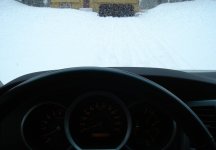
Stuck in snow much?

Heh... [MENTION=134884]RonJR[/MENTION] is right about different snow and conditions being tricky even with proper tread on tires.

I got the 4Runner stuck in pile of snow at work (yes with 35's) dicking around after my shift. The pile I went throw was made after I shoveled/raked the snow/ice that was over a foot thick on a Sequoia parked in front of where I normally park for about 2~3months. Got the rear axle buried and the ice just wasn't letting the 4Runner get enough grip even in 4LO, CDL engaged, and 1st gear feathering the throttle.

No biggie, threw the Maxtraxs under the rear axle and made my way home while running a rough estimate in my head how much regearing and throwing in lockers front and rear would cost me. Though I am getting more and more annoyed with TRAC and VSC in my 4th gen this winter as it's tried to kill me a couple of times on the icier roads.
[MENTION=122163]duffdog[/MENTION]

Yeah that ice can be pretty damn tricky. I remember a couple years back when I had my 33's (Nitto Terra Grapplers) I was the only one who was able to crawl up one of the "closed" highways leading into Tahoe out of our group of 4Runners. The other guys and a couple jeeps couldn't get going much without slipping halfway up, that was lightly dusted with snow really; they ended up needing to get a running start to shoot them up the hill.
 
Last edited:
Driving to work on my less than adequate tires were nerve wracking this morning. Passed by a 4 car pile up. the road is completely iced.

Im not sure if tires had anything to do with it.. I chugged along fine for the most part.

Again. New tires are coming in spring. I rather not get into details but I have to budget for large expenses. Tires were planned since fall. I never lived in the snow so to me 4/32 was still a decent tread.

I was born in the Canadian Snow belt...:yo:...necessary tread depth becomes one of those "little facts of life", that Dad teaches his HS kids.
And have driven through blizzards (decades ago), to get to a safe town to warm up &/or continue on (if blowing & drifting settled some).
- being stranded overnight (on a closed Hwy), can lead to freezing to death
So winter tire condition, isn't taken lightly.

4/32 = 1/8" tread depth = is very inadequate:
Truthfully, we have learned that - one always needs decent tires in the winter months
- or suffer the consequences of
a) getting stuck
b) getting into an accident, due to lack of experience / has a higher probability
Winter takes different driving techniques, that fewer people use today.

More Reading below:

For those who have run winter tires, how many seasons do they usually last?

I have always been a fan of dedicated winter wheels and tires on my previous vehicles -- a Miata and Infiniti I30. Because of the softer rubber compounds, I can see the weight of our 4Runners chewing through those tires in short time.

^^ On 3rd season now on family SUV, winter tread compound will be done in 4 years.
- wife RAV4 gets the winters installed first of Dec. and off in April...equals 5 months/year
- winter tiress on 40% of year & she drives 34,000 Km or 21,000 miles each year
= 8,400 winter miles/year times 4 years = approx. 34K miles to wear out
Here in Ontario - Insurance gives us a 5% discount on our rates, with approved winter spec. tires.

================================================

What makes snow tires good?
https://www.reference.com/vehicles/snow-tires-good-5c7abb812fcc09b8?qo=contentSimilarQuestions

The biggest benefit of snow tires is that they grip the road better in cold weather, which is due to the special rubber used to manufacture them, according to the Weather Channel. Edmunds.com also notes that most snow tires have specially designed treads that improve their grip

The softer the rubber in the tire is, the better it can grip the road, notes Edmunds.com. For this reason, snow tires are usually made with much softer rubber compounds, which can handle freezing temperatures without hardening up. However, the softer rubber makes snow tires a poor choice for warm temperatures, as they may grip too well as the rubber heats up.
In a Weather Channel article, the public relations manager of Michelin states that snow or winter tires are those which are designed for use at temperatures below 45 degrees Fahrenheit. At this temperature, the harder rubber in all-season tires starts to harden up, and they begin to lose traction.

The treads on snow tires are usually much smaller than on other types of tires. The blocks of treads are also cut with many thin lines, known as sipes, which increases the surface area and allows more rubber to contact the road. Some snow tires also contain metal studs, but as Edmunds.com points out, these are illegal during all or part of the year in some areas of both Canada and the United States.

As of 2015, there are a number of vehicle tires made in the United States: B.F Goodrich, Bridgestone/Firestone, Cooper, Goodyear, Dunlop, Kelly-Springfield, Titan Tire and Yokohama Tire. The U.S. Department of Transportation requires all tires have a code indicating where the tires were made and by which company.

For winter, I recommend:
Cooper - MultiMile Artic Claw XSI is a winter tire available with or without studs and designed for drivers of crossovers, vans and SUVs who wish to combine grip on snow or ice, ride comfort and good longevity without sacrificing security.
With these benefits and attractive modern and stylish design, the Multimile AcrticClaw XSI is a good choice for a great value

For summer, I like:
- Firestone Destination Le2, on wife's 2008 RAV4 Limited
- BFG's on my 2000 4Runner SR5
For winter season, next tire purchase will be:
Cooper - MultiMile Artic Claw XSI
 
Last edited:
40 degrees would be hard to drive on on pavement, let alone ice. It's really steep! You probably won't find more than 20% grade even on most very steep roads, and that's only 11-12 degrees.

I Just looked carefully at that street everyone slides down, Its more like 25 degrees on that hill, I'm not sure what percent grade that is. Which doesn't make it much better. The steepest streets I know of are in San Francisco, some of them do get to 40% or worse according to this chart. Some have signs saying you can't drive down them because its just too insane. I'm glad that there is no snow there but I have to drive up them in my cheap Ford company car all the time so it is definitely possible.

http://portolaplanet.com/wp-content/uploads/2015/09/steepest-hills.jpg
 
I have Michelin LTX MS2 tires with plenty of tread, and I've never gotten stuck but I've come close a few times.

I have the Michelins too, and I love them... of course, they're really an on-road tire. I mean I *can* and have gone in dirt and on sand at the beach, but if you
want a good touring / road tire that is OK in the snow and dirt, then the LTX MS2 tires are the way to go. If you like to off-road, then skip 'em.
 
I Just looked carefully at that street everyone slides down, Its more like 25 degrees on that hill, I'm not sure what percent grade that is. Which doesn't make it much better. The steepest streets I know of are in San Francisco, some of them do get to 40% or worse according to this chart. Some have signs saying you can't drive down them because its just too insane. I'm glad that there is no snow there but I have to drive up them in my cheap Ford company car all the time so it is definitely possible.

http://portolaplanet.com/wp-content/uploads/2015/09/steepest-hills.jpg

The streets in San Francisco are the steepest I've seen anywhere (though I don't doubt there are a few steeper streets somewhere). Check out the photos of them: https://priceonomics.com/the-steepest-streets-in-/

It's tough to estimate angle by looking at a street, but you can use a smartphone level app.

I have the Michelins too, and I love them... of course, they're really an on-road tire. I mean I *can* and have gone in dirt and on sand at the beach, but if you
want a good touring / road tire that is OK in the snow and dirt, then the LTX MS2 tires are the way to go. If you like to off-road, then skip 'em.

Yeah, they're definitely not the best for everyone, but I find them to be a good balance. I off road with them sometimes and push the limits, and I've never had a problem with that so far. 99% of my driving is still on roads, which is why I got them.
 
The first time I had my 4th gen out in a snow storm I was really disappointed. I couldn't get any traction and the VSC kept interfering. I couldn't even get up my driveway, and it's relatively flat. I blamed the tires first but the tread was decent and online reviews of my tires were all excellent in the snow.
I realized that the stupid electronics were the problem. Now I make sure to lock my center diff in the snow which disables VSC, the truck is fantastic in the snow now.
 
I haven't had mine out in the snow yet, and this thread had me a little concerned.
So, this morning I played Mythbuster and put it to the test.
With about 5" of new snow/sleet from last night's nor'easter, it was time to find out.

"Old reliable" (a 1998 Ford Explorer) hasn't had an issue with this in the last 18 years, and today was no exception.

The 4R ultimately did fine as well.
2WD was useless, as expected.
4WD unlocked was OK, but did slip a few times.
4WD locked had no problem.

A caveat:
I needed to shift the trans into L so it wouldn't try to upshift at a bad time and cause loss of traction and momentum.

Check out this news video for an idea of the conditions around here...
Nor'easter Causes Slick Roads, Crashes Around New England | NECN

The test: About 20' rise over 100' distance from road into garage, unplowed.
 

Attachments

  • drive768.jpg
    drive768.jpg
    47.4 KB · Views: 255
I realized that the stupid electronics were the problem. Now I make sure to lock my center diff in the snow which disables VSC, the truck is fantastic in the snow now.

Without locking the center diff the VSC works well IF you keep under 2K rpm's.
 
BFG's have great reviews, though I'd bet confirmation bias has a significant impact. I like my AT51's in all winter conditions. My only gripe is that not all the siping is full depth, so I'll have to do some work with a utility blade at some point. They probably won't last as long as KO2's, but they were also half the price.

As for skinny vs wide, contrary to what many believe, there is no difference in friction between the two. Friction is independent of contact area. The difference between the two off road is that skinny tires help to dig down and find solid traction. Furthermore, the weight savings help conserve fuel, unsprung mass and rotational mass. Wider tires are advantageous when float is needed like in deep snow, sand, or mud.

Edited for clarity.

YES, +1 for getting it.
 
The first time I had my 4th gen out in a snow storm I was really disappointed. I couldn't get any traction and the VSC kept interfering. I couldn't even get up my driveway, and it's relatively flat. I blamed the tires first but the tread was decent and online reviews of my tires were all excellent in the snow.
I realized that the stupid electronics were the problem. Now I make sure to lock my center diff in the snow which disables VSC, the truck is fantastic in the snow now.

This is a huge learning curve for anyone driving in the snow. TURN IT OFF. Trust your control over the vehicle. When I drove my little Nissan Altima with 4 Blizzaks and front wheel drive through the New England blizzards to ski over the past few years, I was slowly and confidently passing all sorts of huge trucks and AWD cars that skid off the side of the road. Also, it never hurts to carry a little shovel and some sand/salt mix in your car if you get stuck. I even keep my old carpet mats (upgraded to all weathers) for extra traction just in case.
 
Looks too familiar. Winter camping in Colorado, all the way to the undercarriage. Several days prior I heard cat litter will get you out. Had a 30lb. bag in back. Dug out most of the underneath, channels for the tires........LOTS of cat litter and I was camping in no time !
 
was looking into tires and saw this thread/read it.

in regards to snow driving - I live in MA and winter surf - shiy gets a little crazy sometimes and i need to be able to get around in the snow and home after swimming in sub-freezing water temps.

i have had blizzacks on a lowered gti in the past and recently a lowered wrx.
snow tires work amazing - the compound is soft and tacky which is great for snow and ice driving - even for racing (old winter tires) because of the tackiness.

When driving in the winter (4runner is new to me) is the consensus leaving it in 4hi for roads with packed snow at speeds >20 mph for example, and lock the diff in 4hi for pushing through small or medium depth powder, going pretty slow? the driveway example above led me to think this. having unlocked 4hi with traction control on could be the way to go over locked 4hi with no traction control for >20ish on packed or low depth snow?

Thanks,
-Tom
 
^ironic posting this because its been a drought here, 90+ degrees and full humidity for a lot of summer so far here in MA.
 

Members online

Forum statistics

Threads
278,309
Messages
3,554,075
Members
248,016
Latest member
Advally Service

Trending content

Back
Top