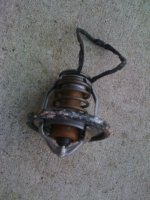
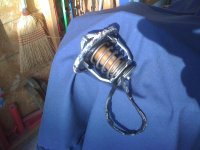
Swapped radiator, etc. today. An interesting discovery.

Qyota

New member
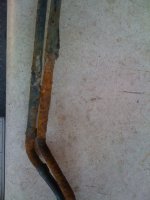
Today I changed the radiator (Koyo A1998), thermostat (Stant) and gasket, cap, and rear heater lines (OEM steel). Everything went pretty well. I was really worried about how the rear heater lines would come out (and go back in), since they are about 4 feet long, and bend in all sorts of funny directions. The old ones were rusted badly, and it was only a matter of time before they sprung a leak and left me stranded. If the new ones last 10+ years, it will be $70 well spent.

Now, for the past year or so (even through the cold-ass winter), I've seen water temps above 200F on my scangauge II. I've been concerned about this for a long time, since when I first got the truck, it would never get hotter than about 188F. I had no idea what changed, but it certainly has been running about 20 degrees hotter than what I would consider "normal".

So, I worked on getting the t-stat housing off, being very careful not to shear off those studs. 1 of the 3 nuts came off, the other two brought the studs with them, but nothing broke! When I removed the old, crusty t-stat, it was pretty apparent what was going on. Whoever replaced the t-stat last was not careful to remove some black RTV sealant someone had put around the housing surface. Believe it or not, there was a ring of RTV jammed into the smaller spring of the t-stat, probably preventing it from opening all the way. Luckily for me, this ring didn't make it's way further into the block! Anyway, I removed the old stat, and cleaned the housing and mating surfaces very well. There is no need for RTV here, if everything is clean and a new gasket is used. Which, of course, is what I did.

Everything went back together as planned, including the rear heat lines. For these, it helped to remove the top half of the transmission dipstick tube. For the coolant, I mixed 50/50 Toyota super long lasting with distilled water, and used the Lisle coolant filler funnel (I tell ya, that thing is WELL worth the $25!). The system took 2 gallons of the mix, and left me with just enough to get the reservoir up to the proper level.

The best part - after a test drive, I couldn't get the water temp above 188F!!!
Friggin' amazing. I'm so glad this worked to get my temps back to normal. Now I'm sorry I didn't do it sooner!

So what happened? I think that ring of RTV was keeping the stat from opening fully, slowing the movement of coolant down enough to raise temps 20 degrees.

I'm a happy camper. Thanks for listening! LBJs and outer TREs next!
:thumb3:
 

Attachments
  • t4rstat1.jpg
    t4rstat1.jpg
    64.3 KB · Views: 1,491
  • t4rstat2.jpg
    t4rstat2.jpg
    82 KB · Views: 1,493
  • t4rstat3.jpg
    t4rstat3.jpg
    74.5 KB · Views: 1,453
Last edited:
Register to hide this ad
I can't wait to do the same job on my cooling system. The temperature reading is about 207 since I started monitoring it with my Scangauge 2 and I have not been sure what to do. Thanks for your post. Well written!
Reading many other posts I am still not sure what the correct position for the thermostat in the housing is. Did you install it with the jiggle valve down or up?
Do you still have OEM part numbers for all installed components?
Thanks a lot!
 
Jiggle valve down.

The only OEM pieces I used were the radiator hoses and clamps, and the rear heat lines. Rear heat lines: 87248-35061. Hose #1: 16571-62070. Hose #2: 16572-62090. Hose clamps: 90467-37005.

The radiator I got on eBay, it was sold as a TYC, but it came in a Koyo box, and it's labeled as an A1998, which is the correct replacement number. The radiator is high quality, and comes with the metal side brackets installed. Super easy to replace.

The t-stat is a Stant 180 degree unit, I think I got this from Rockauto.com, just using the normal year/model look up.
 
nothing better than replacing some bad parts and the warm fuzzy you get as you KNOW its done. and done right.
 
Those heater lines are pretty rusty. I'm assuming they throw down salt in Wisconsin cause I'm in the Pacific Northwest and we get alot of rain but I don't have anything that rusty on my undercarriage.
 
Jiggle valve down.

The only OEM pieces I used were the radiator hoses and clamps, and the rear heat lines. Rear heat lines: 87248-35061. Hose #1: 16571-62070. Hose #2: 16572-62090. Hose clamps: 90467-37005.

The radiator I got on eBay, it was sold as a TYC, but it came in a Koyo box, and it's labeled as an A1998, which is the correct replacement number. The radiator is high quality, and comes with the metal side brackets installed. Super easy to replace.

The t-stat is a Stant 180 degree unit, I think I got this from Rockauto.com, just using the normal year/model look up.

Thanks Qyota. I will do the same swap soon. Does the coolant temperature remain steady 188 or you have noticed some flactuations?
 
Thanks Qyota. I will do the same swap soon. Does the coolant temperature remain steady 188 or you have noticed some flactuations?

Once up to temp, it was either 186 or 188 for the entire drive, which included 35mph zones, 45, and 55. At highway speeds, it was mostly 186. Contrast this with mostly 202-204 for the past year...even in sub-zero air temps. :bash:
 
So replacing the rear lines was a straight forward deal?

Mostly. Here's what I did.

1. Drain coolant
2. Remove the 3 nuts holding the lines to the body. One at the very rear by the rubber lines, one about a foot forward from there, and the last one very near the exhaust downpipe.
3. Disconnect steel lines from rubber lines at the firewall and at the point where the lines enter the cab under the passenger seat. These are just spring clamps. Some coolant will come out from the rear connections.
4. Remove the bolt holding the upper half of the transmission fluid distick tube to the block. Remove the dipstick, then the upper half of the tube.
5. Pull the lines off the 3 body studs that the nuts were on, so the whole assembly is now "loose".
6. Wrangle the lines between the coiled brake line near the passenger fender and the exhaust header, moving them slightly down and forward. You need to get the lines under the main wire harness that enters through the firewall (inside that corrugated rubber tubing). Some light flexing of the lines is necessary.
7. Pull the assembly forward enough to get the back end of the lines in front of the chassis crossmember.
8. Once the ends of the lines are past the crossmember, you can then begin pulling the assembly out the bottom.
9. You'll need to be on your back under the truck, carefully pulling the assembly out the bottom, turning as necessary to avoid hitting things. In the end, the lines came out between the exhaust downpipe and the steering rack.
10. Insert the new tubes in the reverse order! :-)

I moved from under the truck to the engine bay about 12 times doing this...just to be sure I wasn't snagged on anything like the catalytic converter. Have a piece of cardboard or a creeper handy.
 
Last edited:
So replacing the rear lines was a straight forward deal?

Do a search on the rear heater lines. It is a super easy fix, and you don't need to spend the $70 on OEM rigid steel lines. A number of us have replaced ours with flex line for about $5 and they work just the same and won't even rust.

Plus I think the install is easier than what QYota just described. You can check out the link in my sig for my install of the flex lines.
 
Absolutely - running all rubber would have been much easier.You could just cut the rusted lines in half and not bother with a lot of the wrangling. And thinking back on it, I shouldn't have bought the steel lines. But, it's too late, I ordered them about 6 months ago and didn't want to bother trying to return them.

If you do this, though, be careful to run the lines as far away from the exhaust as possible. I believe this is the reason the OEM lines are steel.
 
Absolutely - running all rubber would have been much easier.You could just cut the rusted lines in half and not bother with a lot of the wrangling. And thinking back on it, I shouldn't have bought the steel lines. But, it's too late, I ordered them about 6 months ago and didn't want to bother trying to return them.

If you do this, though, be careful to run the lines as far away from the exhaust as possible. I believe this is the reason the OEM lines are steel.

Yeah, I remember your post about it right after you bought them. Honestly, if I had to do it again, I would just cut the lines off in the engine bay and bypass them with a short piece of flex line. I don't think the rear heater is worth that much, and it adds alot of vulnerability for little added functionality. I mean, air flow from under the passenger seat isn't that great anyway, and you are risking draining your entire engine of coolant (which I did, thank God it didn't overheat). Pretty bad design in my opinion.
 
I was thinking about bypassing the rear heater too. Any negative outcomes rather than inconvenience for rear passengers to expect?
 
I have one of the few Highlander models that doesn't have the rear heater option and I've never had my passengers complain about being cold so IMO the rear heater is a bit overated.
 
I have one of the few Highlander models that doesn't have the rear heater option and I've never had my passengers complain about being cold so IMO the rear heater is a bit overated.

My passangers complain all the time. Maybe it's because I don't remember to roll the window up. Do'h!

Anywho, Oyota-san, did you replace the radiator in order to prevent the "pink milkshake" problem?
 
****. I'm sure my heater lines have to be rusty since everything else gets rusty in the Maritimes. I'd bypass it, but the kids love the rear heater and I like it myself, since having it on with the rear windows cracked helps the windows from fogging up when we're all rainy or wintery.
 
My baby girl likes the rear heat...so to me it's worth keeping. And I get LOTS of heat out of that thing. It actually serves to heat the front seats slightly as well, by proximity.

Bypassing in the engine bay will have no ill-effect, alp.

Satter, I have had an external cooler for over a year now, so this was not to prevent the milkshake. However, I did not know the age of the radiator, and they are cheap enough to just replace and forget about for another decade.
 
Qyota,
Another question: Does the thermostat come with the gasket (o-ring?) or I have to order it separately? Thanks.
 
Thanks for this great info Qyota. It would be hard to imagine the exact same thing happening to cause it, but my coolant temps used to always be 188 too. And now they're 198-200. I've got a bunch of stuff planned to do to mine as soon as I get me new gas saver car out on the road and park the 4runner. The t-stat will be on the list for sure.
 

Members online

No members online now.

Forum statistics

Threads
278,316
Messages
3,554,111
Members
248,016
Latest member
Advally Service

Trending content

Back
Top