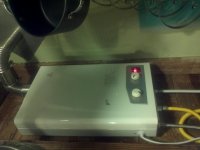
Tankless water heater.

Register to hide this ad
why wouldnt this go under off topic instead of the car section of the forum?

either way, once my higher effiecience tanked unit goes, i am onto a tankless.
 
Rinnai seems to be pretty popular here in Central Florida. Seems to hold up well. They are a bit spendy however. Be safe.
 
Noritz ��
thanks. checking into it.

why wouldnt this go under off topic instead of the car section of the forum?

either way, once my higher effiecience tanked unit goes, i am onto a tankless.
oops. i didnt pay any attention, just noticed, "general discussion" i didnt realise it was a subsection.
mods, can you move it please?

Rinnai seems to be pretty popular here in Central Florida. Seems to hold up well. They are a bit spendy however. Be safe.
checking that one also. thanks.
both it, and the noritz seem to be pretty high end heaters.


im also considering Rheem.
 
When I researched tankless gas water heaters several years ago, the biggest limiting factor was the small gas line into most older homes. The heater requires a larger line and significant plumbing costs to install. Just check your situation before committing to anything.
 
When I researched tankless gas water heaters several years ago, the biggest limiting factor was the small gas line into most older homes. The heater requires a larger line and significant plumbing costs to install. Just check your situation before committing to anything.

good catch.
ive noticed some heaters require a 1/2" line, where others need 3/4"

i believe the feed line to my house is 1/2".
i'll make sure to get the correct one.
 
I've been using a tankless water heater for 6 years now. My current tankless is a Rinnai RL 98LSI and I absolutely love it. Some of the advantages are:
-Unlimited hot water (as long as you have water, gas and electricity)
-Very small footprint, frees up space in the garage.
-Only heats up water when you need it. Not all the time like traditional boilers.
-Run multiple showers at once for as long as you like (dependent on water pressure).
-Some units can be installed outside.

Disadvantages:
-Needs electricity to run. If you have a power outage it won't work.
-Needs minimum flow rate for the unit to kick on. If the faucet is turned on too low, it may not activate the unit.
-The heat exchanger is very susceptible to hard water damage.
-Should be de-scaled once a year.
-Needs specialized vent ducting
-3/4" gas line for higher flow units

Some other things to consider:
-APC battery back up in case of power failure. It'll power it long enough to finish up if you have an outage. An auxiliary generator is even better.
-isolator valves
-water softener (necessary if you live in a hard water area)

Stay away from Takagi. Prior to my Rinnai I had a Takagi TM-32. It failed after 9 months. After sending it back to Takagi they blamed it on hard water and refused to repair/replace it under warranty. I went back and forth with them taking it up to the corporate level and the best they could do was to repair it at a discounted rate of $600 plus shipping.
 
Last edited:
yes, hardwater is something else i'll have to worry about.

i have city water, but i have no idea how HARD it is.
but, the feed lines are old pipe, so there is rust and scale buildup.

maybe this wont work out the way i was hoping.


edit: and thanks for the headsup on Takagi.
 
Last edited:
Expensive to buy, expensive to repair. Too many people showering = cold water. Not enough useage = cold water (as described above). Electricity requirement. :(

Not worth it IMO.
 
My neighbor had one put in. It was very expensive. He is in his mid seventies so he will never get a payback on it. I will sick with my old electric water heater (no gas available here). They go bad after 7 years or so where I live but I can easily and cheaply replace it as needed. I like to keep things simple. Those tankless units are overly complex and will not be cheap to repair down the road.
 
Walter White installed one in his home 3 seasons ago

Hahaha...Along with a lot of sub flooring.:D

Nevada, if your intent is to save money on the gas bill, it'll probably take 10 years to do that. The cost savings may never be realized. A traditional boiler may be the way to go. But if your intent is also for freeing up space and unlimited hot water or simultaneous showers, then go for it. In my situation, it has worked out great and I have no regrets. When my current tankless dies, I'll replace it with another tankless. It'll take about 15 minutes.

This is what occupies the space where the water heater was located.

FD9403AF-5A1D-4905-BBFF-32CB98A8B1D8-85246-000083739B70C827.jpg~original


This is where the tankless sits today.

E464123C-A1C2-484C-AE51-50744D64E923-85246-00008373AB1875D8.jpg~original
 
Hahaha...Along with a lot of sub flooring.:D

Nevada, if your intent is to save money on the gas bill, it'll probably take 10 years to do that. The cost savings may never be realized. A traditional boiler may be the way to go. But if your intent is also for freeing up space and unlimited hot water or simultaneous showers, then go for it. In my situation, it has worked out great and I have no regrets. When my current tankless dies, I'll replace it with another tankless. It'll take about 15 minutes.

This is what occupies the space where the water heater was located.

FD9403AF-5A1D-4905-BBFF-32CB98A8B1D8-85246-000083739B70C827.jpg~original


This is where the tankless sits today.

E464123C-A1C2-484C-AE51-50744D64E923-85246-00008373AB1875D8.jpg~original

yes, i need to use the space. and with 3 kids, there is a lot of laundry, and dishes. so not having to plan when we shower just so we have enough hot water will be nice.

i dont have a gas bill currently. the house is plumbed for it, but the service is disconnected. i expect to see a lower electric bill, and i realise that will likely be offset by the gas bill. and any savings i do get, will likely take many years to get back the cost of the unit/install. but that is not the reason im doing it.

i think the convenience will be more than worth the price.
 
Here is some food for thought. I have both. 40 gallon tank, Rannai Tank less. No NG here, but I have a 500 gallon LP tank buried in the front yard. Electricity here in Central Florida pretty inexpensive compared to other parts of the country. LP however, well it's close to 3.00 per gallon. So I use it sparingly. Sometimes the hot tub heater, (I also have a Heatpump for that)
and Sometimes the Tankless as explained below, and the Outdoor kitchen grill, I use this a lot!


When wife and I are here alone, 40 gallon is really all we need. (Get's about 35 gallons of hot water). But since I live in the land of Disney and I have two extra spare bedrooms, relatives, friends and a stranger or two, frequent our abode. During those times, a flip of a switch and a turn of a couple of valves, and city water then goes through the Rinnai first, then to the hot water tank. With that, I really do have unlimited hot water. And, enough pressure to run multiple showers. Works great for my needs. Better then a larger Tank, and cheaper too.
 
Before selecting your tankless heater you need to know how many appliances/showers you need to be able to run at once. There are many wholesalers that can help you calculate your gallons a min needed. All tankless heaters are a step in the right direction of coming from a tank type but that being said, some brands make a better unit than others. Noritz for example has over 50% market share in Japan but is less relevant in the US because they've only been here a few years. They make their heaters with a 30% thicker copper heat exchanger than competitors and are unmatched as far as quality is concerned. Many retailers however will want you to use a cheaper alternative they can make a better mark up on, so be weary. We have a noritz tankless unit at my main house and I can say first hand that if you have the right tankless heater you will save money and never run out of hot water again. Good luck on the home improvement!
 
Before selecting your tankless heater you need to know how many appliances/showers you need to be able to run at once. There are many wholesalers that can help you calculate your gallons a min needed. All tankless heaters are a step in the right direction of coming from a tank type but that being said, some brands make a better unit than others. Noritz for example has over 50% market share in Japan but is less relevant in the US because they've only been here a few years. They make their heaters with a 30% thicker copper heat exchanger than competitors and are unmatched as far as quality is concerned. Many retailers however will want you to use a cheaper alternative they can make a better mark up on, so be weary. We have a noritz tankless unit at my main house and I can say first hand that if you have the right tankless heater you will save money and never run out of hot water again. Good luck on the home improvement!

yeh, ive got that part figured out. im wanting to get a heater that is larger that what i NEED. part of the reason for doing this, is so we never have to PLAN showers, or hot water use. id hate to go through the trouble, and expense of isntalling one, and then find on special occasions we still have to wait, because we're using more hot water than normal.

ive heard nothing bad about noritz, except the price. its definately an option.

and thanks. this is only a small part of the work ive been doing. im in the process of building bedrooms right now.
 
I went with the EcoSmart ECO 27 and I've had it installed for a week. Seems to work OK so far for my family of 5. It does take a bit longer for the water to warm up at the tap/shower than our old gas powered water tank.

The unit was $500 and the electrical upgrades and re-plumbing totaled about $400 in materials. I did all the work myself and that saved some cash - electricians were estimating over 1K.
 
I went with the EcoSmart ECO 27 and I've had it installed for a week. Seems to work OK so far for my family of 5. It does take a bit longer for the water to warm up at the tap/shower than our old gas powered water tank.

The unit was $500 and the electrical upgrades and re-plumbing totaled about $400 in materials. I did all the work myself and that saved some cash - electricians were estimating over 1K.

good to know.
ecosmart is one i was also considering.
nice to know that small of one will still work.
since i'll be limited by my incoming feed line.
 
Hi, I just wanted to add my two cents...

I use an Eco temp propane two appliance model. Can't remember the specific model but it works great.

The only problem I'd note is that the output temperature varies with the input water temperature; mainly just adjust the flow / flame every spring fall and just deal with weather related fluctuations.

It uses 1/2 inch lines, but I use sink supply lines at the input & output (3/8 inch I.D.). It can be a little tricky to get "warm" as my hot supply T's off the cold and the igniter senses the water pressure (or flow rate) to decide whether to light.

Small 1 bed/bath cabin. Just the two of us. It is so efficient that I can't even tell there's any propane being used. 250 gal tank. I ordered it online through "Sport mans Guide; about $300 I think.

Hope this information is useful,
 

Attachments

  • IMG_20120913_193351.jpg
    IMG_20120913_193351.jpg
    140.7 KB · Views: 84

Members online

Forum statistics

Threads
278,309
Messages
3,554,075
Members
248,016
Latest member
Advally Service

Trending content

Back
Top