Threw a code today...

OK so I did the leakdown today and I got air slowly coming out of the throttle body...indicating intake valve? But wouldn't that be the valve cover gasket and air intake? I just re-did those AFTER learning about the misfire as I did the injectors. So that can't be the problem. I also thought I heard some air coming out of the tailpipe.

Furthermore, there was red crap on the front of the engine, making me think of burnt coolant. But no bubbles in the radiator top. This same red stuff was at the top of the driver side fuel injector wells.

So...I'm at a bit of a loss. And to double check if I was truly at the top dead center compression I followed the cues in the video and did it at the other top stroke just to see. And on the other stroke (presumably exhaust stroke) the air coming out of the throttle body intake valve was tremendous. It blew a latex glove right off (that's how I checked for leakage)
 
OK so I did the leakdown today and I got air slowly coming out of the throttle body...indicating intake valve? But wouldn't that be the valve cover gasket and air intake? I just re-did those AFTER learning about the misfire as I did the injectors. So that can't be the problem. I also thought I heard some air coming out of the tailpipe.

Furthermore, there was red crap on the front of the engine, making me think of burnt coolant. But no bubbles in the radiator top. This same red stuff was at the top of the driver side fuel injector wells.

So...I'm at a bit of a loss. And to double check if I was truly at the top dead center compression I followed the cues in the video and did it at the other top stroke just to see. And on the other stroke (presumably exhaust stroke) the air coming out of the throttle body intake valve was tremendous. It blew a latex glove right off (that's how I checked for leakage)

Yes, you are correct that if you hear air coming out of the throttle body it's getting past the intake valve.

If you've got coolant near the fuel injectors, your intake manifold gasket is probably bad. So, you might have a couple issues going on.

Taking the path of least resistance before pulling the heads off or contemplating an engine replacement, I'd check the valve clearances on the #4 and #6 cylinders and see if they are way off. Maybe a valve clearance adjustment could improve the loss of compression past the valve seats.
 
This is where having a boroscope is a really great thing. This could be a intake manifold gasket issue, or it could be a cracked cylinder head issue.

Pulling the manifolds, and replacing the gaskets is a fairly simple job, and not too expensive. If you have the time and tools, I'd suggest giving it a shot.
 
I did put new intake manifold gaskets on (plenum gaskets right?) as a part of my fuel injector swap. I did injectors, o-rings, plenums, valve cover all in one go.

I have one of those camera scopes you plug into the phone. What would I scope?
 
Drive the vehicle normally. Let it sit over night. Before running the vehicle in the morning, pull the spark plug from #6 and see if there is coolant in the cylinder. If so, you def have a leak in either the head, or head gasket for that cylinder.
 
Drive the vehicle normally. Let it sit over night. Before running the vehicle in the morning, pull the spark plug from #6 and see if there is coolant in the cylinder. If so, you def have a leak in either the head, or head gasket for that cylinder.

This is great advice.

For the intake valve, consider yourself lucky! Unless the valve itself it cracked, all you will need to do is swap out one shim on that valve. Hearing the air hiss in the crankcase is the worst case scenario, since that means your rings are tires and not holding compression. Intake valve is simple and you should gain most, if not all, of your compression back. Just take your time, get a copy of the FSM if you can and be patient. Getting the shim out with the pick tool is a little bit tricky.
 
This is great advice.

I say that for 2 reasons. 1: I'm a retired mechanic. 2: This was a personal experience for me on my 4Runner. I too had a P0303 and P0300. Turned out to be a cracked cylinder head that was also warped. Apparently the PO had slightly over heated the vehicle before I got it, and there was no trace of that on Carfax.
 
I say that for 2 reasons. 1: I'm a retired mechanic. 2: This was a personal experience for me on my 4Runner. I too had a P0303 and P0300. Turned out to be a cracked cylinder head that was also warped. Apparently the PO had slightly over heated the vehicle before I got it, and there was no trace of that on Carfax.

Wow they must have fried the heck out of it. I can't remember the last time I saw a cracked 5VZ head.
 
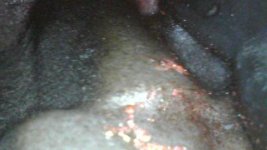
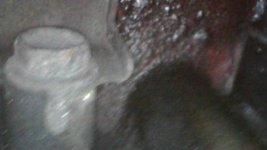
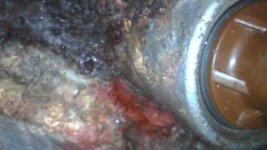
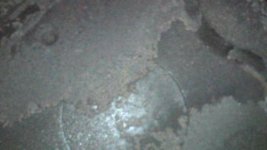
scoped it today, both 4 and 6 were bone dry, at least where my camera could reach. I couldn't make it swivel around. The only red fluid I can find with my camera is by the water pump housing, and oddly enough like I previously stated by the fuel injector holes on the driver side. But coolant doesn't even go up there does it? Maybe it's something else red.
 

Attachments

  • 2019-06-23-11-50-32.jpg
    2019-06-23-11-50-32.jpg
    16.4 KB · Views: 137
  • Resized_2019-06-23-11-50-43_2830.jpg
    Resized_2019-06-23-11-50-43_2830.jpg
    13.8 KB · Views: 138
  • Resized_2019-06-23-11-51-06_1413.jpg
    Resized_2019-06-23-11-51-06_1413.jpg
    20.3 KB · Views: 121
  • 2019-06-23-11-47-14.jpg
    2019-06-23-11-47-14.jpg
    13.9 KB · Views: 137
Is there anything I can diagnose further for this cracked head? My mechanic's not getting back to me and my wife's car is incapacitated as she was just hit so now I'm down to my low compression 4runner and my beater yard F250 with an apparent coolant leak somewhere. I need to get my 4runner working well, and hopefully her subaru back quickly from collision repair.
 
Head Gasket?

You could try rechecking cyl compression in number 6. Pull the spark plug out of cyl 4. Listen for air noise there. This might tell you if there is your suspected head gasket compression leak between 4 and 6 which are adjacent on this engine,3400 right? Because cyl 4 intake valves might be open then...Also look for bubbles under the radiator cap. You can borrow/buy a coolant pressure tester and look where the coolant leaks from under radiator pressure(12 psi or what cap says). I put a new head gasket in a 1997 runner 3400 212,000. For a friend. It white smoked like hell and had two shot-glasses of coolant in the #5 cyl. It ran fine after, i was surprised. To save him money(unexpected failure) i did the other gasket 5k later. It now has 253,000 on it. Dealing with the cams(lock bolt), timing tensioner(Stupid location) and exhaust crossover pipe rusty nuts tough... but can be done if you are mechanical and have good tools. hopefully not a cracked head.
 
I briefly read through your post so bare with me. You did a leak down test and heard a hissing noise through the throttle body which means your intake valve(s) on #6 could be out of adjustment.

If you are not losing coolant and you didn't see any bubble coming out of the radiator when you did the leak down test, your head gasket/head should be fine. The gasket could have failed between the #4 and #6 cylinders, if you remove the spark plug on #4 while pressurizing #6, if there is a leak you should be able to hear/feel air coming out of the spark plug hole (I think?).

You also said you did not see any coolant in the cylinder when you bore scoped it, so that's a good thing but you could still have a bad HG. It should be noted that when I had a bad HG on my 97's original engine, I bore scoped it (cylinder #3 where I was getting the misfire code) the cylinder also looked bone dry and the spark plugs looked the same as the others. I also tried one of those dye tests which came back perfectly normal indicating there was no leak.

When I finally wised up and did a leak down test, the second I pressurized cylinder #3 I saw bubbles coming out of the radiator confirming I did in fact have a bad HG.

I would get a FSM and check the your valve adjustments as already suggested. It could literally be that simple.
 
Last edited:
I rented the compression tester the first go around. For the leakdown I bought the OTC kit, but then returned it since I was like hey I don't need this. The two seem so similar, cant I just use a leakdown tester for all of it? One tool would be great. Then of course there's radiator compression. Any good idea for a one master kit?
 
IMO, a leak down tester is a must have for any mechanic (DIY or professional). It takes a lot of the guessing work out of diagnosing a problem. A compression tester (which I have) is ok but only tells you so much. It's a good tool for doing a quick check on the compression of an engine (for instance, you are looking to buy a used car, lawn mower, boat motor etc).

A cooling system pressure tester (I also have one of these) is good for diagnosing leaks in your cooling system but not very effective for determining if you have a HG leak or not.

I think you already narrowed down what your problem is. Unfortunately, the next step is to pull the valve cover and check your valve clearances. I personally haven't done it but I watched Tim's video that he made, technically its for the 4 banger but the concept is exactly the same for the V6. You just need the FSM pages that covers how to check it on the 5VZFE and get yourself some feeler gauges.

If a couple of your intake valves are out of adjustment, you'll need to buy the special tool that holds down the buckets so you can remove the shims. Once you do the math and determine which shims you need, you put the new shims back in and button it back up.

Keep in mind that if your valve clearances are all within spec but you are still loosing compression through an intake valve, the valve itself could be damaged. Unfortunately, that would require much more work.
 
Last edited:
I rented the compression tester the first go around. For the leakdown I bought the OTC kit, but then returned it since I was like hey I don't need this. The two seem so similar, cant I just use a leakdown tester for all of it? One tool would be great. Then of course there's radiator compression. Any good idea for a one master kit?

A compression tester tells you that you have a compression leak. The leakdown tells you where the leak is. That's the difference.

Oh, did anyone mention you need an air compressor to use a leak down tester?

A coolant system pressure test system is a whole other thing. Don't bother with that unless you have a leak. Auto parts stores also often have a kit for rental.
 
Can I just own a leakdown tester and use that for general compression testing? As long as I don't open the valve to the other gauge it should function the same right? it has the same spark plug hose so I'm assuming it would just "charge" the first gauge with engine cranking
 

Members online

Forum statistics

Threads
278,304
Messages
3,554,041
Members
248,016
Latest member
Advally Service

Trending content

Back
Top