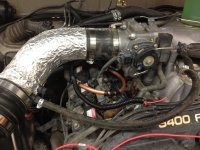
throttle body coolant bypass pic

this is the throttle body coolant bypass mod i did just wanted to share because i have never these this here o this forum
 

Attachments

  • coolant bypass.jpg
    coolant bypass.jpg
    134.1 KB · Views: 10,407
Register to hide this ad
Why do you want to lower temps? Not sure how your mod helps either but whatever...

I hope your spark plugs are not original like your wires.
 
Do you actually know what the temps are under the hood? The coolant temp also?

Being in the camp with Kball, I do not know how this would make the 4runner run that much cooler. But being the optimist, I'd love to see it give you the results you are chasing.
 
Well intake temps with the head light still on is 180 I have the deck plate mod so I'm guessing 200+ plus under hood temps everytime I go to the sand dunes I run no headlight with a intake tube to screwed into the deck plate and intake temps are usually around ambient temps. I also run no hood when I go to the dunes everything stays much cooler
 
Where did you get this idea?

You're attempting to COOL the airflow of the charge through the throttle body by removing the coolant? The air intake sits right on top of, and is heated by the cylinder heads (where all the fire is). You have a metal that really likes to soak up and distribute heat bolted directly to another piece of metal that really likes to soak up and distribute heat directly in contact with a whole lot of hot little explosions... What temperature range do you think those explosions are? In a HEALTHY engine, your exhaust manifold temps can get close to 2K degrees. That's the exhaust side, so let's just ASSUME the intake side is only half that at 1K degrees right at the head with no cooling. Half that again just for the sake of argument, and then AGAIN to make it truly absurd. 250 degrees isn't that hot, but your intake charge is then going to be heated to 250 degrees.

Now, assume you're not doing silly modifications to an otherwise healthy (an assumption) engine for the sake of doing silly modifications to an otherwise healthy (an assumption) engine: if you have coolant (mostly water) running through the intake in a manifold designed specifically to counteract this thermal conduction, even at the super-duper argumentatively reduced temperature of 250, you're better off by 38 degrees at sea level.

I don't have any direct experience with this type of temperature readings on these engines, but the last engine I fiddled with anything that had me checking temps of various systems with an infrared thermometer (and it may just have been because I had one in my hand and was goofing around in the engine compartment) and more or less uncooled intake (this was an older engine) checked out at about 350 a few inches from the head. This intake, however, was hanging out pretty well in the open where airflow was able to affect things; the intakes on these engines are pretty folded up and compact and would not have even that minimal benefit.

So that's the direct effect of removing your intake coolant, the indirect effects are higher charge temperatures => less dense charge => less available oxygen for combustion => less engine output. In a nutshell, you just robbed yourself of several ponies IN THE BEST CASE SCENARIO.

A worst case scenario is runaway thermal buildup (serious structural damage to your intake and/or head resulting in dropped valve seats and the like), and slightly less worse is some nasty pinging and your engine tears itself apart internally.

To summarize: this mod is not doing you any favors.

Attention people who like "cheap" mods to their engine because they think it's cool or something: don't do this, it's not a good idea and could harm your engine.

 
Last edited:
Where did you get this idea?

You're attempting to COOL the airflow of the charge through the throttle body by removing the coolant? The air intake sits right on top of, and is heated by the cylinder heads (where all the fire is). You have a metal that really likes to soak up and distribute heat bolted directly to another piece of metal that really likes to soak up and distribute heat directly in contact with a whole lot of hot little explosions... What temperature range do you think those explosions are? In a HEALTHY engine, your exhaust manifold temps can get close to 2K degrees. That's the exhaust side, so let's just ASSUME the intake side is only half that at 1K degrees right at the head with no cooling. Half that again just for the sake of argument, and then AGAIN to make it truly absurd. 250 degrees isn't that hot, but your intake charge is then going to be heated to 250 degrees.

Now, assume you're not doing silly modifications to an otherwise healthy (an assumption) engine for the sake of doing silly modifications to an otherwise healthy (an assumption) engine: if you have coolant (mostly water) running through the intake in a manifold designed specifically to counteract this thermal conduction, even at the super-duper argumentatively reduced temperature of 250, you're better off by 38 degrees at sea level.

I don't have any direct experience with this type of temperature readings on these engines, but the last engine I fiddled with anything that had me checking temps of various systems with an infrared thermometer (and it may just have been because I had one in my hand and was goofing around in the engine compartment) and more or less uncooled intake (this was an older engine) checked out at about 350 a few inches from the head. This intake, however, was hanging out pretty well in the open where airflow was able to affect things; the intakes on these engines are pretty folded up and compact and would not have even that minimal benefit.

So that's the direct effect of removing your intake coolant, the indirect effects are higher charge temperatures => less dense charge => less available oxygen for combustion => less engine output. In a nutshell, you just robbed yourself of several ponies IN THE BEST CASE SCENARIO.

A worst case scenario is runaway thermal buildup (serious structural damage to your intake and/or head resulting in dropped valve seats and the like), and slightly less worse is some nasty pinging and your engine tears itself apart internally.

To summarize: this mod is not doing you any favors.

Attention people who like "cheap" mods to their engine because they think it's cool or something: don't do this, it's not a good idea and could harm your engine.

There was soooo much incorrect about this post, it's not even funny.

Air intake temps are MUCH closer to ambient air temps in a stock configured draw location than you make them out to be.

Removing the intake heating element part of the IAC(NOT COOLING), which DOES increase the temps of the air intake charge, won't provide you with a significant intake temp drop(opposite actually), and most definitely won't provide a lower engine operating temp....

....But what it WILL do is force the IAC control to remain open, feeding even more hot vented engine gasses into your intake cause it will never sense itself getting up to operating engine temps... So REALLY your gonna have negative effects and vent even more heated engine air, than you already get, directly into the intake, and most likely screw up your idle speed at all times.
 
There was soooo much incorrect about this post, it's not even funny.

Air intake temps are MUCH closer to ambient air temps in a stock configured draw location than you make them out to be.

Removing the intake heating element part of the IAC(NOT COOLING), which DOES increase the temps of the air intake charge, won't provide you with a significant intake temp drop(opposite actually), and most definitely won't provide a lower engine operating temp....

....But what it WILL do is force the IAC control to remain open, feeding even more hot vented engine gasses into your intake cause it will never sense itself getting up to operating engine temps... So REALLY your gonna have negative effects and vent even more heated engine air, than you already get, directly into the intake, and most likely screw up your idle speed at all times.
Nice necro bump. :)

You are right that the coolant through the throttle body is for heating, not cooling. It keeps it from icing up in certain circumstances.

It won't affect idle though. The IAC is controlled by the ECU based on engine temperature. There are no passive elements in there that would change with temp (like an old wax controlled choke or something).

-Charlie
 
Raise your hand if you still stab the gas pedal to the ground to set the choke before starting on cold mornings

Sent from my Nexus 5X using Tapatalk
 
Raise your hand if you still stab the gas pedal to the ground to set the choke before starting on cold mornings

Sent from my Nexus 5X using Tapatalk


On the old CJ7 all I do is touch the throttle and you can hear the choke plate snap shut.


Sent from my iPhone using Tapatalk
 
Raise your hand if you still stab the gas pedal to the ground to set the choke before starting on cold mornings

Sent from my Nexus 5X using Tapatalk

New-fangled automatic chokes. I never did trust them.

Even on manual chokes, the way God intended for carbs to be, a good stomp was often needed to feed a slug of gas into the carb body. There was a small accelerator pump that reacted to a good stomp for cold starts or hard accelerations.
 
I miss my old '84 Tercel wagon 4x4, that thing was like a mini-4runner. It rusted out. It was simple and manual, you just hit the pedal before starting. I still see the odd one around.
 
Raise your hand if you still stab the gas pedal to the ground to set the choke before starting on cold mornings
My old '67 Ford truck took 3 stabs to get it going on a cold (below freezing) morning. Rarely did the choke need to get fully set though. :beer:

Drove it through high school, then it was on to 'new' Toyotas from then on...

-Charlie
 
Raise your hand if you still stab the gas pedal to the ground to set the choke before starting on cold mornings

Sent from my Nexus 5X using Tapatalk

Regularly... My other truck is an 81Datsun 720 4x4 with a Weber 38 dges carb...

I also stomp the floor with my left foot, forgetting there's no clutch in my 4Runner, lol
 
On the old CJ7 all I do is touch the throttle and you can hear the choke plate snap shut.


Sent from my iPhone using Tapatalk

The full stomp when not running and cold actually forced the choke wide open... The little tap once warmed a bit is what would release it...
 
The full stomp when not running and cold actually forced the choke wide open... The little tap once warmed a bit is what would release it...


The little tap warming up releases the high idle cam. I don't give it a full pump of gas because it usually sits a while. So just setting the choke with no accelerator pump squirt will allow oil pressure to start to rise around the time it starts.


Sent from my iPhone using Tapatalk
 

Members online

Forum statistics

Threads
278,311
Messages
3,554,082
Members
248,016
Latest member
Advally Service

Trending content

Back
Top