solsnowbarger
New member
Wait a sec, I'm slowly working my way through this as we speak, jiggle valve on the thermostats goes at 6 o'clock, not 12?



I'm curious, why is it the consensus, at least on this thread, that you need to replace the tensioner and other pulleys when doing this job? I've never tackled a timing belt replacement but I plan on doing it on my 2000 4runner the next time it's due. I've paid for timing belt replacements for a Honda Accord and a Subaru Outback and the only thing that was always recommended was replacing the water pump because it's exposed while doing the timing belt and water pumps are known to go bad often enough to validate replacing it while you're in there. I've never heard of replacing any tensioners or pulleys unless I guess you can visibly see something is wrong or the pulley bearings feel rough.
It just sounds like potentially throwing money away but I do understand the theory of replacing things while you're in there so you don't have to go back in later if one of the pulleys goes bad or the tensioner fails.
I'm just wondering how often these parts go bad? Like I said, I've never had a mechanic ever suggest replacing pulleys or tensioners before and I've paid for several timing belt replacements over the years. Is this something unique to these 3.4 liter engines?

Wait a sec, I'm slowly working my way through this as we speak, jiggle valve on the thermostats goes at 6 o'clock, not 12?
I'm curious, why is it the consensus, at least on this thread, that you need to replace the tensioner and other pulleys when doing this job? I've never tackled a timing belt replacement but I plan on doing it on my 2000 4runner the next time it's due. I've paid for timing belt replacements for a Honda Accord and a Subaru Outback and the only thing that was always recommended was replacing the water pump because it's exposed while doing the timing belt and water pumps are known to go bad often enough to validate replacing it while you're in there. I've never heard of replacing any tensioners or pulleys unless I guess you can visibly see something is wrong or the pulley bearings feel rough.
It just sounds like potentially throwing money away but I do understand the theory of replacing things while you're in there so you don't have to go back in later if one of the pulleys goes bad or the tensioner fails.
I'm just wondering how often these parts go bad? Like I said, I've never had a mechanic ever suggest replacing pulleys or tensioners before and I've paid for several timing belt replacements over the years. Is this something unique to these 3.4 liter engines?
Ahaha, well I'm glad I saw this now instead of 4 hours from now. Thanks brother
How strange, I love my FSM but inconsistencies like that make me nervous.
I have heard of plenty of Honda timing belt tensioners (hydraulic) failing. You ALWAYS replace those in a Honda, as well as water pumps because they often don't last past 120K miles. I always replace the timing belt idler pulley(s) in a Honda V6 cars. The water pump is driven by the timing belt between the cams, instead of just an idler pulley in the 5VZ. For some reason, the water pump in Toyota V6's are very stout, and often last well past 200K. For the 1MZ-FE engine, about 50% of the time Toyota will replace the water pump at the first timing belt change. I had a 1MZ Camry with 190K on the original water pump.
The risk is potential failure like [MENTION=69868]LittleCaesar[/MENTION] said. But not only is it mileage, but time that wears on parts like this. With the age of the vehicle, I would replace everything, as I did just last week. At 205,000 miles, the tensioner idler pulley was bad, as well as the fan bracket bearing. I did a timing belt and water pump on my brother's 98 a couple of years ago, and same thing, timing tensioner idler pulley was bad, he had already replaced the fan bracket at 186K.
If you had 100,000 miles and the truck was 8 years old, then you probably could get away with just replacing the belt and be done on the 5VZ.
Well, I reckon I've been lucky then. I've had a timing belt replacement on a late 80's Honda Accord 4 cylinder at around 200,000 miles and the shop didn't recommend replacing any pulleys or the tensioner. I've also had a timing belt replacement on a 99 Subaru Outback at around 225,000 and also no mention of replacing pulleys or a tensioner. I donated the Honda years ago but I still have the 99 Subaru, currently at 320,000 miles. The Subaru is due for a timing belt. Maybe I'll try to tackle that job and take the advice you and others have given to replace the pulleys and the tensioner.
When I bought my 2000 4 runner, it had 111,000 miles and the timing belt and water pump were recently replaced. I saw the paperwork for the repair and no pulley or tensioner replacement was noted so I guess I'll replace these parts along with the timing belt and water pump when the truck gets near the 200,000 mile range. That's provided something doesn't happen that forces me to get behind the timing cover sooner.
Thanks to everyone for sharing their knowledge. This forum is truly a gold mine of great information for us do-it-yourself mechanics.
How are you determining bearing failure? Just spin the pulley and you can hear grinding etc?The Honda 4 cylinders have a regular spring tensioner, not hydraulic. The 6 cylinders have a hydraulic tensioner. Look on YouTube at all the failures of Honda tensioners, the timing belt is just flapping away in the cover. That's why. Yeah at 320,000 miles if never replaced, I would replace everything including cam and crank seals. The Subie is very easy, but an interferance motor unlike the 5VZ. I would be extremely surprised if they never replaced an idler pulley in the Subie. They are not as stout as the Toyota pulleys, and rarely last more than 120k miles. If a pulley fails in the Subie, its catasrophic and results in engine replacement.
I had a worsening squeaking noise at idle which forced my hand to do the timing belt sooner than 90k miles. Sure enough, I had 2 bad idler bearings.
How are you determining bearing failure? Just spin the pulley and you can hear grinding etc?

Looking for some help..
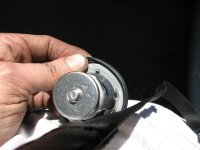
Got a new water pump for my 3.4 and it came with the paper gasket, the thermostat gasket and another o-ring that I cannot for the life of me figure out what to do with it...
It is 1-1/2" OD,1-3/16 ID. Anyone know where this thing is supposed to go?
Did not see one when I disassembled it.
Thanks.