Timing belt job: I really buggered my camshaft getting seals out! JB -Weld time?

Capnemo

New member
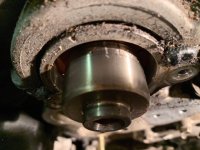
I have never taken engine seals out before, looked up Youtube and saw the drill/screw technique. But on the left camshaft the bit did not go straight, aborted early (I thought) and tried again. Now have four gouges on the left crankshaft surface. It looks worse in the photo but is bad enough.

I imagine the fix is JB Weld, 24 hr wait, sand with narrow strip of sandpaper
as well as can be done? Apply tiny bits of JB Weld with a toothpick? Smooth out a bit first or leave the glob to cure? Obviously I need to degrease first before applying the JB Weld.

What grade paper? 1000?

Advice appreciated...
 

Attachments

  • 8BFB8159-4B81-4BF4-B2E7-7BA873384D29.jpeg
    8BFB8159-4B81-4BF4-B2E7-7BA873384D29.jpeg
    104 KB · Views: 2,046
Register to hide this ad
Not an expert, but I'd be surprised if there was anyway to fix that surface so a seal would actually do it's job - you know seal oil. You could take the cam out, and have the gouges welded, then machined back down, but by then you should just put in a new cam. JB Weld won't work and you wouldn't have a way to polish it down to the correct dimension without removing the cam, back to new cam.

Maybe I'm wrong...
 
Well a new camshaft is like $69 which is fine, PIA to swap out I imagine, however I cannot find any available.

But, I find two brands of camshaft repair sleeve at RockAuto, one by Timken.
Also called Speedi-sleeve or Kwik-sleeve it comes with a tool to slide right over the end of the damaged camshaft, and is thin enough to use the same size new seal.

No brainer. Has anyone used these?
 
ok...so this is maybe crazy
I don't know the critical distance between the cam and the cam gear if the seal can be moved out a bit
but....back in the olden days you could shim a bearing or a seal. Plasti gauge to get the clearance and brass thin strips ...we even did it on connecting rod bearings on big hp motors
but that was long ago...in the dark ages when rocks were soft and we were building 350 hp small blocks, with carbs, good suspension and good brakes,...for the time...that hard race like marlborro virginia was fun...not a straight line....but a real road course
that will take a few of you back in time
but im an old fart when some of your mama's ...well even some of your grandmoms were still in dipaers
reference....350 hp ford 289 cubic inches from 1964.. with one of my buds.carol Shelby., group 44 bob tullis running hot foreign cars(triumphs) Charlie Kolb running jags and 450 Hondas were hot.....those were some good days
 
Last edited:
X2 on Speedi Sleeve

Or move the seal to a different surface

Ain't going to clean that surface up to seal properly again
 
I dunno, I have read several success stories in usng JB Weld to restore seal mating surfaces. Easier with the cam cover off of course but might as well install or resurface the camshaft.

But.

I have a camshaft sleeve kit coming tomorrow. And I have questions... I can understand the interface of the sleeve with the seal will be tight and leak free. But won’t oil seep out between the camshaft and the sleeve?

I think the skeeve was deisigned for circumferential grooves caused by rotational wear, and the sleeve would maybe rest on either side and bridge the groove. But for axial grooves I do not see it. Even if the inner edge and or outer edge of the sleeve is on undamaged shaft, metal to metal how can oil not seep out, although slower than without the sleeve?

I might be missing something.

Just wondering if I should attempt JB Weld and sanding before installing the sleeve.
 
Last edited:
I nicked mine, about that bad. I was trying to be really careful, and using proper seal pullers, moved the wrong way, and did the damage. I had done similar damage years ago on my previous Miata. I fixed both of them with JB Weld. As far as I know, neither leaked. I did my T4R 5-6k miles ago. I keep a piece of cardboard under the engine in my garage, and there is not yet a drop of oil on it.

It is risky trying to repair it. If you don't do it right, you may have to take it all apart again. The repair sleeve mentioned above might be your best option, being the best value, in terms of cost vs risk.

If you choose to repair it, the following is what I would do (and what I did successfully, twice):

Work slow, methodically, and be patient. It will take some time.

Before you do anything, first clean around the nicks with acetone. You don't want to be grinding oil and grease into the tiny sanding scratches.

There are small amounts of metal sticking up around the edges of the nicks. Those need to be sanded down next. Anything finer than 400 or 600 grit sandpaper won't remove anything, and won't do anything but make things shiny. I would start with 220-240 grit to remove stuff.

Wrap sandpaper around a popsicle stick or something, and work on sanding down any metal standing proud of the nicks. That metal standing proud is what will eat up the seal. Also partially wrap sandpaper around the camshaft and work it back and forth. When it appears to be smooth, then go to 400, then 600 grit sandpaper, doing the same thing, to polish it up some.

Then clean it again, with acetone on a rag. Several times.

Mix up the JB Weld, and apply it with a toothpick. Use a magnifying glass to be sure that you filled the nicks completely. You want it to be filled proud of the nicks but not so much that you have to spend hour sanding it back down. Let it cure a full 24 hours. You can speed that up with an infrared heat lamp, if you are careful to keep it back far enough to just get it warm.

Use the same techniques as before to sand down the JB weld flush with the outer face of the camshaft. I think finishing up with 600 grit will get it smooth enough. Going finer than that afterward won't hurt anything, but it probably won't gain you anything. Try to feel it with your fingertip and/or a popsicle stick, to make sure nothing it still still higher than the camshaft surface. If your finger or stick hangs up on anything, you need to keep sanding.

If you cleaned it well and let the JB Weld cure properly, it will stay put. If you sanded it down properly, it won't leak or wear (or eat up) the seal. Both parts done properly will make it as functionally good as new.

 
Last edited:
I know you don't want to hear this, but camshaft oil seals are optional to replace. Most timing belt jobs done by a shop don't even touch them. If you haven't done the other side, just leave it alone. Same goes for the crankshaft seal, also optional.
 
I wish I had read this first, only because I cannot remember if I deburred the damaged areas with a tiny file before or after an intial degreasing. All I had was MEKP. The process you mention makes sense and I have read several similar success stories, and I know from different applications JB Weld is pretty good stuff, the 24 hr variety.

240 sounds awfully course, for the first round, but we will see.

Still wondering if I should should use a sleeve kit too, but wondering why oil will not seep between the camshaft and sleeve.
 
Well, I was trying to be thorough, and gain experience. This recent acquisition has 215k miles on it, the sticker on the camcover was applied at 60k miles and Carfax showed no other timing belt maintenance. But, from the parts I pulled getting down to the seals, someone did replace everything (except the auxiliary belts) because the timing belt, tensioner, water pump and pulleys were fine. Almost left the seals .... The auxiliary belts were all cracked, so with the old sticker and Carfax report I decided to do the whole shebang.
 
I wish I had read this first, only because I cannot remember if I deburred the damaged areas with a tiny file before or after an intial degreasing. All I had was MEKP. The process you mention makes sense and I have read several similar success stories, and I know from different applications JB Weld is pretty good stuff, the 24 hr variety.

240 sounds awfully course, for the first round, but we will see.

Still wondering if I should should use a sleeve kit too, but wondering why oil will not seep between the camshaft and sleeve.

I think MEKP would be fine. And the cleaning before filing/sanding is just an extra step to ensure cleanliness. I get pretty anal about things like that, and try to do everything I can possibly do to increase the odds.

You could start with 400, but that will just take longer. And keep in mind the principle of sanding - the one and only purpose of going to a finer grit is to remove the scratches from the previous grit. I learned that from woodworking. It's most efficient to do all of the "work" with a course grit, then just keep polishing up, grit by grit, after that. I would feel comfortable starting with 240, as long as I spent some time removing those scratches with 400, then 600. The 240 scratches won't be very deep.
 
Last edited:
Thanks for all the advice. When I pick up the sleeve kit tomorrow I will get sandpaper etc for the JB job. The sleeve kit is returnable if I do not use it. Forunately the crankshaft and other camshaft were not damaged.
 
Thanks for all the advice. When I pick up the sleeve kit tomorrow I will get sandpaper etc for the JB job. The sleeve kit is returnable if I do not use it. Forunately the crankshaft and other camshaft were not damaged.

Sounds like a good plan. Myself, I would try the JB job, and as long as it looked and felt good to me when done, I would put it back together and trust it (but still keep and eye out for a leak for a while). As I mentioned, I have seen no evidence of a leak after doing exactly what I described, 5-6k miles ago. I would think if it was gonna leak, it would have done so by now.

Over a few decades, I have become a master at fixing my screwups - lol.
 
JB weld is NOT the proper way to repair this! Over time the seal can cut a groove into even a steel shaft, so think about what would happen with a softer filler like JB weld. Also no matter how steady you are with your hands you'll never get it perfectly smooth.

Definitely use the Speedi sleeve...that's what it's designed for. It's also a whole heck less work to hammer in a repair sleeve than to try to mess with JB weld. They usually come with a bit of glue to secure the sleeve to the shaft and seal against any leakage. You can also use RTV to do the same thing.
 
Last edited:
Nobb I think you are a little pessimistic, have you ever used JB Weld? Not the Kwik Fix, the original 24 hr cure variety. It is tuff as nails under compression. I have seen several accounts where people have gone 10’s of k miles with this repair. I doubt the seal will wear it that quickly, it will be riding on aa film of oil for the most part. I will however consider the sleeve repair, now that you mention a seal between the sleeve and original cam. I have not seen any sealant mentioned in the kit literature, but it could be there, I have not picked up the kit yet. I had thought of using a liquid gasket product on the camshaft before hammering on the sleeve but did bit want to cause deformation of the sleeve, the metal is incredibly thin. My only concern with the sleeve is oil seeping out between the sleeve and camshaft.

I did degrease a few more times and applied the first JB Weld, I figure if I do go ahead with the sleeve it could not hurt to fill the grooves first.
 
Last edited:
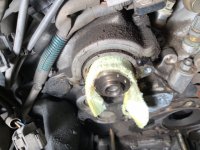
Pix of final degreasing after scuffing with 400 grit, deburred with tiny file last night. Speaking of which, after two “Vietnamese Martinis” (Bombay Sapphire East, Rossi Ex Dry Vermouth, twist of lemon) I was fired up to apply the JB Weld. Bombay Sapphire East BTW has Thai lemongrass and Vietnemese black peppercorns. Fabulous. Fortunately, I only had the kwick set variety so had to wait until today when I was sober.

Photo, degreasing

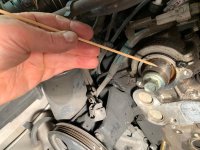
Photo, application with bamboo bbq skewer, note hand resting on power steering
reservoir for steadiness. I layered it thinly, do not mind sanding and filling any valleys on another application, better than sanding too much.

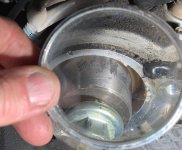
Photo after, with magnifying glass

Will post the after pix when sanded down. I have 3m double sided foam tape to bond the sandpaper to, will try to place into an appropriate sized PVC pipe to just slide over the camshaft for sanding.
 

Attachments

  • 8F9D61DA-E2E9-43AC-8938-019172F2FFB3.jpeg
    8F9D61DA-E2E9-43AC-8938-019172F2FFB3.jpeg
    125.3 KB · Views: 1,034
  • 6C9028BF-AF19-4BD1-B0C9-B2085BD23C41.jpg
    6C9028BF-AF19-4BD1-B0C9-B2085BD23C41.jpg
    130.8 KB · Views: 986
  • 1A2740AD-7A07-4441-AFF9-698ED2684880.jpg
    1A2740AD-7A07-4441-AFF9-698ED2684880.jpg
    128.3 KB · Views: 1,038
Last edited:
Nobb I think you are a little pessimistic, have you ever used JB Weld? Not the Kwik Fix, the original 24 hr cure variety. It is tuff as nails under compression. I have seen several accounts where people have gone 10’s of k miles with this repair.

...

JB weld is not the proper way to repair this, period. 10's of K or compressive forces doesn't mean anything. It proves nothing on the long term longevity under all the heat/cooling cycles. Seal manufacturers have certain surface smoothness specs...too smooth and too rough is no good.

If you JB welded it and still have the engine apart I would throw a Speedi sleeve ontop of it. It literally costs maybe $30 and is so much easier to install so I don't know why even consider JB weld in the first place.
 
I think I made it clear, never having used a sleeve kit, what keeps oil from seeping between the sleeve and camshaft? They do not seem to come with a sealant, I will confirm that when I pick up the kit. I believe these kits were designed for circumferential grooves which is the norm, and the sleeve will bridge the two unworn surfaces on either in these cases. Every product video and Youtube I have seen shows circumferential wear. Radial grooves will
just allow the oil to pour out in micro rivers underneath the sleeve. I see no harm in filling the gouges before installing the sleeve. In fact, a Youtuber reading instructions on a Teadi-Sleeve kit, “”4, if there are any heavily worn areas , fill with metal filler”...although it says to mount the sleeve before it cures.

As far as heating and cooling cycles, I used to work in epoxy, and often epoxy is baked to double or triple it’s strength. You are not going to see shock cooling like is possible in aircraft engines, and epoxy is immune to that anyway.

The kit did not come in today as promised, I see no downside to filling with JB Weld in the meantime.

Lets face it, the only “right” way to do the repair is to replace or resurface the camshaft. But I could not find any suppliers with new ones in stock and I do not have the time to rummage junk yards tearing down motors for camshafts with questionable tolerances of the cam lobes and bearing surfaces.
 
Last edited:

Members online

Forum statistics

Threads
278,315
Messages
3,554,130
Members
248,016
Latest member
Advally Service

Trending content

Back
Top