Towing Help- V8 4runner

4runninSD

New member
Hello,

First off, I love my 05' V8 4runner 4WD!!! I got this vehicle for the passenger capacity and towing ability (7000lbs). So I was looking forward to towing my small 14' toyhauler (3200 dry). When I hooked up to it and tested everything it towed perfect. But I noticed a slight sag in the rear (about 2" from bottoming out) with my equalizer hitch.

So my concerns are once I load this trailer up with water, food, gear and a ATV and dirtbike (estimated 5000lbs) the back is going to sag and bottom out. Is there anything I can do to help it from bottoming out or handle the weight a little more? I mean I don't know how this thing would tow 7k without dragging the hitch on the ground.

Also I was thinking of lifting the frog a little with some bilstein 5100 and wanted to see if I replied the rear shocks too of that would help?

Thanks in advance!
 
Register to hide this ad
I know lots more will chime in, the Firestone airbags are real popular. I dont have any links etc. but I know someone will provide one. ;-)
 
....the Firestone airbags are real popular. I dont have any links etc. but I know someone will provide one. ;-)

X2! I also believe air bag is what you need. I have Airlift 1000 (Air Lift Company AIR LIFT 1000; COIL SPRING - ) , but I am sure Firestone will work identical. I tow my hunting trailer with tongue weight right around 400LBs. I can lift the rear of the truck with trailer connected higher then its normally sits with no load and I do not have equalizer hitch, so I am 100% sure it will solve your problem.
But I can also tell you that I have towed the same trailer once before putting AirLift and it was not as bad as I though it would be with 400 Lbs weight. Yes, the rear was sagging but it was not bad, I guess that is were you can see the progressive springs at work… even very soft one as the rear springs on 4Runner.

If decide to install them shop around (Amazon, e-bay etc) I think you can find them for around $70.00.
 
Last edited:
Towing capacity and tongue weight are two very different things.. You have very heavy tongue weight it seems.
 
Towing capacity and tongue weight are two very different things.. You have very heavy tongue weight it seems.

I agree! We tow a 25' trailer (5300 lbs dry) regularly without the sag you speak of. Are you sure you have the hitch set up right? Have you ever used a weight distributing hitch before? Any RV dealer would be happy to show you how to hook it up right. There is no way that it should produce the sag you speak of with no load on it if the hitch has been set up properly.
 
I agree with the sentiments that your problem is tongue weight, not overall weight. A good general rule of thumb is that you want about 10% of the total trailered weight on the tongue. That's not always easy to achieve depending on what you're towing. With your toy hauler, perhaps you can load weight more over the trailer axle(s) and in the rear to balance it out. Just be sure that you don't take too much weight off of the tongue as that will cause the trailer to sway at higher speeds.

FWIW, I'm about to do my first towing expedition with my 4th gen 4Runner ('04 V8 SE) this weekend, but I've done lots and lots of towing with my 3rd gen V6. When towing heavy loads, I use a sway control. It's a cheap part (like $150 IIRC) and it really makes a big difference in comfort with the short wheelbase trucks, especially in crosswind and downhill situations.

- Scott
 
Towing capacity and tongue weight are two very different things.. You have very heavy tongue weight it seems.

x2... Your sagging issue would seem to be more a matter of too much tongue weight than worn out springs. My 8.5x20' Car Trailer weighs 3,200 lbs empty. When hitched to my V8 4Runner it does not make my 4Runner's rear sag to the extreme yours does. Buy or borrow a trailer tongue scale and measure your tongue weight. I have a Sherline Scale Sherline Trailer Tongue Weight Scales and use it periodically to check my tongue weight. You would be shocked & amazed at how much tongue weight can be impacted by simply relocating cargo to the rear of the trailer (like a spare trailer tire for instance).

In my case, simply moving the car being hauled back a few inches can lighten my tongue weight 100-150 lbs.

I also suggest as other have already that you invest in a sway control system. Some may say it is not needed. I am a FIRM Believer in them.
On my last towing trip (1000+ miles) I encountered 3 or 4 maneuvering situations (1 less than 50 miles from home) where sway control made all the difference. Simply put there are a LOT of azzholes on the roads these days that do stupid things and think that people towing trailers can stop on a dime and maneuver them like a sports car. One needs all the tools one can get to deal with them one of which is sway control.

BTW, a weight distributing hitch setup (tow vehicle & trailer) will also help level your trailer when adjusted properly once the trailer is balanced properly to begin with.
 
Thanks for the information everybody, its good to hear that other are using the 4runners for towing as well.

The setup I have is using the equilizer hitch (weight distribution and Sway control). It was installed adjusted by a reputable trailer place. The install is fine and the sag is only a few inches, my concern is if I load it up more its going to sag even more.

I think the airbags would be overkill, but if thats what most of you use for towing I would consider it. I was hoping there would just be a stiffer spring I could throw on there that would help a bit (like how people but stiffer spring on the front for bumpers). If that isnt sufficient then I would go with airbags or something like that.

I did a little research on my trailer and the tonge weight is 450 lbs (details below) and I figured the weight would be around 5K loaded

Toy Hauler RV Trailer Sport-RV Trailers Sport FR Pull Kitchen-Carson Trailer

Thanks again :thanks:
 
my concern is if I load it up more its going to sag even more.

It all depends on how you load the trailer. If you're sagging the 4Runner a lot, move weight more to the rear. The tongue weight doesn't necessarily have to increase at all as the trailer load increases, but it should in keeping with the 10% rule.

Edit: Actually, looking at the diagram of the trailer, it looks like you might have problems keeping enough weight on the tongue if you're loading all of your stuff in the rear storage compartment, which is completely aft of the trailer axle. I'd bet that if you start piling stuff back there, you'll actually see squat coming off of the 4Runner. Just make sure not to get it too light on the tongue. I did that once and believe me it is very un-fun to try to catch a trailer tank-slapper that's pulling the back of the 4Runner around at 65mph. Pull over, change pants, load trailer correctly, thank the lord that nobody was in the lane next to you, and from then on always tell everyone to keep enough positive tongue weight on the trailer when you get the chance. :-p
 
Last edited:
Weight distributing hitches are adjustable, so you should be easily able to remove the sag that you have. If it's not possible, then my guess is that 1) your WDH capacity is insufficient for the load you are putting on it, and/or 2) you have some kind of weird sub-standard WDH and you should get a quality one. I have had WDH's before with several vehicles, and I was always able to level the vehicle.

Re Airbags that some suggest, those are fine to level a load in the vehicle when not towing. But if you do some study, this is NOT the safest nor the recommended way to level out your tow vehicle from rear sag due to tongue weight of your trailer. The reason is this: if you have two identical tow vehicles and trailers, and one is leveled out via airbags, and the other is leveled out with a weight distributing hitch, they will look pretty much the same, except for the WDH equipment on one.

But in practice, the rig with the WDH is MUCH MUCH SAFER to drive than the rig using only airbags. Here is the reason: When you take the sag out of the rear of the vehicle by inflating airbags, the airbags are supporting the extra several hundred lbs of tongue weight, so that extra weight is still on the rear axle. But when you take the sag out with a WDH, the tongue weight is distributed across the frame between the rear and front axles, so your rig will handle MUCH safer than the non WDH rig. You may not notice the difference in "perfect" driving conditions, but in normal driving, which will include crosswinds, evasive maneuvers, braking, and so on, the difference will be dramatic. Plus, if you also have a Sway Control arm with the WDH, that provides additional stability, and it is well advised.

Airbags should be used to level a load on the vehicle when not towing. If you do some research on the web, you will find that for towing, the safer way to go by far is a WDH (even better with a sway control arm) as opposed to airbags. Night and day difference. And if you are towing, safety should be your priority one. A WDH is quite a cleverly designed and effective safety device.
 
Last edited:
Thanks for the information everybody, its good to hear that other are using the 4runners for towing as well.

The setup I have is using the equilizer hitch (weight distribution and Sway control). It was installed adjusted by a reputable trailer place. The install is fine and the sag is only a few inches, my concern is if I load it up more its going to sag even more.

I think the airbags would be overkill, but if thats what most of you use for towing I would consider it. I was hoping there would just be a stiffer spring I could throw on there that would help a bit (like how people but stiffer spring on the front for bumpers). If that isnt sufficient then I would go with airbags or something like that.

I did a little research on my trailer and the tonge weight is 450 lbs (details below) and I figured the weight would be around 5K loaded

Toy Hauler RV Trailer Sport-RV Trailers Sport FR Pull Kitchen-Carson Trailer

Thanks again :thanks:

First, don't rely on published weight figures for trailers. It is not uncommon for some manufacturers to list factory guestimates on these numbers, which can differ significantly from what you actually end up with. The only way to be sure is take the fully loaded rig to a set of calibrated scales. You can usually find scales at a local full service truck stop, or a wholesale sand/gravel supplier. They may charge a small fee for weighing your rig. You will have to take several weights to determine what you actually have. !st, tow vehicle alone, tow vehicle alone, with trailer connected, both vehicles total weight (connected), and trailer alone, connected to tow vehicle. Then do the math to get approximate trailer tongue weight on tow vehicle. As an earlier poster mentioned, you should try to get the tongue weight to equal about 10-12% of total trailer weight. This will help to keep trailer stable and reduce sway while towing.

As for the hitch setup, even though you had it installed by a dealer, it is not uncommon for the install to not be done properly. You mentioned you have an equalizer system. I use one for my camper, and I did all the setup myself. It isn't that difficult, but it you do have to read and fully understand the setup instructions to get it right. If you don't have the documentation, you can get all you need from their web site, and their help line is very good. I tow a camper that is almost 5,300 lbs loaded, and with the hitch properly setup, I have only about a 2" drop in the rear. It tows well, with no sway. The equalizer system has sway control built in, and if the trailer is balanced properly to the tow vehicle, you should have no problems. That being said, the best tow setup in the world will not compensate for mistakes make by the driver. You have to be sure you are comfortable towing a load that size and weight before taking off. If you don't have much experience towing heavy loads, I suggest you practice as much as possible before going on any long trips. An empty shopping mall lot is a good place to practice turns, and backing up (one of the bigest problem areas for novices). You vehicle can handle the load, if properly set up, but it still isn't like driving empty. Stopping distances are greatly increased, and you need to be very aware of everything around you to keep from being surprised and getting into a situation that can be trouble.
 
So its desert season here in SoCal, so I am prepping my toyhauler for a 4 day trip. I finally was able to get the trailer on flat ground and took some pics to get a second opinion from you guys.

Keep in mind the trailer is NOT fully loaded. I still need to fill it up with 30 gallons of water, a 400ex quad (500lbs) and a CRF450 (220lbs) and Misc food/gear 250 lbs.

I wanted to see what you guys think of the sag in the rear, towing it dry seemed OK, it bounces around a little more than stock but not unbearable. I wanted to see what you guys think of the possibility of FJ rear springs helping a bit?

I have a set of FJ rear springs that I can put on the back, I originally got them to lift the rear to match my 5100s up front but once I got the 5100s installed it was pretty level already.

Take a look at the pics and let me know what you think.

Thanks guys!

bf9eecaa.jpg~original


7baa64e1.jpg~original


how it sits normally
8bedb906.jpg~original
 
It doesn't look all that bad, I've seen much worse. I am also confused about not being able to level out with the WDH. The last heavy towing I did using a WDH was on a conversion van. I would go up in chain links until the van was level. If I recall, I would hook everything togehter, crank the wheel on the trailer up until the van back was a little high actually, then set the link I wanted on the WDH. Once I let everything down, the van set level. If it wasn't, I re-did it, moving up 1 link in the WDH system. Best regards, Doug
 
+1 to what Doug said -- I used to have a van and a 19' travel trailer, and I would perfectly level the rig with the WDH. You should be able to also.

I do see one problem, your trailer is already slightly tipped back from level, and yet your runner is sagging. You need a hitch that drops down so your hitch ball is lower, so that when the runner is level, the trailer is level. You can get those hitches in different # of inches of drop, or you can get an adjustable one. I would suggest you change out that bit of equipment, then work on leveling with the WDH under load.

Cheers!
 
I agree with webby. From the photos it does look as if the trailer is tipped back slightly.
4runninSD you might want to double check the drop/rise on the Weight Distributing Shank you are using.

If you are not sure how to check the drop/rise you can find some information on that at: Trailer Hitches, Hitch Accessories, Hitch Wiring

Depending on what you find out you might need to adjust the shank you are using, reverse it or get a different shank.

I also agree with Dougtoms01 that you should check that you WD hitch is set to the proper number of links.
 
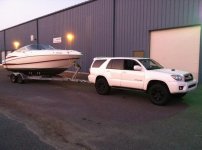
Just go with the Firestone Air Bags. Extremely easy install of about 45 mins to an hours and cost about $70. here is a pic of my 4runner with about 6300lbs of boat, trailer and fuel behind it. I get a 1" sag with only a few lbs of air in the bags. (dont mind the slick roof, i was working on my roof rack lol)
 

Attachments

  • 304795_10150795524350147_504070146_20834998_1608088479_n.jpg
    304795_10150795524350147_504070146_20834998_1608088479_n.jpg
    51.1 KB · Views: 783
Good eye Webby, you are correct. That trailer is tilted back. One way to set that ball height is to unhook the trailer and lower the jack wheel until it's level. Measure the height to the top of the ball on the tongue. Then get what ever ball bar you need to get the ball height on your 4runner to the same height. Then go back to adjusting you WDH. When I was setting my WDH up on the van with a 24ft trailer, I could lift the rear of the van up higher than the front if I wanted too. Get the ball height correct, then go up in links on the WDH until the rigs are level. Best regards, Doug
 
Just go with the Firestone Air Bags. Extremely easy install of about 45 mins to an hours and cost about $70. here is a pic of my 4runner with about 6300lbs of boat, trailer and fuel behind it. I get a 1" sag with only a few lbs of air in the bags. (dont mind the slick roof, i was working on my roof rack lol)

A TV (tow vehicle) and trailer leveled with air bags on the TV will appear almost the same as the same rig leveled with a WDH, but it's just not the same animal, as quite a few folks have found out the hard way. In the case of gusty winds, or a rapid or evasive maneuver, they will handle completely differently. Using a WDH to level your rig distributes most of that weight that was sagging the rear of your TV, to the front axles of the TV, and somewhat less to the axle(s) of the trailer. This results in far superior and safer handling under duress. Adding sway control further improves safety and handling.

When you accomplish the same leveling with air bags, though not noticeable now, that weight is still on the rear axle of the TV, and is therefore still making the front of the TV somewhat lighter in comparison to the rear of the TV, which negatively affects handling.

Therefore, if you just need to level a vehicle with a load on it, air bags are a great way to go. If you are trying to level a TV + trailer, use a WDH. You and your passengers will be much safer, and so will everyone else on the road you encounter.
 
Last edited:
The height of the hitch ball is too high. Your truck sits higher than stock by the looks of it. You can lower the ball if there is another bolt hole on the bottom of the inner half of the hitch or you may have to separate the 2 halves & turn them 180 degrees from each other to get the adjustment you need. It also looks like you need to tighten the adjustment chains. Chech with an RV shop to verify how best to set it up. I tow a 25 ft trailer & have no sagg.
 

Members online

Forum statistics

Threads
278,308
Messages
3,554,060
Members
248,016
Latest member
Advally Service

Trending content

Back
Top