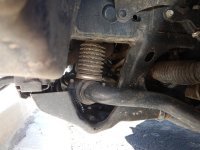
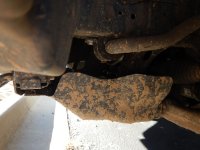
TRD's w/ KDSS - Lower Ground Clearance???

Poughkeepsie Gulch can be done in your 4Runner if you avoid the expert section. I did the expert section downhill in a Jeep Rubicon with a 2 inch lift no problem but the issue would be the departure and approach angles in a 4Runner. When you see the sign just don't turn. It is the roughest of all the roads around Silverton/Ouray/Telluride. Best view in my opinion is Engineer Pass but some like Imogene Pass the best. Ophir Pass is the easiest one.

I haven't done Black Bear Pass but it looks like the most difficult section is one of the switchbacks that in a longer based vehicle you would have to backup 2 or 3 times. Plenty of YouTube videos on that turn.
 
Thanks for the info. It's official I got a spot at the FJ Summit this morning. I scheduled Black Bear pass, Poughkeepsie Gulch, and Imogene Pass. Should make for a great time and a trip of a lifetime for my 6 year old son. Now to get my lift and tires on.

I've watched a ton of videos on both trails. Black Bear just seems narrow and the turn you said, along with the steps. Looks like I'll just need to bypass the wall on Poughkeepsie.


Sent from my iPhone using Tapatalk
 
I cannot wait to return to CO in the 4R, but we have different plans for this summer...

It will be a glorious one, with all the snow. It will be nice till later in the season.
 
I wish I had 8.5" of front skid clearance... mine is more like 6.5" at the lowest point. Less than a foot of snow stops me cold.

I've read through this and several other threads on ground clearance and lifts, and am still completely unclear about what a lift actually does. Will a 2" lift raise that skid plate 2" higher or not?
 
I wish I had 8.5" of front skid clearance... mine is more like 6.5" at the lowest point. Less than a foot of snow stops me cold.

I've read through this and several other threads on ground clearance and lifts, and am still completely unclear about what a lift actually does. Will a 2" lift raise that skid plate 2" higher or not?

I can understand under 8, but where do you measure 6.5? Can your springs have sagged that much? EDIT: Oh, you have a winch...

My 1.25" front springs gave me 1.25 at the fenders and 1.5 under the front skid plate which is what matters. But most lifts are for looks so they are measured at the fenders.

A so-called 2" lift may actually give you more than 2" of lift under the front skid plates. Personally, I was at 9.6" new, 8.75 when I put aftermarket 3/16 skid, and now I am at 10.25, which is all I want. This is plenty enough for standard difficult trails.

Now, in the back, a lift will NOT impact your rear differential clearance, which will remain 9.6. Which is fine. You could do bigger tires, but really the enormous cost and hassle of going 285 70 17 is not worth the 0.5" clearance gain. Again, that tire size is popular for looks, not function.

My 1.25/0 leveling is just a temporary measure until I decide what shocks to get. I intend to be 1.5/1 or 1.5/1.25 something like that.

In sum, an independent suspension is lifted through larger tires, or longer coils or spacers but a solid axle can only be lifted through larger tires. So, a small lift in the front is quite easy. Beyond that you need new upper control arms, stress all angles etc.

That's for stock weight. With a front winch, etc, you will want coils with the correct spring rate for that extra weight. But if you get coils that are too stiff, then that is an issue too. Look into the Dobinsons thread, that is a great selection of quality coils that come in all sorts of rates and heights.

 
Last edited:
Thanks for the detailed and informative reply. I went out and re-measured just to verify my memory - which is apparently failing, as the front skid clearance is actually 8.6" except at one low point on the driver side, where it is just over 8". So I'm on spec after all.

The winch is mounted on a hitch plate and I put in a front hitch receiver so I can put the winch on either end of the vehicle. (I well remember trying to winch out of mudholes with a front bumper winch many years ago...) It only goes on for trips to the backcountry. Anyway, these measurements are without the winch, just the front hitch, which I think is about 40 lbs. Maybe I had measured with the winch on earlier... I'll stick it in and see how much it changes.

It sounds like a 1" front spacer lift will get me most of what I want. I might try one of the Cornfed or Daystars, they are cheap and I can probably DIY. This is my all-purpose vehicle and I like the way it drives on pavement, so don't want to mess that up, or spend a ton of money just for the few moments when I need that extra clearance. A shovel is cheaper and doesn't change the ride... and it's probably just as well if I stay away from snowdrifts...
 
I rented a SR5 and compared the skid plate on it with my stock trail version with KDSS. I measured 8 1/4" to the lowest part of the drivers side of my trail version. The lowest point on the SR5 was toward the back. I measured 9-1/4"

The main problem I have with the KDSS stock skid plate is the approach angle. When I bottom out the front suspension, The skid plate is more exposed and sometimes scrapes the ground. I do prefer the KDSS version over non KDSS as the on road performance is better.

The photos below were taken from the same vantage point to show the difference between the two different skids:
 

Attachments

  • DSCN1132.JPG
    DSCN1132.JPG
    114.5 KB · Views: 526
  • DSCN1134.JPG
    DSCN1134.JPG
    134.1 KB · Views: 528
Last edited:
My RCI skid dropped my front skid clearance from 9.6 to 8.75.

I can offer another data point. I have just installed a full set of RCI skid plates on my 2016 Trail with KDSS. The lowest point are the bolts that connect the front skid plate to the transmission skid plate. At that point, I measured the ground clearance to be 17.2 cm.

One must be grateful in life. That 17.2 cm is a wonderful improvement over my other vehicle, a Volvo V70, which has a mere 10.1 cm ground clearance at its lowest point.

A note on the RCI skid plates: They added less weight to my vehicle than thought. Engine, transmission, transfer case, fuel tank, rear differential, lower control arms, lower links weighed about 50 kg on my bathroom scales, which is less than the theoretical weight gain given on the RCI site. The removed factory skids and hardware weighed over 10kg. Thus the net weight added to my underside of my vehicle is under 40 kg.

Together with my LFD roof rack (20-22 kg) and console safe (4kg), my vehicle is 65 kg heavier than stock. The after-market kill switch, and electronic front parking-aid that I added, doesn't count for weight. The only planned other mod is to direct the exhaust to the side, so that it does not continuously blow hot gases towards my hitch basket. When my stock tires wear out, I'll replace them with the Toyo M55, which have the best puncture resistance.
 
Last edited:
I can offer another data point. I have just installed a full set of RCI skid plates on my 2016 Trail with KDSS. The lowest point are the bolts that connect the front skid plate to the transmission skid plate. At that point, I measured the ground clearance to be 17.2 cm.

One must be grateful in life. That 17.2 cm is a wonderful improvement over my other vehicle, a Volvo V70, which has a mere 10.1 cm ground clearance at its lowest point.

A note on the RCI skid plates: They added less weight to my vehicle than thought. Engine, transmission, transfer case, fuel tank, rear differential, lower control arms, lower links weighed about 50 kg on my bathroom scales, which is less than the theoretical weight gain given on the RCI site. The removed factory skids and hardware weighed over 10kg. Thus the net weight added to my underside of my vehicle is under 40 kg.

Together with my LFD roof rack (20-22 kg) and console safe (4kg), my vehicle is 65 kg heavier than stock. The after-market kill switch, and electronic front parking-aid that I added, doesn't count for weight. The only planned other mod is to direct the exhaust to the side, so that it does not continuously blow hot gases towards my hitch basket. When my stock tires wear out, I'll replace them with the Toyo M55, which have the best puncture resistance.

Man, M55! I have been extremely happy with my ATZ P3. They are about as strong as it gets. But maybe the M55 is perfect for your offroading, I don't know. I do like Toyo and I have looked at M55.
 
Man, M55! I have been extremely happy with my ATZ P3. They are about as strong as it gets. But maybe the M55 is perfect for your offroading, I don't know. I do like Toyo and I have looked at M55.

It's just that I like to minimise my risk of getting a flat on the thousands of kilometres of poorly maintained dirt roads my truck sees every year, in the sparsely populated provinces of the Canadian Maritimes. I looked into various tire options, and the M55 is the most puncture resistant tire I have found in my research. The M55 is heavy but not crazily so, my memory tells me the added tire weight, over stock, comes to about 30 kg (including the spare).

Edit: I have looked up the weight of the stock tires (Bridgestone Dueler HT 684 II) and the M55. The stock tire weighs 17.7kg and the M55 weighs 24.1kg.
 
Last edited:

Members online

Forum statistics

Threads
278,312
Messages
3,554,089
Members
248,016
Latest member
Advally Service

Trending content

Back
Top