

dsfra
Member
I have 38,000 miles on set of BFG T/A KO's, and am seeing bad wear on the fronts:
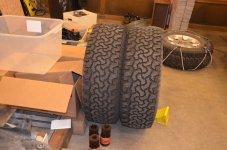
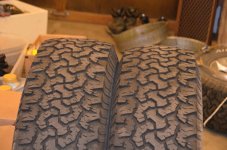
Probably 40% of the miles were while towing, causing to the front end to be somewhat unloaded. When hitched up with ~ 280 lbs of tongue weight, the 4Runner is dead level - the rear settles down on the Timbren bump stop /helper springs; when static the diff is just starting to touch the Timbrens. On pavement I run at 44 psi, and ~ 26 psi in the rocks. The rears have noticeably less tread depth remaining than the fronts, but are worn evenly.
I'm scheduled for an alignment tomorrow morning, and have chatted with one of the dealer service guys (he seemed quite knowledgeable - he actually knew what camber, caster and toe were), and we talked about tweaking the alignment to help compensate for the unloaded fronts. Sitting on the ground (with no trailer), the fronts have some amount of negative camber; up on jack stands unloaded there is a noticeable amount of positive camber. I had to do this qualitatively with a 1x6 held horizontally against the sidewalls and then a bubble level held vertically against the 1x6 - no way to easily get the degrees since I don't have a degee-calibrated level available. The bubble indication was definitive - there was an obvious and repeatable displacement of the bubble as described - no way was it uncertain or inconsistent. I'm referring to positive and negative camber in the usual sense - negative is closer at the top and further apart at the bottom, and positive is closer at the bottom and further apart at the top. Seems like people sometimes reverse the terms, maybe cuz they think it looks kool with the wheels splayed out at the bottom, and that must be "positive".
Anyhow, I'm thinking of having the camber set at the negative edge of the acceptable range (-.12 degrees +/- .75 degrees, i.e. -.63 degrees thru .87 degrees), so when I get some unloading droop on the front suspension I'll end up close to the middle of the range. Anybody played around with such things, and/or have any insights into such matters?
When the 4Runner was new it would wander all over the place on the freeway, and per lots of discussion on this forum I had the castor set to 4 degrees which really really really helped it track straight, so I know that the dealer is willing to take alignment requests - at least they were 5 years ago.
Anyone have any ideas about tweaking toe and/or castor settings w.r.t. unloaded front suspension while towing, in addition to camber? Any input would be appreciated.
And what about needing to do a zero point calibration after an alignment? What's that all about?
Oh yeah - another thing... The dealer wrote it up as a 4-wheel alignment, but I can't find any eccentrics, cams, slotted holes, etc, etc, on the rear suspension. Is there anything that's really align-able on the rear end? Are they saying that they will reference the front end alignment to the center-line of the vehicle, based on the rear end? But not really change any alignment at the rear...
Thanks!
Probably 40% of the miles were while towing, causing to the front end to be somewhat unloaded. When hitched up with ~ 280 lbs of tongue weight, the 4Runner is dead level - the rear settles down on the Timbren bump stop /helper springs; when static the diff is just starting to touch the Timbrens. On pavement I run at 44 psi, and ~ 26 psi in the rocks. The rears have noticeably less tread depth remaining than the fronts, but are worn evenly.
I'm scheduled for an alignment tomorrow morning, and have chatted with one of the dealer service guys (he seemed quite knowledgeable - he actually knew what camber, caster and toe were), and we talked about tweaking the alignment to help compensate for the unloaded fronts. Sitting on the ground (with no trailer), the fronts have some amount of negative camber; up on jack stands unloaded there is a noticeable amount of positive camber. I had to do this qualitatively with a 1x6 held horizontally against the sidewalls and then a bubble level held vertically against the 1x6 - no way to easily get the degrees since I don't have a degee-calibrated level available. The bubble indication was definitive - there was an obvious and repeatable displacement of the bubble as described - no way was it uncertain or inconsistent. I'm referring to positive and negative camber in the usual sense - negative is closer at the top and further apart at the bottom, and positive is closer at the bottom and further apart at the top. Seems like people sometimes reverse the terms, maybe cuz they think it looks kool with the wheels splayed out at the bottom, and that must be "positive".
Anyhow, I'm thinking of having the camber set at the negative edge of the acceptable range (-.12 degrees +/- .75 degrees, i.e. -.63 degrees thru .87 degrees), so when I get some unloading droop on the front suspension I'll end up close to the middle of the range. Anybody played around with such things, and/or have any insights into such matters?
When the 4Runner was new it would wander all over the place on the freeway, and per lots of discussion on this forum I had the castor set to 4 degrees which really really really helped it track straight, so I know that the dealer is willing to take alignment requests - at least they were 5 years ago.
Anyone have any ideas about tweaking toe and/or castor settings w.r.t. unloaded front suspension while towing, in addition to camber? Any input would be appreciated.
And what about needing to do a zero point calibration after an alignment? What's that all about?
Oh yeah - another thing... The dealer wrote it up as a 4-wheel alignment, but I can't find any eccentrics, cams, slotted holes, etc, etc, on the rear suspension. Is there anything that's really align-able on the rear end? Are they saying that they will reference the front end alignment to the center-line of the vehicle, based on the rear end? But not really change any alignment at the rear...
Thanks!
Attachments


Last edited:


