JB.
New member
I was going to put a single thread in the general discussion forum, but the original thread was too 4th gen specific to make that a good fit. The main info applies universally, though, so this version is for the 5th gen forum (other is here).
______________________________________________________________________________________________________________
For anyone who is unfamiliar with the 4wd handling phenomenon or could use a refresher, here's an attempt at something clear and complete. Otherwise, skip this part.
With a locked center connection -- part-time 4WD (SR5-TE) or full-time 4WD with center differential locked (LE) --, the front and rear drive shafts rotate at the same speed, just as if there were one shaft from front to back. During a turn, all four wheels turn in a different size arc and, thus, different speeds. This can't be compensated for by the front and rear diffs because when each side of the diff has traction, any increase in speed on one side is matched by an equal reduction on the other side. Since it's the average speed of the two front wheels and the average speed of the two rear wheels that matters, the effective result is a comparison of one arc for the fronts and one arc for the rears. So, during a turn the rear wheels follow a smaller arc (1 averaged arc) than the fronts and want to turn more slowly. Since the locked drive shaft in between can only rotate at one speed, opposite forces are created between front and rear, with the braking force (skid) being in the front and the drive force (slip) in the back. With same size tires equally inflated, this conflict is near zero when the vehicle is going straight, but starts to come into play as the steering wheel is turned, starting out mild but quickly becoming more severe as the turn is made tighter, resulting in an increasingly heavy feel in the steering wheel and a sensation of brakes being applied. Near the extremes, tires can audibly and visibly skip and skid. On slippery surfaces, this can occur more easily but on pavement more stress is imparted to the drive train, especially at very low speed where releasing energy through the tires is more difficult and there is no momentum to unweight the inside tires during a turn. It also results in handling changes that usually make the car want to turn a little wider (understeer) than it normally would, due to the tendency of a front wheel to skid. (The words bind and windup, in combination with various parts of the drive line - differential, transfer case, axle, transmission - are terms often used to describe this phenomenon. In other domains, a separate phrase - Tight Corner Braking - is also widely used).
______________________________________________________________________________________________________________
The attitude about using locked 4wd on pavement seems to vary a bit among vehicle generations. In the 4th gen forum, it has traditionally been considered a simple rule - don't do it. 5th gen owners, as a group, seem a little more flexible. Can't say I'm surprised, as I <a href="http://www.toyota-4runner.org/482748-post49.html" target="_blank">anticipated</a> such a few years back. Still, I think there's info here that may add context in a way that makes some people more comfortable occasionally using their trucks this way.
Too much reading, what's the gist? That typical road turning, including surface street turns on right angle streets, should not be considered a barrier to satisfying the recommended 10 miles per month driving in 4wd. Such turns require turning the steering wheel in the vicinity of about 1/2 revolution. The steering effects in that range, as shown below, are likely milder than many have assumed. Hopefully, having an idea of when and how much the steering stresses comes into play can help SR5 and TE owners in deciding the appropriate use of 4wd.
Disclaimer: Anyone who is unsure or uncomfortable with any of this should just follow the general rule and not use 4wd on pavement. That's the safest route. If this thread makes you unsure and you would like something to make it easy to dismiss, read <a href="http://www.4x4abc.com/4WD101/axle-wind-up.html" target="_blank">this</a>.
--
There's more blab, uh, detail in the other thread but here's the core info: When turning the vehicle, the degree to which the front driveshaft wants to rotate faster than the rear is as follows.*
SWR=Steering Wheel Revolution
*The following needs to be mentioned even though it doesn't matter (that's a cue to skip). A full SWR in one direction is slightly more than 1.5 in the 4th gen. It's 1.35 in the 5th gen. Assuming the steering variability is similar between the two, that seems to imply the percentages should be around 10% higher for the 5th gen. 10% is probably not too far above the margin of error for the 4th gen numbers anyway (due to rounding, left and right turns not exactly equal, etc), so the numbers below should be usefully close.
1/4 SWR ≈ ..0.3%
1/2 SWR ≈ ..1%
3/4 SWR ≈ ..3%
1.0 SWR ≈ ...6%
maxSWR ≈ ..15%
"They're just numbers, what's the context?" The experimenting in the 4th gen suggested the center differential is capable of locking/unlocking during a turn up to perhaps about a 1% difference. Not a recommended practice, but it illustrates how mild 1% and below really is. Most street turns can be completed with 1/2 SWR or less. Sometimes 3/4 is required but when that's the case the wheel spends only a moment in that position with the average position through the turn being much less.
Comparing the above numbers to the much higher rear diff percentages provides more context.
1/4 SWR ≈ ..4%
1/2 SWR ≈ ..9%
3/4 SWR ≈ ..15%
1.0 SWR ≈ ...22%
maxSWR ≈ ..40%
--
What are some other considerations in using 4wd on pavement? Tire/drive train wear and fuel consumption are accelerated, so most will probably want to avoid overuse. Road handling changes, but most importantly on slick surfaces where the tires will be induced to lose a little traction in turns, reducing steering precision and usually inducing understeer, but per the above, it should be fairly minimal until somewhere up around 1/2 SWR. Familiarization with the handling ahead of time is a good idea. When understeer occurs during acceleration it can be disconcerting to the unprepared as the vehicle traces a wider path than expected. It's probably also a good idea to caution people not to let the numbers make them overconfident in keeping 4wd on for a long time on dry stretches of fast, relatively straight roads. The stresses are small, but they are constant under high power output, and transfer and diff fluid temperatures can rise higher than normal if used this way too long (much longer than the 10 mile monthly lubrication guideline). It's probably moot, though, as it's doubtful anyone would choose to do this, but I suppose forgetting could pose a (small) risk.
Other things can affect level of driveline stress -- tire pressure, tread type, pavement condition etc -- but it seems hard to go too wrong around 1/2 SWR with the wheels rolling at at decent speed. Steering effort remains a useful guide and hopefully even more so in conjunction with the above.
--
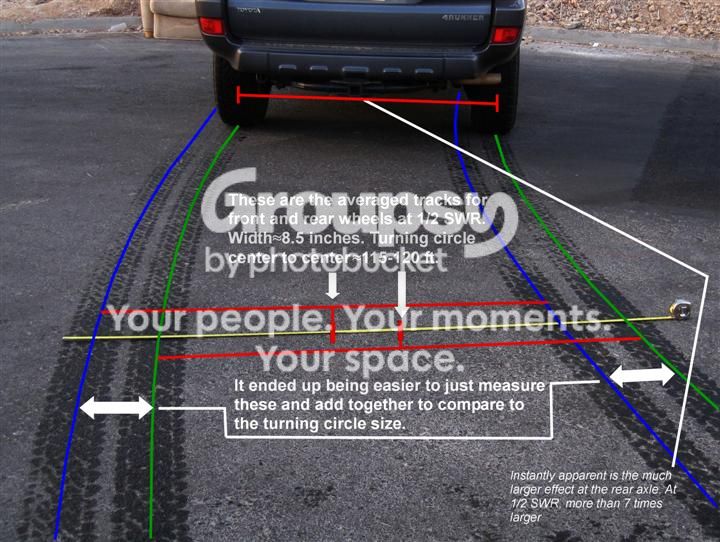
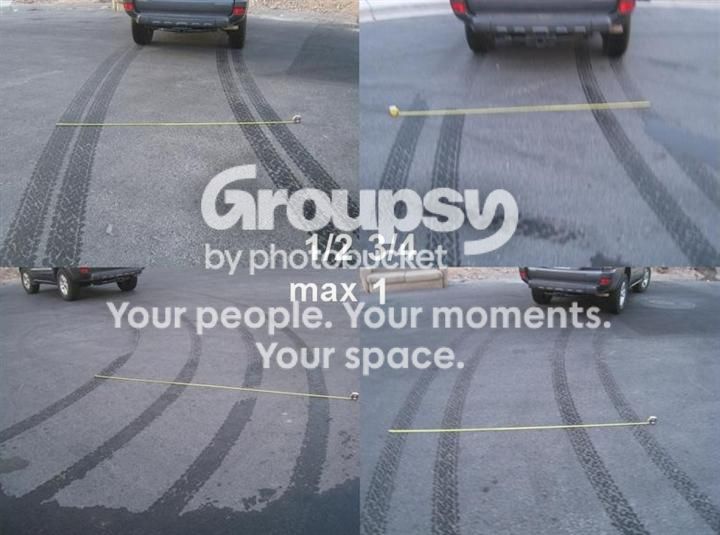
Here's how the measurements were taken. Turning circles were determined by a combination of parking lot step-offs and gps track circles.
______________________________________________________________________________________________________________
For anyone who is unfamiliar with the 4wd handling phenomenon or could use a refresher, here's an attempt at something clear and complete. Otherwise, skip this part.
With a locked center connection -- part-time 4WD (SR5-TE) or full-time 4WD with center differential locked (LE) --, the front and rear drive shafts rotate at the same speed, just as if there were one shaft from front to back. During a turn, all four wheels turn in a different size arc and, thus, different speeds. This can't be compensated for by the front and rear diffs because when each side of the diff has traction, any increase in speed on one side is matched by an equal reduction on the other side. Since it's the average speed of the two front wheels and the average speed of the two rear wheels that matters, the effective result is a comparison of one arc for the fronts and one arc for the rears. So, during a turn the rear wheels follow a smaller arc (1 averaged arc) than the fronts and want to turn more slowly. Since the locked drive shaft in between can only rotate at one speed, opposite forces are created between front and rear, with the braking force (skid) being in the front and the drive force (slip) in the back. With same size tires equally inflated, this conflict is near zero when the vehicle is going straight, but starts to come into play as the steering wheel is turned, starting out mild but quickly becoming more severe as the turn is made tighter, resulting in an increasingly heavy feel in the steering wheel and a sensation of brakes being applied. Near the extremes, tires can audibly and visibly skip and skid. On slippery surfaces, this can occur more easily but on pavement more stress is imparted to the drive train, especially at very low speed where releasing energy through the tires is more difficult and there is no momentum to unweight the inside tires during a turn. It also results in handling changes that usually make the car want to turn a little wider (understeer) than it normally would, due to the tendency of a front wheel to skid. (The words bind and windup, in combination with various parts of the drive line - differential, transfer case, axle, transmission - are terms often used to describe this phenomenon. In other domains, a separate phrase - Tight Corner Braking - is also widely used).
______________________________________________________________________________________________________________
The attitude about using locked 4wd on pavement seems to vary a bit among vehicle generations. In the 4th gen forum, it has traditionally been considered a simple rule - don't do it. 5th gen owners, as a group, seem a little more flexible. Can't say I'm surprised, as I <a href="http://www.toyota-4runner.org/482748-post49.html" target="_blank">anticipated</a> such a few years back. Still, I think there's info here that may add context in a way that makes some people more comfortable occasionally using their trucks this way.
Too much reading, what's the gist? That typical road turning, including surface street turns on right angle streets, should not be considered a barrier to satisfying the recommended 10 miles per month driving in 4wd. Such turns require turning the steering wheel in the vicinity of about 1/2 revolution. The steering effects in that range, as shown below, are likely milder than many have assumed. Hopefully, having an idea of when and how much the steering stresses comes into play can help SR5 and TE owners in deciding the appropriate use of 4wd.
Disclaimer: Anyone who is unsure or uncomfortable with any of this should just follow the general rule and not use 4wd on pavement. That's the safest route. If this thread makes you unsure and you would like something to make it easy to dismiss, read <a href="http://www.4x4abc.com/4WD101/axle-wind-up.html" target="_blank">this</a>.
--
There's more blab, uh, detail in the other thread but here's the core info: When turning the vehicle, the degree to which the front driveshaft wants to rotate faster than the rear is as follows.*
SWR=Steering Wheel Revolution
*The following needs to be mentioned even though it doesn't matter (that's a cue to skip). A full SWR in one direction is slightly more than 1.5 in the 4th gen. It's 1.35 in the 5th gen. Assuming the steering variability is similar between the two, that seems to imply the percentages should be around 10% higher for the 5th gen. 10% is probably not too far above the margin of error for the 4th gen numbers anyway (due to rounding, left and right turns not exactly equal, etc), so the numbers below should be usefully close.
1/4 SWR ≈ ..0.3%
1/2 SWR ≈ ..1%
3/4 SWR ≈ ..3%
1.0 SWR ≈ ...6%
maxSWR ≈ ..15%
"They're just numbers, what's the context?" The experimenting in the 4th gen suggested the center differential is capable of locking/unlocking during a turn up to perhaps about a 1% difference. Not a recommended practice, but it illustrates how mild 1% and below really is. Most street turns can be completed with 1/2 SWR or less. Sometimes 3/4 is required but when that's the case the wheel spends only a moment in that position with the average position through the turn being much less.
Comparing the above numbers to the much higher rear diff percentages provides more context.
1/4 SWR ≈ ..4%
1/2 SWR ≈ ..9%
3/4 SWR ≈ ..15%
1.0 SWR ≈ ...22%
maxSWR ≈ ..40%
--
What are some other considerations in using 4wd on pavement? Tire/drive train wear and fuel consumption are accelerated, so most will probably want to avoid overuse. Road handling changes, but most importantly on slick surfaces where the tires will be induced to lose a little traction in turns, reducing steering precision and usually inducing understeer, but per the above, it should be fairly minimal until somewhere up around 1/2 SWR. Familiarization with the handling ahead of time is a good idea. When understeer occurs during acceleration it can be disconcerting to the unprepared as the vehicle traces a wider path than expected. It's probably also a good idea to caution people not to let the numbers make them overconfident in keeping 4wd on for a long time on dry stretches of fast, relatively straight roads. The stresses are small, but they are constant under high power output, and transfer and diff fluid temperatures can rise higher than normal if used this way too long (much longer than the 10 mile monthly lubrication guideline). It's probably moot, though, as it's doubtful anyone would choose to do this, but I suppose forgetting could pose a (small) risk.
Other things can affect level of driveline stress -- tire pressure, tread type, pavement condition etc -- but it seems hard to go too wrong around 1/2 SWR with the wheels rolling at at decent speed. Steering effort remains a useful guide and hopefully even more so in conjunction with the above.
--
Here's how the measurements were taken. Turning circles were determined by a combination of parking lot step-offs and gps track circles.
Last edited: