V8 Coolant Leak — Head Gasket??

cice

Member
Hi everyone,
I have a 2007 4.7L V8 with 230k miles on it. The engine runs as well as it ever has, no stuttering, idles smooth, and gets up and goes well. No white or blue snow from the exhaust. Oil looks nice and clean, no milkshake. However I seem to be going through at least the entire coolant reservoir and then some in about a month. What’s the best way to figure out where the coolant leak is? I don’t see any puddles or anything like that in the garage. It doesn’t sound like the head gasket… but then I’m a little biased in hoping it is not the head gasket!! Thanks for the help!!
 
Register to hide this ad
No visible leaks could be a sign of head gasket, sorry to say... However if there is a significant amount of loss you should be seeing white smoke out the exhaust from my experience. Could buy a block tester to determine.
 
On the 4th Gens a coolant leak will almost always leave pink crystallization at the leak area even with minor leaks, so that's what you're looking for, common leak areas are the bottom and or top corners of the radiator where the plastic side tanks are attached, this can sometimes be hard to see because of the fan shroud, also around the thermostat housing, and of course any hose that maybe old and starting to deteriorate.

On the V8 if the water pump is leaking it will be hard to detect/see because of it being behind the timing belt cover.

Also on the V8 there are cross over pipes under the intake that can't be seen without removing the intake.

I would place my bet on one of the more common areas, the radiator would be my first place to check out.
 
Last edited:
On the 4th Gens a coolant leak will almost always leave pink crystallization at the leak area even with minor leaks, so that's what you're looking for, common leak areas are the bottom and or top corners of the radiator where the plastic side tanks are attached, this can sometimes be hard to see because of the fan shroud, also around the thermostat housing, and of course any hose that maybe old and starting to deteriorate.

On the V8 if the water pump is leaking it will be hard to detect/see because of it being behind the timing belt cover.

Also on the V8 there are cross over pipes under the intake that can't be seen without removing the intake.

I would place my bet on one of the more common areas, the radiator would be my first place to check out.
Agreed. Also check the valley between the heads, under the intake.

Head gasket leaks are not common on the V8 at all, so it's very unlikely to be that.
 
No visible leaks could be a sign of head gasket, sorry to say... However if there is a significant amount of loss you should be seeing white smoke out the exhaust from my experience. Could buy a block tester to determine.

I would agree if it was a V6. The V8 doesn't have issues with head gasket leaks. See previous replies for suggestions.
 
Thanks guys! Today I used one of those exhaust gas detection kits and the fluid stayed blue the whole time while the engine was running and hot. Blue became my favorite color during that test because that meant not exhaust fumes in the coolant and (most likely) no head gasket leak. :reddance:

I then got the Autozone radiator pressure tester kit and pumped it up to 20psi (which was too high in retrospect). The system took about 30 minutes to drop down below 15psi. Does that sound like a leak or is it normal for a coolant system to slowly loose pressure with one of the pressure testers?

Everything was bone dry, no leaks that I could see on the exterior of the engine.

I recently replaced the radiator cap with a cheap one from Autozone... maybe that's a place to start? If it was the water pump or something buried under the intake manifold, how would I ever figure that out without tearing into the engine? :mmph:

Thanks again for the help!
 
Thanks guys! Today I used one of those exhaust gas detection kits and the fluid stayed blue the whole time while the engine was running and hot. Blue became my favorite color during that test because that meant not exhaust fumes in the coolant and (most likely) no head gasket leak. :reddance:

I then got the Autozone radiator pressure tester kit and pumped it up to 20psi (which was too high in retrospect). The system took about 30 minutes to drop down below 15psi. Does that sound like a leak or is it normal for a coolant system to slowly loose pressure with one of the pressure testers?

Everything was bone dry, no leaks that I could see on the exterior of the engine.

I recently replaced the radiator cap with a cheap one from Autozone... maybe that's a place to start? If it was the water pump or something buried under the intake manifold, how would I ever figure that out without tearing into the engine? :mmph:

Thanks again for the help!

Definitely sounds like a small leak of some sort.

You can see under the intake without taking anything apart. Just shine a flashlight under the throttle body.

When was the timing belt done last? The water pump should be replaced at the same time so if the timing belt is due, then so is the water pump and it's likely leaking from there. You might be able to see some pink using a flashlight again but also maybe not.

Get an OEM radiator cap. If the Autozone one is leaking or not sealing, you should see signs of leaking there.
 
Thanks everyone, Toyota radiator cap and reservoir cap ordered! Hopefully those solve the leak...

I installed a new Denso radiator and Toyota hoses when I did the timing belt about 40k miles ago. I also replaced the water pump when I did the timing belt, so I'd be really surprised if any of those are the issue.

In addition to the new radiator cap, my plan is to use the radiator pressure test tool to pressure up the system to ~15 PSI when the engine is cool and keep it pressurized for a few hours to see if that will cause whatever is leaking to leak out enough coolant for me to see the puddle! That's this weekend's fun project! :usa:
 
Mine was leaking from the bypass/crossover pipe under the intake manifold. There was a small Oring that failed. It was really hard to see the leak initially. Sometimes I would smell coolant but not see any pooling under the vehicle. I knew it was leaking because I was filling the reservoir. Finally I saw the pink crystals building up underneath the intake. I actually had two orings go had one on the thermostat housing and the other was on the bypass/cross over pipe. I changed the thermostat housing one pretty easily. Then changed the one under the intake when I replaced the starter.
 

Attachments

  • 65246146800__F455850B-F4B2-4773-9905-D76513DB362D.jpg
    65246146800__F455850B-F4B2-4773-9905-D76513DB362D.jpg
    117.2 KB · Views: 3
UV light will make the antifreeze glow bright pink, may help to narrow down location of leak.
The antifreeze can look white too, under normal light, when it dries.
 
:thanks:
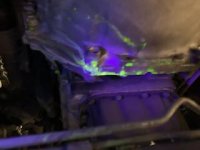
I put dye in the coolant, drove it around, and didn't see anything light up with the UV flashlight. However, it is really hard to see under the intake. The Toyota radiator cap and reservoir cap arrived today so I installed both of them. Hopefully that solves the issue.

What still seems strange to me is that the instructions for the radiator pressure test kit loan-a-tool from Autozone said that if the system holds pressure for several minutes it is fine. I pumped it up to 15 psi today and it took two hours to drop to 12 psi...

Oh well, in a few days of driving I'll know if the new Toyota caps did anything.
 
FOUND IT!! :party:

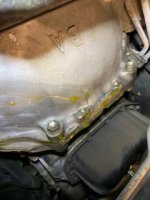
The dye really lights up the coolant! This is the back of the engine, you can see the coolant on the bell housing where the transmission meets the engine. The oil pan is also visible in the pictures.

Does this mean the crossover under the intake manifold is leaking? Or could something else be leaking? The heater hoses don't appear to have any leaks.
 

Attachments

  • IMG_6971.jpeg
    IMG_6971.jpeg
    40.4 KB · Views: 4
  • IMG_6967.jpeg
    IMG_6967.jpeg
    17 KB · Views: 3
Last edited:
That'll be either the coolant crossover behind the intake/kinda under it or one of the heater hoses back there against the firewall. The intake will have to come off to verify the crossover.
 
If it's the crossover, hopefully it just needs new gaskets. It is possible that the crossover is damaged, like pitted from corrosion but unlikely. The part number for the crossover gaskets is 16341-50020 and you will need 2 of them. If it's the crossover between the heads that is.

There's also another pipe for the rear heater hose that runs under the intake. It's also possible that pipe is damaged and is the cause of you leak. You can see the crossover at the rear of the engine here and the heater pipe to the left of the starter in this pic.

20200313_135241-X4.jpg
 
Well I took the intake manifold off and it was the rear coolant crossover that was leaking! I replaced the starter, the gaskets for the rear crossover and the front crossover. :D I also replaced the coolant pipe o ring for the heater. What a big, difficult repair!! Definitely the most difficult I’ve done due to the tight tight spaces! Also if anyone else decides to do this, if you replace the front crossover gaskets (which why not you are already in there) you have to take the thermostat housing off also, which means you’ll need new o ring for it and RTV for the rectangular connection.

Hopefully no more coolant leak!!

Thanks for everyone’s help!
 

Members online

Forum statistics

Threads
278,312
Messages
3,554,089
Members
248,016
Latest member
Advally Service

Trending content

Back
Top