Weird Science

GangsterOfLove

New member
Tail light went out. No big deal - how hard could this be?

Went to Pep Boys, checked their stock, decided to go modern and get a pair of 7443 LED replacement lamps. Put them I and I really liked how crisp the tail lights looked. Thy should - the pair of them cost $20:


Set up a mirror to check the brake lights and that's when things went sideways.


With the tail lights on, stepping on the brakes makes them go off. With the tail lights off, the brake lights don't work at all. Being the veteran of many equipment trailer re-wires and several 1960's - 1970's German cars I know exactly what this is - a bad ground.

Except it isn't. I put plain old incandescent lamps back in the tail lights and they work just fine. What we have here is electronic over-complication on a fairly high level. One or more computers have identified the LED lamps as unwanted interlopers and refuse to feed them.

I can see several fixes here. The easiest is to leave the incandescents in there, but that feels like defeat. I could run a piece of plain old wire from the battery, through an inline fuse to a mechanical brake light switch on the pedal back to the brake lights - easy enough and as reliable as a claw hammer. My third option is to figure out what sort of electronic wizardry is involved in making the brake lights operate on my truck and figure out a workaround.

Maybe you guys will help me with that?
 
Register to hide this ad
Why don't you put a resistor inline? Half the time I hear about people converting to LEDs they need to add a resistor since the LED doesn't draw as much current(?) as a normal bulb so the system doesn't identify it.
 
Try putting the LEDs in one at a time. Make sure they work, if they aren't then pull the bulb out and flip it around and see if that fixes it. These 3rd gens don't have a canbus system or anything so they don't sense when a brake light bulb is out.
 
Yup, not rocket science here. The bulbs often do have a polarity issue, especially the substandard ones. Then again, they could just be faulty. The good news is there probably isn't anything wrong with your vehicle. This isn't some german sideways engineered rig, it's a Toyota! The only time the resistor comes in to play is with the flasher.

By the way you are spot on with the ground issue, but it is most likely within the bulb itself, not the socket.
 
No need for resistors unless you're replacing the turn signal bulbs with LEDs (prevents hyper flashing)

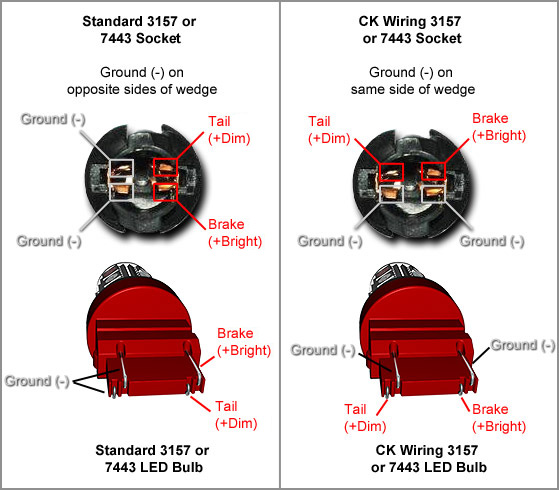
If flipping the bulbs doesn't do it,make sure you bought standard 7443 socket bulbs and not the CK type.

led-car-bulb-CK-wiring.jpg
 
I had thought they were keyed to go in only one way but they aren't. How a two "filament" lamp works without making sure it only goes in one way is beyond me.

So I flipped them around. They still don't work, but differently. Now the brake lights don't do anything at all, as opposed to making the tail lights go out when they were in the other way.

I put incandescents back in. They work fine.

Very strange.
 
If flipping the bulbs doesn't do it,make sure you bought standard 7443 socket bulbs and not the CK type.

led-car-bulb-CK-wiring.jpg

Hmm. That would explain a lot of things but the package doesn't say "CK on it anywhere. Just "7443LED". They're made by Philips, if that matters.

Has anyone found a brand that works in the stock housing?
 
I had thought they were keyed to go in only one way but they aren't. How a two "filament" lamp works without making sure it only goes in one way is beyond me.

An incandescent light is simply a wire with high resistance, inside a vacuum. Electricity goes through the filament (in either direction) and the resistance causes it to heat up so much it glows. The vacuum prevents it from burning itself up. Current can flow through in either direction.

An LED however, is a one-way component. A diode is basically a check valve for electricity. Current can flow through in one direction but not the other. LEDs happen to glow while doing so. Since an LED has very little resistive load, systems designed otherwise can act in funny ways!
 
I had something similar happen to me when I changed the tail lights on my Grand Am to altezza style lights with new bulbs already in the tail light assembly... As it turns out, the original bulbs were slightly different but physically interchangeable. The new tail lights all had 3156 bulbs but original called for brake/marker lights 3157 and the turn signal / reverse lights 3156.
 
Last edited:
I had thought they were keyed to go in only one way but they aren't. How a two "filament" lamp works without making sure it only goes in one way is beyond me.

So I flipped them around. They still don't work, but differently. Now the brake lights don't do anything at all, as opposed to making the tail lights go out when they were in the other way.

I put incandescents back in. They work fine.

Very strange.

Did you try them one at a time? Take both out and just put in one. If it doesn't work then flip it. If that doesn't work then you've got a problem.
 
Hmm. That would explain a lot of things but the package doesn't say "CK on it anywhere. Just "7443LED". They're made by Philips, if that matters.

Has anyone found a brand that works in the stock housing?

Odd,those Philips LEDs should've worked,they make the better "plug n play" LEDs in the market. I run their 194, 921 and 7440 LEDs in a couple of vehicles.

If you haven't returned them yet you should get an exchange and give them a second chance.
 

Members online

No members online now.

Forum statistics

Threads
278,304
Messages
3,554,041
Members
248,016
Latest member
Advally Service

Trending content

Back
Top