What happens, exactly, when you hit the redline?

I understand the scenario and how to do that (i.e. shift into 1 or 2, O/D off, etc), but wouldn't that put strain on the lower gears considering they can't upshift to the next gear i.e. and the downhill/gravity force of the slope trying to make the car go faster?

It does put additional strain on the gears, but not near enough to matter. I always drop out of OD on long freeway descents, and if I have to I'll downshift further to keep my speed in check.

If you find you're riding the brakes to control your speed, downshift. Better that than you lose your brakes to overheating.
 
Hi-jacking the thread here for a second, I think the OP got plenty of answers.

So basically on a steep downhill, it's better to be in a low gear and no foot on the break at all in an automatic? Or a combo of the low gear and the break pedal?

I understand the scenario and how to do that (i.e. shift into 1 or 2, O/D off, etc), but wouldn't that put strain on the lower gears considering they can't upshift to the next gear i.e. and the downhill/gravity force of the slope trying to make the car go faster?
It will likely be a combination, but being in a lower gear is a more efficient system for maintaining a safe speed. The automatic transmission computer in a lot of vehicles nowadays, including 4runners (going back to at least 4th gen, maybe earlier I'm not sure), will actually downshift when they sense you're going downhill and need to regulate speed (your brake input). This allows you to take a lot of heat and stress off of the rotors and pads, which aren't really designed to slow you over a long duration.

In terms of strain on the gears, someone more versed than me can probably give a better answer than I can, but my thoughts are as follows. 1, the lower gears are larger, so they're better equipped to handle additional stress (more material). 2, the transmission is being constantly cooled and lubricated from the transmission fluid. As long as this is changed regularly and kept at a safe temperature, nothing unusual should occur in your transmission from downshifting.

I can't speak for automatics, but when I drive a 5 speed I almost always use the transmission to slow down. Hills, stop lights, cute girls, doesn't matter. Brakes were only used when I needed a short, significant decrease in speed: coming to a complete stop, going into a sharp turn, car cut me off, etc. Damn I miss my manual. :cry:

Guess I was a little late on that response. Great points from [MENTION=124801]cashmoney[/MENTION] and [MENTION=49649]KidVermicious[/MENTION] though.

 
It does put additional strain on the gears, but not near enough to matter. I always drop out of OD on long freeway descents, and if I have to I'll downshift further to keep my speed in check.

If you find you're riding the brakes to control your speed, downshift. Better that than you lose your brakes to overheating.

Thanks for the input.

Do you personally use your breaks at all on those descends or just the lower gears?
 
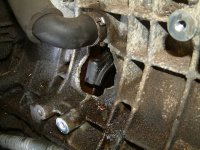
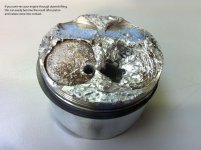
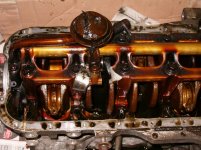
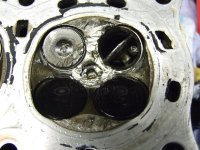
This is what could and probably will happen if you over-rev the engine!


Have fun doing it!! Let me know how it turns out for you!
 

Attachments

  • HOLEINBLOCK.jpg
    HOLEINBLOCK.jpg
    112.2 KB · Views: 294
  • PISTONHEAD.jpg
    PISTONHEAD.jpg
    136.7 KB · Views: 345
  • RODINOILPAN.jpg
    RODINOILPAN.jpg
    129.7 KB · Views: 307
  • VALVES.jpg
    VALVES.jpg
    78.1 KB · Views: 265
Thanks for the input.

Do you personally use your breaks at all on those descends or just the lower gears?

Yeah, definitely. Compression keeps my speed in check on the straights so I'm not having to powerbrake into the corners. Keeping the brakes from overheating is the goal.
 
This is what could and probably will happen if you over-rev the engine!

This is actually a VERY different scenario: you will blow the engine if, by error, you shift into 2nd when you mean to shift into 4rd. The rev limiter can't save you there, because you're not using the gas pedal to redline it, you're actually mechanically forcing the enginer waay over the redline.
 
Shift? Odds are extremely high that if you're bringing the engine to the rev limiter in a stock vehicle, you've already exceeded peak torque and horsepower, so acceleration and especially speed are being hindered by the gear you're in, not by the redline/rev limiter.

That's actually a very good point.
 
Correct. But over revving by downshifting or over revving by not shifting is still over revving and will still lead to the above pictures.

One thing we haven't touched base on is a speed limiter. THOSE are absolutely annoying as heck and I have had my butt pucker up while passing because of a speed limiter shutting me down part way through a pass.
 
Last edited:
This is actually a VERY different scenario: you will blow the engine if, by error, you shift into 2nd when you mean to shift into 4rd. The rev limiter can't save you there, because you're not using the gas pedal to redline it, you're actually mechanically forcing the enginer waay over the redline.

The 4Runner won't let you do that.
If you know so much about this subject then why ask the questions? I have noticed you ask some unusual questions.
 
No because what you are doing is using a combination of gearing and engine braking and service brakes to slow the vehicle down instead of relying solely on the service brakes. By downshifting you are keeping the RPM's up higher and taking advantage of the engines natural braking. There's no or little strain on the transmission doing this. You are also keeping the torque converter locked up which also helps slow things down which also helps keep the transmission fluid cooler.

Rule of thumb is : descend in the same gear you'd use to go uphill.
 
Because it is dangerous to have an electronic nanny suddenly, unexpectedly, cut off the gas when, say, I am trying to pass or merge.

Your other points are valid.
perhaps you need some driving lessons.

Or learn to drive and shift before you hit red line? You do know you aren't supposed to hit the redline and then sit on it right? It's there so you don't take an engine designed not to go past 6000rpm (or whatever your car is set for) and take it to 7000 or higher and blow it up.
this.
Rule of thumb is : descend in the same gear you'd use to go uphill.
or lower. i use this as a general rule, but for sure not a hard rule.
 
Shift? Odds are extremely high that if you're bringing the engine to the rev limiter in a stock vehicle, you've already exceeded peak torque and horsepower, so acceleration and especially speed are being hindered by the gear you're in, not by the redline/rev limiter.

That's actually a very good point.

A point I already made with this statement.
Also, if the engine lacks sufficient airflow through the engine (due to restrictive head ports, cams, valves, etc, etc) to make more power at higher RPM, then a higher rev-limit is a waste of time anyway.

Very few stock engines have a power output that is still increasing, when the rev-limiter kicks in. A few high-performance Motorcycles come to mind as exceptions.

I've modified too many engines for increased performance over the years to remember them all, but when it comes to stock street-legal car engines, they were all past their power peaks at the rev-limiter.

Increasing the rev-limiter by itself was pointless, without making changes to increase the airflow through the engine, and installing parts that are capable of handling the increase in RPM.

If you're hitting the rev-limiter unexpectedly when passing, you need to work on your spatial awareness.
 
I remember the first time I hit the speed limiter in my Supra. 119 mph or some such.

Luckily my new Supra doesn't have the speed limiter. :D
 
In an auto, doesn't the rev limiter simply indicate it's time to shift to the next gear (Either automatically or manually with paddle shifters)?

Sounds simple enough. And in the last gear, obviously you need to slow the hell down if hitting the highest gear redline.
 
OP sounds like a child getting his opinions from a combination of his state's driver's manual and some Top Gear reruns.
 
also it would be good to point out that if the computer is cutting your fuel, you have an issue. the truck will continue to shift through its gears since it has a computer and is automatic. the only time that it would arrest the engine would be if traction control was interfering or if you reached the speed limiter, which is not for maintaining the durability of your engine, but making sure your tires don't exceed their speed rating and rip themselves apart.

so if you are experiencing the engine giving out while passing, either you're a dumbass and you don't know what you're talking about or your truck is broken.
 

Members online

Forum statistics

Threads
278,316
Messages
3,554,120
Members
248,016
Latest member
Advally Service

Trending content

Back
Top