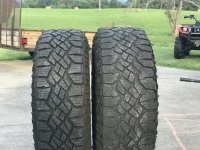
What I've learned about Duratrac tires on our trucks...

Same here but it's always nice to run something very different. We've only run a few when we were in the area for other reasons. One of these seasons we'll make a dedicated trip just for wheeling.

As a matter of fact one of my sidewall splits was in AZ. Had fun on Hog Canyon (?) but we were solo and are accustomed to wheeling on the rocks so the sand was quite an adventure. It would have been nice to have someone else with us but chose keeping safe instead of buried in the sand!

:cheers:
 
I'm running P rated 265/70R17 Duratracs on my Tacoma. Their load rating at 2679lbs each is more than double my truck weight and hauling capacity. I don't offroad near sharp rocks or where airing down is needed so these fit the bill. They were a lot cheaper than the LTs and weight less so my little 4cyl can lug them around no problem. I love em.

EDIT: Only thing I would have liked about the LTs in the white sidewall lettering. Maybe a bit old man of me but I always liked how white lettering contrasts with a black sidewall
 
Last edited:
They're great in snow but crap off-road. I've had two sidewalls split and will never buy these expensive pieces of crap again. Just wanted to let those of you who get off the pavement that these are not the tires you want.

Same. They've been great in snow, ice, rain, dirt, rocks, but after two sidewall splits from hitting rocks (we weren't even in anything sharp) I'm about over it. Granted I'm running Ps, which have softer sidewalls, but I'll be upgrading to some E rated Coopers. I'll take the mpg hit to not have to worry about making it home or replacing tires after I get home.
 
I know this is an old thread, but I have been researching this too and have a question or two maybe some of y'all can answer. I found out that the LT has a deeper tread pattern and more aggressive side lung pattern than the P rated tire in some other brands but does anyone know about the Duratrac or have you actually seen them side by side? Just curious. I may be willing to go with the LT if it has larger lugs and/or sidewall pattern.
 
I know this is an old thread, but I have been researching this too and have a question or two maybe some of y'all can answer. I found out that the LT has a deeper tread pattern and more aggressive side lung pattern than the P rated tire in some other brands but does anyone know about the Duratrac or have you actually seen them side by side? Just curious. I may be willing to go with the LT if it has larger lugs and/or sidewall pattern.

https://tiresize.com/tires/Goodyear/Wrangler-DuraTrac.htm

assuming you are going 265/70/17
P is 16/32 tread
LT is 18/32 tread

My brother has P and I have LT 285's When they are side by side you can tell slightly the difference. But when apart, its hard to tell. Shoulder lugs look the same, depth couldn't tell much because I have way more miles than his. The P has a more rounded edge than the LT.

I even have some pics! I will attach from my phone!
 

Attachments

  • IMG_1543.jpg
    IMG_1543.jpg
    139.6 KB · Views: 2,436
Last edited:
Load info?!?

Bumping this thread in hopes of some insight.

Trying to decide between tires, and found something funny that doesn't make sense. WTH is going on?

SL load rated Duratrac:

WRANGLER DURATRACSize: 265/70R17Service Description:115S Load Range: SLUTQG: 500 B BMax Load: 2679 lbs.Max Inflation Pressure:


C load rated Duratrac:

WRANGLER DURATRACSize: LT265/70R17Service Description:112/109Q Load Range: CUTQG: NoneMax Load: 2470 lbs.Max Inflation Pressure:


So the SL's have a higher load rating and the higher inflation pressure. This shouldn't be the case. If you reduce the SL rates tires load by 9% (I've heard you do this) they are almost identical.

Does this mean the SL rated Duratracs have thicker sidewalls?
 
Bumping this thread in hopes of some insight.

Trying to decide between tires, and found something funny that doesn't make sense. WTH is going on?

SL load rated Duratrac:

WRANGLER DURATRACSize: 265/70R17Service Description:115S Load Range: SLUTQG: 500 B BMax Load: 2679 lbs.Max Inflation Pressure:


C load rated Duratrac:

WRANGLER DURATRACSize: LT265/70R17Service Description:112/109Q Load Range: CUTQG: NoneMax Load: 2470 lbs.Max Inflation Pressure:


So the SL's have a higher load rating and the higher inflation pressure. This shouldn't be the case. If you reduce the SL rates tires load by 9% (I've heard you do this) they are almost identical.

Does this mean the SL rated Duratracs have thicker sidewalls?

No.

Max pressure for the LT is 50psi.
For the Standard Load (which in this case is a metric size -- a very close equivalent of P-metric) its 36psi.

Same size LT tires (in the case of 265/70/17) require an additional about 12psi to match the load capacity of a Standard Load tire. That is why the two tires have similar load capacities at significantly different air pressures.

The thicker, stronger construction of an LT is to accommodate additional air pressure which is what is required to increase load capacity, but the thicker construction, by itself -- with no pressure adjustment, actually decreases load capacity (creates more heat, more prone to long term cracking) leaving the LT tire needing extra air to achieve parity with the SL tire.

LT tires need more presssure

 
No.

Max pressure for the LT is 50psi.
For the Standard Load (which in this case is a metric size -- a very close equivalent of P-metric) its 36psi.

Same size LT tires (in the case of 265/70/17) require an additional about 12psi to match the load capacity of a Standard Load tire. That is why the two tires have similar load capacities at significantly different air pressures.

The thicker, stronger construction of an LT is to accommodate additional air pressure which is what is required to increase load capacity, but the thicker construction, by itself -- with no pressure adjustment, actually decreases load capacity (creates more heat, more prone to long term cracking) leaving the LT tire needing extra air to achieve parity with the SL tire.

LT tires need more presssure


Thanks for confirming what I thought it should be, BUT I screwed up and didn't paste the air pressure for either. The SL has an inflation pressure of 51. The LT C version has an inflation pressure of 50. I checked two sites to confirm. What am I missing?

SpecificationsGOODYEARWRANGLER DURATRACSize: 265/70R17Service Description:115S Load Range: SLUTQG: 500 B BMax Load: 2679 lbs.Max Inflation Pressure:51 psiTread Depth:16/32"Tire Weight: 44 lbs.Rim Width Range:7-9"Measured Rim Width:
 
Thanks for confirming what I thought it should be, BUT I screwed up and didn't paste the air pressure for either. The SL has an inflation pressure of 51. The LT C version has an inflation pressure of 50. I checked two sites to confirm. What am I missing?

SpecificationsGOODYEARWRANGLER DURATRACSize: 265/70R17Service Description:115S Load Range: SLUTQG: 500 B BMax Load: 2679 lbs.Max Inflation Pressure:51 psiTread Depth:16/32"Tire Weight: 44 lbs.Rim Width Range:7-9"Measured Rim Width:

To quote from the LT tires thread: "The horizontal lines on the P-metric tires (referencing the chart) represent the ability to add pressure for special conditions (like high speed) but the extra psi assigns no additional load capacity."

In other words, the load capacity of the SL tire at 51psi is the same as it is at 36psi.
 
I don't run Duratracs, but to chime in about load ratings...

I went offroading with a friend of mine who has a Forester with C load rated General Grabber AT2s. I was running E rated Grabber AT2s.

While treating our vehicles similarly over some rather jagged rocks, he popped a tire. I didn't. I run the LTs for puncture protection, rather than for towing or something like that. It's good peace of mine knowing that, I'm probably not ever going to puncture a tire offroad because I'm running tires rated for more abuse than my truck is capable of giving. And if by some chance I do puncture one, my spare is an E rated General Grabber, as well.
 
To quote from the LT tires thread: "The horizontal lines on the P-metric tires (referencing the chart) represent the ability to add pressure for special conditions (like high speed) but the extra psi assigns no additional load capacity."

In other words, the load capacity of the SL tire at 51psi is the same as it is at 36psi.

Thanks JB! Appreciate you taking time to explain it to me. I thought thee was a chance that it was just marketing, and the two tires were the same. Wrong.
 
No.

Max pressure for the LT is 50psi.
For the Standard Load (which in this case is a metric size -- a very close equivalent of P-metric) its 36psi.

Same size LT tires (in the case of 265/70/17) require an additional about 12psi to match the load capacity of a Standard Load tire. That is why the two tires have similar load capacities at significantly different air pressures.

The thicker, stronger construction of an LT is to accommodate additional air pressure which is what is required to increase load capacity, but the thicker construction, by itself -- with no pressure adjustment, actually decreases load capacity (creates more heat, more prone to long term cracking) leaving the LT tire needing extra air to achieve parity with the SL tire.

LT tires need more presssure

This is old, but for the record, it is wrong. Many SL tires in 4R sizes have maximum pressure of 51 psi and the remaining ones are 44 and not 36. Load ratings between P and C are often identical after adjusting for LT application (which is a discussion in itself, since the 4R is not a pickup).

I have not seen one ounce of evidence that a C tire is necessarily stronger for offroading than a B tire. Of course, if the tire does have a 3-ply sidewall (like many LTCs in 255 75 17) then the C will be stronger.

I don't run Duratracs, but to chime in about load ratings...

I went offroading with a friend of mine who has a Forester with C load rated General Grabber AT2s. I was running E rated Grabber AT2s.

While treating our vehicles similarly over some rather jagged rocks, he popped a tire. I didn't. I run the LTs for puncture protection, rather than for towing or something like that. It's good peace of mine knowing that, I'm probably not ever going to puncture a tire offroad because I'm running tires rated for more abuse than my truck is capable of giving. And if by some chance I do puncture one, my spare is an E rated General Grabber, as well.

It is the common perception that E-load tires have stronger sidewalls for offroading because they have stronger construction so as to hold 80 psi and thus higher loads.

But in practice, unless the E load has a 3-ply sidewall, the advantage is likely way smaller offroad than it is when hauling, which is the design parameter.

I could definitely use a tough tire offroad yet I am running SL which is better at everything other than sidewall strength. The trick is to run the SL at or near street pressures. By contrast, the E must be aired down both for traction (terrain compliance) and comfort. On road the only possible advantage of D or E is added cornering stability at proper pressures. The rest is a laundry list of shortcomings.
 
This is old, but for the record, it is wrong. Many SL tires in 4R sizes have maximum pressure of 51 psi and the remaining ones are 44 and not 36. Load ratings between P and C are often identical after adjusting for LT application (which is a discussion in itself, since the 4R is not a pickup).

I have not seen one ounce of evidence that a C tire is necessarily stronger for offroading than a B tire. Of course, if the tire does have a 3-ply sidewall (like many LTCs in 255 75 17) then the C will be stronger.


It is the common perception that E-load tires have stronger sidewalls for offroading because they have stronger construction so as to hold 80 psi and thus higher loads.

But in practice, unless the E load has a 3-ply sidewall, the advantage is likely way smaller offroad than it is when hauling, which is the design parameter.

I could definitely use a tough tire offroad yet I am running SL which is better at everything other than sidewall strength. The trick is to run the SL at or near street pressures. By contrast, the E must be aired down both for traction (terrain compliance) and comfort. On road the only possible advantage of D or E is added cornering stability at proper pressures. The rest is a laundry list of shortcomings.
On Grabbers, at least, the sidewalls are rated at 10-ply. I believe it's a '3-ply rated at 10-ply' (not sure how that's actually measured) but like I said, it's capable of handling more abuse than I can throw at them with something the weight of the 4Runner. The hit in gas mileage was 1 mpg. Oh well. I didn't buy this thing for gas mileage.

I would much rather run an aired down (or even aired up, I've offroaded mine at 40psi and they're bumpy but still grip fine for light offroad) E-load and not worry about sidewall punctures than run an SL and not have to worry about airing down.

Also, that sidewall stability on-road is amazing. I've been in trucks with C-load Grabbers and they handle like complete garbage compared to mine with the E's. It's night and day. Otherwise though, I didn't buy them to be good on-road. I bought them to be good offroad. If your truck sees 90% pavement, yeah, there's 0 reason to get E-load tires. Otherwise, I see no reason not to.
 
Bumping this thread in hopes of some insight.

Trying to decide between tires, and found something funny that doesn't make sense. WTH is going on?

SL load rated Duratrac:

WRANGLER DURATRACSize: 265/70R17Service Description:115S Load Range: SLUTQG: 500 B BMax Load: 2679 lbs.Max Inflation Pressure:


C load rated Duratrac:

WRANGLER DURATRACSize: LT265/70R17Service Description:112/109Q Load Range: CUTQG: NoneMax Load: 2470 lbs.Max Inflation Pressure:


So the SL's have a higher load rating and the higher inflation pressure. This shouldn't be the case. If you reduce the SL rates tires load by 9% (I've heard you do this) they are almost identical.

Does this mean the SL rated Duratracs have thicker sidewalls?

Such a good question. I just purchased LT265/70R17 C load Duratracs and was puzzled by the same question. I also started to worry they were not rated enough for my 4R.


No.

Max pressure for the LT is 50psi.
For the Standard Load (which in this case is a metric size -- a very close equivalent of P-metric) its 36psi.

Same size LT tires (in the case of 265/70/17) require an additional about 12psi to match the load capacity of a Standard Load tire. That is why the two tires have similar load capacities at significantly different air pressures.

The thicker, stronger construction of an LT is to accommodate additional air pressure which is what is required to increase load capacity, but the thicker construction, by itself -- with no pressure adjustment, actually decreases load capacity (creates more heat, more prone to long term cracking) leaving the LT tire needing extra air to achieve parity with the SL tire.

LT tires need more presssure

Fantastic info! The 112/109Q rating made no sense. So if i need the full weight capacity on my C's i can just add a little more (closer to 50) PSI and i am good to go. I'm running 35psi for now.

The C rated Duratracs ar 10 ply too.

Sorry to bump old thread but good info!
 
Last edited:
@JB.

Max PSI is 50 and max weight capacity is attained at that PSI. Wouldn't it be pushing the tire at 50 PSI?

Going to bring my PSI to 40 today.

I have a 5 Gen BTW.
 
Last edited:
Alright let’s beat this dead horse!

Anyone running or know if TRD pro wheels with 255/80/17 Cooper ST Maxx will cause any rubbing? Currently running 5100's all around with the fronts set at 0.85".
 

Members online

Forum statistics

Threads
278,316
Messages
3,554,124
Members
248,016
Latest member
Advally Service

Trending content

Back
Top