When to lock the Torsen center differential (H4L)?

Bilbo

New member
I suppose this is a two part question about locking the Limited’s Torsen Center Differential in high gears:

1. When should I? Or maybe I should just leave it unlocked even when it’s icy or snow-packed? 2. Why?

As a bit of background, the Torsen CD, when unlocked, distributes torque to both front and rear wheels at all times. The default torque distribution is 40% front and 60% rear, but it will change (max 30F,70R; 53F,47R) to increase torque distribution to the wheels with greater traction. It also allows the front and rear drive shafts to turn at different RPM’s (Torsen calls this “differentiation”). Without differentiation, you couldn’t turn corners on dry pavement.

When the CD is locked, it acts just like a part-time 4WD, like an SR5, with an engaged 4WD. No torque management and no differentiation. The torque distribution is fixed at 50F and 50R, and the drive shafts are locked to a single rotational speed. Relative wheel traction is ignored. And as with a part-time 4WD, the same warnings are given for a locked CD: driving on dry pavement is not recommended.

So, in snowy and icy conditions, the unlocked CD is already engaging both front and rears wheels. If there is a loss of traction, the CD will send to the wheels with greater traction. You are never in a position where no torque is applied to an axle. These all seem like good things to overcome traction loss in the snow. But is there an advantage to the fixed drive shaft rotation? Or maybe it just doesn’t matter all that much?

I know this is long-winded, but I just wanted to lay it out. The manual doesn’t have much to say about when to use 4HL. It tells you not to use it when tires can’t slide. I’ve asked a few people who are vehicle-savvy, but with no luck. By the way, when when using low gears in the 5th gen, there is no choice, only a locked CD in Low. I’m only asking about other driving circumstances – from highways and urban areas to unpaved roads, mining roads, etc.
 
Register to hide this ad
My 05 had the same setup, and the only time I would lock the center diff was when I was off road and needed the extra grip. But on snowy roads, and driving at normal highway speeds, I would leave it unlocked and let the diff do the work for you.

When you're stuck in the ditch, then lock the diff and put it in low range.
 
H4L is really not needed in my opinion. I have never been in a situation in my 03 full time 4x4 or my limited time off road in my 14 that it helped to be locked in high range. We do not have enough power to spin the wheels that much in high range that locking the diff would be helpful. If you do lock it you have to remember to unlock it when on dry pavement. The one thing I miss the most is that my 03 you could unlock the center diff in low also. You could drive anywhere in low without the binding when it is locked. There was only a few times when it was helpful to lock the diff in low range but on my 14 you do not have that choice.
 
I lock the center diff if the roads are snow packed, there isn't any downside to that and theoretically it is better traction as there is no reaction time needed. I have noticed a slip here and there when it's open, it corrects but still requires some reaction time. Since I put better tires on that is less of an issue but I still lock it. I will say my wife's Audi has the same 40/60 bias and it seems to react faster, but that could be my perception more than reality.
 
I have found that on snow covered surfaces, my Limited seems to work best with the CD left unlocked, especially in situations where you're applying power and turning at the same time. Combined with the VSC, it seems almost unstoppable. Having owned part-time 4WD vehicles in the past, the Limited's Full Time 4WD and open CD seems to work a lot better in most winter conditions.

On the other hand, when pushing through deep snow, it seems that the having the CD locked works a little better.
 
I will say my wife's Audi has the same 40/60 bias and it seems to react faster, but that could be my perception more than reality.
Nah it's probably reality. As much as I dislike Volkswagens their Quattro system is pretty good.
 
I have found that on snow covered surfaces, my Limited seems to work best with the CD left unlocked, especially in situations where you're applying power and turning at the same time. Combined with the VSC, it seems almost unstoppable. Having owned part-time 4WD vehicles in the past, the Limited's Full Time 4WD and open CD seems to work a lot better in most winter conditions.

On the other hand, when pushing through deep snow, it seems that the having the CD locked works a little better.

VSC is still active even with center diff locked, I don't see how it could be better unlocked especially turning as the physics of it would mean you want more balanced traction so 50/50 is better than 40/60? The reaction time is excellent and I feel it is better then the JGC I had previously in that regard. Proper tires seemed to make a bigger impact than locking to not (center diff) for me.
 
well during the bad days, I lock my LE before I leave the house. I live in a valley on one side of the hill and have to go thru a bunch of hills to get to the north hill onto the 15 mile straight stretch to work.

to get out of my unplowed subdivision, I have to go down a hill and back up to even get out. down a hill to a T stop sign. go east down a hill, stop light and up a hill. drive 1 mile and up another hill again. left turn stoplight middle of town. drive 2-3 miles to a stoplight (which I always freaking hit at red).

now this hill is killer. ~1/4(8) mile long with about 6+% grade with a bend. a lot of times this hill always has some fwd just spinning up the hill all the way. after this hill I will unlock the CD and go on my way.

most of the time I have the CD locked to get some speed to get up this hill (since the bottom of the hill has a stop light). even 4wd lose momentum going up this hill and end up just spinning wheels due to the ice or glazed snow since the fwd vehicles just spin the snow to a nice ice sheen. one year it was so crowded with stuck vehicles in the warden's Tacoma I took the center median to get around the vehicles as I didn't want to lose my momentum.
 
This question comes up so often, and there's a lot of confusion about how exactly the multimode 4WD works and when you should be in what mode.

I suppose this is a two part question about locking the Limited’s Torsen Center Differential in high gears:

1. When should I? Or maybe I should just leave it unlocked even when it’s icy or snow-packed? 2. Why?

As a bit of background, the Torsen CD, when unlocked, distributes torque to both front and rear wheels at all times. The default torque distribution is 40% front and 60% rear, but it will change (max 30F,70R; 53F,47R) to increase torque distribution to the wheels with greater traction. It also allows the front and rear drive shafts to turn at different RPM’s (Torsen calls this “differentiation”). Without differentiation, you couldn’t turn corners on dry pavement.

When the CD is locked, it acts just like a part-time 4WD, like an SR5, with an engaged 4WD. No torque management and no differentiation. The torque distribution is fixed at 50F and 50R, and the drive shafts are locked to a single rotational speed. Relative wheel traction is ignored. And as with a part-time 4WD, the same warnings are given for a locked CD: driving on dry pavement is not recommended.

So, in snowy and icy conditions, the unlocked CD is already engaging both front and rears wheels. If there is a loss of traction, the CD will send to the wheels with greater traction. You are never in a position where no torque is applied to an axle. These all seem like good things to overcome traction loss in the snow. But is there an advantage to the fixed drive shaft rotation? Or maybe it just doesn’t matter all that much?

I know this is long-winded, but I just wanted to lay it out. The manual doesn’t have much to say about when to use 4HL. It tells you not to use it when tires can’t slide. I’ve asked a few people who are vehicle-savvy, but with no luck. By the way, when when using low gears in the 5th gen, there is no choice, only a locked CD in Low. I’m only asking about other driving circumstances – from highways and urban areas to unpaved roads, mining roads, etc.

So I'm guessing you've seen a FWD or RWD vehicle stuck in mud or snow and spinning just one wheel while the other sits there? That's the axle differential causing that. It's designed to let one wheel spin faster than the other, which lets the vehicle corner under power without scrubbing tires. Without the differential, each axle would be forced to turn at the same speed as the other, and because the wheels want to spin at different speeds during a turn, increased tire wear and drivetrain wear would result - in extreme situations, an axle could snap or the tires could break loose completely causing extreme under or oversteer (which is why it's so easy to do donuts with a locked or limited slip rear).

A normal part-time 4WD system (like the 5th gen SR5) ties the front and rear driveshafts together in exactly the same way that the axles would be tied together if they had no differential between them, which is why it's not recommended to use part-time 4WD on pavement or in other high traction situations - you get understeer and increased component wear. A full-time 4WD vehicle has a "center" differential on the transfer case which behaves exactly like an axle differential - it allows the front and rear driveshafts to spin at different rates and lets you use your 4WD anywhere without fear of tire scrub or drivetrain wear, and without fear of losing traction due to under or oversteer when travelling on slick surfaces the way a part-time 4WD vehicle might.

However, to get back to the one-tire-spinning problem, because all four wheels are now connected by differentials, it is possible for a full-time 4WD vehicle to get stuck just like that FWD or RWD vehicle, with all the power being transmitted to that one uselessly spinning tire. Toyota does two things about that in your 4Runner - one, as you noted, the Torsen diff specifically does not allow ALL the power to be transmitted to one driveshaft or the other, so even when one wheel is spinning free, the others are still getting some power. It's kinda like a limited-slip axle diff in that regard. Two, your 4Runner has the center diff lock, and when you engage that, the center diff behaves exactly like a locked axle differential (or exactly like the transfer case on a part-time 4WD vehicle, natch), splitting the available power from the transmission exactly 50/50 between the front and rear driveshafts, ensuring better low speed traction.

Does that make a little more sense? In a high speed high traction situation, just use 2WD (if you have that option?). For high speed low traction situations like icy wintery roads, go 4WD with the center diff unlocked and you'll get a little better stability. You can also use 4WD with the center diff unlocked on gravel roads or light mud, and you'll have a better turning radius than a traditional part-time 4WD truck and be less likely to break the rear end free and fishtail. However, once you get into or anticipate a low speed situation where it's likely that you might lose all traction with one tire (rock crawling, badly rutted trails, steep gravelly hill climbs, etc), lock that center diff.

As an aside, I noticed you said "the CD will send to the wheels with greater traction". For what it's worth, this is a pet peeve of mine and it's absolutely not true. The ability to actively modulate power to specific wheels depending on which ones have traction is a feature of AWD, and you don't have AWD. You have a full-time 4WD system that Toyota calls "multimode", and multimode and AWD are not the same thing. The Torsen center diff splits torque passively and won't let it all go to just one driveshaft, and your traction control can apply selective braking to wheels that are losing traction or to try and control a slide, and together the two systems can partially emulate a true AWD setup. But they don't come close to AWD in terms of managing high speed traction - they will not actively transfer power away from a spinning tire, and they will not take control and save you from spinning out in a snowstorm and winding up in a ditch the way a true AWD will. I just want to make that point, because I see way too many guys on this board with multimode 4WD who don't understand what they have or what it's limitations are. I worry that some guys (not you necessarily, Bilbo) are making the mistake of thinking they're in a Subaru or other AWD crosssover, and they definitely aren't - the 4Runner is much heavier, with a higher center of gravity, and does not have the handling or slick surface road traction of a true AWD vehicle.
 
Because when locked you have a front wheel (partially) skidding through the turn. How much depends on steering angle.

http://www.toyota-4runner.org/5th-gen-t4rs/133871-using-part-time-4wd-dry-pavement-te-sr5.html

I'm making two assumptions, first roads are fully snow packed as stated and second you are on the gas driving through the turn. If it's slick enough for the front to slide the rear would slide just as easy, ie sure a front wheel drive can slide right though but so would a rear wheel drive when it swings out the back end. Isn't the 50/50 split ideal because the wheels are all pushing equally providing the pull traction from the front and the push from the rear? In the 40/60 split it would seam the extra power to the rear axle could increase the chance of kicking out the rear. Please expand if incorrect?

After seeing kidvermicious post, I am thinking in terms of driving through the city not blasting down the road at 55mph+. Is there a difference?
 
Last edited:
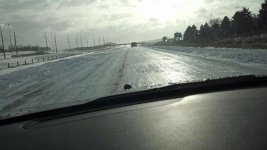
unless your driving on a highway like this. we get this all the time here on my 15 mile stretch to base from town.

in these conditions, its sometimes better to be locked driving so if a tire does lose traction, vsc etc doesnt engage and cause bigger issues.

and there have been times when even the winds we get normally can even push a large profile vehicle sideways at 25 mph. that was fun in the 4runner a few years back on an ice covered road. no system can compensate for that.

example photo (not mine)
.
 

Attachments

  • ice covered road.jpg
    ice covered road.jpg
    32.5 KB · Views: 8,890
I'm making two assumptions, first roads are fully snow packed as stated and second you are on the gas driving through the turn. If it's slick enough for the front to slide the rear would slide just as easy, ie sure a front wheel drive can slide right though but so would a rear wheel drive when it swings out the back end. Isn't the 50/50 split ideal because the wheels are all pushing equally providing the pull traction from the front and the push from the rear? In the 40/60 split it would seam the extra power to the rear axle could increase the chance of kicking out the rear. Please expand if incorrect?

After seeing kidvermicious post, I am thinking in terms of driving through the city not blasting down the road at 55mph+. Is there a difference?

I'm pretty sure [MENTION=2798]JB.[/MENTION] meant this: Let's assume both front wheels are being powered and you go around a sharp turn. The outside wheel will have to travel further than the inside so the inside wheel will "scrub" a bit and you will lose a bit of traction.
 
Last edited:
unless your driving on a highway like this. we get this all the time here on my 15 mile stretch to base from town.

in these conditions, its sometimes better to be locked driving so if a tire does lose traction, vsc etc doesnt engage and cause bigger issues.

and there have been times when even the winds we get normally can even push a large profile vehicle sideways at 25 mph. that was fun in the 4runner a few years back on an ice covered road. no system can compensate for that.

example photo (not mine)
.
I have a question for you: Excluding solid sheet ice, has there ever been a time up in Nort Dakooota when VSC or TRAC have not kept you pointing in the direction you want to go? I find it almost impossible with VSC on to mess it up on normal snow covered roads. Sure, you get the initial beginnings of a slide or push but all of a sudden *poof* (magic happens) and you are not in a guardrail or over the hill, you are going around the turn, albeit slower, because TRAC killed your acceleration.
I excluded sheet ice because unless you have studs or chains (or a Zamboni) sheet ice is it's own animal and requires letting go of the wheel and hoping you get off the ice before you have to go around a turn because you can't turn at speed on solid ice.

For the new guys reading this, please refer to the link in my signature on how all these 4WD systems work and the differences between AWD, part time 4WD and full time 4WD.
 
As an aside, I noticed you said "the CD will send to the wheels with greater traction". For what it's worth, this is a pet peeve of mine and it's absolutely not true. The ability to actively modulate power to specific wheels depending on which ones have traction is a feature of AWD, and you don't have AWD. You have a full-time 4WD system that Toyota calls "multimode", and multimode and AWD are not the same thing. The Torsen center diff splits torque passively and won't let it all go to just one driveshaft, and your traction control can apply selective braking to wheels that are losing traction or to try and control a slide, and together the two systems can partially emulate a true AWD setup. But they don't come close to AWD in terms of managing high speed traction - they will not actively transfer power away from a spinning tire, and they will not take control and save you from spinning out in a snowstorm and winding up in a ditch the way a true AWD will. I just want to make that point, because I see way too many guys on this board with multimode 4WD who don't understand what they have or what it's limitations are. I worry that some guys (not you necessarily, Bilbo) are making the mistake of thinking they're in a Subaru or other AWD crosssover, and they definitely aren't - the 4Runner is much heavier, with a higher center of gravity, and does not have the handling or slick surface road traction of a true AWD vehicle.

There's a huge amount of variation between AWD systems, and it's often hard to get good information about how they physically work. Honda/Acura has at least three systems. The lightest is used on the CR-V, and IIRC it used a clutch to send some power to the rear axle, but I don't think it can choose which side it goes to. They call it Realtime 4WD, and it might be useful to keep from getting stuck in some situations, but other than that it's not very useful, and the car is basically FWD. The Pilot and Ridgeline are called 4WD even though they are really AWD, and their system is called VTM-4. It used a pair of clutches in the rear to send power to either the right or left side. From what I've read, it can work well, but sometimes it doesn't activate when you need it. It only works up to a certain speed. Some Acuras have SH-AWD, which can actively split power between the rear wheels to improve handling, even before slipping is detected. I think it's a mechanical system. It sounds like it works really well on the road, but I don't think it's intended for driving off road trails. Subaru has several different systems, and I haven't been able to find good information about which models use which type. Some use clutches and run mostly FWD, and some use viscous coupling, and some might use something else. A lot of small crossovers use a lightweight system like Honda's realtime, but it's hard to find information about how they work, and whether they have anything to control a spinning wheel using the brakes like our 4runners do. Most of them buy the technology from a company like Bosch, so many of them are the same, but they wont tell you. The Highlander hybrid (used to?) have a motor in the rear to make it AWD, which is ideal since there is no mechanical coupling to worry about, but it was only like 60hp, and it tended to overheat. The upcoming Tesla X looks really good.


Here's a thread with some info about the limited slip center (4th gen, but it works basically the same as the 5th Limited) http://www.toyota-4runner.org/4th-gen-t4rs/181476-limited-slip-center-differential.html
 
There's a huge amount of variation between AWD systems, and it's often hard to get good information about how they physically work. Honda/Acura has at least three systems. The lightest is used on the CR-V, and IIRC it used a clutch to send some power to the rear axle, but I don't think it can choose which side it goes to. They call it Realtime 4WD, and it might be useful to keep from getting stuck in some situations, but other than that it's not very useful, and the car is basically FWD. The Pilot and Ridgeline are called 4WD even though they are really AWD, and their system is called VTM-4. It used a pair of clutches in the rear to send power to either the right or left side. From what I've read, it can work well, but sometimes it doesn't activate when you need it. It only works up to a certain speed. Some Acuras have SH-AWD, which can actively split power between the rear wheels to improve handling, even before slipping is detected. I think it's a mechanical system. It sounds like it works really well on the road, but I don't think it's intended for driving off road trails. Subaru has several different systems, and I haven't been able to find good information about which models use which type. Some use clutches and run mostly FWD, and some use viscous coupling, and some might use something else. A lot of small crossovers use a lightweight system like Honda's realtime, but it's hard to find information about how they work, and whether they have anything to control a spinning wheel using the brakes like our 4runners do. Most of them buy the technology from a company like Bosch, so many of them are the same, but they wont tell you. The Highlander hybrid (used to?) have a motor in the rear to make it AWD, which is ideal since there is no mechanical coupling to worry about, but it was only like 60hp, and it tended to overheat. The upcoming Tesla X looks really good.


Here's a thread with some info about the limited slip center (4th gen, but it works basically the same as the 5th Limited) http://www.toyota-4runner.org/4th-gen-t4rs/181476-limited-slip-center-differential.html

Good stuff there. It's very difficult to tell what is what when there's no standard, that's for sure.
 
I have a question for you: Excluding solid sheet ice, has there ever been a time up in Nort Dakooota when VSC or TRAC have not kept you pointing in the direction you want to go? I find it almost impossible with VSC on to mess it up on normal snow covered roads. Sure, you get the initial beginnings of a slide or push but all of a sudden *poof* (magic happens) and you are not in a guardrail or over the hill, you are going around the turn, albeit slower, because TRAC killed your acceleration.
I excluded sheet ice because unless you have studs or chains (or a Zamboni) sheet ice is it's own animal and requires letting go of the wheel and hoping you get off the ice before you have to go around a turn because you can't turn at speed on solid ice.

For the new guys reading this, please refer to the link in my signature on how all these 4WD systems work and the differences between AWD, part time 4WD and full time 4WD.

it depends on the road conditions and your level of experience in snow.

if the roads have had a few days/weeks of maintenance on them from the city I will leave it off. the first few days is the worse and I will lock the CD and turn off vsc since most of the time I use the 4wd system to pull me into the direction I want to go (it goes back to basics of slides in a fwd, rwd, awd-hybrid, awd-subaru/audi, or 4wd and 4wd-locked).

in a slide with 4wd locked you point the wheels in the direction you want to go in a slide, with vsc, this hinders that whereas in a 4hL I just give some gas and go and it pulls me back on my line.

with vsc on, when the brakes kick and adjusts, sometimes this amplifies the slide since that one wheel is locked on ice/snow which doesnt help.

on the flip side, dropping down gears going down a long steep hill helps slow you down and not slide, whereas using the brakes can engage the abs and cause ever so slight sliding of the rear or whole vehicle out of your line. I had this happen back in the 90's coming down a hill to a set of railroad tracks and only going 15-20 mph, ended up sliding 1/2 down the hill for that move until I figured it out.

last year the warden figured that out finally in her Tacoma, so now she drops down 2-3 gear coming down the hill from work to home.

sometimes its better to have vsc and sometimes its not. but only experience would give you the idea of when each applies.

when I first started driving these smart systems, I used them exclusively, but over the last 20-30 years in North Dakota winters, I have learn to work with them and adjust.

I have driven rwd sedans (no accidents, but fun as hell to slide in an open field), fwd cars (1 slide off the road due to spring slush), Subaru (no accidents), and 4runners (no accidents). now I have had accidents but never due to snow, always during the dam summer months. someone opened a car door as I was driving by (me and warden), backed into the DQ pole (warden, son), forgot to lock the hitch on the uhaul while loading, school riding lawn mower slid into the rear quarter panel of the 98 4runner.

I still vehemently tell my wife and daughter to leave those systems on and don't tell them how to disable them between starts. I do show them how to lock the center diff (rav4 or turn off the nannies in the Tacoma) to get up those areas in town that are slick at stop lights/signs, but since its the temp solution, it re-engages after 25-30 mph.

all the above is first and foremost, dependent on driving for the conditions. doing 70 on a ice covered road, yeah seeya in the ditch or hospital. and if it gets too bad, stay the hell home. which I have done several times and just took vacation time.

good example. back in 1994, I was driving down to texas for USAF cross training. left just before turkey day and headed to I-29 to drive to texas. sometime after hitting the SD border at night, the road had a funny look to it. slowed down to about 20mph, hit the brakes and promptly slid. freaked me out. so I ended up doing about 25-35 mph until I hit watertown, which took about 3-4 hours. during this time frame, one person passed me, guess what he was doing probably 55 mph and all I could think was, that person was crazy driving at that speed on that black ice road.
 
This question comes up so often, and there's a lot of confusion about how exactly the multimode 4WD works and when you should be in what mode.
...
As an aside, I noticed you said "the CD will send to the wheels with greater traction". For what it's worth, this is a pet peeve of mine and it's absolutely not true. The ability to actively modulate power to specific wheels depending on which ones have traction is a feature of AWD, and you don't have AWD. ...

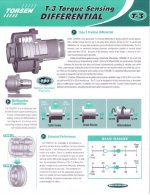
[MENTION=49649]KidVermicious[/MENTION] I tried to be very careful and precise in my description of Torsen T-3 operation. And while information straight from Torsen is hard to come by (their website is down), I do have a really bad copy of their T-3 information sheet. In part, it reads:

"Unlike conventional speed-sensing limited slip differentials, TORSEN's T-3 is a full-time torque-sensing, torque-biasing system. Torque and differentiation are continuously managed between the front and rear axles and biased instantaneously according to variable road conditions, automatically shifting the power to the wheel with the most traction before any wheel slippage can occur."

I realize this contradicts much of what I've found on web forums about the T-3, this discussion included, but Torsen's description seems quite clear. Is it not?

Hey, the good news is that the T-3 is "designed to perform for the life of the vehicle."

Screen Shot 2014-10-10 at 11.58.38 PM.jpg
 

Attachments

  • Screen Shot 2014-10-10 at 11.58.38 PM.jpg
    Screen Shot 2014-10-10 at 11.58.38 PM.jpg
    108 KB · Views: 4,582
[MENTION=49649]KidVermicious[/MENTION] I tried to be very careful and precise in my description of Torsen T-3 operation. And while information straight from Torsen is hard to come by (their website is down), I do have a really bad copy of their T-3 information sheet. In part, it reads:

"Unlike conventional speed-sensing limited slip differentials, TORSEN's T-3 is a full-time torque-sensing, torque-biasing system. Torque and differentiation are continuously managed between the front and rear axles and biased instantaneously according to variable road conditions, automatically shifting the power to the wheel with the most traction before any wheel slippage can occur."

I realize this contradicts much of what I've found on web forums about the T-3, this discussion included, but Torsen's description seems quite clear. Is it not?

Hey, the good news is that the T-3 is "designed to perform for the life of the vehicle."

View attachment 136466

I think they've confused themselves. What they're describing is the function of the diff when used on an axle, I think. When used on the tcase, as in your 4Runner, it's not seeing the wheels, it sees the driveshafts. Ergo, it can't direct power to the wheel with the most grip.

How it knows which driveshaft has the most resistance (or "grip"), and what the existence of two wheels on the other side of each open diff does to what the T3 "sees", is beyond me. Reading your blurb, it may be more effective than I thought. But it's still not AWD in the sense that I laid out above. It's not biasing power away from individual wheels that have lost traction.
 
I think they've confused themselves. What they're describing is the function of the diff when used on an axle, I think. When used on the tcase, as in your 4Runner, it's not seeing the wheels, it sees the driveshafts. Ergo, it can't direct power to the wheel with the most grip.

How it knows which driveshaft has the most resistance (or "grip"), and what the existence of two wheels on the other side of each open diff does to what the T3 "sees", is beyond me. Reading your blurb, it may be more effective than I thought. But it's still not AWD in the sense that I laid out above. It's not biasing power away from individual wheels that have lost traction.
Your description of "AWD" refers only to a specific type of AWD, which isn't consistent with the majority of AWD systems, as most can't actively transfer power 100%. The multimode awd with the torsen CD is a more capable "awd" system than many other claimed "awd" systems out there.
 

Members online

Forum statistics

Threads
278,316
Messages
3,554,120
Members
248,016
Latest member
Advally Service

Trending content

Back
Top