When to replace lower ball joints?

4runnerfever67

New member
Hi. I'm trying to find out how many miles should the lower ball joints last? I have a 3" lift and do some light/moderate offloading. At what mileage interval should they be replaced?

I'm finding threads that talk about replacing them with over 200k miles for peace of mind. But I want to know when after they are replaced should you replace them again?

Thanks
 
Register to hide this ad
It's not so much a question of milage interval, to many variables affect that. It's more when they show the first signs of wear. My suggestion is to jack up your control arms one at a time and put a pry bar between the LCA and spindle and see if there is any slop when you pry down. So this every oil change or some other frequent interval. Replace the moment you sell any slop. Also if you ever have to pop those ball joints off for other jobs (CVs, suspension, etc) that's a good time to feel how tight the ball is in the cup which should give and even finer approximation of the ball joint health.
 
The lower ball joints topic has been thoroughly discussed on this forum for years.


google search:
site:toyota-4Runner.org/3rd-gen-t4rs/ when to change lower ball joints

[using the sticky for alternatives searching and you can spend hours on that topic. :-) ]

Notes: Use the bolts that spiker engineering tested and proved that are the best.

keep with normal size tires and rim sizes and if not off roading 100k is a good estimate or replacement interval.

You can also use tim the toolman videos to measure the ply.. As you can not feel the (.5mm max amount of ply in the joint (I think that's the number))
 
FYI: Forum consensus, developed over many years and many reports from members, is to strongly prefer only OEM Toyota lower ball joints. 555 Sankei have been reported---anecdotally, of course--- as failing early.
Look at it this way: The Toyota OEM design is weak, engineering-wise. Why go down market from there?
 
Noted. The pair I bought came in Sankei 555 branded packaging, made in Japan. I was under the impression that Sankei is an OEM manufacturer for Toyota. These units seem super-high quality to me. The casting of the arm in which the LBJs are mounted looked far better than anything I saw at the typical parts houses. Is it possible that the complaints of poor quality are from folks who got counterfeit goods?
 
FYI: Forum consensus, developed over many years and many reports from members, is to strongly prefer only OEM Toyota lower ball joints. 555 Sankei have been reported---anecdotally, of course--- as failing early.
Look at it this way: The Toyota OEM design is weak, engineering-wise. Why go down market from there?

Thanks for this input. You learn something every day!
 
The overwhelming consensus on this forum (and it's been that way for many years) is to only use OEM LBJ's and replace the bolts. I highly recommend you take that advise.

As to your original question, I believe most guys say every 100k miles. If you wheel a decent amount, you may want to replace sooner.

Good luck
 
I agree with the above and [MENTION=89081]pluton[/MENTION], with as something as crucial and important like LBJ's, I'd definitely go OEM and nothing but. Things like, timing belt, water pump, VCG's and a few others to name a few. You can't risk something like that with aftermarket parts.
 
When needed YMMV.
You can do the by the book inspection if you have the tools, .5mm(.020") wear limit hard to see with naked eye.
For a rough check I do the prybar check when doing tire rotation, if you can see movement with naked eye
your in the Oh Chit stage. What brand you use up to you, I go Toyota.
 
Noted. The pair I bought came in Sankei 555 branded packaging, made in Japan. I was under the impression that Sankei is an OEM manufacturer for Toyota.
555 stuff is generally very good, and they are an OEM supplier for Toyota - maybe even for the 3rd gen lower ball joints. The problem is, the aftermarket parts are not the same design as the OEM ball joints, which is the problem.

-Charlie
 
555 stuff is generally very good, and they are an OEM supplier for Toyota - maybe even for the 3rd gen lower ball joints. The problem is, the aftermarket parts are not the same design as the OEM ball joints, which is the problem.

-Charlie

Copy that. I thought having a greaseable joint would be better. I made this decision before joining this forum. This forum did not come up in any of my searches at the time when researching LBJ's. I found out about the 2001-02 recall and felt like avoiding an OEM joint due to that issue...

But, thanks everyone for all the input.

Cheers.
 
The one time I dropped my guard I got burnt.
Have always gone with factory Toyota OEM replacement parts when replacing a critical part or a part that involves a lot of labor to replace.
LBJ replacement…….OEM from reputable online Toyota dealer parts dept.
Same thing when I replaced rear wheel bearings, retainers & seals as well as valve covers and related parts.
Couldn’t resist the lower price advertised on eBay for supposedly factory OEM parts when time came to replace the inner tie rods.
They arrived couple weeks after purchase but I didn’t attempt to install for almost a year later.
Once I removed the original OEM parts I quickly realized the replacement parts were counterfeit parts and not OEM as advertised.
Purchased another pair from reputable Toyota dealer, lesson learned.
Still have the counterfeit parts on my workbench to remind myself never to make the same mistake 2X!
When it comes to LBJ’s, go OEM directly from the dealer.
 
Last edited:
The one time I dropped my guard I got burnt.
Have always gone with factory Toyota OEM replacement parts when replacing a critical part or a part that involves a lot of labor to replace.
LBJ replacement…….OEM from reputable online Toyota dealer parts dept.
Same thing when I replaced rear wheel bearings, retainers & seals as well as valve covers and related parts.
Couldn’t resist the lower price advertised on eBay for supposedly factory OEM parts when time came to replace the inner tie rods.
They arrived couple weeks after purchase but I didn’t attempt to install for almost a year later.
Once I removed the original OEM parts I quickly realized the replacement parts were counterfeit parts and not OEM as advertised.
Purchased another pair from reputable Toyota dealer, lesson learned.
Still have the counterfeit paid on my workbench to remind myself never to make the same mistake 2X!
When it comes to LBJ’s, go OEM directly from the dealer.

There are at least some parts that are from OEM suppliers that you can get for cheaper from a parts store. Specifically in my case, Koyo rear bearings from Napa. They are the OEM bearings and they are cheaper than dealership prices AND you get the a set of retainers with each.
 
Lower ball joint failure story 2025

Greetings, first post.
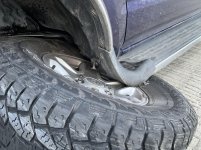
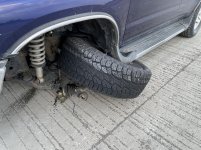
I wanted to share my story of a failed lower ball joint on a 2001 SR5, stock, no lift, 218k miles. The driver's side lower ball joint failed while traveling on the Interstate at 65mph. KABOOM!

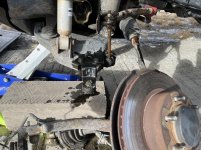
Somehow, the tire/rim/assembly wedged under the front running board (like a ski). The brakes failed, too, so I had to dodge morning rush hour across two lanes, pull out of a spin and glide to a stop in a place suitable for a wrecker. I was very lucky.

The lower ball joint recall from Toyota on this vehicle was performed in 2006 by the dealership.

This is evidently still a problem for post-recall vehicles which almost put me into a ditch and ruined the vehicle (or worse). If the tire/rim had not become lodged like it did it is my opinion that things could have turned out quite differently. The only part holding the tire, rim, and brake assembly was the steering linkage (!).

PLEASE BE AWARE OF THIS DEFECT ON POST-RECALL VEHICLES AS THE PROBLEM EVIDENTLY PERSISTS.
 

Attachments

  • Image (2).jpg
    Image (2).jpg
    131.2 KB · Views: 591
  • Image (1).jpg
    Image (1).jpg
    139.6 KB · Views: 585
  • Image.jpg
    Image.jpg
    140.7 KB · Views: 581
PLEASE BE AWARE OF THIS DEFECT ON POST-RECALL VEHICLES AS THE PROBLEM EVIDENTLY PERSISTS.
Well, they didn't change the ball joint design. Oh, and they aren't lifetime parts - your lower ball joints were 18 years old with probably >150k miles on them... If the boot was damaged and allowed some grit to get in there or corrosion to happen, this will be much more likely to happen.

Glad to hear the damage wasn't worse, and hopefully you used OEM parts. The aftermarket ones last about 1/10 as long as the OEM lower ball joints.

-Charlie
 
That's nuts, but glade you are safe and the 4runner isn't damaged that badly. Yeah ball joints are a wear item and need inspection/replacement over time. Have the ball joints been replaced after the recall was done? 19 years is a long time for ball joints.
 

Members online

Forum statistics

Threads
278,309
Messages
3,554,068
Members
248,016
Latest member
Advally Service

Trending content

Back
Top