Which came first, the Seafoam or new spark plugs?

Register to hide this ad
Either way, you can do it before the new plugs or after, perhaps with new plugs it'll work a bit better at burning the crud out.
 
Catfish, what benefit do you expect from seafoam through the intake manifold? Do run run in heavy stop and go traffic and often times your trip is too short to let your engine fully warm up or something?
I could be way off base but I believe in normal operating condition and using top tier fuels these modern engines (especially Toyota and Honda) run pretty clean. I have on the other hand heard of issues involving overheating of valves using such combustion chamber cleaners through the intake if something goes wrong. I do think your engine can handle it with no problem but unless youre really certain you have an issue you might want to try adding a can to half a tank and see if that helps?
Back to your original question, if it was me if I was going to pull plugs I'd, like to have a look a the plugs before any fuel treatment. A plug reading will give you a good idea of how your engine is really running. The seafoam treatment will erase or alter that clue. So if I still wanted to seafoam it I'd pull the plugs (or a couple not next to each and if they were ugly carboned up I'd put them back in and seafoam with the old plugs. Then change them all at which point you can see what the effect of the seafoam had. But more likely I'd try to figure out why my engine was running dirty.
 
OK, sorry for the absence...it was a busy week. I had noticed that my truck was starting to run a bit rough...idling was kinda shaky, as well as a noticeable lag on accelerating. In addition, my gas gauge/sensor has been off a lot lately, even causing me to run out of gas a couple of times...once still showing a half tank of gas. My guess was the sensor in the tank might be dirty and/or clogged.

The old plugs had 80k miles in them, so I figured it was a good time to replace them (even though they technically had 20k more life left in them)...and I had time to do it. I also figured it might be a good time to run a Seafoam treatment on the engine...couldn't hurt, right?

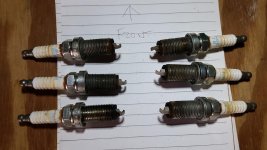
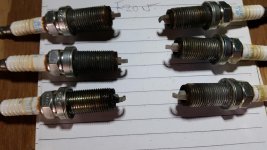
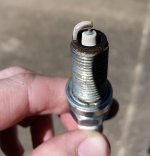
In the end, I replaced the plugs first, then ran the Seafoam. The only reason I did it in that order was timing...had I run the Seafoam first, I would've had to wait for the engine to cool down before replacing the plugs...and I just didn't have that extra few hours at my disposal. I've attached a few pics of the old plugs for fun.

I put half a bottle in one of the vac lines, half a bottle into the crankcase, and half a bottle into the gas tank. Not sure if it's a direct result of the Seafoam, the new plugs, or a combination thereof, but my truck is running more smoothly since doing this project. I've taken a few 200+ mile trips in the past week, and have noticed a bit of a bump in my mileage, as well.

 

Attachments

  • 20170320_160313.jpg
    20170320_160313.jpg
    138.3 KB · Views: 828
  • 20170320_160319.jpg
    20170320_160319.jpg
    135.5 KB · Views: 893
  • 20170320_160350.jpg
    20170320_160350.jpg
    113.8 KB · Views: 1,059
Did you check the gaps on the old plugs compared to the new ones?

If the gap on the old plugs was over the recommended .039 to .043 and especially over the maximum of around .050 that would have a big difference on performance and MPG.
 
I didn't check them after removing them, but I did gap them before installing them a few years ago. The gap wouldn't change over time, would it?
 
I didn't check them after removing them, but I did gap them before installing them a few years ago. The gap wouldn't change over time, would it?

Yes indeed it will, the electrode wears down/burns away over time which leaves you with the gap being greatly increased.

Platinum and Iridium plugs last longer because of the metal the electrode is made of, i.e. either Platinum and
especially Iridium is much harder than what is used on more common plugs and takes longer to burn away.
 
Yes indeed it will, the electrode wears down/burns away over time which leaves you with the gap being greatly increased.

Platinum and Iridium plugs last longer because of the metal the electrode is made of, i.e. either Platinum and
especially Iridium is much harder than what is used on more common plugs and takes longer to burn away.

Ahhh, gotcha. The plugs I removed were iridium plugs; I'll have to check the gap tonight and see if it changed over 80k miles...
 

Members online

Forum statistics

Threads
278,316
Messages
3,554,120
Members
248,016
Latest member
Advally Service

Trending content

Back
Top