Yet another towing thread

mmike87

New member
I have a 2016 TEP, stock aside from stock-size Ko2's. I am looking at a Jayco 19XUD with a max GVW of 4500 pounds (like 3600 empty.) I know the 4R tops off at 5k pounds, so I'd need to be conscious of cargo in the truck as well as passenger weight, but we normally take two vehicles anyway so I am not too concerned there.

I know I need a brake controller and feel comfortable installing that myself. I also read that an aux oil/air tranny cooler is recommended as well. I'd likely see if the dealer had anything they could install.

I would probably take 3-4 trips a year, most of them would likely be within 20-40 miles (there are a lot of campgrounds around here that are really nice.) Maybe one of the trips would be within a couple hundred miles.

Is that all I would need for my needs? Some people suggested air bag or something .. not sure what those are or how difficult they are to install, or how necessary they would be for what I am hoping to do.

Any suggestions appreciated. Thanks.
 
Register to hide this ad
Trailer brake is a must since 4 Runner hitch does not have anti-sway system. Make sure your trailer distribution 60% front and 40% behind center of axle.
 
I just had the AirLift kit installed in our 4R. Easy install (I did our 04) but because of shoulder surgery my local off road shop did it for me. Jisco Offroad shop in Slippery Rock PA. AWESOME guys and VETERAN owned.
 
i wouldn't start off with a transmission cooler, but do get something to monitor transmission temps and see what they look like on one of your short trips. if you need a cooler install one after that, but having to take it slow on one 20mile trip isn't the end of the world if you find out you need one.

i don't understand the anti-sway comment, i don't see why you couldn't use an anti-sway hitch on your 4runner
 
The stock hitch is not anti-sway. You can get anti sway hitch bars but it is just a band aid. Trailer brakes and manual override is a way to go to control HEAVY trailer.

accident.jpg
 
I tow a lot with my 2010 SR5. I was going to put a trans cooler on mine at first, but was told it already had one from the factory. I have never had a problem with overheating and have 193xxx miles on it.

The biggest improvement to towing was hands down the Airlift 1000 air bags. It is like night and day in terms of how the vehicle handles.
My TT only has a GVW of 2800 lbs. and I tow all over the Rocky Mountains. I would be a little concerned about going up to 4500 lbs, at least around here. I have to grab a lot of gears going over some of these passes. Maybe on flat land you would be OK.

Besides the brake controller, you should also look into some sort of anti sway device that goes between your hitch and trailer.
 
The stock hitch is not anti-sway. You can get anti sway hitch bars but it is just a band aid. Trailer brakes and manual override is a way to go to control HEAVY trailer.

accident.jpg

I'm confused.

The stock hitch is a piece of seamless 2.5" square tube with a hole drilled in it for a pin. Just like every other 2" receiver hitch. There's nothing anti-sway about a receiver hitch on any truck. The attachment you put in it may or may not have antisway properties. But that's got nothing to do with the vehicle.

A weight distributing hitch is a good idea. I would recommend one for most campers.


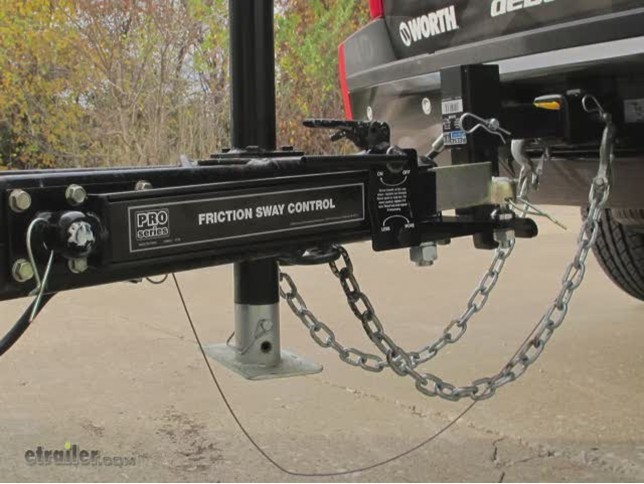
A friction sway control hitch is probably the best way to end up with your trailer upside down. They are a baindaid for poor trailer properties. And if you are relying on one to dampen trailer sway and it fails for any reason - rain, oil, ? you're in big trouble. Fix the trailer. Don't put a $100 bandaid on it. This is bad:
install-pro-series-weight-distribution-sway-control-83660_644.jpg


Fixing the sway means 4 things: load balance fore/aft, load distribution from axle center, distance from tongue to axle center, and speed. They all contribute to the problem of an unstable trailer sway. The tongue weight is usually the most common thing people look at. But it's only 1 of 4 equally contributing factors.

The further your load distribution is from the axles, the more likely to be unstable. The shorter the distance from hitch to axle, the worse it will be. The further back the weight is and the faster you go the worse it will be. Almost all trailers will exhibit uncontrolled sway given enough speed. So - the idea is to adjust the other parameters enough that the speed where it occurs is far outside of your range of driving.

So you can make a trailer with negative tongue weight - but still a very stable trailer if your load is nearly directly over the axle and the axle is far from the hitch. Similarly you can have a trailer with proper tongue weight, that is still unsafe if the trailer has a short wheel base and load moved out to the very ends of the trailer.

Campers tend to be the worst trailers because they have weight that is not located near the axle. And they often have short wheelbases for the length of weight as it's set throughout the trailer. Then add to it a desire to make it easy to tow with light tongue weight and the result is often a marginal trailer to start with. Then you add a bunch of heavy crap to the front or rear cargo holds and pretty soon you're on your side along the highway trying to figure out what happened.

The most important part IMO is not to put a bunch of weight out in the ends of your camper. And add a weight distributing hitch - it effectively acts like a longer wheel base. I'd guess almost all campers of that size come with one already. But if not - I'd go get one. They're not very expensive.

But skip the friction sway device. It will only mask a problem until it fails. And then you'll be way outside of the range where you might be able to correct the problem.


Finally - yes your 4runner does have electronic sway control. It will take over and safely manage a trailer sway in most instances. That doesn't mean you should rely on that. It's a safety feature that might save your butt if you fail at everything else first.
 
Last edited:
The stock hitch is not anti-sway. You can get anti sway hitch bars but it is just a band aid. Trailer brakes and manual override is a way to go to control HEAVY trailer.

accident.jpg

i'm still lost, why can't you use an antisway hitch on the 4runner? brakes are a must and the vehicle also has electronic sway control, but why not use an anti-sway hitch?

Why are you saying you shouldn't use one? They make a big difference when getting passed by big trucks and stuff, no one is saying ONLY rely on the hitch. you should be able to get a good weight distributing anti-sway hitch for a few hundred bucks.

or are you just saying that they don't stop all sway? (because, i mean duh)
 
To answer the OP - Yes the 4runner has a transmission cooler. It's a liquid to liquid cooler that runs through the bottom of the radiator. Is it enough for towing large campers? That probably depends on how far, how fast, and how steep your roads are. The weight of the trailer is of less concern than the shape for transmission issues. The wind resistance is the primary friction you have to overcome at highway speeds. Most campers are not aerodynamic. So you'll have a lot of drag back there. Some folks have reported seeing pretty high transmission temps towing. The Tacoma has an auxiliary cooler. I personally think it wouldn't be a bad idea to install one. If I were regularly towing a large camper - I'd probably put one on. If nothing else, they should be able to use an aftermarket one.

On the other hand - I don't think there is any example of any 5th gen transmission failure that I'm aware of for any reason. So maybe it's overkill? I don't know. It's cheap insurance.
 
i'm still lost, why can't you use an antisway hitch on the 4runner? brakes are a must and the vehicle also has electronic sway control, but why not use an anti-sway hitch?

Why are you saying you shouldn't use one? They make a big difference when getting passed by big trucks and stuff, no one is saying ONLY rely on the hitch. you should be able to get a good weight distributing anti-sway hitch for a few hundred bucks.

or are you just saying that they don't stop all sway? (because, i mean duh)

Nope, Im saying antisway hitch by itself is not enough for heavy trailer. Use whatever but my point is to outfit the trailer itself properly with brakes and correct weight distribution.
 
The stock hitch is not anti-sway. You can get anti sway hitch bars but it is just a band aid. Trailer brakes and manual override is a way to go to control HEAVY trailer.

accident.jpg

Well, a brake controller is a given as far as I am concerned. Cheap and pretty easy to install, no reason not to have one as far as I am concerned.
 
I'm confused.

The stock hitch is a piece of seamless 2.5" square tube with a hole drilled in it for a pin. Just like every other 2" receiver hitch. There's nothing anti-sway about a receiver hitch on any truck. The attachment you put in it may or may not have antisway properties. But that's got nothing to do with the vehicle.

A weight distributing hitch is a good idea. I would recommend one for most campers.


A friction sway control hitch is probably the best way to end up with your trailer upside down. They are a baindaid for poor trailer properties. And if you are relying on one to dampen trailer sway and it fails for any reason - rain, oil, ? you're in big trouble. Fix the trailer. Don't put a $100 bandaid on it. This is bad:
install-pro-series-weight-distribution-sway-control-83660_644.jpg


Fixing the sway means 4 things: load balance fore/aft, load distribution from axle center, distance from tongue to axle center, and speed. They all contribute to the problem of an unstable trailer sway. The tongue weight is usually the most common thing people look at. But it's only 1 of 4 equally contributing factors.

The further your load distribution is from the axles, the more likely to be unstable. The shorter the distance from hitch to axle, the worse it will be. The further back the weight is and the faster you go the worse it will be. Almost all trailers will exhibit uncontrolled sway given enough speed. So - the idea is to adjust the other parameters enough that the speed where it occurs is far outside of your range of driving.

So you can make a trailer with negative tongue weight - but still a very stable trailer if your load is nearly directly over the axle and the axle is far from the hitch. Similarly you can have a trailer with proper tongue weight, that is still unsafe if the trailer has a short wheel base and load moved out to the very ends of the trailer.

Campers tend to be the worst trailers because they have weight that is not located near the axle. And they often have short wheelbases for the length of weight as it's set throughout the trailer. Then add to it a desire to make it easy to tow with light tongue weight and the result is often a marginal trailer to start with. Then you add a bunch of heavy crap to the front or rear cargo holds and pretty soon you're on your side along the highway trying to figure out what happened.

The most important part IMO is not to put a bunch of weight out in the ends of your camper. And add a weight distributing hitch - it effectively acts like a longer wheel base. I'd guess almost all campers of that size come with one already. But if not - I'd go get one. They're not very expensive.

But skip the friction sway device. It will only mask a problem until it fails. And then you'll be way outside of the range where you might be able to correct the problem.


Finally - yes your 4runner does have electronic sway control. It will take over and safely manage a trailer sway in most instances. That doesn't mean you should rely on that. It's a safety feature that might save your butt if you fail at everything else first.

So, what enables the electronic sway control? Just the installation of a brake controller?
 
So, forgive my ignorance ... but are air bags AND a weight distribution hitch worthwhile? They seem (to me) to kind of do the same thing? -ish?
 
So, what enables the electronic sway control? Just the installation of a brake controller?

It's completely automatic. The vehicle has some pretty sophisticated sensors that will measure yaw, pitch, and direction and engage automatically. Just like vehicle stability control. You'll know when it engages. It's not a substitute for proper trailer tracking. It's more like emergency override. It can outmaneuver an uncontrollable trailer sway that a driver cannot.

<iframe width="736" height="414" src="https://www.youtube.com/embed/x2Jj4Xsnei0" frameborder="0" allowfullscreen></iframe>

Here's a good demonstration - although with a different manufacturer

<iframe width="854" height="480" src="https://www.youtube.com/embed/Zrpowvtn0d8" frameborder="0" allowfullscreen></iframe>
 
Last edited:
So, in my owner's manual it says this:

"If enabled, Trailer Sway Control can also help to
stabilize the vehicle and trailer."

and this:

◆ Trailer Sway Control
Helps the driver to control trailer sway by selectively applying brake
pressure for individual wheels and reducing engine torque when
trailer sway is detected.
Trailer Sway Control is part of the VSC system and will not operate
if VSC is turned off or experiences a malfunction.

I had never noticed that before ... thanks for the info!
 
Last edited:
So, forgive my ignorance ... but are air bags AND a weight distribution hitch worthwhile? They seem (to me) to kind of do the same thing? -ish?

I think it depends how much towing and hauling you want. Generally I'd say yes. The airbags are ~ $100 and can be installed in about an hour. So they should be pretty inexpensive. They basically just help with the 4runner's pretty low rear spring rate. The weight distribution does take a lot of weight off the rear axle. It's not necessary to have both. Just gives you a little more weight capacity in the rear. I'd put a weight distributing hitch on first. Even with my parents HD2500 pickup they use a weight dist. hitch for a 7500lb camp trailer because of poor dynamics of a huge box. It makes towing a lot more enjoyable. The weight isn't an issue at all. The dump trailer with 15,000lbs doesn't need a weight dist. It has far better trailing dynamics even with a lot more weight.

Campers are just really marginal trailers for sway issues. I'm not sure what else can be said. IMO - try a test run. You can use the weight dist hitch and see if you think you need more rear load capacity. It's not likely to be some crazy out of control experience. Just take it easy as you get used to it. Take a few test drives a few weeks before your first long trip. The RV sales place should let you either take the one you're buying or a comparable size used one for a few test drives to see if it's what you want.
 
I'll chime in with info I learned mostly from here. Get a decent WDH with built in sway control, and get rear spring air bags.

A month ago, I drove from Saint Louis to just outside of Philly, picked up a 4300 pound Lance 1685, and pulled it down to DC, then over the Appalachians back to Saint Louis. Ten days ago I went camping 150 miles away. I use Firestone Airbags with ~20 pounds pressure, and a Fastway E2 WDH with antisway trunion bars (600/6000).

My 2016 Limited did a fine job. No sway (even when being passed by semis), and same rake as without the trailer.

The only issue was going from 21 mpg to about 11 mpg....

;)
 
OK, thanks, everyone ... I think the strategy I'll try, if we decide on a camper at all, is certainly brake controller and WDH for cut 1, monitor trans temps, add aux cooler if need be and maybe air bags, too if the WDH alone isn't cutting it.

Thanks again!
 
i wouldn't start off with a transmission cooler, but do get something to monitor transmission temps and see what they look like on one of your short trips. if you need a cooler install one after that, but having to take it slow on one 20mile trip isn't the end of the world if you find out you need one.

i don't understand the anti-sway comment, i don't see why you couldn't use an anti-sway hitch on your 4runner


Does the 5th gen 4runner come standard with a transmission cooler? I am getting conflicting info on that question. It seems that Canadian models do. I bought a used 2016 from a dealer in Pa. The salesman thought that it had a transmission cooler since it had a tow hitch and wiring installed - but I felt like he was just making an assumption. "Transmission cooler" is not listed specifically as a feature so I am left wondering...
 
Does the 5th gen 4runner come standard with a transmission cooler? I am getting conflicting info on that question. It seems that Canadian models do. I bought a used 2016 from a dealer in Pa. The salesman thought that it had a transmission cooler since it had a tow hitch and wiring installed - but I felt like he was just making an assumption. "Transmission cooler" is not listed specifically as a feature so I am left wondering...

I bought my '17 TRD OR last month. Dealer told me one came factory on it. I'll get under it tomorrow and double check. Cooler also isn't listed on my sheet either. So I'm wondering if he was just gassing up the sale.
This is what I'm towing around the Adirondacks, it's pretty light though.

13a55916d84978a647acd129b014b59a.jpg
 
Last edited:

Members online

Forum statistics

Threads
278,308
Messages
3,554,058
Members
248,016
Latest member
Advally Service

Trending content

Back
Top