Nice video, thanks for sharing. Not exactly "scientific", but still interesting experiment and results. In this example with his 2nd Generation Tacoma, it may be true that 4WD is better due to a constant Brake Distribution force (70 F/30 R ish) that you can add some extra engine braking force and better distribute the braking for the traction scenario.
However, more modern vehicles use EBD (Electronic Brake Distribution) that is not at a constant distribution. Rather modern EBD is variable and is coupled with ABS for further control. It is able to distribute brake force between front and rear as well as individual wheels.
So, in theory the absolute best case braking on a modern vehicle would be in Neutral. That's because the drivetrain cannot create any unexpected changes in torque (downshift) and your brake system generates 10x+ the brake torque of engine braking/downshifting so it's contribution is insignificant. This allows the EBD to apply the maximum brake torque to each wheel individually for it's available traction. The EBD is constantly shuffling this torque based on a feedback loop with wheel speed, vehicle speed, steering angle, and other sensors to always maximize wheel torque per traction. Essentially launch control in reverse.
Modern electronics work well. But not as well as mechanical linkage. It would require time travel for electronic brake force distribution to equal mechanical linkage.
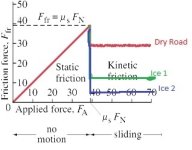
It starts with a basic idea of the threshold of motion. At any level of brake force applied to the tire/road interface before it skids, the friction force equals the applied force. And 2wd and 4x4 cars will stop similarly. That holds true until you reach the threshold of motion. The threshold of motion is the point at which the applied force exceeds the maximum static friction - this is where you start to skid. Once you start to skid you are now in a state of kinetic friction with the surface. The the graph at the bottom shows this threshold at different deltas between static and kinetic. On snow and ice the delta is significant. Often 10:1 or greater.
Braking system on most vehicles is friction surfaces actuated by hydraulic pressure. Each tire’s brake operates largely independent of the other tires brakes and the vehicle using software and mechanical systems attempts to apply approximately similar normal force adjusted (weight on the tire) braking force. The idea being if there is a uniform road surface and brake force is adjusted to match the weight on the tire, it'll reach the threshold of motion about the same time as the other tires.
The assumption of uniform surface does not hold in snow and ice conditions. At any given time on snow and ice each tire may have significantly different contact patch conditions with the underlying surface. This would be represented on the graph as having the peak static friction (or threshold of motion) being different for each tire and varying rapidly with time/movement as the tire rolls over the variable snow and ice road surface. And that is something that an ECU cannot know, calculate, or adjust for until a tire has already slipped and the signal from the hall effect sensor in the ABS system registers a slip. (This is why it would require time travel for a current ABS system to match mechanical linkage - it would have to detect actual slip in the future, then adjust before it happens.)
The common rotational velocity deceleration with mechanical linked tires (4x4) means all the tires will decelerate together and importantly they will
reach the max static friction at the same time. That's the key to stopping faster in this situation. With uncoupled systems (2wd) the first tire to reach max static friction will slip and then the ABS will flutter about the peak friction point giving some less than full braking force as it slips, releases brake force, tires spins again, re applies brake force, and slips again. My guess is the best systems might reach 70%, but I haven't measured it. Might be 50% might be a bit higher. But it's always below 100%.
So to put some really simplified math in here if you have 4 tires that have 5, 10, 15, 20 as the units of static friction at each of the 4 tires and the kinetic friction is 10%, then the linked 4X4 system can achieve the entire combined 50 units of friction with the surface before slipping. The non-linked system will apply uniform brake force to each tire (not the ground after one type slips). So after all 4 tires reach 5 (20 combined) tire 1 slips and starts to slide. Keep applying more brake and at 10 (31 system) tire two slips. And you can keep going to a max of 15 (33 combined units) before tire 3 slips and you’re going to then drop to about 18 combined units. Peak braking friction force applied to stop the car for the uncoupled car is roughly 33 units. Compared to 50 for the coupled system. Under certain conditions the difference is quite large.
The greater the difference between static and kinetic friction and the greater the variability in the road surface the greater the benefit in braking of the mechanical connection. In some conditions it'll be small. In others it'll be quite large. The above represents a snapshot in time, but actual braking is the integral of summation of every moment along the entire stop. And throughout a stop a vehicle may experience points where it has very uniform surface and points where it's significantly varied between each tire's contact patch. Over a stop where there's half a dozen patches of ice and some dry road and some mixed areas - the stopping distance of the 4x4 will end up measurably shorter.
And that's what you see in basically every test of a mechanically linked 4x4 or awd system vs an ABS system. The worst of all would be uncoupling all of the tires if you could shift the transfer case into N at speed as that would effectively disconnect the two rear wheels from each other.
This also does not apply to clutch based awd systems that are open clutch or any other design that is not a mechanical linkage like the Rav4 hybrid that has two independent drive systems. It only works with a true mechanical linkage. It does not have to have locking differentials, because it's transferring torque from traction to non-traction tires, it works in reverse of applied torque from the engine and open diffs work the same as locked in this case. So an awd limited 4Runner will act the same as it would with the center diff locked under braking.
The complete formula for braking distance with static and kinetic friction includes an integral of 4 subfunctions each with a jump discontinuity that varies in magnitude and point of occurrence, so it's very complicated and it would take me a while to even figure out how to write it out on a forum like this. Adding in an abs functionality would make it even more complicated because we'd have to make a bunch of assumptions about the ABS system, processing speed, etc. Maybe I can hand write and take a picture if someone really needs it for some reason.
I'd just rely on empirical results. - go test it. Best part of this is that we can all test it. Any of us who has a 4x4 4Runner can find an icy parking lot and go try it.