I'm in trouble - '97 base model - gallons of water in the gas tank - how to drain it?

Don't ask how the water got there - as it's embarrassing - but it's there now.
I'm in trouble. I have to figure out today how to get that water out.

It's a '97 base model, 2WD, 5speed, 2.4L engine, with AC.
I pushed it outside so that I can work in a windy open environment.

At least an entire jug of WATER is in the tank (which is currently 3/4 full).
So that's about 5 gallons of water below about 8 gallons of gas in the fuel tank.

I tried to shove a 1/2-inch vinyl siphon hose into the fuel filler but the hose only goes in only an arm's length and then stops dead.
Obviously there's some kind of restrictor (anti roll ball or anti siphon or whatever).

I will look for a drain plug in the fuel tank - where I'm hoping to God that there is one - but preliminary searches haven't found it yet.
I found the TimTheToolman sending-unit video - which shows how to drop the tank - but I'm hoping to God I don't have to do that.

Which is why I'm desperately asking for help here.

I've got plenty of catch pans to safely collect the fuel to put into plenty of gas jugs so safely collecting the waste isn't the problem.
Getting it OUT of the fuel tank is the issue I'm asking about.

I'm assuming I have three main options, so I'm asking which are feasible.
1. Siphon it out (can it be done?)
2. Drain it out (is there a drain plug or a hose that drains from the bottom?)
3. Pump it out (by jumping 12V across the fuel pump?)

I can "guess" there are other options, but they're less obvious how:
4. There's apparently an "access hole" under the rear seat (but then how to get a hose into the tank?)
5. Remove the large-diameter fuel filler hose from the tank (but WHERE is the anti-siphon restrictor located?)
6. Remove any fuel line into the tank (and hope that gravity might get rid of the bottom 5 gallons?)
7. Use a separate fuel pump on a fuel line (and hope that the fuel line goes to the bottom of the tank?)
8. Worst case, I can drop the fuel tank (but I'm hoping I won't have to go that far)

Right now, I don't know what is the best approach.

My main question on siphoning is whether or not it's possible and what kind of tube will get past the restrictor?
My main question on draining is simply WHERE is the drain plug and how do I access it?

If neither of those two easy solutions will work, then I'm stuck with draining the fuel using a pump. I don't (yet) know where the fuel pump is, but I assume it's in the tank. So I have to find the lines to the fuel pump.

So my main question for letting the onboard fuel pump do the work is where do I connect the 12VDC to on the fuel pump power circuit and where do I open the fuel pump lines (presumably far away from where I connect the 12VDC to prevent sparks from causing a problem).

A neighbor said he's going to drop off two different types of ancillary fuel pumps, so another option is to use one of those outdoor fuel pumps to drain - but the same question arises as to WHERE and HOW to connect that ancillary fuel pump to the lines.
1. 12V Fuel transfer Pump
2. Automatic Fuel Transfer Pump

I will check on my phone periodically as I don't have time so I hope someone can advise me as to what THEY used when they had a similar problem.
 
Last edited:
Register to hide this ad
So you create a post. Which is great and detailed I now know its a earlier model.
Never good to make multiple posts, I get it but this one is all you really needed. :-)

1.) Your easiest way is to disconnect your return line and power the internal fuel pump via the access cover at the fuel pump tank plug under the rear drivers side.

Using the internal pump will get enough of it out that fresh 10% ethanol will get the rest of the system cleaned out. :-)

2.) if your not in the rust belt. you could take the filler line off the tank then remove the filler neck off the tank. Then you can get your line in the tank that way.

I know I would just use the fuel pump to pump the tank clean. Using the return line in the engine compartment as the exiting point. That's how I would do it. Others may have different thoughts.

No way would i try to run the water out of the tank. I keep the engine off until this water issue is gone. :-)
 
I would disconnect the feed line at the filter and as stated above, use the pump to drain the tank. I would not run water through the filter and up to the injectors. Just disconnect the feed at the filter.
 
you could take the filler line off the tank then remove the filler neck off the tank. Then you can get your line in the tank that way.

Thanks. Apologies for the desperation. Yesterday it was topped off with five gallons of what turned out to be water, and today it ran for only a few moments before it died and wouldn't restart (I wasn't the driver but it never made it more than 20 feet out of the garage). I'm worried about hydrolock.

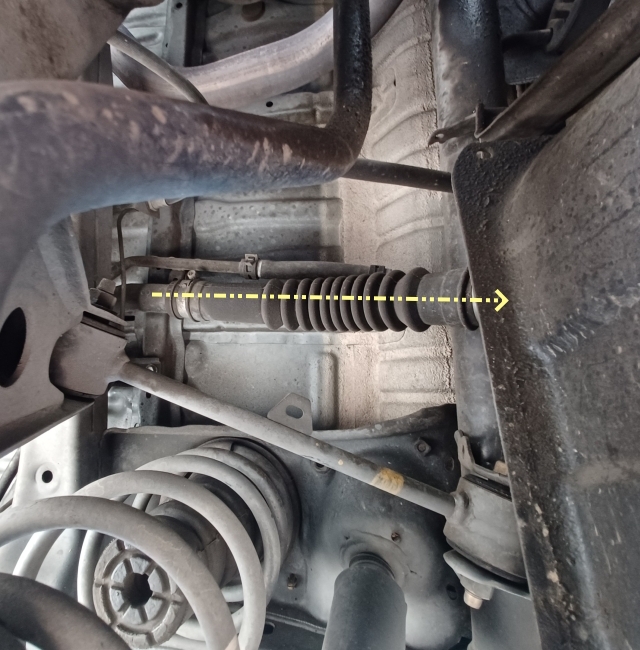
I made a LOT of mistakes since I was flying blind, but in the end, I opted for the fuel filler hose removal to get to the gas tank to siphon the liquid out.
fuel-filler-hose.jpg


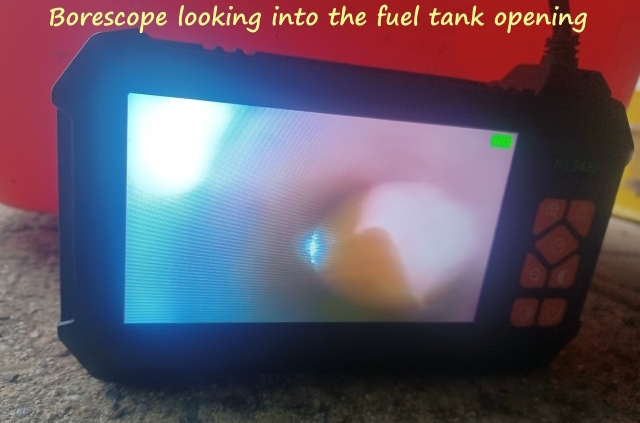
Unfortunately I also wasted a LOT of time with the borescope my friend lent me, but then after an hour of not getting it to show me anything, I started wondering what would happen if there was a tiny spark - and I shut it down - but I never did find any anti-siphon valve that I could identify.
looking-into-fuel-tank.jpg


I hated all the false starts, but I did quickly search first for a DIY but I wasn't able to do a complete search due to time constraints. Even so, I was very surprised I didn't find anyone in the initial searches who showed, with a DIY with photos, how they emptied the tank without dropping it.
removal.jpg


I might have to write up the DIY if it doesn't exist (but I'd be shocked if a 30-year-old 4Runner has no DIY for getting the gas out of the tank).

I was able to siphon out just a few ounces over 11 gallons.
empty.jpg


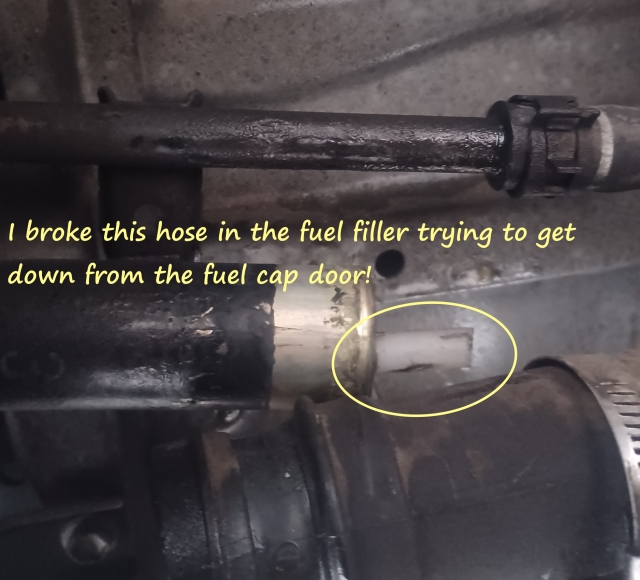
I first tried all sorts of hoses starting from the fuel filler cap door, but they kept getting stuck (if they were flexible) or breaking apart inside the fuel-filler tube (if they were more rigid). This one broke off but I pulled it out later.
broken-hose.jpg


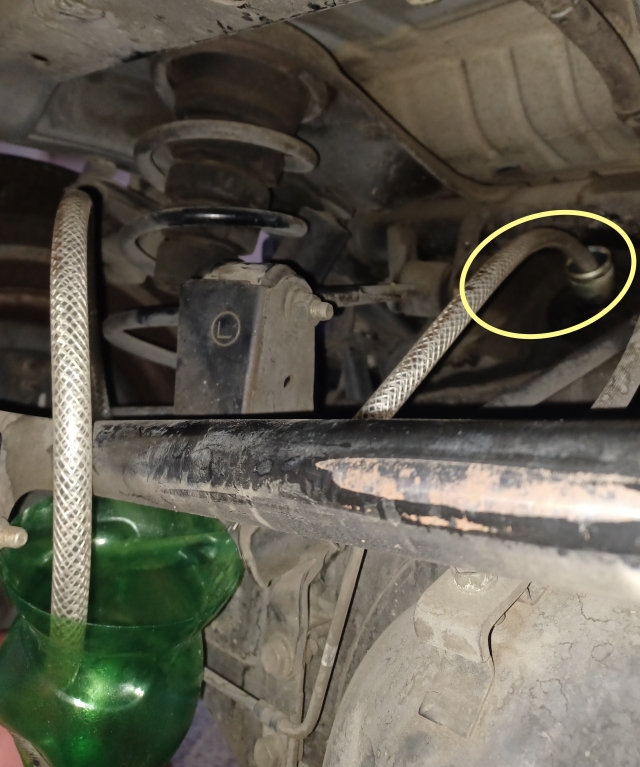
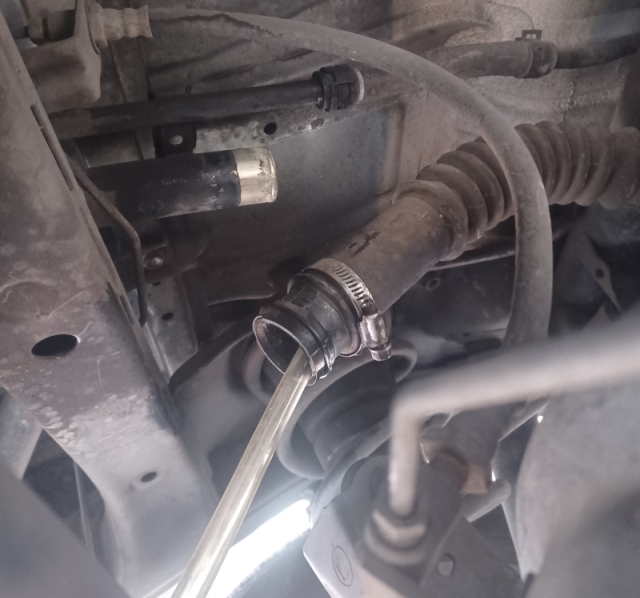
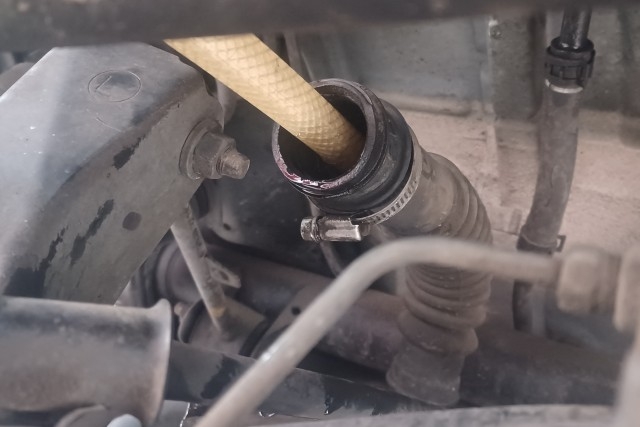
I ended up removing both 10mm/#2Phillips hose clamps ends of the foot-long 1-1/2-inch diameter rubber filler hose which goes into the rump hump of the fuel tank. Then I shoved my 3/8ths inch beer carbonation vinyl hose into the tank as far as it would go, and blew on it until I felt resistance.
hose.jpg


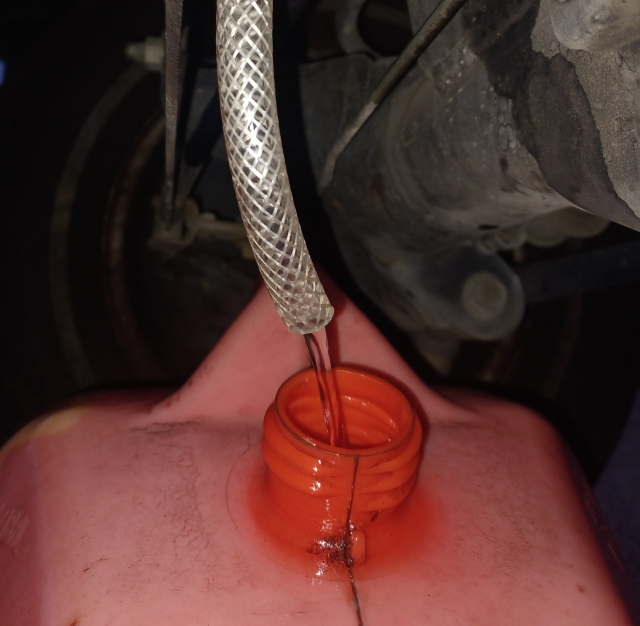
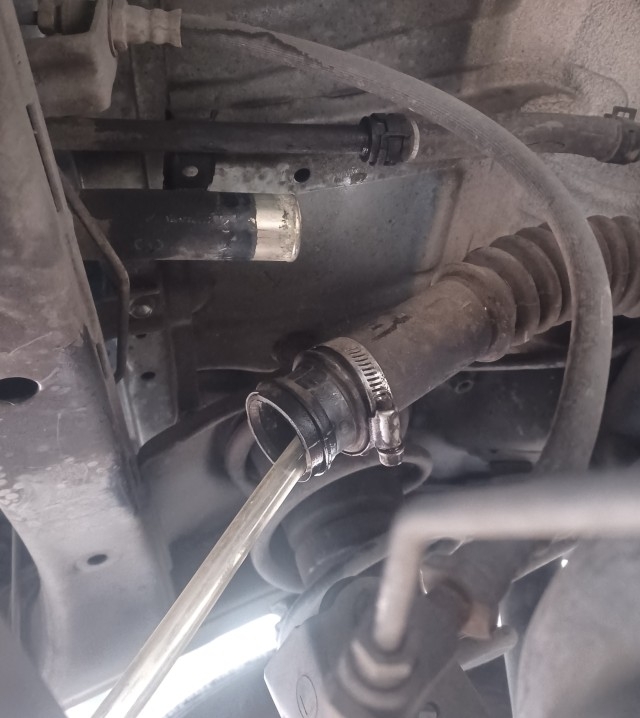
Then, lucky me, I mouth siphoned (I'm still burping gas). After a few wet starts, 11 gallons eventually ran out continuously but very slowly. Very very very slowly. Took at least an hour or more just to empty 11 gallons.
slow.jpg


Without a DIY, I made a ton of guesses, all of which failed except the final guess. For example, the siphon hose gets stuck if you try to remove only the upper end of the foot-long fuel-filler rubber hose, and you need a stiffer siphon hose than the one in this photo (which failed).
false-start.jpg


And, if you try to go through the fuel filler door, that hose will break inside the fuel-filler hose - which you'll have to open up to remove the pieces.


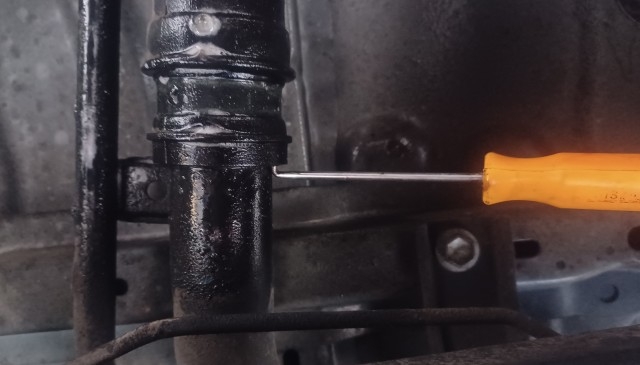
I need to thank Tim-The-Toolman for his trick of Harbor Freight angled pick tools to loosen the hose after removing the 10mm hose-clamp bolts.
timthetoolmantrick.jpg


But I tried removing only the upper end of the hose and that just won't work. The hose gets stuck every time in those creased folds.
this-wont-work.jpg


I wasted a LOT of time trying to find the optimal hose but no hose would work from the upper end of the fuel filler hose so my recommendation is to go deep the first time instead of wasting time on the wrong end.
hose-size-is-tricky.jpg


At the end I carefully poured the results into gas cans where I stopped at the 5-gallon mark to make sure I measured the 11 gallons right.

I am forced to leave it unbuttoned overnight - but tomorrow I'll check this thread for advice to see what the next step is. I'm completely unfamiliar with water in gas tanks. I saw something about ethanol. Where do I get it?

Can I just put some kind of store-bought alcohol into the tank? Or should it be from a 10% blend. Do you think the engine was damaged? I hope not.

I apologize for having so many questions. This was thrust upon me with no preparation. My friend belatedly dropped off the 12VDC fuel pump so I will see if I can get out the last vestiges of fuel tomorrow morning. Sorry for the run-on sentences.

Any advice is appreciatred, as this is a first for me and I couldn't' find a single DIY - but I admit I didn't have a whole lot of time to look either.
 
Supposedly you can use rubbing alcohol make the engine burn the water off. But he was testing that with a lawn mower, carbureted engines will run if they can run no matter how poorly. The ECU in a 4runner might quit if the alcohol water mix is too different from the gasoline it was designed to run.

Also important to remember the fuel lines were designed for 10% ethanol max (E10). I've never heard of someone messing up the fuel lines on a 3rd gen by going over.
 
The 3rd gen 4runners have I'd say about 97% metal fuel lines, with the last 3% being from metal lines to engine. Cars now a days have some type of pex/plastic/vinyl tubing that isn't friendly to ethanol with quick disconnects.

There is a baffle/sump where the pump sits where it might be impossible to get the water out due to its shape. I'd put the front up on ramps to make any remaining water go to the back of the tank and then you can get it out from there.

Only other way to get it 100% empty and clean would be to drop the tank and drain and let dry.

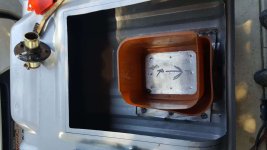
This pic is the baffle/sump that's in the stock tank.
 

Attachments

  • 20191012_132331_compress83_VxnPXzvW1q.jpeg
    20191012_132331_compress83_VxnPXzvW1q.jpeg
    113.5 KB · Views: 611
Last edited:
This pic is the baffle/sump that's in the stock tank.

Thanks for the picture of the baffle inside the tank around the water pump. It behooves us to all know where all the bends & baffles are, in case the next person who reads this needs to know ahead of time.

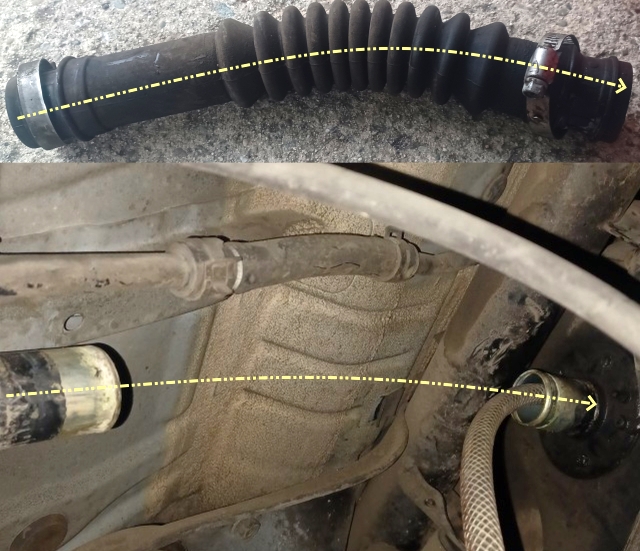
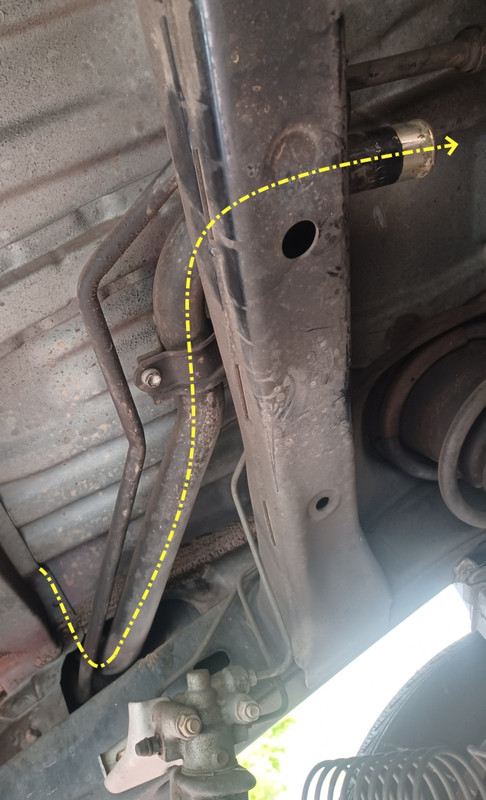
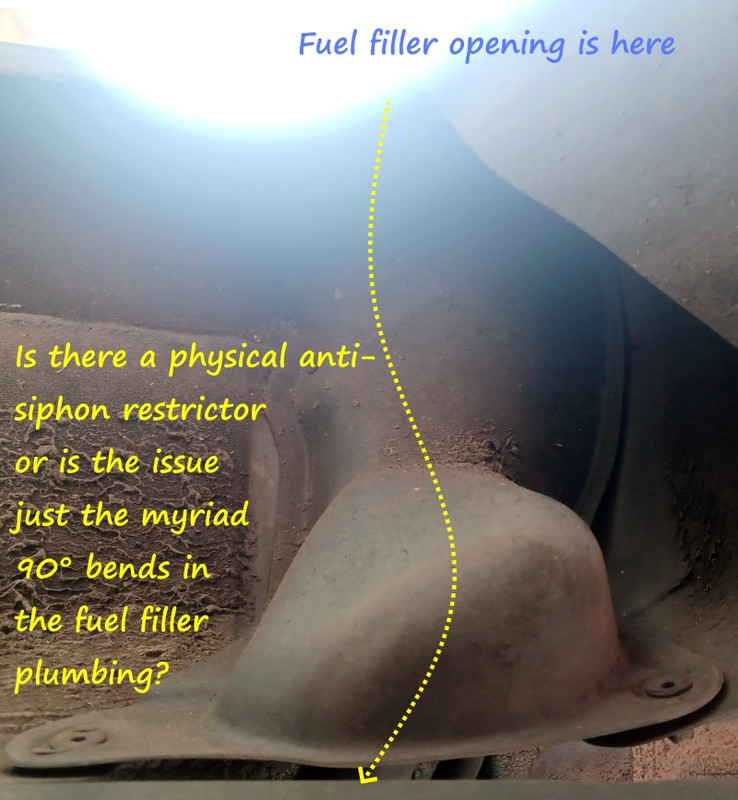
For example, here's a picture of the pipe from the fuel filler door to the rubber hose that connects to the back top rump of the gas tank. I don't see any anti-siphon valves - but - it sure has a couple of very sharp bends, which I think prevents siphoning from the gas cap entry door.
antisiphon.jpg


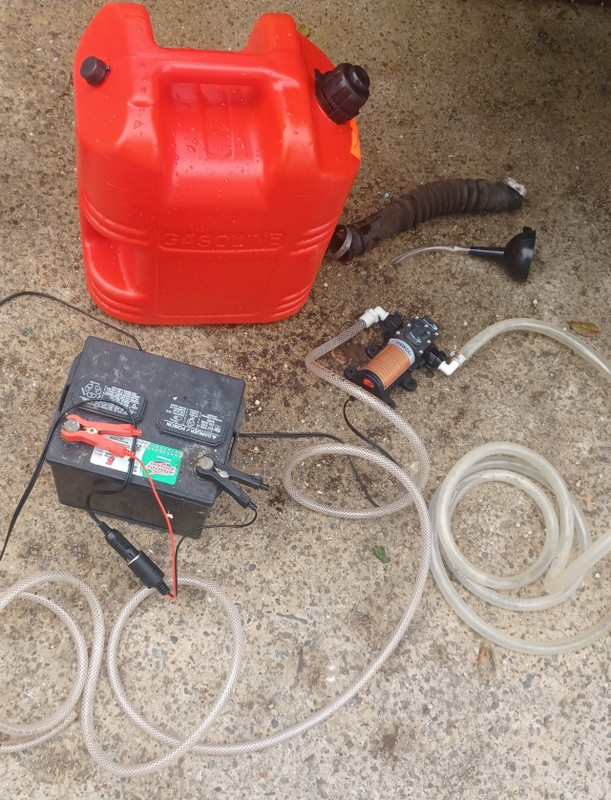
I finally got 13-1/2 gallons of liquid out using the 12VDC fuel pump lent to me by my friend, where each gallon was more water and less gas than the prior gallon was.
12v-gaspump.jpg


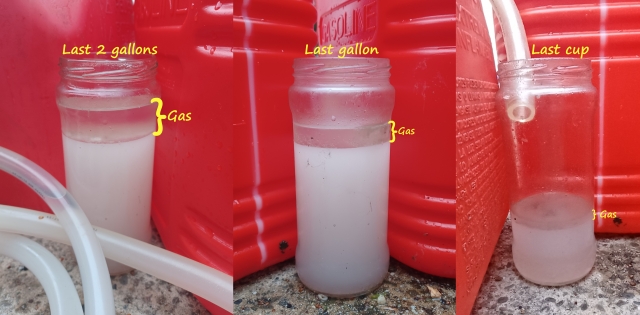
I took the advice above to tilt the vehicle from rear high first, and then in the end, front up in the air as far as I could get it. When I jacked up the front as far as I could get it, I got another cup of liquid, so that helped as the last few gallons were almost all water as you can tell from this composite photo.
waterratio.jpg


Tomorrow I'll head to Costco to get the 10% Ethanol blend of fuel. Given the tank is almost completely empty, is there a special procedure I should use to gently ease the engine back using regular fuel?

I don't know what to do once I fill it with gasoline. Should I run the fuel lines dry first by cranking the engine with the tank completely empty?

Should I replace the fuel filter?
(I don't even know where it is, but I haven't looked yet.)

Where's the rule book on how to proceed? :)
 
Most people in this country are forced to buy gasoline cut with 10% ethanol whether I like it or not (I do not), so treat it like any regular fill up because that's what it is. If you're confident that you got the water out you can treat it like any other fill up

If possible you want to agitate the fuel and the water because if they separate the engine could be pumped pure water (if there is any) instead of the mix.

If you're not confident, Heet might help with water contamination even though pump gasoline has ethanol it's not added to fight water contamination, it's added to boost octane and appease corn farmers.

Don't let the fuel pump run dry, the pump is lubricated by the fuel and you can wear out the motor if you do.

It would be a good time to change the fuel filter if you ever wanted to because it's not like the fuel you're losing is fuel you want.
 
I would disconnect the feed line at the filter and as stated above, use the pump to drain the tank. I would not run water through the filter and up to the injectors. Just disconnect the feed at the filter.

Good idea. I cant see it hurting either way though.. As most likely the water is already at the injectors anyways. The fresh fuel get whats left. :-)

I just wasn't looking for the next thread of I stripped my fuel nuts lines at the fuel filter. Now what do i do...;-) As we all know those nuts into the fuel filter can cause major nightmares. Especially in the rust belt areas.
 
If you're not confident, Heet might help with water contamination even though pump gasoline has ethanol it's not added to fight water contamination, it's added to boost octane and appease corn farmers.

Thanks for the advice on Heet. I watched the Project Farm video on that, but for now, I'm confident almost all the water is out of that 18-1/2 gallon tank.

My "worries" on that is I have no idea how to pump the water that got into the lines out.

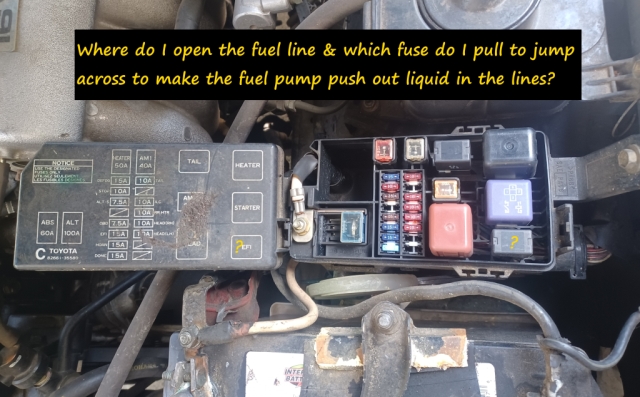
In a few places I saw you remove a fuse and jump across it, but my EFI fuse won't come out.
fuses.jpg


Don't let the fuel pump run dry, the pump is lubricated by the fuel and you can wear out the motor if you do.

What I don't know is where to open the lines and how to make the fuel pump work since when I tried to pull the EFI fuse, it wouldn't budge.

It would be a good time to change the fuel filter if you ever wanted to because it's not like the fuel you're losing is fuel you want.

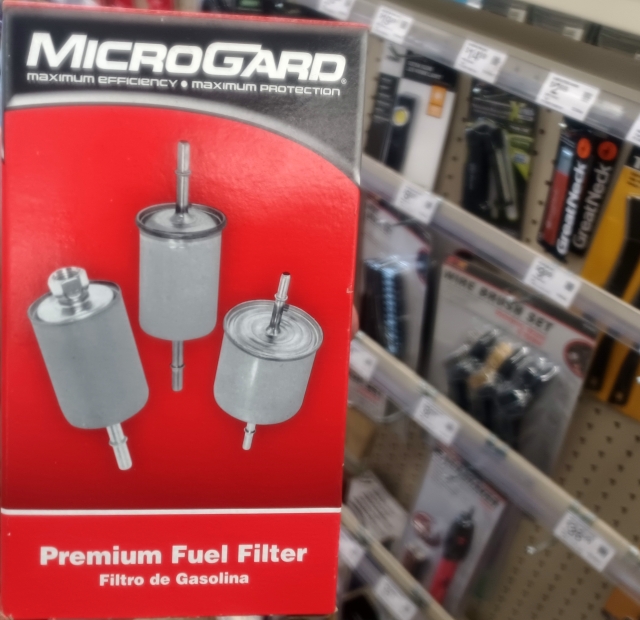
I think I'll get a fuel filter anyways. Is there a recommended brand? Or will anything that fits from Amazon work?

I don't know if I need to say this, but I don't know what I'm doing (yet) as this was thrust upon me without any prior planning so your help is appreciated.
 
Thanks for the advice on Heet. I watched the Project Farm video on that, but for now, I'm confident almost all the water is out of that 18-1/2 gallon tank.

My "worries" on that is I have no idea how to pump the water that got into the lines out.

In a few places I saw you remove a fuse and jump across it, but my EFI fuse won't come out.
The engine has a return-type fuel system. When the fuel pump is on, the fuel lines have a constant flow of fuel from the tank, up to the engine, past all the fuel injectors to the pressure regulator and back to the tank.

Just put in fresh fuel and drive it.

In factory form, the fuel pump only runs when the engine is cranking (key in START position) or the engine is running (circuit opening relay triggered by the ECU when the engine is running).

If you want to power the fuel pump in the key ON, engine OFF position, you need to jumper the circuit opening relay that is bolted/mounted on the bottom of the fuse box in the driver's side lower dash. (early OBD-I Toyota's had a way to do it from the diagnostic connector in the engine bay, but that connection is not there on the 3rd gen 4Runner...) Obviously you can also directly power it with the right wires under the rear driver's side seat bottom too...

-Charlie
 
Just put in fresh fuel and drive it.

To give an update, that post gave me the confidence today to do exactly what Charlie recommended, even though I did pick up a fuel filter at O'Reilly's this morning to replace the one under the driver's seat area (but the comment about stripping the threads scared me off as it had already been days since the original problem).
microguardfilter.jpg


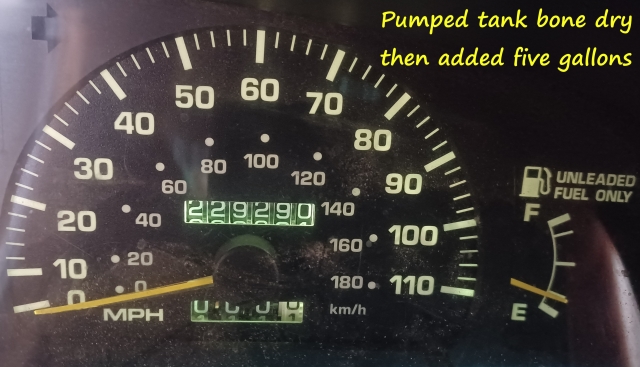
I put five gallons of gasoline of Costco into the tank (which, interestingly, brought the fuel gauge level to 1/4 reading for the nominal 18.5 gallon tank).
fivegallons.jpg


Then I tried starting it until the battery died. I jumped the battery from a donor vehicle (with that donor vehicle running) and tried again, and again, and again, and again.

Finally the engine sputtered to the point that I could get it to run for a few seconds by vigorously pumping the gas pedal (do they still have accelerator injectors?).

After a few of those very rough starts, the engine started purring beautifully.
Thank you everyone for your kind help and supportive encouragement.

Without you, I wouldn't have had the knowledge or courage to overcome what turned out to be 95% water in the last few gallons in the tank.
 
Finally the engine sputtered to the point that I could get it to run for a few seconds by vigorously pumping the gas pedal (do they still have accelerator injectors?).

After a few of those very rough starts, the engine started purring beautifully.
Thank you everyone for your kind help and supportive encouragement.

Without you, I wouldn't have had the knowledge or courage to overcome what turned out to be 95% water in the last few gallons in the tank.
No throttle pump in the traditional (carb) sense, though there is 'accelerator enrichment' that dumps a bit of extra fuel on large throttle changes. It just sounds like you needed to get the water out of the injectors themselves.

There is a 'flood-clear' function. If you go full throttle when starting, it actually turns OFF the fuel injectors if you need to crank and not start the engine.

You will likely want to check the condition of the engine oil - there may have been a fair amount of water that got in there. Running it a while to evaporate it or just changing the oil may be a good idea.

-Charlie
 
No throttle pump in the traditional (carb) sense, though there is 'accelerator enrichment' that dumps a bit of extra fuel on large throttle changes.

Thanks for explaining that. I'm told by my Dad that in the olden days, you guys pumped the pedal BEFORE starting the car, which he said squirts the juice into the cold intake manifold to increase the fuel:air ratio for starting.

I was definitely giving "large throttle changes" as I was pumping vigorously to the firewall a couple times a second just to keep the engine alive in the beginning.

It just sounds like you needed to get the water out of the injectors themselves.

I'm a little confused by that statement because the injectors don't "store" fuel, so I guess what you mean is there must have been a lot of water left in the fuel lines from the fuel tank to the engine and back in the lines to the fuel tank.

Then, when I cranked the engine, all that water got pushed through the injectors into the combustion chamber (worried about hydrolock all the time) and then whatever was unused went back to the fuel tank (I guess). I wonder what the volume of the fuel lines are.

a. Looking it up, I think the supply lines are 5/16 inch ID and the return lines are 1/4 inch ID
b. The wheelbase is 105.3 inches apparently
c. Fuel line kits are apparently around 38 to 46 inches long

If I calculate the volume in those two fuel lines of about 40 inches, the approximate volume of fuel in a 40-inch section of the 5/16-inch supply line is about 3.068 cubic inches while the approximate volume of fuel in a 40-inch section of the 1/4-inch return line is about 1.964 cubic inches, for a total of 5.032 cubic inches (or a little less than 3 fluid ounces, and a little over 82 milliliters of water).

Given we have about 1-1/2 ounces of water in the supply line, I'm trying to calculate how many cranks that will take to get rid of. It took me ten or fifteen minutes of cranking, but that wasn't constant (as the battery was clearly dwindling until I jumped it with another vehicle).

I looked it up to find that passenger vehicles typically consume between 0.2 to 0.5 gallons per hour at idle (which is roughly 25 to 64 ounces per hour).
If I arbitrarily pick 30 ounces per hour for easy numbers, it would take approximately 3 minutes to consume the 1.5 ounces of water in the supply lines.

That kind of makes sense empirically because once I had the engine running at all, it still took longer than that before it idled nicely.

There is a 'flood-clear' function. If you go full throttle when starting, it actually turns OFF the fuel injectors if you need to crank and not start the engine.

Oh! That's interesting. Thanks for that tidbit. I didn't know that.
But even that is confusing.
1. I turn the ignition on to crank the engine
2. I press (and hold?) the throttle to the floorboards
3. That (apparently) turns OFF the injectors

But does that mean the injectors are WIDE OPEN or are they CLOSED?

You will likely want to check the condition of the engine oil - there may have been a fair amount of water that got in there. Running it a while to evaporate it or just changing the oil may be a good idea.

Ah! Good idea. I didn't even THINK of that. I'm sure there's water in the oil, and I haven't changed it in a while. I'll get a Purolator filter (which seems to work best for me) and change the oil asap.

BTW, I'll write up a separate thread on the AMOUNT of fuel in the gas tank since I have the unique chance to put fuel in it.

With the car in the garage (on a perfectly flat concrete pad)...
1. From ~1 gallon to bone dry empty it reads just a hare below the last line
2. Five gallons exactly up from bone dry, it reads, surprisingly, at 1/4 tank!
3. Ten gallons exactly up from bone dry, it reads, surprisingly, at 1/2 tank.
4. Fifteen gallons, it read 3/4
5. Twenty gallons (which it took!) it was way over the full line

Yes. It took 20 gallons. For a nominal 18.5 gallon tank.
I can only assume one or more of three things:
a. It's bigger than they say maybe?
b. The pump isn't all the way on the bottom of the tank maybe?
c. Or, I was filling up the hoses (but how much can they hold?)

It never leaked out, but I didn't want to try pouring more than 20 gallons into an 18.5 gallon fuel tank as I worried about the EVAP system being overloaded with fuel instead of vapors.
 
Last edited:
Yes.. Smell the oil and verify it too doesn't need changed. I see you decided to pull the filler tube off and drain the tank that way. Would work as well. Take a lot longer but works. :-) Also great to see you got all the water out now. How is the rig running? The 10% ethanol should take care of any trace of water left. A tank or 2 and you should be as good as new. :-)
 
Yes.. Smell the oil and verify it too doesn't need changed. I see you decided to pull the filler tube off and drain the tank that way. Would work as well. Take a lot longer but works. :-) Also great to see you got all the water out now. How is the rig running? The 10% ethanol should take care of any trace of water left. A tank or 2 and you should be as good as new. :-)

Yes. I appreciate all your help. Thank you for asking for a follow-up. It's always good when I read problem threads to see that the OP finally posts with the solution he ended up using.
Given I want to be that guy, will answer any follow-up questions. The great news is the engine is purring like a kitten now. But I will change the oil & filter - just in case.

I really am thankful for your help which was invaluable. People like me don't have the knowledge and hence the confidence to KNOW what to do, especially when it's thrust upon us suddenly, so we have zero background.

I've NEVER had to do any of this, so I didn't even know how to get the fuel out, and most of the time I was worried about hydro lock - so I was scared to death of running the engine at any point, especially before I had the fuel out. I was also worried about burning out the fuel pump since it didn't have liquid to cool it.

Of course, having made a bad situation worse many a time myself, I was also worried about opening the fuel lines at any point, since a second disaster could have befallen me.
I also worried that the borrowed borescope would blow up the tank, but in the few minutes that I used it, I was dismayed that I couldn't recognize anything. Do you guys have the same problem when you use an endoscope/borescope in the fuel system lines? Everything was blurry. I didn't' want to tell my friend who lent it to me that it sucked so I just said "works great".

To his credit, the two fuel pumps he lent me did work great, albeit slowly. Don't expect gas-station speeds out of those two pumps.

What also worked great was you guys helped me a lot with the confidence to move forward on the repair. Once you guys tell me what to do, I can follow instructions.
My problem was most of the instructions told me to do things I didn't even know where the parts were, so that's the main reason I didn't open the fuel lines.

I could SEE the foot-long 2-inch-wide big fat fuel filler hose and it seemed easy enough to remove the two pipe clamps. Actually I only needed to remove the lower pipe clamp (the one closest to the rump of the tank).

For the next guy with the same problem, if you read this thread years from now, here's a few tidbits I learned the hard way.

1. Forget siphoning. Just forget it. You'll just break a tube in the bends.
2. Try removing only the bottom 10mm hose clamp on the tank rump
3. Best to use a six-inch or longer 10mm hand-held nutdriver
4. If the hose is in the way, remove the topmost 10mm hose clamp
5. Make a note of the DIRECTION (it's not symmetric)
6. Don't even think of siphoning the gas out of the tank from there
7. Use a 12V fuel pump (the one I used from Amazon worked perfectly)
4. I used a 12V clear vinyl carbonation hose, about 1/2-inch OD
5. The hose has to be small enough and yet you do not want it to break
5. It's NOT a smooth run - it's like bumper cars in there
6. You push, stop, twist, push, stop, pull back, push, stop, etc.
7. Blow INTO the hose to feel if you're in the liquid, then pump.
8. It takes HOURS (because the pump is so slow)
9. If you jack the front up as high as you can - you get the last cup
10. You can tell it's empty by the sound of the hose when it hits the bottom

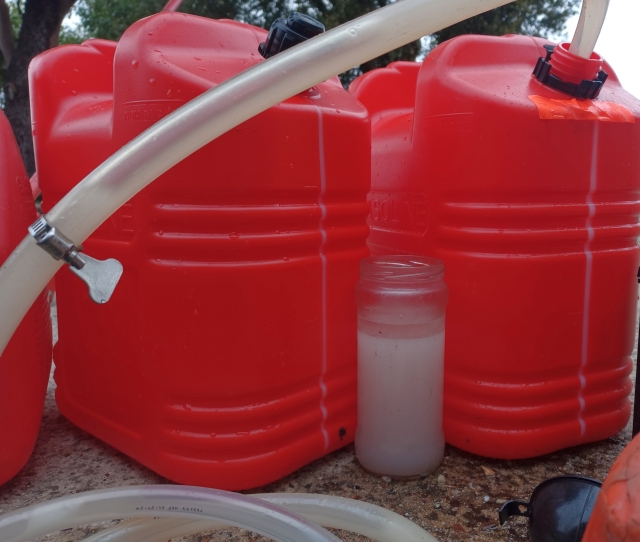
As an experienced person (which I am now) would expect, the proportion of "milk" to "clear" kept increasing as I went to the last 3 gallons, last 2 gallons, last gallon, and down to the last cup (see my milk frothing photos).

Near the end it was 2 inches of "milk" to 1/4-inch of clear gasoline.
I have no idea if there is an anti-siphon valve though, but it might just be the sharp kinks in the pipe that prevent siphoning.

Now I have 13-1/2 gallons of very wet gasoline (5 gallons of which is water).
I'm pretty sure it's not worth letting it settle out and re-using the gas, is it?

But then, now what do I do with my 13-1/2 gallons of milky cleaning fluid?
cleaningfluid.jpg
 
Last edited:
Thanks for explaining that. I'm told by my Dad that in the olden days, you guys pumped the pedal BEFORE starting the car, which he said squirts the juice into the cold intake manifold to increase the fuel:air ratio for starting.
Yes, the amount you pumped depended on conditions and the engine/carb combination and tune. Then add in a manual choke... lots of variables to get an old engine started. I drove a '67 Ford truck in high school... (it was quite old at the time)

I'm a little confused by that statement because the injectors don't "store" fuel, so I guess what you mean is there must have been a lot of water left in the fuel lines from the fuel tank to the engine and back in the lines to the fuel tank.

Then, when I cranked the engine, all that water got pushed through the injectors into the combustion chamber (worried about hydrolock all the time) and then whatever was unused went back to the fuel tank (I guess).
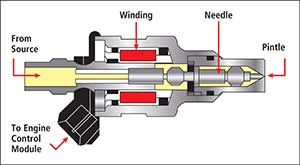
There is most definitely fuel inside a fuel injector. It has to pass from the top through the middle to the bottom where the actual 'valve' is.

FAST-5-X-SECTION-HORIZ.jpg


All of that yellow is fuel that won't get circulated by the fuel pump while cranking/running - it can only escape through the pintle valve during normal operation.

You were worried about hydrolocking for no reason. Fuel and water flow close enough to the same for this. If the fuel injectors wouldn't hydrolock the motor with fuel, it won't with water. The cylinder is emptied every 4 strokes, remember? Unless a fuel injector gets stuck open, it can't/won't hydrolock the motor. (hydrolock doesn't just happen with water...)

I looked it up to find that passenger vehicles typically consume between 0.2 to 0.5 gallons per hour at idle (which is roughly 25 to 64 ounces per hour).
If I arbitrarily pick 30 ounces per hour for easy numbers, it would take approximately 3 minutes to consume the 1.5 ounces of water in the supply lines.
The engine wasn't running while you were cranking though, right? It was more like 100rpm while cranking, which requires much lower fuel flow.
Oh! That's interesting. Thanks for that tidbit. I didn't know that.
But even that is confusing.
1. I turn the ignition on to crank the engine
2. I press (and hold?) the throttle to the floorboards
3. That (apparently) turns OFF the injectors

But does that mean the injectors are WIDE OPEN or are they CLOSED?
Off = closed.

-Charlie
 
I am just glad you got it resolved. Feedback is always great to see as well, as it may help other down the road That is all that really matters.

I sometimes forget that half the members do not have do with the rust. So when not dealing with that makes life a lot easier. I seen people try to remove the fuel filter off and end up replacing both fuel lines because they round the nut off or it all rusts all together twisting the lines themselves.. :(
 
I am just glad you got it resolved.
Thanks. What helps most is the encouragement to do things (like crank the engine) when nothing good is happening for the first ten or fifteen minutes.

Also what's very helpful are the suggestions (e.g., where to attack the tank opening) - and - sometimes - the warnings (e.g., don't run the fuelpump for long on a dry tank).

Feedback is always great to see as well, as it may help other down the road That is all that really matters.

Thanks for noticing that I strive to provide feedback. Mostly I do so because I'm keenly aware that in many threads, the problem is raised and solutions are suggested, and then the thread just dies. We never learn what happened.

So nobody benefits but the original poster. I want my threads to at least benefit the NEXT person with the same problem.

In my case, there was a LOT of water in that gas tank! Gallons of the stuff.

So if there is a next person reading this, maybe years from now, forget about siphoning it out. You'll end up with gallons left.
You have to get a fuel pump and pump it out. There's really no other way if you're going to attack it the way that I did.

Yes, you can drop the tank. But pumping is easier. Much easier I'm sure.

One thing I NEVER FOUND was what in the heck was RESTRICTING the siphon hose when I dropped it down from the fuel filler cap?
I see bends. But that's all I see.

Is there a RESTRICTOR or not?
fuelrestrictor.jpg


I sometimes forget that half the members do not have do with the rust. So when not dealing with that makes life a lot easier.

It does. There's really no rust on this vehicle as you can see from the photos. I haven't replaced the fuel filter yet, but I will be wary of stripping the threads based on the warnings kindly provided.

I seen people try to remove the fuel filter off and end up replacing both fuel lines because they round the nut off or it all rusts all together twisting the lines themselves.. :(

Oh, many a time I've made a job worse. I was thinking exactly that when I was pulling the borescope out of the fuel tank, when I wondered - what if there's a spark?

My biggest worry was "hydrolock" but that was kindly explained away, so my main worries after that were just how to get it out.

Now I only have the problem of 13-1/2 gallons of petroleum-based "cleaning fluid" to deal with. I'll call my disposal company to ask what they suggest, but I might just use it to clean things for the next few years. :)
 
Last edited:
You cleaning solution is great for starting fires. So just have a cookout a few times and roast hot dogs and marshmallows.

Any place that has one of those oil waste burners furnaces will gladly take that off your hands. Especially if lots of old oil is added to it to cut the water content. Like 1 quart that 3 quarts used oll/transmission fluid, gear grease. Too much water doesn't burn as well. So it needs to be cut to burn in those furnaces. :-)
 

Members online

Forum statistics

Threads
278,317
Messages
3,554,129
Members
248,016
Latest member
Advally Service

Trending content

Back
Top