Purpose of the air resonator

giro

New member
What is the purpose of the resonator, the black cube that's part of the air filter housing aka Air Cleaner Housing?

It's just 2 tubes going into a plastic box, and it's after the filter. I'm guessing it just dampens the pressure a bit, and that things wouldn't be too bad if I just bypassed it by connecting the hoses. Does anyone know what it does, or have already bypassed it?

Today I temporarily bypassed it with some 5/8" drip line after having it be a casualty of an exploding fan. But I don't see much about it in the FSM (pages SR-47 and EC-26 in my '92 manuals), and it looks like it can't be ordered as a separate piece.
 
Register to hide this ad
mainly for noise. you can get rid of the box if you want

Just to confirm, this is the resonator box in the engine compartment right next to the filter. In searches, there's another thing in the exhaust system after the muffler in newer 4runners that some are removing to get more exhaust noise, so I just want to double check that you aren't talking about that.

It seems like there would be some baffles in there or something if it were all about noise, but it also seems strange that something that close to the air intake would matter as far as noise.
 
[MENTION=12148]giro[/MENTION] Your question inspired me to search for an answer. Found this article:


The resonator itself couldn't be simpler in design; it's basically just an expansion chamber or wide spot in the otherwise-smooth intake pipe. It may or may not contain some kind of baffle or plate, depending upon the design and the intent of the designers. Resonators come in two types: In-line resonators are open chambers that sit in the intake tube, while side-branch resonators are chambers that sit next to the tube and are connected to it via a small duct or channel (ours).

The Common Misconception
Most hot-rodders and car enthusiasts think of intake resonators as simple mufflers in the intake tube, devices designed to siphon all the awesomeness out of a car's sound track to appease soccer moms and senior citizens. That makes it a prime candidate for the "chuck-it" school of auto modification. After all, it's basically just a plastic tumor growing off of a tube that should by definition be as smooth and blemish free as possible. While sound control is indeed part of the resonator's job, the sound control itself is really more of a side effect of its primary purpose.

Pressure Wave Harmonics
Air flowing into your cylinder head's intake port doesn't move in a straight line while the valve is open, then politely stop in its tracks to await another valve opening. When the valve closes, the moving column of air slams into it, then compresses and bounces back like a spring. This pressure wave travels backward at the speed of sound until the intake runner opens up or it hits something, and then it bounces back toward the cylinder. This is the "first harmonic." The pressure wave actually bounces back and forth two or three more times before the intake valve opens again.

Intake Tube Pulses
The resonator in your intake is technically known as a Helmholz resonator, an acoustic device used to control pressure wave harmonics. Air bouncing back out of your engine and into the intake tube doesn't do it in a single pulse the way it would in a single intake runner; the multiple pistons put out pressure waves at their own intervals, and some of those are going to try to bounce back in while others are going out. The result is a "clog" or high pressure area in your intake tube that ultimately limits airflow through almost the entire rpm spectrum.

The Resonator
Adding an expansion chamber to the intake tube forces air coming back out of the engine to slow down to fill the cavity, thus expending a great deal of its energy and slowing the pressure wave reversion. This slowdown allows fresh air to flow toward the engine without fighting pressure reversion waves the entire way, thus aiding in cylinder filling. Since these pressure waves are essentially sound, giving them a place to expend their energy before exiting the air filter box ends up dampening the intake noise and quieting the engine. Thus, the resonator helps to make the engine paradoxically quieter and more powerful.

 
And 50,000 posters who swore up and down that the intake silencer mod gave them more power cry out at once, and then are silent.

:D
 
And 50,000 posters who swore up and down that the intake silencer mod gave them more power cry out at once, and then are silent.

:D


Darth Bunny finds your lack of faith disturbing. Oh, and he has your stapler.
562338_211430612362645_1744256901_n.jpg
 

Attachments

  • 562338_211430612362645_1744256901_n.jpg
    562338_211430612362645_1744256901_n.jpg
    75.5 KB · Views: 8,992
Wow...
That was a lot of reading and wile it sounds good on paper.
You should also keep in mind that there's a large distance from the intake valve to where the air resonator is hooked up. The distance from the intake valve to the throttle body is almost double of that from the throttle body to the resonator thanks to the upper intake plenum.
Something to try if you ever have your engine running with the tubes off of the throttle body. Hold your hand near the opening and see how much "air bounces back".
;):
 
Great! Thanks Antman.

This resonator box isn't the one before the throttle body, it's part of the Air Suction System (FSM EC-26). But actually it looks like it's one step closer to the exhaust, with the FSM saying "To reduce HC and CO emissions, this system draws in air into exhaust ports to accelerate oxidation, using vacuum generated by the exhaust pulsation in the exhaust manifold."

It did sound a little different yesterday, but that was with the hood up, no fan, and a little less hood insulation than before so I thought I was just imagining it. Sounds like there might have really been a bit different tone coming from the tailpipe.

Thanks!!!
 
Wait...What? :ohwell:
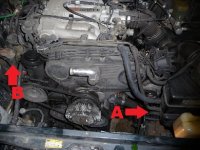
This is what you started talking about.
What is the purpose of the resonator, the black cube that's part of the air filter housing aka Air Cleaner Housing?
It's just 2 tubes going into a plastic box, and it's after the filter.

In the pic below.
Are you asking about (A) or (B)?

Because we started with (A).

:suspicious:

(Pic not of my engine. Found it on google.)
 

Attachments

  • FZPJR7LFWS6KD3J_LARGE.jpg
    FZPJR7LFWS6KD3J_LARGE.jpg
    66.3 KB · Views: 10,176
Last edited:
Because we started with (A).

Yes, A. But there's 2 boxes there, and this is the upper one, that has it's input coming across and around the top of the air cleaner. I'd put in a pic, but mine's in more than few pieces right now.

That description was from EC-26 of the '92 FSM.

Separately, the main airflow from the air cleaner that goes straight back and then to the throttle body goes through a "plastic section" just off the air cleaner before going into the tube that bends around to the throttle body. It seems like that part is more fitting to the description Antman posted, and maybe was also a resonator of sorts. But looking a second time at the FSM, maybe not as I can see a path to the intake too.

Either way, I think we're good. It's pretty simple and should hold up, as long as it's not it with fan shrapnel. I'll grab one when I head to pick-n-pull.

The test drive up a hill this morning found other issues, but those details are for a different thread.

Thanks everyone!
 

Members online

Forum statistics

Threads
278,316
Messages
3,554,111
Members
248,016
Latest member
Advally Service

Trending content

Back
Top