Did you use the stock wire or did you run new supply wires and if so what gauge?
I ran new supply wires, 4 AWG.
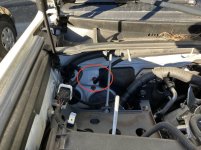
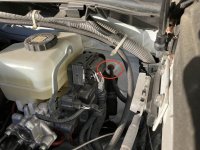
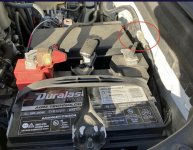
I put a Blue Sea Systems 5191 Fuse Block Terminal on the starter battery positive terminal, and installed a 60A fuse in it (as recommended by RedArc for the BCDC1240D charger). Then a 4 AWG wire from that fuse block, to the rear of the engine bay, across the firewall, through a small hole on the passenger side of the firewall, into the passenger cabin area, to connect to the RedArc charger power input wire. This wire brings power from the alternator to the RedArc charger.
Now the wiring described above would provide power continuously to the RedArc charger, regardless of whether the vehicle is running or parked and turned off. I didn't want that, since that would drain the starter battery. So the wire that comes into the passenger cabin area from the firewall actually connects to a relay before it continues on to the RedArc charger. The other two terminals of the relay connect to a switch that I installed in the 4Runner dashboard, just in front of the center console. I push the switch to its On position to complete the connection in the relay so that power flows to the RedArc charger, and I push the switch to its Off position to break that connection inside the relay when I want to turn the RedArc charger off. The switch itself is powered by thin wires that go to an Add-a-Fuse in an ignition-switched socket in the OEM 12V fuse block under the steering wheel. This means that power will flow to the RedArc charger (which means the RedArc charger will be running and charging the LiFePO4 battery) only when two conditions hold: (1) the ignition is turned on, and (2) I have pushed the switch to the On position. The RedArc charger won't pull power from the starter battery (draining it) when the car is parked and turned off, and it won't charge the LiFePO4 battery unless I push the dashboard switch to On.
From the RedArc power output wire, a 4 AWG wire to another 60A fuse, on a Blue Sea Systems 2151 Dual MRBF Terminal Fuse Block installed on the positive terminal of the LiFePO4 battery. This wire carries the charging current from the RedArc to the LiFePO4 battery.
From the LiFePO4 battery negative terminal, a 4 AWG wire going back through the firewall on the driver's side, to the same ground point on the inner fender (near the starter battery) where the starter battery is grounded. So my LiFePO4 auxiliary battery system will have the same ground as the 4Runner starter battery.
The 2151 Dual fuse block on the LiFePO4 positive terminal has space for two fuses. The 2nd fuse is a 100A fuse. A 4 AWG wire from that 100A fuse brings 12V power to the 1200W inverter. 100A is a lot of current, so I installed my inverter fairly close to the LiFePO4 battery. If it were much further away, this wire would have to be 2 AWG or even thicker, and it's expensive and inconvenient to work with such thick wires.
This is a great wire gauge chart:
http://assets.bluesea.com/files/resources/newsletter/images/DC_wire_selection_chartlg.jpg
When determining the circuit length prior to consulting the chart, it's the entire round-trip circuit, from power source (such as the positive terminal of a battery), to the device being powered, and back again to the ground point. The length is not just the length of the wire from the power source to the device being powered.