2001-2002 Throttle Body Design Question

mtbtim

Elite Member
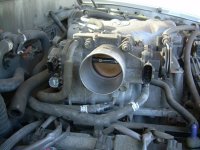
Hey Dudes, I have a question about the newer throttle body design that the 01 and 02 models have. With the 1996-2000 models, they have a screw on IAC valve on the bottom of it. With the 01 and 02 models, there is an obvious air bypass with 6 little air passage holes on the upper back side of the throttle plate with a fitting feeding the chamber the air holes lead to. There's an air bypass hose that attaches to that fitting. The air chamber is on the top of the throttle body and has a plate held on with 4 screws.

Here's a link to a Tacoma World thread that will give you a visual of what I'm talking about: 3.4L w/ ETCS TB cleaning | Tacoma World

So, here's my question, where does that air bypass hose lead and what on the motor is controlling sending air through that hose to the backside of the throttle plate so the engine gets the air it needs during idle? With the 96-00 models, it's obvious the IAC is controlling the delivery of air. I'm just trying to understand how the 01-02 models accomplish this.
 
Last edited:
Register to hide this ad
There is two things going on on the 5VZ for idle air. The injectors are 'air assist' so there is an atmospheric pressure line that runs down to the fuel injectors and allows some air through at each injector (supposed to increase fuel atomization or fuel mixing).

Along with that is the normal idle-air controlling mechanism. On the 01/02, it is probably just holding the throttle plate itself open slightly for idle control. There should be some mechanical minimum or stop that keeps just enough air going to the engine in case of throttle plate failure, then a slight amount of throttle opening is electronic for idle control. That's how most modern DBW throttle plates work.

-Charlie
 
There is two things going on on the 5VZ for idle air. The injectors are 'air assist' so there is an atmospheric pressure line that runs down to the fuel injectors and allows some air through at each injector (supposed to increase fuel atomization or fuel mixing).

Along with that is the normal idle-air controlling mechanism. On the 01/02, it is probably just holding the throttle plate itself open slightly for idle control. There should be some mechanical minimum or stop that keeps just enough air going to the engine in case of throttle plate failure, then a slight amount of throttle opening is electronic for idle control. That's how most modern DBW throttle plates work.

-Charlie

Thanks for the response Charlie. I don't believe there is anything that could hold the throttle plate partially open on these throttle bodies. It's purely a mechanical cable driven device just like it is on the 1996-2000 models. That's at least what I can surmise by looking at it. If you look at the Tacoma World link I shared, there clearly is a system of providing air to the backside of the throttle plate through those 6 small holes. What I don't know is what mechanism the engine is using to deliver the air there. Unless those 6 holes are there for a different purpose. I'm assuming that's the mechanism being used to deliver the air to the engine during idling conditions.
 
There is a clutch that disengages the throttle cable from the throttle body so the motor can take over when the engine is operating. The direct cable actuation is a fail-safe that Toyota kept around until they had the DBW thing figure out...

-Charlie
 
There is a clutch that disengages the throttle cable from the throttle body so the motor can take over when the engine is operating. The direct cable actuation is a fail-safe that Toyota kept around until they had the DBW thing figure out...

-Charlie

You lost me Charlie. The throttle cable is attached to the gas pedal. When you push it, the throttle plate opens and when you release it the throttle plate closes. I think I'm more confused than when I started this thread. I don't see how the engine would "take over" the control of the throttle adjustment unless it was a true drive by wire set-up with no cable. So, you're saying these 01 and 02 models are using both DBW and Cable actuated throttle control?
 
You lost me Charlie. The throttle cable is attached to the gas pedal. When you push it, the throttle plate opens and when you release it the throttle plate closes. I think I'm more confused than when I started this thread. I don't see how the engine would "take over" the control of the throttle adjustment unless it was a true drive by wire set-up with no cable. So, you're saying these 01 and 02 models are using both DBW and Cable actuated throttle control?

Yes they do. They kept the cable as a fail safe but the 01 and 02 are a hybrid drive by wire. The servo motor controls the throttle plate. This is why these throttle bodys cost a fortune for new ones.


It's not like the modern throttle by wire as the cable is still there.

I know it's an odd config but that's what Charlie is saying. :)

Sent from my SM-J337V using Tapatalk
 
Yes they do. They kept the cable as a fail safe but the 01 and 02 are a hybrid drive by wire. The servo motor controls the throttle plate. This is why these throttle bodys cost a fortune for new ones.


It's not like the modern throttle by wire as the cable is still there.

I know it's an odd config but that's what Charlie is saying. :)

Sent from my SM-J337V using Tapatalk

Ok, I get it. But, do we know how the engine is getting the air it needs during idling with this throttle body? Charlie thinks the computer is sending a signal for the motor to open the throttle plate a little. If that's is the case, what's the purpose of the six small holes on the backside of the throttle plate. Guys have reported having an idling issue after cleaning their throttle body. Once they realized they ended up pushing a bunch of crap into those 6 small holes during the cleaning and they cleared them out, their idle went back to normal.

Can anyone tell me on their 01 or 02 model where the hose goes that attaches to the nipple on the top left of the throttle body? It goes to the back side of the throttle body but I can't tell from the picture what it connects to. That's the hose that feeds the chamber where the 6 holes are found. On the 1996-2000 models, the air assist hose connects up to the bottom of IAC. This is the air assist system Charlie was talking about for the injectors and it's one of things we checked in the video we made of testing the IAC. It's possible the hose I'm referring to in the picture is the air assist hose for the injectors for the 01 and 02 models.

So, when these guys have cleaned their throttle body and inadvertently shoved debris into those 6 holes on the back side of the throttle plate, maybe they were negatively affecting the air assist system to the injectors.

Another thing I'm wondering about now with this 01 and 02 throttle body is could you throw off the calibration of the throttle plate since it's partially a DBW system? I remember watching a video about cleaning a throttle body and IAC and the guy mentioned he didn't think it would be smart to manually move the throttle place on a fully electronic throttle body because it could mess up the calibration. I'm just trying to understand why some guys have had a high idle after cleaning this newer style throttle body.

01 Throttle body.jpg
 

Attachments

  • 01 Throttle body.jpg
    01 Throttle body.jpg
    122.7 KB · Views: 8,451
Last edited:
That hose goes to the injectors, just like on the 96-99 rigs.

In your video you called it an “Air assist” when you unplugged it for testing.

It goes down to a “y” and then to 2 nipples on the lower intake manifold. In the manifold there are 2 milled channels down each side of the manifold that intersect each of the injector ports.

In the throttle body on the 00-01 it looks to go into a chamber under that plate on top and then to your 6 holes. I’ve never removed that plate. Don’t know what’s inside.

For the 96-99 that hose goes to the IAC chamber.

It looks to me that it’s an uncontrolled path to the intake air that engine vacuum would pull air through and into the injector pintle caps.

Maybe that path supplies some of the idle air, but I don’t believe it’s the primary source.
 
All I know is i only go so far as to clean the butterfly from the outside and I noticed on my '01 it does not shut completely when the engine is off. Mine hasn't given me issues, I just clean it a bit cuz I'm bored.

So it seems idle air is mechanical for a base rpm with perhaps that fancy 'idle motor' to adjust rpms when the a/c cuts in and out.

Thought it was odd yet it works and she purrs like a kitten!

Luck and I do appreciate minds digging deeper into this gawd-awful 01-02 everyone loves to hate. : ^ )))
 
That hose goes to the injectors, just like on the 96-99 rigs.

In your video you called it an “Air assist” when you unplugged it for testing.

It goes down to a “y” and then to 2 nipples on the lower intake manifold. In the manifold there are 2 milled channels down each side of the manifold that intersect each of the injector ports.

In the throttle body on the 00-01 it looks to go into a chamber under that plate on top and then to your 6 holes. I’ve never removed that plate. Don’t know what’s inside.

For the 96-99 that hose goes to the IAC chamber.

It looks to me that it’s an uncontrolled path to the intake air that engine vacuum would pull air through and into the injector pintle caps.

Maybe that path supplies some of the idle air, but I don’t believe it’s the primary source.

Thanks for your response. I think I finally have all the pieces of the puzzle. What [MENTION=139000]phattyduck[/MENTION] said at first that there must be a mechanical minimum stop for the throttle plate was confirmed by [MENTION=75316]jgue467[/MENTION]. Your comment about where that hose goes confirms it's for the air assist system to the injectors. Just like the 96-00 models, there is a free flow of air that runs through to the intake manifold and to the injectors. On the 96-00 throttle body, the IAC has 3 distinct chambers. Two of these are chambers allow air to pass through from the front of the throttle plate to behind the throttle plate that the mechanical door of the IAC controls to give the engine the air it needs when idling. These chambers also feed the air assist system and it's always getting the air it needs whether it's when the engine is idling and the IAC is providing the path for air or it gets it's air when the throttle plate is opened and the IAC valve closes.

The 3rd chamber is for the coolant to travel through. For a final question for the 96-00 models, why did the Toyota engineers have coolant running through the IAC? Does super cold conditions negatively affect the function of the IAC?
 
They run coolant through both model throttle bodies, and most modern vehicles.
Keeps the throttle from freezing up in cold climates AFAIK.

Hot rodders bypass it and claim power gains due to colder intake air.
Similar theory to throttle body spacer/thermal shield.
 
Last edited:
They run coolant through both model throttle bodies, and most modern vehicles.
Keeps the throttle from freezing up in cold climates AFAIK.

Hot rodders bypass it and claim power gains due to colder intake air.
Similar theory to throttle body spacer/thermal shield.

Ok, gotcha. I thought since the coolant was flowing through the IAC it was more for it's function than the throttle body function. But, through the process of conduction, it would heat up the area right around the throttle plate eventually. I imagine they also wanted to to make sure the IAC door wouldn't freeze up either and move freely.

Thanks for all the responses guys. I now understand better how these throttle bodies work.
 
They run coolant through both model throttle bodies, and most modern vehicles.
Keeps the throttle from freezing up in cold climates AFAIK.
It doesn't even have to be below freezing. The action of the air going from atmospheric pressure to intake manifold vacuum cools the air down (opposite of compressing it in a turbo or supercharger). If the air is moist and near freezing, it can cause both below freezing temps and condensation.

It is run through the idle-air motor, as that is where the air passes through most when there is a large difference in ambient to manifold pressure. Ice can build up and either block passages or freeze the actuator.

-Charlie
 
You lost me Charlie. The throttle cable is attached to the gas pedal. When you push it, the throttle plate opens and when you release it the throttle plate closes. I think I'm more confused than when I started this thread. I don't see how the engine would "take over" the control of the throttle adjustment unless it was a true drive by wire set-up with no cable. So, you're saying these 01 and 02 models are using both DBW and Cable actuated throttle control?
The throttle body has an electronic clutch that disconnects the throttle cable from the throttle plate in normal operation. When the key is Off, the clutch re-connects the throttle cable to the throttle plate and it will seem like a normal throttle connection.

There are actually two TPS sensors on the throttle body - one on the cable side (throttle 'demand') and one on the throttle body (actual throttle postion). There is also a motor that move the throttle plate when the throttle clutch disconnects the throttle cable from the throttle plate.

This has been discussed before:
2001 and 2002 Are NOT Drive By Wire

-Charlie
 
The throttle body has an electronic clutch that disconnects the throttle cable from the throttle plate in normal operation. When the key is Off, the clutch re-connects the throttle cable to the throttle plate and it will seem like a normal throttle connection.

There are actually two TPS sensors on the throttle body - one on the cable side (throttle 'demand') and one on the throttle body (actual throttle postion). There is also a motor that move the throttle plate when the throttle clutch disconnects the throttle cable from the throttle plate.

This has been discussed before:
2001 and 2002 Are NOT Drive By Wire

-Charlie

Thanks for the response and link to the other thread Charlie.
 
I'm going to throw a wrench in the cogs here.

I have an over-bored throttle body with a custom butterfly valve (brass plate) that is seamless with the body housing. There is no gap between the valve and the housing since it's CNC machined to tight tolerances. On top of that, I have some non-air assist injectors with large o-rings that appear to completely block the air-assist holes that are in the intake manifold. My 4Runner idles fine (except when the engine gets hot & idles for 5 min or so then it stumbles a little down to 550 RPMs).

So that means my valve is airtight as can be and there's no airflow from the throttle body to the injectors. My idle is the same from when before I modded all that so theoretically if you follow the logic my engine should stall, but it doesn't. Although my IAC is clean and does operate, maybe that's the part that fails when dirty and affects idle & stalling. I have a 98 though.
 
Although my IAC is clean and does operate, maybe that's the part that fails when dirty and affects idle & stalling. I have a 98 though.
The '96-'00 throttle bodies should close completely when the throttle is released (there is some spec in the FSM, I'm sure). The IAC should supply sufficient air for idling the engine.

The amount of air that passes through the air assist injectors must be fairly small...

-Charlie
 
The '96-'00 throttle bodies should close completely when the throttle is released (there is some spec in the FSM, I'm sure). The IAC should supply sufficient air for idling the engine.


The amount of air that passes through the air assist injectors must be fairly small...


-Charlie
It's supposed to be open just slightly. I can't remember if it's a percentage or a physical distance. I remember looking through mine during my swap process and you could see the light coming through the edge of plate.

Otherwise your engine gets no air and stalls completely but you know that lol I think you were just being short with words, but for others who may derail it, it is supposed to be open a small smalllllll amount

Sent from my Pixel 3 XL using Tapatalk
 
It's supposed to be open just slightly. I can't remember if it's a percentage or a physical distance. I remember looking through mine during my swap process and you could see the light coming through the edge of plate.

Otherwise your engine gets no air and stalls completely but you know that lol I think you were just being short with words, but for others who may derail it, it is supposed to be open a small smalllllll amount

Sent from my Pixel 3 XL using Tapatalk

It depends what throttle body you're talking about. The 96-00 throttle plate closes all the way. Yes, there might be tiny slivers of space on the sides you can see light coming through but that's not where the engine is truly getting the air it needs when idling. The IAC valve is providing the engine the air it needs.

Now, if you're talking about the 01 and 02 throttle bodies, those throttle plates don't close all the way because the engine is using the air traveling through the throttle body bore to keep the engine running.
 
Another thing I'm wondering about now with this 01 and 02 throttle body is could you throw off the calibration of the throttle plate since it's partially a DBW system? I remember watching a video about cleaning a throttle body and IAC and the guy mentioned he didn't think it would be smart to manually move the throttle place on a fully electronic throttle body because it could mess up the calibration. I'm just trying to understand why some guys have had a high idle after cleaning this newer style throttle body.

I went back & forth for a little while about the best way to clean my throttle body because of the same info you mentioned. I ended up cleaning it the same way as it would be done on 96-00 by manually moving the throttle plate. I still don't have confirmation if this is correct or not but haven't noticed any issues for the last 80k. Been doing it this way everytime I clean the MAF and change the spark plugs. The only time I've seen a temporary high idle was after cleaning the throttle body on my friends 99 but it resolved after several minutes.
 

Members online

Forum statistics

Threads
278,307
Messages
3,554,056
Members
248,016
Latest member
Advally Service

Trending content

Back
Top