2005 Land Rover LR3

Thai

Elite Member
Preview: 2005 Land Rover LR3
Disco is dead - at least in the U.S.
by Henny Hemmes (2004-04-05)

This is the first official photo of the brand-new Land Rover Discovery, which likely will be renamed the LR3 for the U.S. market. The Discovery 3 has the same bold stance as its predecessor, which was on the market for fifteen years.

The Discovery debuted in 1989 and had a facelift in 1994.

The new Discovery's styling is a melding of the last models brutish good looks and the Range Rover's tailored shape. Land Rover design cues - like the square front, flat rear end, the roof that has two levels, and a lot of room around the wheels - are even more pronounced than before. New is the rear hatch that is split asymmetrically.

With new technologies applied to the third generation, the Ford division wants the Discovery to be the benchmark in the compact SUV class. New is Land Rover's patented Terrain Response system, which was showed on the Range Stormer concept car in Detroit. The system provided maximum traction without compromising on driveability and comfort. There is a choice of five terrain settings via a rotary switch on the center console: one for normal driving, one for slippery conditions (grass/gravel/snow), and three special off-road settings (mud/ruts, sand, rock crawl). Terrain Response then automatically selects the most appropriate settings for the vehicle's advanced electronic controls and traction aids - including ride height, engine torque response, electronic traction control (ETC), hill descent control (HDC), and transmission settings.

Furthermore the Discovery has an integrated body-frame structure, which according to Land Rover, combines high torsional stiffness with optimal on-road capabilities and comfort.

The new Discovery is also equipped with adaptive headlights that illuminate the road ahead in the corners.

There will be a choice of two engines: the old V-8 engine has been replaced by a new 4.4-liter V-8. This is a version of Jaguar's 4.2-liter V-8, which delivers in the Discovery 300 hp and had 313 lb-ft of torque. This power plant will work together with a six-speed automatic transmission. Furthermore there is the 2.7-liter common-rail turbodiesel that will also be delivered in the Jaguar S-Type and the new Peugeot 407 sedan. This engine has been developed in a joint venture between Ford and the French PSA (Peugeot, Citro
 
Register to hide this ad
Land Rover Launches New LR3 at New York Auto Show

IRVINE, CA - Land Rover introduces LR3, an all-new SUV that makes its debut at the New York International Auto Show on April 7. With its class-leading breadth of capability, innovative user-friendly technology, and new levels of interior space, the Land Rover LR3 is set to offer the ultimate premium sport-utility package.

"A true Land Rover, the LR3 benefits from a clarity of purpose and conviction that is evident from the clean design to the versatility and outstanding driving experience. Like all new Land Rovers, it's always great to drive on-road, as well as being best-in-class off-road," said Matthew Taylor, managing director, Land Rover.

LR3 is a new vehicle in every way. Developed by and for Land Rover, it is a modern architecture that is designed to offer excellent on-pavement behavior while upholding Land Rover's rigorous off-road standards. Building on the philosophy established by Range Rover, it introduces a breadth of capability and a level of luxury that sets a new standard for the category.

Power is from a Jaguar-sourced 4.4-litre 300bhp (SAE) V8 - tailored to meet Land Rover requirements particularly for off-road usage - a six-speed 'intelligent shifting' automatic gearbox, permanent four-wheel drive, fully independent electronic air suspension and seating for up to seven adult-sized passengers.

The Land Rover LR3 continues the brand's tradition of introducing class-leading technologies, the most significant of which is Terrain Response
 
Pics

Discovery3_101.jpg

Discovery3_105.jpg

LR3_08.jpg

LR3_11.jpg
 
What Is It?

2005 Land Rover LR3

What's Special About It?

Land Rover enters the 2005 SUV market with a new Land Rover-designed seven-passenger vehicle dubbed the LR3. Touted as the Discovery replacement, the LR3 continues to live by Land Rover's outdoor off-road creed, but this vehicle has been optimized for on-road driving as well.

The LR3 is powered by a Jaguar-sourced 4.4-liter V8 engine which produces 300 horsepower. A six-speed automatic transmission, full-time all-wheel drive and a full-independent electronic air suspension work together to complement Land Rover's new patented Terrain Response feature. Terrain Response allows the driver to choose one of five unique terrain settings with the flick of a rotary switch. The system then instructs the vehicle's electronic controls and traction systems to appropriately adjust to meet the challenges of the selected surface.

Off-roaders and regular commuters alike will appreciate the additional LR3 features which include a DVD navigation system, adaptive headlights for better illumination on curving roads and an available in-vehicle entertainment system. There is also a three-panel glass setup on the LR3's roof, a sunroof, plus two moonroofs which are positioned to flood the cabin with natural light. Fold-flat seats (they're not just for minivans anymore) provide greater functional cargo space which is easily accessed through the split rear tailgate.

What's Edmunds' Take?

The Land Rover LR3 is styled much like the larger Range Rover, with a similar front end and functional power vent. Other traditional Land Rover design cues, like the typical short overhangs and bold lines are incorporated as well, which assures us that this new SUV is truly a member of the Land Rover family. The Land Rover LR3 goes on sale later this year.
 
Idiot controls.

There is a choice of five terrain settings via a rotary switch on the center console: one for normal driving, one for slippery conditions (grass/gravel/snow), and three special off-road settings (mud/ruts, sand, rock crawl). Terrain Response then automatically selects the most appropriate settings for the vehicle's advanced electronic controls and traction aids - including ride height, engine torque response, electronic traction control (ETC), hill descent control (HDC), and transmission settings.
This is, I suppose, so that even a complete idiot can drive this off-road?

Actually, 5 settings! I think I would exhaust myself as I frantically switched between settings. On the 4WD roads I have been on the conditions go between sand, gravel, ruts and rock crawl or some combination every few feet. In addition to this you would still also need to control transmission speed selection.
 
Re: Idiot controls.

dcampen said:
This is, I suppose, so that even a complete idiot can drive this off-road?

I think that this will prove to be a mstake among true 4x4 fans. Basically, you're leaving it up to the engineers to dictate what you should use in off-roading...even though these engineers are not driving the car.
 
Oh my.....

Plastic exterior, smooth surfaces, flush headlamps, nice glossy paint, no racks.....this is a sad Land Rover indeed.

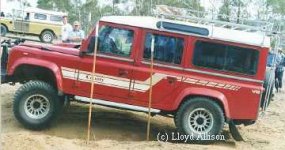
This is how I shall remember the Land Rovers
 

Attachments

  • 198x-110v8.jpg
    198x-110v8.jpg
    14 KB · Views: 2,979
I really like the clean design. Just wish they kept the swing gate with the spare on it. It does look very much like the Range Rover, which is a good thing. I think it might actually take sales from the Range Rover as it will seat more, and probably be more spacious inside.

I wish the complete specs will get out soon, my girlfriend likes Land Rovers and I'm trying to get her to move from the Freelander. The Range Rover is just too expensive. Maybe she can get a competent 4x4 vehicle then (hope the new one is).

I hope it has less problems than some of the other Land Rover products. But to be honest if I look at the 4th Gen Runner Toyota's reliability is overrated, it is my first Toyota and so far I had to take it back to the dealer for repairs more than the BMW and Volvo we owned before combined! None of the Toyota problems were too serious but still, driveline clunck (fixed myself with info from forums like these), moonroof (3 times), cracked windshield (eventually had to pay myself as dealer tried to imply it was a rock, while it cracked standing in the sun while I was shopping??), seat squeek (intermitted so not solved yet) and some various rattles than come and go (some fixed). Make no mistake I love my Runner, but I think the dealers are not always the sharpest. The Freelander has had lots of problems with the soft top (dont buy the soft top), but once that was sorted out it has had some issues but no more than the Toyota.

I know the first year of the Range Rover had lots of issues with all the fancy electronics, hopefully they have learned and will not be making the same mistakes.

My 2c on reliability :)
 
FirstToyz said:
I don't consider anything you described as a reliability issue. Maybe a quality issue but I have to say my 4R has no more quality issues than any other Lexus, Nissan, Honda that I have owned meaning excellent.

The windshield crack sucks but that sounds like bad luck. Who knows someone might have thrown something on your truck or something?
And I can't consider slip joint lube a reliability issue can you? Considering I have experienced that on other pickups and suv's I've driven...

The reliability is something you find out about well into ownership. Toyota is the king and Land Rover is well behind the gold standard.

Ford owns Land Rover don't they? If so, I'm not sure if the quality will get better or worse!:p

Anyway, the new LR looks good. The interior looks WIDE. It's a pretty big suv now.

Point takne on quality vs reliability. I dont expect the 4Runner to breakdown on me while on the road or off it. But I still find it unexeptable to go through these issues. I understand that any new model will have issues, but the dealer's incompetence to fix it straight away is amazing. Especially with well known issues. I have stated it atother places, but I guess that is why people pay $10k for the L on the grill :)

I hope Land Rover can improve on reliability and quality in general, they do make something different to other manufacturers and it will be a pity of they dissappear from the scene.
 
LR3 Press Kit

OVERVIEW

• Outstanding breadth of capability matched to distinctive & versatile design

• An all-new premium SUV, packed with user-friendly technology

• Exceptional breadth of capability – dynamic on-road performance and class-leading off-road

• Bold and distinctive design that delivers a spacious, versatile and comfortable seven-seat cabin

• Production debuts for Land Rover’s innovative Terrain Response™ and Integrated Body-frame™

• New engines tailored for Land Rover, plus six-speed transmissions and air suspension

• Eye-catching

Land Rover’s all-new Discovery 3 is a technology-packed, premium SUV designed to deliver outstanding performance, both on the road and off-road. The bold, versatile design is distinctively Land Rover and offers exceptional space, comfort and flexibility, for up to seven adults.

"The Discovery 3 is a new generation Land Rover, a vehicle of great conviction that points the way forward for the company," says managing director Matthew Taylor. "As you would expect from a Land Rover, it is awesome off-road. What may be more surprising to some is its great performance on-road too. The result is the widest breadth of capability in the class."
It is the first vehicle wholly developed by the new management team that took over Land Rover in July 2000, following the purchase by Ford Motor Company. It replaces the current Discovery, one of the best-selling SUVs in its class.

SPACIOUS & COMFORTABLE

Roomier yet externally not much bigger than the outgoing Discovery, the new Discovery 3 features a spacious cabin packed with clever stowage locations, as well as either five or seven comfortable seats. Even the third-row seats in the seven-seat version are roomy enough for 95th percentile adults. All rear seats fold into the floor when not in use, to create a vast, flat load space. According to design director Geoff Upex, the vehicle was designed ‘from the inside out’.

"Our priorities were cabin space, comfort, the Command driving position and elevated ‘stadium seating’ in the rear," says Upex. "The exterior design is a reflection of those interior priorities. It is very geometric, very minimalist, and very modern. Everything is there for a reason. It is pure product design, rather than fancy automotive styling. The best vehicles inevitably are. It is also distinctively Land Rover. You won’t confuse this vehicle with anything else."

IMPRESSIVE ENGINES, TAILORED FOR LAND ROVER NEEDS

For dynamic on-road performance, the top-of-the-range engine option is a 4.4-litre 295bhp (220kW) petrol V8, derived from Jaguar’s acclaimed AJ-V8 4.2-litre. Developments for Land Rover include increased low-end torque (maximum of 425Nm or 315lb.ft), greater weather-proofing – especially against dust and water ingress – and revised breathing for wading in rivers. This is likely to be the most popular engine in the Discovery 3’s biggest market, the USA.

For Europe, the best-selling engine is expected to be the refined and flexible 2.7-litre TDV6 turbodiesel (not available in North America), a high pressure ‘common rail’ unit that uses variable geometry turbocharging. Another version of this new V6 recently made a much-praised debut in the Jaguar S-Type. The Land Rover engine has been extensively developed to suit the Discovery 3 and produces 190bhp (140kW) and a massive 440Nm (325lb.ft) of torque. Technical advances include its CGI (compacted graphite iron) block, which is lighter, stiffer and more durable than conventional cast iron.

Selected markets will also take a 4.0-litre 215bhp (160kW) petrol V6 engine that is torquey (360Nm or 265lb.ft), smooth and durable. For Discovery 3, it too has been extensively developed to suit Land Rover’s unique requirements.

The petrol engines are mated to a six-speed ‘intelligent shift’ electronically controlled ZF automatic transmission. It offers a ‘sport’ mode which delivers more performance-oriented throttle response and gear shifts, and also features Land Rover’s Command Shift operation – which gives the driver full manual control of gear changing. The TDV6 is available either with this advanced automatic transmission, or with a six-speed ZF manual gearbox.

Drive goes to all four wheels. Electronic Traction Control and Dynamic Stability Control modulate power supply and braking, ensuring maximum grip in all conditions. Throttle response, gear change patterns and suspension settings are also computer controlled, determined by speed and road (or off-road) conditions. Low range is also available, for tough terrain. This can be easily selected, electronically, on the move. The central differential fully locks if conditions require greater traction.

USER-FRIENDLY NEW TECHNOLOGIES

The Discovery 3 bristles with new technologies. Among them is Land Rover’s patented Terrain Response™ system, previewed on the recent Range Stormer concept car. Terrain Response is a major advance that optimizes drivability and comfort, as well as maximizing traction. The driver simply chooses one of five terrain settings via a chunky rotary dial on the centre console: a general driving program, plus one for slippery conditions (known as grass/gravel/snow) and three special off-road modes, namely mud and ruts, sand, and rock crawl. Terrain Response then automatically selects the most appropriate settings for the vehicle's advanced electronic controls and traction aids.

Vehicle functions controlled by Terrain Response™ include ride height, engine torque response, Hill Descent Control (which limits downhill speed, and is an award-winning and patented Land Rover technology), Electronic Traction Control, transmission and differential settings. "Terrain Response is a good example of Land Rover’s commitment to offering ‘smart’ technology that aids the driver," says Matthew Taylor. "It is easy to use. It simplifies rather than complicates driving."

The Discovery 3 also offers the option of adaptive headlights that swivel with the direction of travel to illuminate the road ahead.
Another innovation is Land Rover’s Integrated Body-frame™, a new type of vehicle architecture that combines the torsional rigidity, car-like handling and refinement of a monocoque (or unitary) body with the strength and versatility of a traditional ladder-frame, as used on many SUVs. Computer-aided design, high-strength steel and a sophisticated hydroforming production technique combine to deliver this new technology. Hydroforming uses high-pressure fluids rather than a press tool to shape the frame, which results in a lighter weight, cleverer shapes and much tighter tolerances.
Handling is further helped by fully independent suspension. Height adjustable air springs, similar to those used on the award-winning Range Rover, will be fitted to the majority of Discovery 3s. Entry-level models use coil springs. Double wishbones are used front and rear, offering good wheel control and articulation. Rack-and-pinion steering delivers precise and intuitive control.
 
THE ALL-NEW LAND ROVER DISCOVERY 3 IN SHORT
FUNCTIONAL DESIGN

• Design derived from purpose, to offer maximum cabin space and versatility

• Modern but true to Land Rover heritage – clean lines, simple and contemporary surfaces

• Generous space and comfort for driver and all passengers in airy cabin

• Excellent visibility thanks to Command driving position and stadium seating

• Distinctive and asymmetric two-piece tailgate provides flexibility and ease of access

OUTSTANDING ON-ROAD & OFF-ROAD DYNAMICS

• Land Rover’s innovative Integrated Body-frame provides the basis for outstanding dynamics on-road and off-road

• Delivers the comfort, refinement and on-road attributes of a monocoque with the strength of a traditional body-frame for outstanding off-road capability

• Terrain Response™ makes production debut – patented Land Rover technology that maximizes traction and optimizes drivability and comfort

• Vehicle set-up optimized by simply selecting one of five Terrain Response™ settings

• Fully independent suspension all-round for car-like handling and smooth on-road ride

• Cross-linked, computer controlled air suspension on higher series models increases both on-road refinement and off-road capability

• Full-time 4x4 system, plus advanced electronic controls including Traction Control, Dynamic Stability Control and Land Rover’s award-winning Hill Descent Control

• Anti-lock brakes plus new Electronic Park Brake

• Responsive, power-assisted rack-and-pinion steering

• Adaptive headlights available, which swivel with direction of travel

STRONG & SPACIOUS BODY

• Rigid body design aids handling precision, driving refinement and ride

• Much greater interior space than outgoing Discovery model, with only slightly larger exterior dimensions

• Iconic stepped roof enhances space, airiness and visibility, with sunroof and large glazed alpine roof available

• Weight-saving aluminum bonnet and two-piece tailgate

• Wide doors and asymmetric tailgate design provide easy access

POWERFUL ENGINES & ADVANCED TRANSMISSIONS

• Engine line-up headed by Jaguar-derived 4.4-litre petrol V8 – the most powerful engine ever fitted to a production Land Rover

• Outstanding new TDV6 2.7-litre turbodiesel is expected to be the best-seller in Europe

• Smooth and torquey 4.0-litre petrol V6 also available (selected markets only)

• All engines developed to meet Land Rover’s exacting demands, especially for off-road performance and durability

• Acclaimed ZF six-speed, intelligent shift automatic transmission for all engines, with six-speed manual also available for TDV6 diesel

• Electronically lockable centre differential – electronically lockable rear differential available, too

TESTING & DEVELOPMENT

• One of the toughest and most varied testing programmes ever, covering
4 million miles on five continents

• Reflects the Discovery 3’s class-leading range of capabilities, with high-speed drives at the Nürburgring circuit, scaling sand dunes in Dubai and tackling rough tracks in the Australian outback

• Developed to meet Land Rover’s unique off-road standards – arguably the toughest of any vehicle manufacturer – including wading depth, angles for climb and descent, and temperature extremes

• Extensive road and high-speed development, plus real-world city driving from Tokyo to New York

• Massive laboratory test programme, including Land Rover’s own advanced facilities in the UK

DESIGN

The design goal for the Discovery 3 was simple. To produce a modern vehicle that offered maximum cabin space and versatility, and would be instantly recognizable as a Land Rover.

FUNCTIONAL DESIGN

According to Land Rover’s design director Geoff Upex: "The Discovery 3 is a vehicle derived from its purpose. Everything you see has been done for a reason. It is functional design, not decoration.

"The vehicle is designed from the inside out. The Discovery 3 had to be great for passengers and the driver. It had to have a Command driving position, for better visibility and safety. It had to have rear ‘stadium seating’ for superb passenger visibility. This vehicle can take you almost anywhere, so it’s important to enjoy the view."

Upex describes it as product design, rather than car styling. "Car styling dates quickly. Look at old movies, and more than anything else, the cars date them. But truly functional design does not date."

Upex also describes the Discovery 3 as ‘a work of conviction’. "We were very single-minded in what we wanted. Look at an early sketch of the Discovery 3, and the design has not changed. That is always a sign of good design."
 
MODERN BUT TRUE TO LINEAGE

Although modern and clearly 21st century, the Discovery 3 is true to Land Rover heritage. It is very geometric, very clean sided, like the original 1948 Land Rover (which evolved into the current Defender).

"Land Rover design is all about clean lines, simple and contemporary surfaces," says Upex. "Straight, geometric styling does not date, and gives visibility advantages, especially for off-roading and parking."
The iconic Discovery stepped roof provides airiness and space, increasing passenger headroom and comfort. This is a key reason why even the rear-most seats, in the seven-seat version, are generous enough for 95th percentile adults. The high roof and wide doors help cabin egress and ingress too. Other time-honored Land Rover features are also retained, including the clamshell bonnet and the short front overhang (which helps ground clearance when off road).

REJECTING THE SUPERFLUOUS

Two design details on the Discovery 3 that have aroused particular comment are the asymmetric tailgate and the lack of a side styling ‘line’ through the doors. The tailgate is a two-piece design, as on the Range Rover, rather than a large outward-opening door, as on previous Discovery models. There are major practical benefits to the new asymmetric shape. First, when the upper part of the tailgate is raised, the asymmetrically shaped lower lid reduces load height into the boot. When both upper and lower halves are opened, the asymmetric shape reduces ‘reach in’ distance. Unlike earlier Discoverys, the spare wheel is now mounted under the body, rather than on the rear door.
The lack of a side styling line is simply explained. It is superfluous and was rejected.
"It was an area of comment in preview clinics with potential customers," says Upex. "Most cars have side styling lines, so people expect them. But we found the more people looked at, and became familiar with, the Discovery 3, the more they liked it and ‘got it’. There was similar comment about the car only having one side air intake. ‘Why not two?’ people asked. Simple – it only needs one. So it only has one."

TIMELESS INSPIRATIONS

"It is a clean, simple, minimalist shape," says Upex. "That is not only appropriate for a new Land Rover, it also ensures a fresh look for many years. Simple, minimal design invariably lasts well."

As part of the design exercise in shaping the Discovery 3, Land Rover designers looked at many products thought to be timeless. One was Health House, a home in Los Angeles designed by Richard Neutra, a pupil of Frank Lloyd Wright. It is timeless and elegant – and could have been designed in the 1990s. In fact it was designed in the 1920s.

"We were lucky in being able to look much closer to home, too," says Upex. "The Land Rover Defender, still a style icon, has a basic shape that goes back to 1948. The first Range Rover of 1970 set a design language that unashamedly continues with the latest Range Rover."
Upex is confident that the latest Discovery 3 will go down as a Land Rover design classic, too.

INTERIOR

"The cabin was the starting point for the creation of the Discovery 3," says
Land Rover design director Geoff Upex. "It was designed from the inside out. Maximum cabin space and comfort dictated the entire form of the vehicle." As a result, the Discovery 3 offers outstanding space and versatility.

CLASS-LEADING INTERIOR

In every major dimension, the new vehicle's interior is either class-leading or among the very best. Compared with the outgoing Discovery model, the major improvements are in legroom, shoulder room, and third-row headroom. The Discovery 3 has an extremely spacious third row of seats (where fitted) – large enough for 95th percentile adults – underlining its superiority as a seven-seater. The wide doors are designed to ensure easy cabin and boot access.
Second and third seat rows can fold right down into the floor, enabling the Discovery 3 to transform into a luxury load-carrier with a flat floor and vast capacity.

SEATING COMFORT PLUS EXTRAORDINARY VERSATILITY

The vehicle can be specified with either two or three rows of seats, giving space for five or seven adults respectively. All seats face forwards and provide a head restraint and full lap-and-diagonal inertia reel seatbelt. ‘Stadium seating’ means that each row is higher than the one in front, improving the view for all passengers, helped by the deep glazing. The stepped roof ensures plenty of headroom throughout.

All seats are large and comfortable, and higher level Discovery 3 models come with leather upholstery. Both outer seats in the second row are equipped with Isofix attachment points for European-standard and North American child seats.
Front seats are available with power adjustment, covering fore and aft movement, height and squab recline, plus manual lumbar support adjustment. In addition, the driver’s seat offers electric cushion tilt adjustment. On manual front seats there is fore and aft adjustment and squab recline, plus lumbar support and height adjust on the driver’s seat.

In the five-seat version, the back seats are asymmetrically split (65:35). They fold by lifting the lower cushions and moving the squabs forward, to give a flat loading deck.
In the seven-seat version, the second row features three individual seats. Each folds separately and all retract into the footwell. The two outer seats can also jack-knife forward, to provide easy access to the third-row seats. These also fold flat into the floor, and when all rear seats are down, the huge, flat cargo area is almost two meters long.

On the seven-seat version, the individual folding arrangements for all five rear seats provide anything from a two- to a seven-seat vehicle, with varying formats of load space.

MULTIPLE STOWAGE AREAS

Extensive stowage space was a priority in a vehicle that prides itself on its exceptional practicality and versatility.
In the fascia, there are two gloveboxes on the passenger side, and a tray at the base of the front console with a non-slip mat. There is also a coin tray and a clip for tickets and toll slips.

The use of an Electronic Park Brake, rather than a conventional handbrake, liberates extra space in the centre console. A large cubby box, which can hold up to four drink cans, is fitted right behind the console, and this is even available with a cooling system to keep the drinks chilled. The cubby box lid can be folded back to act as a useful tray for rear seat passengers. A mobile phone can be stowed within the cubby box lid, and can be integrated into a hands-free system.

Large cup holders for driver and front seat passenger are fitted in the centre console, and there is an additional folding cup holder for the passenger.

Both front doors have capacious bins, including holders for large bottles of water or soft drink. The rear side doors also have large bins, again big enough for drink bottles. In all, 17.5 liters of drinks can be stowed in a Discovery 3.
Large lower quarter panels in the rear compartment provide stowage space for those sitting in the third row, or secure stowage in the boot area. The top surface includes a cup holder and shallow tray, as well as in-car entertainment controls for the rear-seat passengers. Recesses, closed with nets, are also offered for extra stowage.
 
ARCHITECTURAL SHAPES & PREMIUM MATERIALS

The facial has a simple, geometric look. It utilizes the Land Rover design language initiated in the latest Range Rover: very architectural, with clear vertical and horizontal lines. There is large instrumentation, plus good-sized, tactile and intuitive controls. Switches are kept to a minimum – the built-in technology, including Land Rover’s new Terrain Response system, can do much of the work for the driver.

The facial moulding is in Thermoplastic Urethane (TPU), which has a luxury feel, resists fade caused by sunlight and has fewer plasticizers to reduce the mist deposited on the inside of the windscreen. The facial is supported on a die-cast magnesium alloy cross-beam that is both light and strong, and provides precise mounting – improving finish and reducing any propensity to rattle.

The top panel for the facial is designed for pleasing looks, feel and longevity. Controls that are used regularly, such as facial vents, typically have a rubberized finish, to improve touch and boost their premium feel.

Roof trim and door pillar trim are soft fabric, and all grab handles are damped. Two roof-mounted consoles provide interior lighting, with separate lights for the third-row passengers. Low-level ‘waterfall’ lighting is incorporated into the front dome lamp, and is activated when the headlamps are turned on.

When the alpine roof is specified, full width blinds provide shade and extra privacy.
Carpets are soft but hard wearing. They are also easily cleaned, helped by the sill-free body design, to assist sweeping out the cabin.

AIR CONDITIONING ON ALL MODELS

Air conditioning is standard on all Discovery 3 models and comes in two forms, manually operated and automatic. Both include a particulate filter to remove pollutants in both fresh air and recalculating modes, and four facial-mounted adjustable vents with thumbwheel shut-offs. There is an additional lap cooler vent for the driver beneath the steering wheel. Airflow is also directed at the windscreen, side windows and front footwells. For the second row of seats, there are two vents at the back of the centre console.

On higher level vehicles, fully automatic temperature control is used. This system automatically uses the air conditioning and heater to maintain a constant temperature. The temperature is selected using separate facial-mounted controls for driver and passenger. Both sides operate independently.

In selected hot-weather markets, the system can also be specified with optional rear air conditioning and heating. The rear cabin temperature can also be controlled separately.
In cold-weather markets, an additional 5kW fuel-burning heater supplements the heat generated by the TDV6 diesel engine.

IN-CAR ENTERTAINMENT & INFORMATION

The Discovery 3 offers a high level of in-car entertainment systems and one of the most advanced navigation systems available. Higher-line models have a six-CD in-dash unit. Six speakers are fitted to entry models, while upper range models use harman/kardon systems with nine speakers, including a sub-woofer. A premium 14-speaker harman/kardon ‘Logic 7’ seven-channel digital surround system is also available. The head unit can also play MP3 files and, with 11x compression the equivalent of a 66 CD library can be stored and played in the vehicle.

The optional state-of-the-art navigation system is DVD-based, and includes the latest generation of off-road navigation. There is an interface to Traffic Message Channel (TMC) systems (where available), which broadcast messages on a specific radio channel to warn of hold-ups. This information is also shown on-screen, and the navigation system can suggest an alternative route to ensure the driver has an uninterrupted journey.

The navigation system is controlled by a 180mm (7 inch) high resolution touch screen, while two buttons switch the screen between the main ‘Home’ menu and the navigation system. Voice recognition is available for navigation and audio controls. The screen also displays information from the Terrain Response™ system.

SAFETY – UP TO EIGHT AIRBAGS

The enormously strong Integrated Body-frame architecture of the Discovery 3, with its hydroformed frame, gives tremendous protection in case of impacts, and door-mounted anti-intrusion side-beams offer further protection. Computer-aided design has helped optimize the Discovery 3’s intrinsic ability to protect passengers in severe impacts.

Passenger safety is further improved by the use of up to eight airbags. The driver’s airbag is installed in the steering wheel boss and the front passenger airbag is in the facial. Two airbags in the front seats provide protection for the thorax.

There are two full-length curtain airbags fitted in the cant rails above the first and second rows of seats, offering side protection. Two additional side bags are fitted in the rearmost area, when seven seats are specified.
 
STRUCTURE

The body of the Discovery 3 is a combination of steel, much of which is high-strength grades, and aluminum. Unlike most bodies attached to separate platforms, the Discovery 3 body is a key part of the structure. This match of rigid body and strong platform gives Land Rover’s all-new Integrated Body-frame structure its uniqueness, its stiffness and its strength.

INTEGRATED BODY-FRAME

The body's high torsional stiffness helps handling precision, driving refinement, ride and comfort, as well as reducing shakes and rattles. Although it has much greater cabin space, the Discovery 3 is only 176mm longer than the outgoing Discovery model, and only 30mm wider. It is also lower.

The Body in Detail

The Discovery 3’s body is manufactured like a conventional monocoque. Two monosides are welded to the floor, roof and bulkheads, creating a strong, single structure. Significant use is made of high-strength steels, while enormously strong boron steel is used for the A- and B-pillars, for added strength in front and side impacts.

The roof structure can accommodate both sunroof and alpine roof. The sunroof is a conventional cassette-type design that opens rearwards, outside the vehicle. The alpine roof is a large, full width glass roof bonded into the metal structure, above the second and third-row seats. To preserve strength, it is braced by cross members, invisible from the outside. When neither sunroof nor alpine roof is fitted, the outer roof panel is a single large steel pressing with styled swages to add strength and prevent booming.

The tailgate, doors, bonnet and front wings are separate, bolt-on assemblies. Lightweight magnesium alloy is used for part of the front structure and forms part of the front crash crumple zone.

The bonnet, a characteristic Land Rover clamshell design, is aluminum, which saves weight. Benefits include ease of opening and closing, with gas struts to provide assistance and retain the bonnet in the open position. The hinges allow the bonnet to be locked vertically for easier access to the engine compartment for servicing.

The asymmetric tailgate is a two-piece design, like the Range Rover’s. The lower half opens downwards, the top half upwards. The asymmetrically shaped design improves reach-in distance and load height.

"It is a distinctive design and true to Land Rover’s lineage," says design director Geoff Upex. "But it is also a very practical design, with real loading benefits."

When the vehicle is stationary, the upper tailgate can be closed independently of the lower tailgate, partly enclosing the vehicle interior while the lower tailgate can be used, for example, as a viewing platform. The lower tailgate is also designed as an acoustic chamber for the sub-woofer (where fitted) for the in-car entertainment system.

Both upper and lower tailgates are made from lightweight aluminum, which helps reduce total vehicle mass and also makes closing and opening easier. When fully open, the tailgates give superb access to the rear of the vehicle, to help with loading large or heavy objects.
All four doors are wide and provide easy access. Made of steel, they have boron steel-reinforced side intrusion beams to improve impact performance.

The front and rear bumpers, end trims, sill finishers and wheel arch eyebrows are all polypropylene injection mouldings to brush off minor damage in normal and off-road driving.
Both bumpers have energy absorbing elements to protect vital components in low speed impacts. The headlamp lenses are moulded in damage-resistant polycarbonate.

Advanced Paint Facility

The completed body is subjected to a comprehensive painting and finishing process to ensure it retains an attractive appearance throughout its long life. All steel panels vulnerable to corrosion are zinc coated. Alloy structures, which are inherently corrosion resistant, are treated to prevent electrolytic interaction with adjoining steel components.
The body is finished in one of the most environmentally friendly and advanced paint facilities in the world.
 

Members online

No members online now.

Forum statistics

Threads
278,309
Messages
3,554,071
Members
248,016
Latest member
Advally Service

Trending content

Back
Top