2012 Diesel Jeep Grand Cherokee: First Drive

Comment about being built on Mercedes frame makes it even worse. Go to the Mercedes forums and you will find out they spend a lot of time in the shop.

First of all, they don't have frames. The ML, GL, Jeep GC and Durango are all unibody.

Second, while they share the same platform, they don't share the stuff that breaks -- drivetrains, electronics, interiors, etc. are all unique to each brand.

Third, while Mercedes quality was in the crapper, it has made huge strides. My wife owned a 2002 C240. Quality on that car was crap, with electronic problems galore. But her 2010 C300 has been flawless in 30,000 miles.

Fourth, if there is one thing that Mercedes actually does well it is the basic unibody structure itself, which is what is being shared. Mercedes are very safe vehicles with very strong, crash-worth passenger cells.

Now there are plenty of reasons to be wary of the Jeep GC, and its durability certainly does give me pause, but the shared platform with Mercedes isn't one of them.
 
Last edited:
Electronical?? I really like that...

I commute about two hours everyday...and I have seen more Mercedes-Benz with a tail light out or one brake light on then all the other manufactures combined....quality isn't what comes to mind for the price point.
 
I commute about two hours everyday...and I have seen more Mercedes-Benz with a tail light out or one brake light on then all the other manufactures combined....quality isn't what comes to mind for the price point.

So, your direct experience with Mercedes is seeing them on the highway? Versus my direct experience owning two for the past 10+ years.

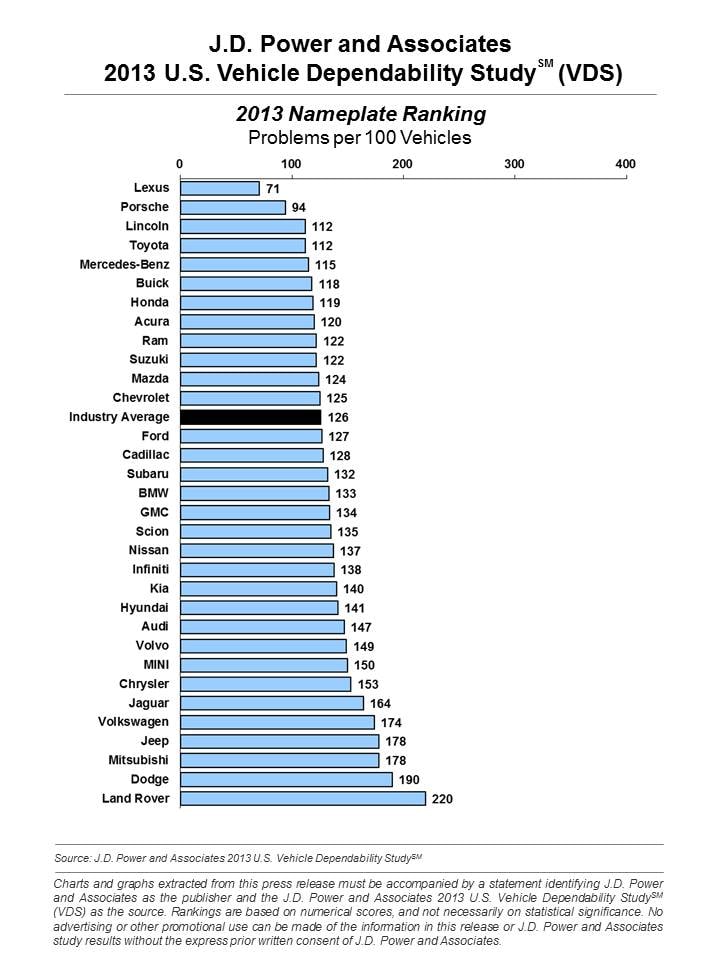
JD Power certainly has issues, but as you can see Mercedes is near the top. Jeep is near the bottom.

d113c91c0a0d02b701d3ac6eb051e9f9.jpg


Consumer reports also shows the C300 as being better than average.

Yes, Mercedes quality absolutely sucked around 2000. It was horrid. But they really have gotten dramatically better.
 
Electronical?? I really like that...

I commute about two hours everyday...and I have seen more Mercedes-Benz with a tail light out or one brake light on then all the other manufactures combined....quality isn't what comes to mind for the price point.

Yep. People measure quality many different ways. I have a simple measure: What is the desirability of the vehicle after five years? In a mass produced vehicle that desire translates into a high resale value. Check a five year old JGC price vs new compared to a Toyota. Don't give me "Oh, they changed it and made it better!" No they didn't. They added a few features and updated a few things. Listen, I am not a specific brand guy. I am a reliability and durability guy. As I evaluate a vehicle that is the most important and if a manufacturer has a vehicle that I would want and meets that criteria I will put that into my buy column. Jeep is not there.

Now some of you are making a big deal out of a diesel or 8 speed transmission as a breakthrough. Do me a favor: Google Konigsegg free valve technology. THAT is a breakthrough for technology. Ford's ecoboost (read same turbo tech from the '70's with new engine management tech. People like the Konigsegg guy and several others are coming up with stuff that pushes the big guys (Including Toyota) into innovaton.

Here. I even went to the trouble to give you a link. http://www.motorward.com/2013/02/koenigseggs-free-valve-concept-explained-video/
 
Last edited:
I looked at all of the options when buying the 4R, it looks like a 4x4 with character. Like a Wrangler but not a design from WWII. The Cherokee just looks like every other soccer mom SUV out there. Too bad, since it has the right stuff off road.
 
Yep. People measure quality many different ways. I have a simple measure: What is the desirability of the vehicle after five years? In a mass produced vehicle that desire translates into a high resale value. Check a five year old JGC price vs new compared to a Toyota. Don't give me "Oh, they changed it and made it better!" No they didn't. They added a few features and updated a few things. Listen, I am not a specific brand guy. I am a reliability and durability guy. As I evaluate a vehicle that is the most important and if a manufacturer has a vehicle that I would want and meets that criteria I will put that into my buy column. Jeep is not there.

Now some of you are making a big deal out of a diesel or 8 speed transmission as a breakthrough. Do me a favor: Google Konigsegg free valve technology. THAT is a breakthrough for technology. Ford's ecoboost (read same turbo tech from the '70's with new engine management tech. People like the Konigsegg guy and several others are coming up with stuff that pushes the big guys (Including Toyota) into innovaton.

Here. I even went to the trouble to give you a link. Koenigsegg’s Free Valve Concept Explained – Video | Motorward

Respect the hell out of you, but the way you talk it's as if any jeep owner is lucky their vehicle doesn't burst into flames at any moment.

Like me, you're a technical guy. Details nerd, if you will. Let's hear it. What are the details, specs, or specific assembly issues you see as problems in the current JGC? Genuinely interested. :cowboy:
 
Jeep's quality is improving while Toyota's has been waning of late. I don't think they've passed each other going opposite ways yet, but some of the comments I've read are pretty ridiculous.

I don't think there are many (if any) pure piece of shit vehicles manufactured today. If you have a frame of reference of more than a few decades, you'll feel more comfortable agreeing with me. A lot of you guys refer to the old Daimler days while bashing the current crop... You've lost me on the logic progression with that line of thinking.

Still a toyota fan first for the main reason of ruggedness and quality of work, but let's not get lost in fanboy-ness. Especially if the feelings are driven by an outdated reference.

What is YOUR frame of reference for the first comment? The big 3 keep telling us quality is improving, but it has yet to show in any data. Japanese brands are still at the top.

I test drove a JGC, they are very nice vehicles, but I work hard for my money and I'm not willing to gamble $40k. Most of us on T4R (including you, apparently) prioritized reliability and ruggedness when we chose a Toyota, and I don't think there's anything wrong with pointing out Jeeps continued shortcomings in that area.

And before you start drinking the "we're as good as the Japanese" cool-aid, here's a few links to check out:

NUMMI Plant Closure Ends Toyota-GM Venture : NPR

Chrysler Workers in Michigan Caught Smoking & Drinking - "Again" 7-14-2011 - YouTube

Detroit Auto Workers Busted on the Job Drinking Beer & Smoking Pot on Break.flv - YouTube

I'm just not willing to send my wife and kid out in something that those d-bags built.
 
Last edited:
What is YOUR frame of reference for the first comment? The big 3 keep telling us quality is improving, but it has yet to show in any data. Japanese brands are still at the top.

I test drove a JGC, they are very nice vehicles, but I work hard for my money and I'm not willing to gamble $40k. Most of us on T4R (including you, apparently) prioritized reliability and ruggedness when we chose a Toyota, and I don't think there's anything wrong with pointing out Jeeps continued shortcomings in that area.

And before you start drinking the "we're as good as the Japanese" cool-aid, here's a few links to check out:

NUMMI Plant Closure Ends Toyota-GM Venture : NPR

Chrysler Workers in Michigan Caught Smoking & Drinking - "Again" 7-14-2011 - YouTube

Detroit Auto Workers Busted on the Job Drinking Beer & Smoking Pot on Break.flv - YouTube

I'm just not willing to send my wife and kid out in something that those d-bags built.

How young are some of you guys? Do you really not remember domestic automobiles from even as near back as the 80s and the 90s? American vehicles from that era, particularly Chrysler, were absolutely horrible. Seemingly designed by accountants, and put together by second graders with zip ties and crazy glue. Just using those 2 decades alone for a frame of reference, you just simply can't say, with any accuracy, that the new JGC has not improved tremendously.

Who is trying to convince anyone the big 3 have surpassed the japs? I said the exact opposite, actually. I made the comment that they are improving... Even 1E agreed on that fact. Further to my agreement with him, as he said, they aren't there yet. That's for damn sure. They aren't. But they are getting better, and thats good news. Not only for domestic lovers but for jap lovers as well. Competition breeds innovation. Look to Apple for a lesson in that. Took the market by storm then no one was around putting pressure on them anymore, and in most expert opinions, their innovation and even QC to a degree, began to wane as of late. Still (subjectively, let's not start a flame war about this) the best, like Toyota, but their competitors are catching up.

Hope no feelings are being hurt here. Just talking about cars with dudes. :rockon:
 
How young are some of you guys? Do you really not remember domestic automobiles from even as near back as the 80s and the 90s? American vehicles from that era, particularly Chrysler, were absolutely horrible. Seemingly designed by accountants, and put together by second graders with zip ties and crazy glue. Just using those 2 decades alone for a frame of reference, you just simply can't say, with any accuracy, that the new JGC has not improved tremendously.

I bought a '78 Pontiac Trans Am new. Lord what a complete POS that car was.
 
I bought a '78 Pontiac Trans Am new. Lord what a complete POS that car was.

I don't know if it's the right car but as a young kid (4-5yrs old) I remember an old Dodge Volare? station wagon that my dad had bought. Thing would flood and die in the middle of the street, intersection where ever the hell it wanted to. My dad sold that after 2 short years and bought a new Buick Century (1982?) that lasted us through most of the 80's.
 
Respect the hell out of you, but the way you talk it's as if any jeep owner is lucky their vehicle doesn't burst into flames at any moment.

Like me, you're a technical guy. Details nerd, if you will. Let's hear it. What are the details, specs, or specific assembly issues you see as problems in the current JGC? Genuinely interested. :cowboy:

You have to bear with me on this one as it goes outside the realm of pure engineering into the real world of business. This is my OPINION on the way the automotive world operates. I only want to write this one time so everyone please pay attention. I am going to try not to quote any numbers and speak mainly about concepts. I will use generalities and try to explain it as such. This is the view from 30,000 feet.

Imagine you own a vehicle manufacturing company and you want to make money, which is the driver for each and every one of them. How do you do it? Well, there are several different ways. The simplest way is to look at how much you spend and sell it for more than that. Simple right? Not so fast. What if, because of previous negotiations and costs, there was no possible way you could sell a vehicle for more than you had in it. How could you turn a profit per vehicle then?

Well, you could do what the typical US manufacturers did and still do: Sell the vehicle for less than it cost to manufacture and make it up somewhere else. Where you ask? The only place you can: Parts and service. (Note: you can Google any of these concepts I am discussing. It's all out there, from places like Forbes and Bloomberg. You just have to dig a little and it's not in a neat and tidy package)

I don't have the report anymore but in the 2005-2006 range companies like Ford, Chrysler and GM were losing money on every new vehicle. They had to make it back some way so they did by selling many more parts, which typically have a much larger margin than complete vehicles. These guys have been using that business model for many decades. Build a vehicle and lose money and make it up on repairs.
Wait. Stop for a minute. How could they do that and more important, why do that? Why not just build a vehicle that did not break and sell it for more money? Well, the answer is complex. If they were only competing against themselves that would be no problem. Unfortunately, they were competing against some smart Japanese guys too who had already figured that out. Japanese manufacturers were and still are (not to the same extent though) selling a vehicle that costs less to manufacture than it's selling price. If I remember correctly, Toyota was making around $2,600.00 per car in pre tax profit compared to around $500.00 for Ford and Chrysler was losing about $400.00 per car. I think this was around 2008 or so. Anyway, this had been going on for decades. The big three was running like our federal government using deficit spending. Why? Simple. The labor costs. The big three were backed into a corner by the unions. For example (and this is current year) such things as amount of time for employee breaks in the plant cost the Japanese about $113.00 per car whereas the big three costs $250.00 per car. Vacations, retirement and salaries keep adding up to eventually you can't keep up.
So where does that leave them then? C'mon, their engineers are smart guys why don't they design components that don't break or wear out as often? That sounds like conspiracy theory talk but it's just business. Let's face it: With today's technology you could build a vehicle to go 250K miles with no problems. It's proven already by the makers of our 4Runners. Why don't the other guys do it as well? In my simple opinion they could. As a matter of fact they are in the process of making those changes but they can't change completely overnight and still remain competitive. Why? UAW contracts are still high. They are getting better but still high. Manufacturing methods are improving too but they are for the Japanese also. I don't mean to leave the European manufacturers out but they are basically the same as our big three. Sell it for below or break even costs and make the profit on parts.
I read the data and it looks better for the big three. All you really have to do is take the reported profits and divide it by the number of vehicles sold to get the profit per vehicle. It's getting to the point where companies like Chrysler (Fiat) are making a little money on their new vehicles but they are still not in the same league as Toyota and Honda. It's basically just a difference in the business models, brought on by decades of poor management of the big three.

So there you have it. It's tough to find that information on the internet but if you go to reputable sites like Forbes or WSJ the information is there. You just have to piece it together. So, does someone want to ask me again why I don't want to buy a Jeep? It's simple. Why buy something that needs replacement parts well before their time when I can buy something that statistically won't need any parts for it's design life. Look at the repair histories for both vehicles. As I said before, Jeep and Fords are getting better but it will be a decade or more before they are competitive.

 
Last edited:
How young are some of you guys? Do you really not remember domestic automobiles from even as near back as the 80s and the 90s? American vehicles from that era, particularly Chrysler, were absolutely horrible. Seemingly designed by accountants, and put together by second graders with zip ties and crazy glue. Just using those 2 decades alone for a frame of reference, you just simply can't say, with any accuracy, that the new JGC has not improved tremendously.

Who is trying to convince anyone the big 3 have surpassed the japs? I said the exact opposite, actually. I made the comment that they are improving... Even 1E agreed on that fact. Further to my agreement with him, as he said, they aren't there yet. That's for damn sure. They aren't. But they are getting better, and thats good news. Not only for domestic lovers but for jap lovers as well. Competition breeds innovation. Look to Apple for a lesson in that. Took the market by storm then no one was around putting pressure on them anymore, and in most expert opinions, their innovation and even QC to a degree, began to wane as of late. Still (subjectively, let's not start a flame war about this) the best, like Toyota, but their competitors are catching up.

Hope no feelings are being hurt here. Just talking about cars with dudes. :rockon:
The JGC went on sale in 1992 as a 1993 model year, reliabilty and resale value was horrible then and still is. In that regard, I don't see any change in the last 2 decades from when they started building them. I did lease a 99' JGC Laredo, and the reliabilty was horrible, I could not wait to turn that thing in.
 
Let's face it: With today's technology you could build a vehicle to go 250K miles with no problems. It's proven already by the makers of our 4Runners.

I wish that I could say I've had no problems while putting 125k miles on my 4th gen 4Runner, but that wouldn't be true.

While I consider pads and rotors to be normal wear items, replacing the front calipers three times and the rears twice is not normal and it is what I would consider a problem. My truck has a harmonic vibration between 60 and 70 mph that appears to be coming from the front diff. There was a TSB for this for the GX470, but Toyota refused to address this on my truck.

I'm hoping that my transfer case actuator doesn't leak -- I did see oil on my driveway under the centerline of the vehicle last summer, then it stopped. If it does, that will cost more than $1k to fix it. I'm also hoping my exhaust manifolds don't crack, as that would be another $1k+ fix.

Now, do I think my 4Runner is one of the more reliable SUVs on the market? Yes. Is it perfect? No. Will it go 250k with no problems? Well, it has already had problems, so no.

Btw, Autoblog just published a test drive of the JGC diesel: 2014 Jeep Grand Cherokee EcoDiesel First Drive
 
You have to bear with me on this one as it goes outside the realm of pure engineering into the real world of business. This is my OPINION on the way the automotive world operates. I only want to write this one time so everyone please pay attention. I am going to try not to quote any numbers and speak mainly about concepts. I will use generalities and try to explain it as such. This is the view from 30,000 feet.

Imagine you own a vehicle manufacturing company and you want to make money, which is the driver for each and every one of them. How do you do it? Well, there are several different ways. The simplest way is to look at how much you spend and sell it for more than that. Simple right? Not so fast. What if, because of previous negotiations and costs, there was no possible way you could sell a vehicle for more than you had in it. How could you turn a profit per vehicle then?

Well, you could do what the typical US manufacturers did and still do: Sell the vehicle for less than it cost to manufacture and make it up somewhere else. Where you ask? The only place you can: Parts and service. (Note: you can Google any of these concepts I am discussing. It's all out there, from places like Forbes and Bloomberg. You just have to dig a little and it's not in a neat and tidy package)

I don't have the report anymore but in the 2005-2006 range companies like Ford, Chrysler and GM were losing money on every new vehicle. They had to make it back some way so they did by selling many more parts, which typically have a much larger margin than complete vehicles. These guys have been using that business model for many decades. Build a vehicle and lose money and make it up on repairs.
Wait. Stop for a minute. How could they do that and more important, why do that? Why not just build a vehicle that did not break and sell it for more money? Well, the answer is complex. If they were only competing against themselves that would be no problem. Unfortunately, they were competing against some smart Japanese guys too who had already figured that out. Japanese manufacturers were and still are (not to the same extent though) selling a vehicle that costs less to manufacture than it's selling price. If I remember correctly, Toyota was making around $2,600.00 per car in pre tax profit compared to around $500.00 for Ford and Chrysler was losing about $400.00 per car. I think this was around 2008 or so. Anyway, this had been going on for decades. The big three was running like our federal government using deficit spending. Why? Simple. The labor costs. The big three were backed into a corner by the unions. For example (and this is current year) such things as amount of time for employee breaks in the plant cost the Japanese about $113.00 per car whereas the big three costs $250.00 per car. Vacations, retirement and salaries keep adding up to eventually you can't keep up.
So where does that leave them then? C'mon, their engineers are smart guys why don't they design components that don't break or wear out as often? That sounds like conspiracy theory talk but it's just business. Let's face it: With today's technology you could build a vehicle to go 250K miles with no problems. It's proven already by the makers of our 4Runners. Why don't the other guys do it as well? In my simple opinion they could. As a matter of fact they are in the process of making those changes but they can't change completely overnight and still remain competitive. Why? UAW contracts are still high. They are getting better but still high. Manufacturing methods are improving too but they are for the Japanese also. I don't mean to leave the European manufacturers out but they are basically the same as our big three. Sell it for below or break even costs and make the profit on parts.
I read the data and it looks better for the big three. All you really have to do is take the reported profits and divide it by the number of vehicles sold to get the profit per vehicle. It's getting to the point where companies like Chrysler (Fiat) are making a little money on their new vehicles but they are still not in the same league as Toyota and Honda. It's basically just a difference in the business models, brought on by decades of poor management of the big three.

So there you have it. It's tough to find that information on the internet but if you go to reputable sites like Forbes or WSJ the information is there. You just have to piece it together. So, does someone want to ask me again why I don't want to buy a Jeep? It's simple. Why buy something that needs replacement parts well before their time when I can buy something that statistically won't need any parts for it's design life. Look at the repair histories for both vehicles. As I said before, Jeep and Fords are getting better but it will be a decade or more before they are competitive.

I'm more intimately familiar with what you stated here than you realize. There is nothing to agree or disagree about regarding what you wrote; it's simple historical fact. However, it still does not disqualify my original contention. They have improved. You stated as such yourself. The above argument and some of the others in this thread, are about something different entirely.

Which is more reliable and better built? There is no doubt, Toyota. Has the JGC (and general domestic automobile production quality) gotten better recently? Yes. My only point.

My caution was against making broad value judgements on the current crop based on vehicles from a different era of manufacturing entirely. You want to say the current JGC still isn't as quality of a vehicle when compared to the 4R based on current data and evidence? Great! I agree with you. You want to say the current JGC is garbage because of experience or data from the 80s and 90s? Come on, man.... :cowboy:
 
I wish that I could say I've had no problems while putting 125k miles on my 4th gen 4Runner, but that wouldn't be true.

While I consider pads and rotors to be normal wear items, replacing the front calipers three times and the rears twice is not normal and it is what I would consider a problem. My truck has a harmonic vibration between 60 and 70 mph that appears to be coming from the front diff. There was a TSB for this for the GX470, but Toyota refused to address this on my truck.

I'm hoping that my transfer case actuator doesn't leak -- I did see oil on my driveway under the centerline of the vehicle last summer, then it stopped. If it does, that will cost more than $1k to fix it. I'm also hoping my exhaust manifolds don't crack, as that would be another $1k+ fix.

Now, do I think my 4Runner is one of the more reliable SUVs on the market? Yes. Is it perfect? No. Will it go 250k with no problems? Well, it has already had problems, so no.

Btw, Autoblog just published a test drive of the JGC diesel: 2014 Jeep Grand Cherokee EcoDiesel First Drive

I did say "statistically" in there somewhere lol. Edit: no I didn't. I should have worded it differently. Anything can break or have an issue. My point was the Jeep gives you much better odds of breaking than Toyota.

I'm more intimately familiar with what you stated here than you realize. There is nothing to agree or disagree about regarding what you wrote; it's simple historical fact. However, it still does not disqualify my original contention. They have improved. You stated as such yourself. The above argument and some of the others in this thread, are about something different entirely.

Which is more reliable and better built? There is no doubt, Toyota. Has the JGC (and general domestic automobile production quality) gotten better recently? Yes. My only point.

My caution was against making broad value judgements on the current crop based on vehicles from a different era of manufacturing entirely. You want to say the current JGC still isn't as quality of a vehicle when compared to the 4R based on current data and evidence? Great! I agree with you. You want to say the current JGC is garbage because of experience or data from the 80s and 90s? Come on, man.... :cowboy:

No argument here. I again will say Jeep, and the big three in general, are getting better. It will be at least a decade before they are equivalent IMO. In 2012 JGC had 38 out of 100 visits for repairs on 2012 JGC models. Toyota 4Runner had 9 per 100 I think. Industry average was in the 20's per 100.
 
Last edited:
I wish that I could say I've had no problems while putting 125k miles on my 4th gen 4Runner, but that wouldn't be true.

While I consider pads and rotors to be normal wear items, replacing the front calipers three times and the rears twice is not normal and it is what I would consider a problem. My truck has a harmonic vibration between 60 and 70 mph that appears to be coming from the front diff. There was a TSB for this for the GX470, but Toyota refused to address this on my truck.

I'm hoping that my transfer case actuator doesn't leak -- I did see oil on my driveway under the centerline of the vehicle last summer, then it stopped. If it does, that will cost more than $1k to fix it. I'm also hoping my exhaust manifolds don't crack, as that would be another $1k+ fix.

Now, do I think my 4Runner is one of the more reliable SUVs on the market? Yes. Is it perfect? No. Will it go 250k with no problems? Well, it has already had problems, so no.

Btw, Autoblog just published a test drive of the JGC diesel: 2014 Jeep Grand Cherokee EcoDiesel First Drive

My. God. The combination of the horrible looking mid year refresh, white paint, disgusting wheels, and clinical overdose of chrome makes that thing look repulsive.

I thought the initial redesign was handsome and rugged with a hint of upscale. This refresh looks like an "American" vehicle TRYING to look European by raiding Liberace and Elton John's closet. Complete disaster, imo.
 

Members online

Forum statistics

Threads
278,317
Messages
3,554,126
Members
248,016
Latest member
Advally Service

Trending content

Back
Top