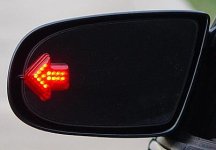
Let's forget about the people whom have already purchased the vehicle with the missing signal lights and seeking recourse, and talk about the 4runners still sitting on the lot right now waiting to be purchased.
Is it you opinion that, by offering for sale a mis-represented 4runner, Toyota has done nothing that: (1) offends public policy as established by statute, common law, or other means; (2) is immoral, unethical, troublesome, or corrupt; and (3) substantially injures consumers (or competitors or other businesspeople)?
To me it would seem like a pretty obvious case of false advertising because it sure seems like it would offend some kind of public policy, is down right unethical, and well substantiality of injury is in the eye of beholder. Quite frankly, I don't see a many consumers out there that would NOT act differently should they realize that a line item on the window sticker is missing from the vehicle they are about to purchase.
I understand you keep trying to plea the case that well the consumer bought it without caring/noticing so tough luck, but what about when you don't have this as deciding factor?
I'm pretty sure there are plenty of 4runner sitting on the lots right now waiting to be sold and with the incorrectly advertised options. Would you say that it is fair to assume that Toyota has some kind of legal responsibility to either correct the window sticker, or add the option before sales? And if so, why is it that all of a suddenly after Toyota sneaks one by you and you mistakenly purchase the vehicle, they are no longer legally responsible?
This issue is probably not clear-cut as you make it seem...IMO, the deciding factor is going to be in one of those 100s of legal documents you sign off when your purchased the vehicle.
Are you talking about a representation/warranty claim? Or false advertising claim? Or just mixing terms thinking they're the same?
Quite different animals.... For false advertising, the buyer might have to prove that he would have made a different purchasing decision were it not for the false statement. In this case, that means either not purchasing at all OR purchasing whatever thousand dollar upgrade is required to get the Premium version or something similar.
I have strong doubts that you have been admitted to the bar in the state where I bought the truck. Just as I have doubts that you are well-versed in nuances of consumer-protection laws in that state.
Ok. You can continue to have any strong opinion you want. Have a ball; I won't stop you. I have strong doubts that the missing signal is a big deal at all. I have a strong inclination that you're looking for a hand out since you read the sticker after signing a ton of paperwork and driving home (smart move).
You misinterpret "substantially." It is a legal term that has a more nuanced connotation than in lay use. It is a bare minimum threshold, not a requirement that the injury be very large. A substantial injury must be more than trivial, not speculative, and not something like "it hurt my feelings that the sticker is wrong." This is certainly a substantial injury.
I understand the meaning of substantial/substantially. It is akin to "actual" rather than theoretical or imagined (although not always physical in nature for some of the newer claims being allowed). I would certainly not be able to call this a substantial (non-trivial) injury immediately without many more pieces of information. Actual? Non-trivial? Perhaps, depending on the other circumstances.... but it seems like a factual determination is needed. This becomes more difficult of an argument to make when Toyota would ask "if it is so non-trivial of an item to be missing, then how were you not able to see the lack of the feature that should have been clearly visible?"
As for the 43 pages the customer likely signed, in most states any ambiguity or conflict are strictly construed against the drafter of the contract. Thus, Toyota/dealer would have the burden of showing that the customer should have known that the contract & window sticker did not accurately represent the equipment on the vehicles. Given the typical consumer protection laws and that the dealer is engaged in the business of selling cards and is presumed to be more sophisticated, Toyota would have a tough time meeting that burden.
Agreed, interpreted against the drafter (dealer). However, I wouldn't say that the dealer would have a tough time. Outwardly physical attribute vs. the 1-line description. It's a question of fact, not law.
You are right in this. This dispute will never see a courtroom. Toyota would simply settle with the aggrieved customer and save face. Another way of looking at it -- Toyota's legal costs in defending itself would dwarf the cost of restitution.
Toyota would simply either 1) install the signal lights, 2) pay the customer some negotiated value as settlement, or 3) rescind the contract and put all parties back to the same position they were in. The third option may not be available in some situations (if the customer sold his other vehicle and rescission would leave him without a vehicle).
Not sure option 3 is truly an option for a sale that has already taken place and where the purchaser has already registered the car and put miles on it. Obviously, this depends on the state law applicable as to what the dealer would be able to do with the car if the contract was rescinded. For example, if titled/registered cars cannot be sold as new then perhaps the dealer cannot be made whole if the transaction was "undone". Or, if the dealer is unable to advertise a car as "new" with more than XXXX miles on the odometer, then again it might not be able to be made whole again. I can see possible fact patterns that would not allow the purchaser to recover 100% of the sale price (or, more accurately, would require the purchaser to get 100% back, but then also pay the dealer for diminished value (or lost sale or something similar).
I am not defending Toyota or the dealership. I don't mind Toyota one bit, but I've never been a fan of dealerships given their sleazy reputations. The point is that there is a single line on the window sticker indicating the presence of a certain feature. IF the buyer read the sticker in detail (this is a big IF), the buyer would have had every opportunity to ensure compliance if any particular features truly would make a difference. IF the buyer read the sticker and did not notice the line at all, it is clear that the dealer's mistake had no impact on the buyer's decision. IF the buyer read the sticker and this one item's inclusion or lack thereof would have made a difference in the purchase decision, it was easily seen from the exterior of the vehicle that the item was not present. I honestly don't think there was anything intentionally deceptive here (though, consumer protection laws don't require malice or even intent). I'm also not sure that any prospective buyer would ever have their purchasing decision affected even a little bit if the vehicle does not come with the signals on the mirror (either not buy at all or step up to Premium or Trail or Limited).
It was a dealer/manufacturer mistake on the sticker. However, the buyer had the opportunity to see this and make a further inquiry prior to the contract (again - all assuming a standard face to face purchasing process). Seems that most people here think it's ok that the buyer also made a mistake in not checking before signing the papers (if he even cares in the first place). The OP didn't care or bother to check at the time of signing. Man up and live with it.