2014 Towing Capacity

You are correct Sir. My apologies.

Overcaffeinated, methinks.

No worries.

It's this very discrepancy that I'm talking about, though, between the website & the OM. And yes, it's only 300#, and yes, I'm being anal. I'm Type A, what else can I say? But it's precisely because I'm doing my homework and I want to do this right that this whole thing even occurred to me.
 
I guess my question would be...how often do you plan to tow at the "far end" of that spectrum?

If that 300 lbs is cutting it close, there may be some additional steps that would add some security to maxing it out. (LT tires, WD hitch, Airbags)
 
Kind of sucks the Highlander (2013 and 2014) tow capacity is still 5,000. That logic escapes me. So much for the Body on frame toughness. :behindsofa:

Even the FWD LTD is showing a 5,000 lb capacity??
 
I guess my question would be...how often do you plan to tow at the "far end" of that spectrum?

If that 300 lbs is cutting it close, there may be some additional steps that would add some security to maxing it out. (LT tires, WD hitch, Airbags)

I probably won't do it very often but, at least this first time, it will be quite far (CA to NC).

Already have LT tires. Plan on an Equal-i-zer WDH. Brake controller, of course, and will probably spec the trailer with brakes on both axles. Tranny cooler, too. Was thinking about some Timbrens or airbags for the rear, but my understanding is that a good WDH will level the truck on it's own, so I'm not sure I want to mess with the suspension.

Thoughts?
 
Have not checked, but other than the VVti in the 4R, how is the engine/gearing different? I'm surprised there is a tranny/axle gearing difference? Makes sense if so, but you are saying the T4R is geared higher/numerically lower than the Taco?

Just checked the Taco double cab gear ratio is 3.73, the tow capacity is 6400 in 2014. HP TQ is 236/266 vs 270/278 for the 2014 4R. Thought the 4Runner has 3.73s too, but not sure.
Taco has the same trans and gearing, but is a good bit lighter.

I mean that if you put a supercharger, or switch to 4.56 gears, the 4runner could tow more.
 
I probably won't do it very often but, at least this first time, it will be quite far (CA to NC).

Already have LT tires. Plan on an Equal-i-zer WDH. Brake controller, of course, and will probably spec the trailer with brakes on both axles. Tranny cooler, too. Was thinking about some Timbrens or airbags for the rear, but my understanding is that a good WDH will level the truck on it's own, so I'm not sure I want to mess with the suspension.

Thoughts?

I definitely think you have key components covered...probably the cheapest upgrade would be airbags, brakes and controller next, coolers, etc....all good stuff. I think based on that direction alone you would tow safely and responsibly, unlike some people who love to tout the same pictures of their overloaded Trail as some sort of conquest.

I think one of the possible stumbling blocks is just the short wheelbase of the 4Runner, compared to length of the trailer in tow.

Good luck to you...sounds like you have a great start and have a handle on what you need for a safe trip.
 
Kind of sucks the Highlander (2013 and 2014) tow capacity is still 5,000. That logic escapes me. So much for the Body on frame toughness. :behindsofa:

Even the FWD LTD is showing a 5,000 lb capacity??

The body on frame part hasn't much to do with it, I'm not sure how toyota tests tow ratings but I bet they tested the tundra much more than any other model with a trailer as that truck is somewhat designed to tow a heavy trailer.

If you look at chevy and ford and how they test the heavy duty/super duty you will find serious testing with thousands and thousands of miles because this is a serious aspect of the truck.

the rating could be because of the hitch class or simply because of a gearing change etc etc.

IMO follow the guide lines and its probably not a good idea to tow near max as a regular occurrence. JMHO

God Bless
 
Never insinuated any such thing.

I don't want to hijack this decent thread...


but every time someone talks about towing near or at the limit...it's like Pavlov's Dog you're going to pull out those pictures with those overloaded trailers bragging about pulling cross country blah, blah, blah....

I think you're an irresponsible idiot, and you're ****ing dangerous, but you insist on broadcasting that....it's a miracle things didn't go south on you.

Sadly people like you that insist on pushing that envelope generally survive in an accident, and it almost always seems they manage to take an innocent victim.

Maybe you need the attention, or you basically just don't give two flying shits about anyone around you.
 
And yes, it's only 300#, and yes, I'm being anal.

Ya' think?

Bob it's one thing to push the limit of towing capacity. What you're talking about is another thing altogether. As someone who's made the long East Coast to West Coast trip many times and towed thousands of miles in a foreign country let me suggest you change the question.

Perhaps the real question should be........what can I do to lighten the load and make this issue go away?
 
I don't want to hijack this decent thread...


but every time someone talks about towing near or at the limit...it's like Pavlov's Dog you're going to pull out those pictures with those overloaded trailers bragging about pulling cross country blah, blah, blah....

I think you're an irresponsible idiot, and you're ****ing dangerous, but you insist on broadcasting that....it's a miracle things didn't go south on you.

Sadly people like you that insist on pushing that envelope generally survive in an accident, and it almost always seems they manage to take an innocent victim.

Maybe you need the attention, or you basically just don't give two flying shits about anyone around you.

No animals were harmed in the production of those photos.
 
perhaps im missing something here, but if the limit is 4700, then there shouldn't be any issue towing at 4700, all day every day. that is in fact what its rated at, it should be able to be USED at that.

whether that rating be 4700, or 5000, or 10,000. if they didn't want it used at that limit, they would give it a lower limit.
 
I don't want to hijack this decent thread...


but every time someone talks about towing near or at the limit...it's like Pavlov's Dog you're going to pull out those pictures with those overloaded trailers bragging about pulling cross country blah, blah, blah....

I think you're an irresponsible idiot, and you're ****ing dangerous, but you insist on broadcasting that....it's a miracle things didn't go south on you.

Sadly people like you that insist on pushing that envelope generally survive in an accident, and it almost always seems they manage to take an innocent victim.

Maybe you need the attention, or you basically just don't give two flying shits about anyone around you.

do you know the weights of the vehicles on the trailer?
what makes you think the trailer is overloaded?

id guess the trailer itself is rated to hold much more weight than we see on there.
and as far as the trailer load being too much for the 4runner. we also don't know that, if we don't know what those vehicles weigh. that vet? I doubt its over. the other 2? no idea. theres no way to tell by looking at those pictures.
 
Another thing that confuses me is GCVWR. For my truck it's 11300#. If you subtract curb weight (4675#) and max TWR (5000#) you still end up with an extra 1625#. I know that fuel & fluids aren't taken into consideration with curb weight, but even factoring them in you have well over 1000# to play with. You could say that value is for passengers & cargo, but you're supposed to deduct that weight from TWR, so it ends up being a wash. What am I misunderstanding?
From reading the SAE standard (J2807) and looking at a few of Toyota's other vehicles, the 11300 GCWR seems wrong. Should be ~9700lbs. Per J2807, GCWR = TVTW (Tow Vehicle Tow Weight) + TWR (Trailer Weight Rating). TVTW = Curb Weight* + 150 lb driver + 150 lb front seat passenger.

*Technically not curb weight but "the weight of the tow-vehicle used for EPA emissions and fuel economy certification including all options in
excess of 33% sales penetration"

So for a 2014 4x4 SR5, GCWR = 4675 (curb) + 150 +150 + 4700 (TWR) = 9675 lbs.

Looking at Tacomas/Sequoias, the numbers on Toyota's website works out pretty well with respect to GCWR vs. tow rating.

So either Toyota completed J2807 with 1625 of payload, or the 11300 number is wrong.
 
Last edited:
From reading the SAE standard (J2807) and looking at a few of Toyota's other vehicles, the 11300 GCWR seems wrong. Should be ~9700lbs. Per J2807, GCWR = TVTW (Tow Vehicle Tow Weight) + TWR (Trailer Weight Rating). TVTW = Curb Weight* + 150 lb driver + 150 lb front seat passenger.

*Technically not curb weight but "the weight of the tow-vehicle used for EPA emissions and fuel economy certification including all options in
excess of 33% sales penetration"

So for a 2014 4x4 SR5, GCWR = 4675 (curb) + 150 +150 + 4700 (TWR) = 9675 lbs.

Looking at Tacomas/Sequoias, the numbers on Toyota's website works out pretty well with respect to GCWR vs. tow rating.

So either Toyota completed J2807 with 1625 of payload, or the 11300 number is wrong.

Thanks. Glad I'm not the only one confused by Toyota's numbers.
 
Perhaps the real question should be........what can I do to lighten the load and make this issue go away?

What I could do is spend $6000-$8000 for a 900# aluminum trailer, albeit one that won't accept a weight distributing hitch.

Or I could spend $2000 for a 1600# steel trailer, use a good WDH with sway control, put brakes on both axles, and tow under the limit (even if just barely) of what Toyota rated this truck to pull. The limit is a limit for a reason, and now with this new SAE standard, it should be especially so.
 
perhaps im missing something here, but if the limit is 4700, then there shouldn't be any issue towing at 4700, all day every day. that is in fact what its rated at, it should be able to be USED at that.

A 4 Runner can be used at the max limit nevada. However the concept you're responding too is not what CAN be done, but how often it should be. Orc addressed that very well in a previous post:

"When you play at the limit something is going to give sooner than if you were at around half."

Let me explain it with an analogy. A man is 6' 1" and a husky 200#. Can he carry 100% of his weight for a total of 400 pounds? Sure if he's in good physical condition and lifts carefully to protect his back.

However in your example this man would be carrying 100% of his body weight "all day every day," and that's quite a different thing altogether isn't it? The short version is while the 4 Runner is rated to carry 4,700#, Toyota built an SUV not a tractor trailer.

On your other post you make a fair point we don't have specifics on the weight Ryan1975 was towing. However it's not like we're in the dark here, and a reasonably accurate estimate is possible. For example I believe the blue Landcruiser being towed is a 60 series. With the big tires and wheels we're at about 5,000 pounds.

The 50s' Ford with the primer hood and front quarter panel was made when Detroit stamped out parts from a much heavier gauge steel than used today. Forget aluminum. She looks like a 1958 Victoria hardtop sedan which came off the line at a bare minimum of 3,500 pounds. I can also tell you from experience old cars like that "gain" weight through the years with all kinds of stuff put in and on them.

Then we have the newer Corvette which is obviously a C6 body, and if not an ounce was added or being carried inside, is still 3,300 pounds. Which brings us to the trailer.

The one Ryan tows with must be a good 18" feet at least. Look how much is left over with a 15 1/5 foot Landcruiser sitting on it. Possibly it's all aluminum trailer in the 1,200 pound range. However that's really unlikely since it would be one mother of an expensive trailer. This looks like a classic 18' steel trailer which come in at about 1,800 pounds.

So if the Corvette was dead empty that "Ooops" trip from New York to Michigan to KC was flying down the Interstate at about 5,100 pounds minimum. The Ford Victoria tow was in the range of 5,300 pounds, and the massive Landcruiser was moving at highway speeds while carrying along something in the neighborhood of 6,800 pounds !

If someone thinks TitanPat was harsh in his post while pointing out the safety hazard of doing this, fair enough. However his point these vehicles were being carried across several states in a manner that very well could have endangered the lives of other people on the road, is very real given the apparent facts.

 
Last edited:
What I could do is spend $6000-$8000 for a 900# aluminum trailer, albeit one that won't accept a weight distributing hitch.

Or I could spend $2000 for a 1600# steel trailer, use a good WDH with sway control, put brakes on both axles, and tow under the limit (even if just barely) of what Toyota rated this truck to pull. The limit is a limit for a reason, and now with this new SAE standard, it should be especially so.

My only recommendation would be to buy once. Get what you want to have for a long time.

If there was any other way to get your car to NC other than towing it, that would be my plan. Then I could enjoy the drive at speed.

Words cannot express how uncomfortable towing anywhere near 5,000 lbs. as far as you are planning on traveling for one straight trip would be.
But I will try:
Towing heavy (3,000 - 5,000lbs.) is fine for up to 200 to 300 miles at a time (per day) depending on your skill and patience level. Think about running 30 - 40 mph thru mountains and running 55 ish all those other miles all the while you are totally concentrating on maintaining control while being pushed around by the weight as it bounces across our terrible federal highway system.

My wife wants to vacation in Florida for one week, with out TT in tow. I won't do it because I know how much the drive there and back would suck. Now spending two weeks making multiple destination stops including Florida would rock.

My posts shouldn't be taken for factual data. They are purely fictional, for entertainment purposes and should not be constituted as actually related to scientific, technical, engineering, legal, spiritual or practical advice.
 
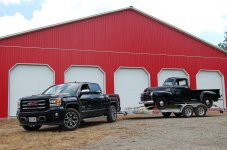
This trailer was about 900 lbs. The old feller on board was less than 4,000.
If I didn't have mirrors, wouldn't have known there was anything out back, was even running in four-cylinder-mode. Steel trailer would have added another layer of uncomfortable variables.
 

Attachments

  • DSC_0036.jpg
    DSC_0036.jpg
    139 KB · Views: 4,130

Members online

No members online now.

Forum statistics

Threads
278,310
Messages
3,554,080
Members
248,016
Latest member
Advally Service

Trending content

Back
Top