rickashay
New member
Afternoon guys/gals,
I'd like to create a definitive resource for people looking to run 35's. There is a lot of information about in but you have to dig in multiple build threads and there is still a lot of information missing. Also, there are SO many variables that are not specifically discussed: amount of caster on UCA's, wheel specs, bumpstop drops, etc. I am currently on the fence about running a 295 vs. 315 but I hope this resource will serve others in the future regardless of my personal decision. I hope to update this thread as more information is found or is made available.
To get this out of the way early, running a 35" tire has its own set of pros and cons, like any modification you make to your vehicle.
PROS
- increased ground clearance
- wider tire for increased flotation in deep snow and deep mud conditions
- more tire sidewall ratio, usually allows for a more "cushioned" ride
- increased tire width means increased protection of the rim due to the wider tire (assuming rim width stays constant)
- lets be honest... they look badass
- easier rollover on trail obstacles due to increased tire diameter
CONS
- regearing becomes a consideration, but not required
- more wear & tear on components due to increased tire weight (rotational mass)
- reduced driving performance due to increased tire weight (braking and acceleration)
- reduced fuel economy
- trimming and/or additional prep required: trimming, bumpstop adjustments, potentially axle relocation, specific wheel offsets required
Current Research:
**PLEASE, IF YOU HAVE 1ST HAND EXPERIENCE WITH THIS TIRE SIZE, FEEL FREE TO COMMENT. INCLUDE YOUR PARTICULAR SPECS BELOW**
Tire Size:
Tire Make/Model:
Wheels: diameter x width - offset/backspacing
Bodylift: Yes/No (if yes, what size?)
Approx. Suspension lift setting over stock: (do not include bodylift)
Aftermarket UCA's:
Caster correction: (if running aftermarket UCA's, how much caster?)
Bumpers: Stock or Aftermarket
Trimming: Where specifically did you trim to make the tires fit?
Bumpstop drop? (if yes, how much)
Notes: To avoid any/all assumptions, leave a note about your setup. Does it still rub at full compression? Where? Any issues? Anything you would do differently? Biggest pain-point with running 35's on the 4th Gen? Are your links extended to push the axle further rearwards?
Wheels:
Everyone running 35's is either running aftermarket wheels or OEM wheels with wheel spacers. This leads me to believe the need for a larger negative offset to keep the wide (~12-12.5") tires off of the upper control arm and also out of the body mount and firewall.
I'd like to get deeper into wheel specs to document and find the "sweet spot" for running 35's on these rigs. My initial research says 3.5-4" BS (rim width dependant) or around -25mm to -35mm offset.
Trimming:
This is where a ton of variables come into play. Most running 35's are running aftermarket bumpers, so let's just assume if you're running factory bumpers and 35's you will be required to trim the plastic to make them work.
Bodymount chop: required.
Stock Fenders:
Front:
Looking for info... not sure if a 35" tire rubs the bottom of the flare at full compression and/or if the pinchweld area of the fender needs to be cut rearwards with a 35.
Rear:
It looks like people w/o bodylifts have to trim the rear bumper valence on the factory bumper for sure.
Stolen from [MENTION=87687]LTDSC[/MENTION] Build Thread:
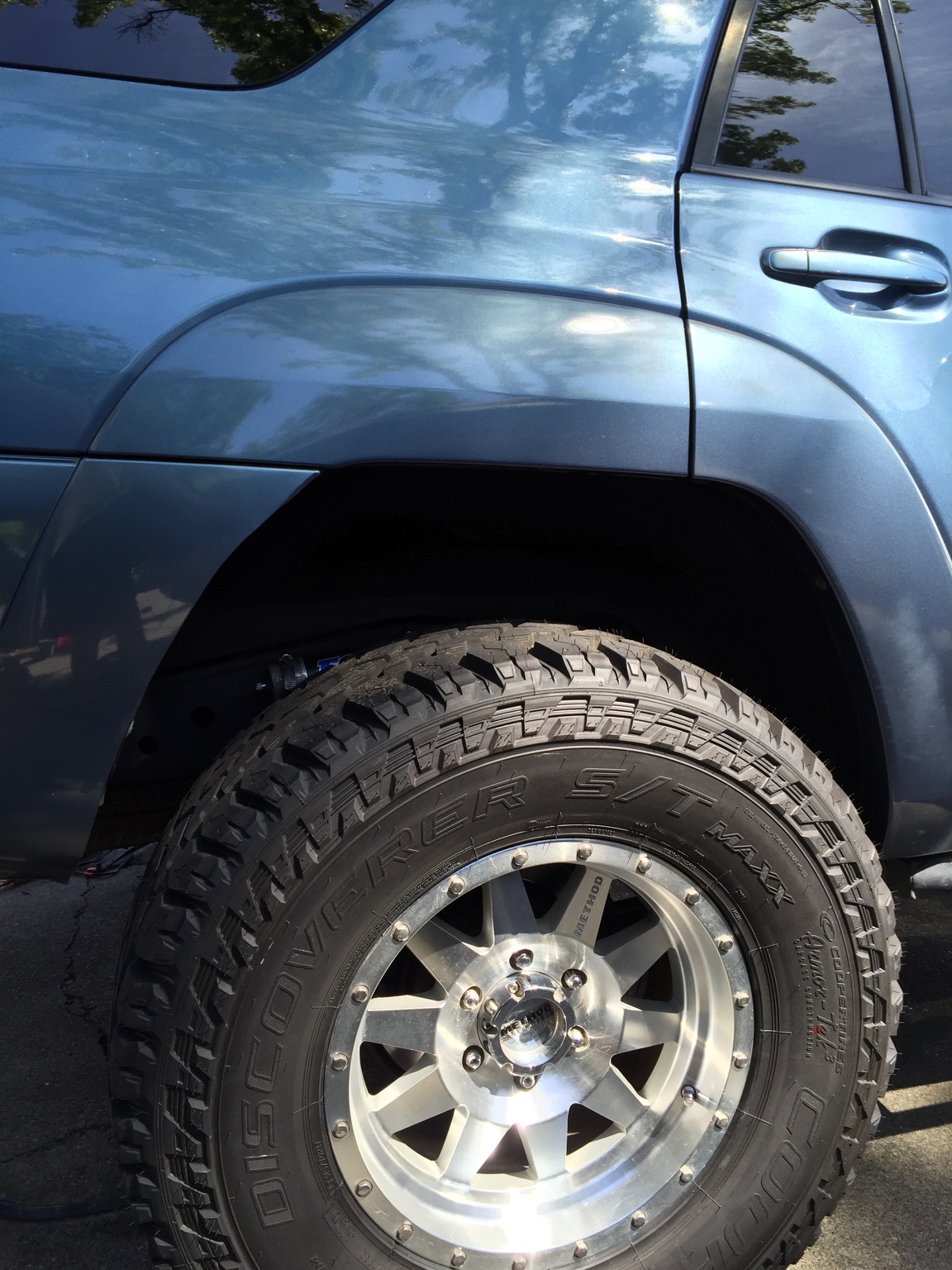
Aftermarket fiberglass front fenders:
No trimming required.
Bumpstops: I have read that with 35's and no bodylift, the rear bumpstop drop is a requirement to keep the tire out of the upper fender. Anyone running no bodylift, 35's, and factory bumpstop location?
Suspension: Despite what a lot of people think, lift height doesn't actually have anything to do with tire clearance. It will help on the daily as you drive around town, but if you offroad, your tire needs to fit at full lock and full compression. The best way to "fit" a tire properly is to actually remove the front coilover and test fit the tire at full compression, trimming everything that is needed as you cycle the movement of the arms and turn lock to lock. Still, interested to s ee what feedback comes here.
Aftermarket UCA's: This is a topic not normally touched on. From experience, I know that the caster setting plays a significant role in how well a large tire will fit. The ability to push the tire forward and away from the firewall has huge benefits in terms of clearance. This may mean more trimming of the front OEM bumper, but aftermarket bumpers should be fine.
What are the big-tire guys running for UCA caster settings?
Members running 35's:
@dapitbull
@LTDSC
@the_josh
@BlackWorksInc
@Rushingman
@t-man
@CruzadoBlanco
I'd like to create a definitive resource for people looking to run 35's. There is a lot of information about in but you have to dig in multiple build threads and there is still a lot of information missing. Also, there are SO many variables that are not specifically discussed: amount of caster on UCA's, wheel specs, bumpstop drops, etc. I am currently on the fence about running a 295 vs. 315 but I hope this resource will serve others in the future regardless of my personal decision. I hope to update this thread as more information is found or is made available.
To get this out of the way early, running a 35" tire has its own set of pros and cons, like any modification you make to your vehicle.
PROS
- increased ground clearance
- wider tire for increased flotation in deep snow and deep mud conditions
- more tire sidewall ratio, usually allows for a more "cushioned" ride
- increased tire width means increased protection of the rim due to the wider tire (assuming rim width stays constant)
- lets be honest... they look badass
- easier rollover on trail obstacles due to increased tire diameter
CONS
- regearing becomes a consideration, but not required
- more wear & tear on components due to increased tire weight (rotational mass)
- reduced driving performance due to increased tire weight (braking and acceleration)
- reduced fuel economy
- trimming and/or additional prep required: trimming, bumpstop adjustments, potentially axle relocation, specific wheel offsets required
Current Research:
**PLEASE, IF YOU HAVE 1ST HAND EXPERIENCE WITH THIS TIRE SIZE, FEEL FREE TO COMMENT. INCLUDE YOUR PARTICULAR SPECS BELOW**
Tire Size:
Tire Make/Model:
Wheels: diameter x width - offset/backspacing
Bodylift: Yes/No (if yes, what size?)
Approx. Suspension lift setting over stock: (do not include bodylift)
Aftermarket UCA's:
Caster correction: (if running aftermarket UCA's, how much caster?)
Bumpers: Stock or Aftermarket
Trimming: Where specifically did you trim to make the tires fit?
Bumpstop drop? (if yes, how much)
Notes: To avoid any/all assumptions, leave a note about your setup. Does it still rub at full compression? Where? Any issues? Anything you would do differently? Biggest pain-point with running 35's on the 4th Gen? Are your links extended to push the axle further rearwards?
Wheels:
Everyone running 35's is either running aftermarket wheels or OEM wheels with wheel spacers. This leads me to believe the need for a larger negative offset to keep the wide (~12-12.5") tires off of the upper control arm and also out of the body mount and firewall.
I'd like to get deeper into wheel specs to document and find the "sweet spot" for running 35's on these rigs. My initial research says 3.5-4" BS (rim width dependant) or around -25mm to -35mm offset.
Trimming:
This is where a ton of variables come into play. Most running 35's are running aftermarket bumpers, so let's just assume if you're running factory bumpers and 35's you will be required to trim the plastic to make them work.
Bodymount chop: required.
Stock Fenders:
Front:
Looking for info... not sure if a 35" tire rubs the bottom of the flare at full compression and/or if the pinchweld area of the fender needs to be cut rearwards with a 35.
Rear:
It looks like people w/o bodylifts have to trim the rear bumper valence on the factory bumper for sure.
Stolen from [MENTION=87687]LTDSC[/MENTION] Build Thread:
Aftermarket fiberglass front fenders:
No trimming required.
Bumpstops: I have read that with 35's and no bodylift, the rear bumpstop drop is a requirement to keep the tire out of the upper fender. Anyone running no bodylift, 35's, and factory bumpstop location?
Suspension: Despite what a lot of people think, lift height doesn't actually have anything to do with tire clearance. It will help on the daily as you drive around town, but if you offroad, your tire needs to fit at full lock and full compression. The best way to "fit" a tire properly is to actually remove the front coilover and test fit the tire at full compression, trimming everything that is needed as you cycle the movement of the arms and turn lock to lock. Still, interested to s ee what feedback comes here.
Aftermarket UCA's: This is a topic not normally touched on. From experience, I know that the caster setting plays a significant role in how well a large tire will fit. The ability to push the tire forward and away from the firewall has huge benefits in terms of clearance. This may mean more trimming of the front OEM bumper, but aftermarket bumpers should be fine.
What are the big-tire guys running for UCA caster settings?
Members running 35's:
@dapitbull
@LTDSC
@the_josh
@BlackWorksInc
@Rushingman
@t-man
@CruzadoBlanco
Last edited: