

rigtec
New member
Hi forum team'
Whenever I decide to post some 4Runner modification or build project that I'm involved with, before I post it, I'll always ask myself if this will add anything to the forum that's different from what has already been contributed, or is it just... da' same ole thang'. imp: But I really like when I find out that it's different because I can't find much info by doing a search, and that's sorta what happened with this. Before my new alternator arrived, I did a 5'th gen 4r alternator replacement search; guess I felt a little 'intimidated' due to the lack of room available in which to remove the old one. But during my search, all that came up were ad's for "Auto Zone, Amazon, Pep-boys, ebay"...etc so I decided to write something about this myself! I also thought that this subject, while not particularly innovative or taboo, may not be as common or as well understood as some other subjects, so there may be a place under the heading of 5'th gen 4r alternator upgrading! Allow me to offer just a little background to the chain of events.
I bought my 2012 4Runner L.E. back in April of 2012. Since that time, I've added a few amenities e.g., PIAA fog light (520) kit, "Dual (750w rms) power amplifier" Sub-woofer system, software driven PEQ and x-overs... yada, yada, yada! So I decided that I needed to upgrade the vehical's stock 130 amp electrical system to prevent having a constant current overload on the truck's main electrical block and, to meet the increased electrical demand imposed by the installed, and future, "after market accessories".
Our O.E. Toyota alternator (small case "Denso hairpin") will deliver about 130 amps @ full output (appx 80 amps @ curbside idle); "for a luxury vehical, that's barely enough for it's standard electrical components". Just a few months ago, I discovered a company by the name of "DC Power engineering", who claimed to build a large case "Denso hairpin" alternator capable of 270 amps full output (180 amps curbside idle).
Well, this alternator (270XP), will fit in the exact same footprint as the original, even the wiring harness will align w/ no mods so I ordered it but It'll take up to five weeks to arrive because it's "made to order", said the C/S gentleman. Looking at the original one and trying to assess the swap, there's really not a lot of room to remove it from it's operational location. I did quite a few searches trying to find someone (anyone), who has done this before but I came up "empty handed".
I know it's not a big deal to swap an alternator; at least most of them aren't. I was an auto mechanic in the old days; mid 70's to mid 80's. But after that I went into the Commercial-Indus'l Air conditioning/Building controls field, joined the 'Steamfitters union' and have never looked back! But now, some twenty plus years later, I barely remember how to open the hood... ... If it's something that I can do in my driveway then ok, I'll do it. But, if I'm going to get half way into the job then learn that the power steering lines or freakin water pump has to be removed first, I'm gonna be... :yell: !!! hahahaha!
I don't know if anyone else here has ever changed a 5th gen 4R alternator yet, but if you're planning it or need to... BEWARE! Looking at it, standing in front of the truck, you can see that it might be a b*tch getting it out from it's station. The engine head overlaps it on top, the a/c compressor beneath, hoses/piping and large harness to the right, and engine block to the south,:faint:ugh... There are, what looks like two bolts (through the 'ears') holding it in place. But what you can't see is a third bolt and bracket down underneath the alternator, securing it to the exhaust manifold which is very difficult to remove from up top; glad I had my mechanic taking care of it for me this time (my mechanic >:caked:< me)... dodged a bullet! Additionally, there is an electrical system harness that's secured to the alternator as well, so IF you ever need to R&R your alternator on a 5th gen, give yourself plenty of extra time to do this one; even the service time estimate guide advises 1.5 hrs to do this job, which is just short of the actual time that it took and this mechanic works really fast.
Snapped a couple pics.
BEFORE


AFTER


Perty ain't it!!
Back in January, I took a couple of pictures of my volt meter read-outs (O.E.M. alternator) under very different conditions. The first is just after starting the truck. There were no lights on in the vehical (during the day), and I deliberately shut down the heat (blower fan), and the audio system. Here's a snap-shot of an "UN-LOADED" charging system voltage reading (taken @ idle); cold battery (ambient temp=18 deg F), "standing voltage" was @11.49 (w/engine off).

As you can see, the battery/charging system voltage is good (still 18 deg F) @12.83, as indicated by the "battery icon" (showing full) on the right of the numeric display, and the green 'LED' just beneath the number 12. The alternator is trying to replace the battery's surface charge, depleted by start-up and the severe cold; it will eventually rise to 13.9 volts before leveling off at 13.8. Incidently, the two JL Audio "HD-750/1" power amps will consume about 56 amps (each), to deliver their full output of 750 watts true rms . So that's 112 amps from a gross budget of 130A, leaving only 18 amps from the "full-fielded" alternator. Then, there's another 'add-on'. The PIAA 520 foglights, which can use up to 10 amps gross, leaving only around eight amps to run the truck... and to charge the battery! Here's another snap-shot of a completely loaded charging system voltage reading (taken @ idle) at night. The engine has reached it's normal operating temperature, and the low beams, foglights, heater fan and the audio subwoofer system, are in full operation at this time.

As indicated by the voltage monitor in this photograph, the battery icon is "completely depleted", and the red 'LED' is showing an urgent warning, prompting the driver to get this checked ASAP!. Now, I'm not in the habit of abusing my truck, it's audio components, or it's electrical system; this 'overload' condition was created just for this test. But if I wanted to operate it's electrical loads at full potential, I'd like knowing that it would be just fine!
"CONTINUED BELOW"
Whenever I decide to post some 4Runner modification or build project that I'm involved with, before I post it, I'll always ask myself if this will add anything to the forum that's different from what has already been contributed, or is it just... da' same ole thang'.
imp: But I really like when I find out that it's different because I can't find much info by doing a search, and that's sorta what happened with this. Before my new alternator arrived, I did a 5'th gen 4r alternator replacement search; guess I felt a little 'intimidated' due to the lack of room available in which to remove the old one. But during my search, all that came up were ad's for "Auto Zone, Amazon, Pep-boys, ebay"...etc so I decided to write something about this myself! I also thought that this subject, while not particularly innovative or taboo, may not be as common or as well understood as some other subjects, so there may be a place under the heading of 5'th gen 4r alternator upgrading! Allow me to offer just a little background to the chain of events.I bought my 2012 4Runner L.E. back in April of 2012. Since that time, I've added a few amenities e.g., PIAA fog light (520) kit, "Dual (750w rms) power amplifier" Sub-woofer system, software driven PEQ and x-overs... yada, yada, yada! So I decided that I needed to upgrade the vehical's stock 130 amp electrical system to prevent having a constant current overload on the truck's main electrical block and, to meet the increased electrical demand imposed by the installed, and future, "after market accessories".
Our O.E. Toyota alternator (small case "Denso hairpin") will deliver about 130 amps @ full output (appx 80 amps @ curbside idle); "for a luxury vehical, that's barely enough for it's standard electrical components". Just a few months ago, I discovered a company by the name of "DC Power engineering", who claimed to build a large case "Denso hairpin" alternator capable of 270 amps full output (180 amps curbside idle).
Well, this alternator (270XP), will fit in the exact same footprint as the original, even the wiring harness will align w/ no mods so I ordered it but It'll take up to five weeks to arrive because it's "made to order", said the C/S gentleman. Looking at the original one and trying to assess the swap, there's really not a lot of room to remove it from it's operational location. I did quite a few searches trying to find someone (anyone), who has done this before but I came up "empty handed".
I know it's not a big deal to swap an alternator; at least most of them aren't. I was an auto mechanic in the old days; mid 70's to mid 80's. But after that I went into the Commercial-Indus'l Air conditioning/Building controls field, joined the 'Steamfitters union' and have never looked back! But now, some twenty plus years later, I barely remember how to open the hood...
... If it's something that I can do in my driveway then ok, I'll do it. But, if I'm going to get half way into the job then learn that the power steering lines or freakin water pump has to be removed first, I'm gonna be... :yell: !!! hahahaha!I don't know if anyone else here has ever changed a 5th gen 4R alternator yet, but if you're planning it or need to... BEWARE! Looking at it, standing in front of the truck, you can see that it might be a b*tch getting it out from it's station. The engine head overlaps it on top, the a/c compressor beneath, hoses/piping and large harness to the right, and engine block to the south,:faint:ugh... There are, what looks like two bolts (through the 'ears') holding it in place. But what you can't see is a third bolt and bracket down underneath the alternator, securing it to the exhaust manifold which is very difficult to remove from up top; glad I had my mechanic taking care of it for me this time (my mechanic >:caked:< me)... dodged a bullet! Additionally, there is an electrical system harness that's secured to the alternator as well, so IF you ever need to R&R your alternator on a 5th gen, give yourself plenty of extra time to do this one; even the service time estimate guide advises 1.5 hrs to do this job, which is just short of the actual time that it took and this mechanic works really fast.
Snapped a couple pics.
BEFORE
AFTER
Perty ain't it!!
Back in January, I took a couple of pictures of my volt meter read-outs (O.E.M. alternator) under very different conditions. The first is just after starting the truck. There were no lights on in the vehical (during the day), and I deliberately shut down the heat (blower fan), and the audio system. Here's a snap-shot of an "UN-LOADED" charging system voltage reading (taken @ idle); cold battery (ambient temp=18 deg F), "standing voltage" was @11.49 (w/engine off).
As you can see, the battery/charging system voltage is good (still 18 deg F) @12.83, as indicated by the "battery icon" (showing full) on the right of the numeric display, and the green 'LED' just beneath the number 12. The alternator is trying to replace the battery's surface charge, depleted by start-up and the severe cold; it will eventually rise to 13.9 volts before leveling off at 13.8. Incidently, the two JL Audio "HD-750/1" power amps will consume about 56 amps (each), to deliver their full output of 750 watts true rms . So that's 112 amps from a gross budget of 130A, leaving only 18 amps from the "full-fielded" alternator. Then, there's another 'add-on'. The PIAA 520 foglights, which can use up to 10 amps gross, leaving only around eight amps to run the truck... and to charge the battery! Here's another snap-shot of a completely loaded charging system voltage reading (taken @ idle) at night. The engine has reached it's normal operating temperature, and the low beams, foglights, heater fan and the audio subwoofer system, are in full operation at this time.
As indicated by the voltage monitor in this photograph, the battery icon is "completely depleted", and the red 'LED' is showing an urgent warning, prompting the driver to get this checked ASAP!. Now, I'm not in the habit of abusing my truck, it's audio components, or it's electrical system; this 'overload' condition was created just for this test. But if I wanted to operate it's electrical loads at full potential, I'd like knowing that it would be just fine!
"CONTINUED BELOW"
Last edited:


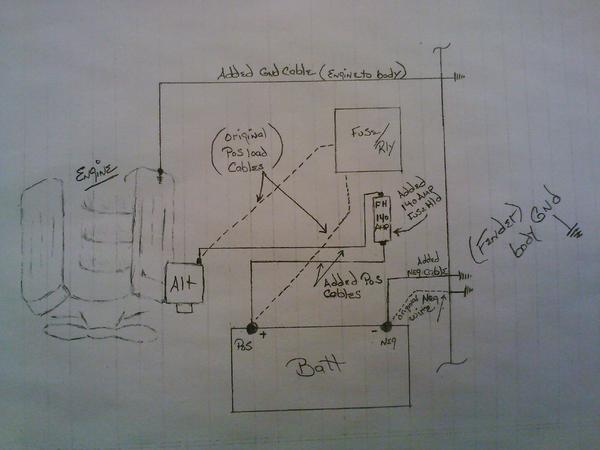


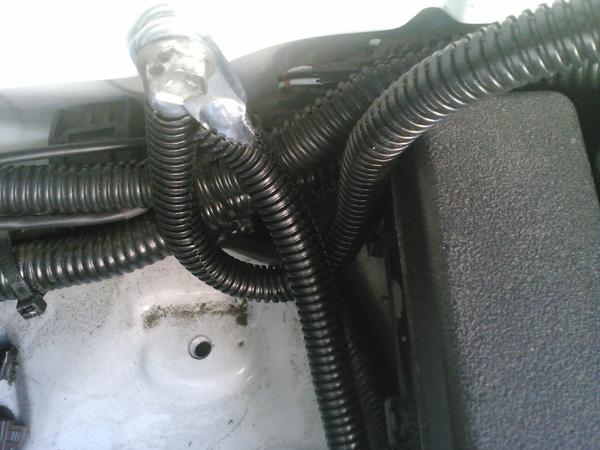


 : Most average residential homes have a 100 to 250 ampere electrical panel in it's garage or basement. The utility 'electric and gas company' has an electrical grid at the home's service hook-up (the meter), which can provide more than 10,000 amperes to that entire block on demand if needed; remember, this almost limitless grid is already hooked-up to the home! See my point? Just having an available electrical resource like a "Dual battery set-up" or a "Triple High output alternator bundle" is only a pool which can only make electricity available when needed and cannot cause the vehicle to consume more current than it needs. "The electrical system puts a demand on the generator; not the other way around!" Hope this helps, :thumb:


