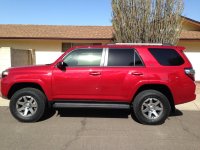
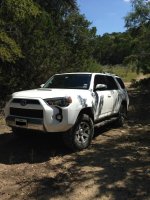
Had (4) 5100's installed on my '14 Trail this week. Learned something a bit surprising I me. You guys may be aware and maybe it's been covered, but i haven't seen it after reading every 5100 thread i coud find in past months so thought I'd share.
The mechanic I used is steeped in building race suspensions and track cars in general, so he's very precise about what "level" really means. I requested that the adjustable front's be set to .85 to "level" the truck some, and left it at that. He measured the truck frame front and rear prior to installation. Determined it was close to level, and installed the 5100's to stock height as a result. Measured after the install and the truck ended up only 2mm higher in the rear than the front, so it was really close to "level". Obviously we had two different visions of what we were looking to achieve. Being the stand-up guy that he is, he took the truck back the next day and re-did the work to set them at .the 85" setting. Looks much better, nose dive is greatly reduced, and I couldn't be happier. He has a customer for life.
Now, I read that some reported feeling like being in a spaceship ready for takeoff when theirs were set to 1.75" with no rear lift, and this might be be why. If the frame is essentially level with 5100's set at stock setting, then if set at 1.75" the front to rear frame rake would have to be raked by the same amount, no? This may be elementary to some but wasn't to me. Given the aesthetic rake of the truck when stock, I wouldn't have expected this to be the case. However, the more I thought about it, why would Toyota build a truck with a non-level frame and canted suspension geometry. They wouldn't....makes sense now. Wheel wells cut differently between front and rear. Something to consider when looking to set the fronts at 1.75" lift with a stock rear suspension.
The mechanic I used is steeped in building race suspensions and track cars in general, so he's very precise about what "level" really means. I requested that the adjustable front's be set to .85 to "level" the truck some, and left it at that. He measured the truck frame front and rear prior to installation. Determined it was close to level, and installed the 5100's to stock height as a result. Measured after the install and the truck ended up only 2mm higher in the rear than the front, so it was really close to "level". Obviously we had two different visions of what we were looking to achieve. Being the stand-up guy that he is, he took the truck back the next day and re-did the work to set them at .the 85" setting. Looks much better, nose dive is greatly reduced, and I couldn't be happier. He has a customer for life.
Now, I read that some reported feeling like being in a spaceship ready for takeoff when theirs were set to 1.75" with no rear lift, and this might be be why. If the frame is essentially level with 5100's set at stock setting, then if set at 1.75" the front to rear frame rake would have to be raked by the same amount, no? This may be elementary to some but wasn't to me. Given the aesthetic rake of the truck when stock, I wouldn't have expected this to be the case. However, the more I thought about it, why would Toyota build a truck with a non-level frame and canted suspension geometry. They wouldn't....makes sense now. Wheel wells cut differently between front and rear. Something to consider when looking to set the fronts at 1.75" lift with a stock rear suspension.