5th Generation Poor Fuel Efficiency Causes?

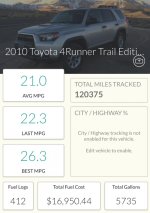
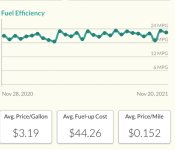
Still happy with my MPGs overall. It’s not consistent tank to tank but it has been year to year.
 

Attachments

  • 9C412FC6-B006-4645-9AF2-9086835E23BC.jpg
    9C412FC6-B006-4645-9AF2-9086835E23BC.jpg
    111.6 KB · Views: 680
  • 44AB0DFC-5CC1-4132-8A9F-C982272F3A71.jpg
    44AB0DFC-5CC1-4132-8A9F-C982272F3A71.jpg
    60.5 KB · Views: 690
I have a gen3 (306,000 miles) with slightly larger than stock tires and a 2023 TRD OR Premium all stock. The gen3 gets an average of 18MPG on the highway. So far the 23 has done a little better than that averaging 20mpg on the highway.

I've owned a number of 4Runners and what I found with each of them is the biggest difference in my mileage will be wind speed/direction and driving speed. If I'm on 2 lane roads running 65ish I'll hit 19 with the gen3 and 20-21 with the 23. If I'm on the interstate running 78mph that will drop by 2mph on either. If I'm heading into a 20 mph wind all bets are off. Also cold temps and whatever they use for winter fuel will also impact mileage.

Lets face it, if we wanted awesome fuel economy we wouldn't have bought a 4Runner.
 
If a dealer did the diffs and transfer case - it's all but guaranteed they used non-synthetic fluids to refill. Toyota uses synthetic gear lubes in all the cases. So you're going to lose some mpg from that, but probably not a lot. Maybe 1mpg.

Do you have an lift, level kit, or aftermarket roof rack? Or even a bug deflector? All of those will hurt your highway mileage. GM did a pretty good study a while back that showed that a bug deflector alone will cost about 1mpg.

The common issue on the 5vz (your 3rd gen 4R) was the O2 sensors. They could essentially wear out, but you wouldn't know because the engine wouldn't identify them as having an issue. So over time they'd slowly cause a slight rich burn condition and fuel mileage would drop. I considered it sort of like preventative maintenance on my 1996. I changed them at 150 and 200k miles. Both times I had a noticeable bump up in fuel economy after.

Those are the big ones I can think of. I don't think I'm aware of any O2 sensor issues on the 5th gens though.

The wheel bearings usually start making a lot of nose is how you know they're bad. Not from anything mpg related. If they were causing excessive drag, they'd overheat and fail pretty fast. They don't have a lot of cooling ability and the thermal runaway happens pretty quick if something goes wrong that increases friction a lot.

The one thing that can cause excess drag and you may not notice is a seized brake caliper or parking brake. After you drive next time put your hand on the wheels. The brakes will probably be kinda hot, so don't burn yourself, but feel if you can for any one of the wheels being a lot hotter than the others. That would suggest a frozen brake caliper.

Could also be your driving - style or the nature of your driving. Lots of city driving of course is going to reduce mpg. Driving north of about 90mph really kills the mpg too. The next time you're on an open stretch of highway on flat ground, reset the mpg calculator and see what it gets at 65mph. For a stock 4Runner you should get around 21mpg.

Finally - double check that your tires are inflated properly.

Those are all the ideas I know of.

Good luck.

2014 SR5 with 349K miles. Running Cooper AT3 LT (e-rated) in stock size. Everything else is stock. MPG has declined from 19.1 last just to just over 16 currently as measured by fuel purchased and miles on a recent 1281 mile trip from Fullerton, CA to Stevensville, Montana running typically at 80 mph.

Back in December I was doing work that had the battery disconnected for about an hour and reset the ECM. It then started to experience low idle and intermittent stalling when coming to stop after warming up. I cleaned the MAF to no effect. I cleaned the throttle body which cured the low idle and stalling, but the best mpg we saw on the dash was 16.7 after recycling the ECM. Now we see 15.7 and the calculated mileage of 16 mpg.

Spark plugs are nearing 100K miles, so I have a new set of Denso Iridium Long Life on order. All fluids are synthetic. Rear brake pads recently replaced and front pads have 75% wear left. Recently cleaned and greased pins in front calipers along with greasing the shims and back of pads to eliminate a squeal when backing up on cold mornings. Air filter has about 10K miles on it and is relatively clean.

16 mpg is not going to make or break us, but I would like to recover to 19 mpg.
 
[MENTION=177976]CutthroatSlam[/MENTION] 10% drop due to winter fuel wouldn’t be unreasonable… maybe a factor. And/or higher ethanol content (within regulation but higher than your usual station). Extreme cold temps in your area will result in lower mpg too.

Have you cleaned your injectors in awhile? Some seafoam in the tank may help.

Curious how your fuel economy will change in a few months with non winter fuel and more moderate temps.
 
[MENTION=177976]CutthroatSlam[/MENTION] 10% drop due to winter fuel wouldn’t be unreasonable… maybe a factor. And/or higher ethanol content (within regulation but higher than your usual station). Extreme cold temps in your area will result in lower mpg too.

Have you cleaned your injectors in awhile? Some seafoam in the tank may help.

Curious how your fuel economy will change in a few months with non winter fuel and more moderate temps.

Have never cleaned fuel injectors.
 
Driving through cold, denser air, will also reduce MPG. If the 4Runner gets started to let it 'warmup' before driving, you are getting ZERO MPG during that time, which will bring the MPG average down. Not to mention all the lubricants in the driveline will be thicker due to cold temps, creating more drag, and lowering MPG further.

Cold temperatures reduce MPG all the way around. I wouldn't draw any conclusions about your MPG average, until warmer temps return.
 
Driving through cold, denser air, will also reduce MPG. If the 4Runner gets started to let it 'warmup' before driving, you are getting ZERO MPG during that time, which will bring the MPG average down. Not to mention all the lubricants in the driveline will be thicker due to cold temps, creating more drag, and lowering MPG further.

Cold temperatures reduce MPG all the way around. I wouldn't draw any conclusions about your MPG average, until warmer temps return.
Indeed. The vehicle revs higher while it is driving on warmup cycle as well. Shifts to every gear noticeably later, revving higher, until it's up to temp. On my 3 mile commute, I get 16mpg in summer and 13-14mpg in winter, just because the engine is on warm-up cycle for much more of that commute. During summer it will shift into overdrive on a certain 40mph section, which it won't do on the coldest winter days, for example. Thanks to the old-tech mechanical engine fan, it probably takes longer to warm up than any other vehicle, since it actively tries to cool everything down while it's already ice cold.

My lifetime is about 20mpg in mine. I'm never lifting it. If I ever oversize tires, it'll be by an inch or less. I'm on P-metric A/Ts. I have seen a number of 25mpg tanks. I drive conservatively, bleed speed on steep canyons rather than letting it downshift twice, and do not generally cruise over about 73mph. 4.0L is a lot of engine. If you let it rev high, it's gonna suck down fuel. If you did mods that require it to rev high just to function as a basic vehicle keeping up with traffic, it's gonna suck down fuel.
 
Last edited:

Members online

Forum statistics

Threads
278,308
Messages
3,554,058
Members
248,016
Latest member
Advally Service

Trending content

Back
Top