95 4 runner stranded me-Ignition/Distributor?

mikedks

New member
Let the title says, my 95 4Runner 3.0 auto w/166K miles stranded me 150 miles from home(w/family!).

Quick history, my Runner is mostly stock, have done a shat ton of work on it over the years. Much help from you guys of course, thank you. Never really had any issues with how it ran, though it would occasionally throw a code if I accelerated too hard. If I recall, it was always an ignition code, would eventually reset with no issues in how it ran. Before I took the family into the mountains with the Runner, I replaced the coil and ignitor, no issues, ran great. On the way home, 100 miles in, 95 degree's outside, in the moutains, 70 mph, under fairly hard acceleration the Runner cut out for a split second 2 different times. The last time it died for good, would turn over, sputter for a second and die.

Thank god for AAA premium, towed us all the way home. Tried it when I got home and guess what?, started and ran fine. shit, worse than being broken down.

I have had a similar problem on a GM product in the past and am leaning toward the distributor as the issue. Unfortunately, was not able to do any
diagnostics on the road due to family being with me.

Would really love some advice on how I can properly diagnose if I have a failing distributor. Don't really want to throw money by replacing with no
solid diagnosis.
 
Register to hide this ad
Check out 4crawler he has a wonderful website with all kinds of diagnostic walkthroughs from the FSM or get a copy of the FSM and you will have all the answers you need.
Link to 4 crawler in my signature.


Sent from my iPhone using Tapatalk
 
I pulled out the FSM and ran my checks on the ignition system including distributor and input coils, all where surprisingly within spec. Last place I checked(probably should have been first) was the fuse box, to my great surprise, the EFI fuse is completely melted. Also not completely blown, truck runs fine.
Also explains why there is no code, according to FSM, pulling the EFI fuse clears the trouble codes.

This is where I am probably out of my comfort zone, I am a remove/replace type of shadetree "mechanic" in the driveway type of guy. Anyway, I do have the FSM and after a visual inspection will start testing the elements of the fuel circuit. I should mention that I checked the O2 sensor wiring, as per another thread, all appears intact.

Are there elements are the fuel circuit that are more prone to failure? where should be my starting point?

thanks guys
 
It would be nice to know if you had spark when it played dead.
How much fuel was in your tank?
Do you mean the EFI fuse was melted but still had continuety? Like it blew then healed itself?
One thought, new parts( and I don't know what quality you used) are not always without issues. You say you just replaced the ignition coil. Weak or failing ignition coils sometimes fail under high temperature conditions then work Ok once cooled off. Also I would look closely a the wiring, grounding and connector contacts on the work you recently performed on your ignition circuit.
I'm not sur how you test the resistance on a fuel pump under high load in extreme conditions but I'd probably look there if I ruled out ignition issues.
 
It would be nice to know if you had spark when it played dead.
How much fuel was in your tank?
Do you mean the EFI fuse was melted but still had continuety? Like it blew then healed itself?
One thought, new parts( and I don't know what quality you used) are not always without issues. You say you just replaced the ignition coil. Weak or failing ignition coils sometimes fail under high temperature conditions then work Ok once cooled off. Also I would look closely a the wiring, grounding and connector contacts on the work you recently performed on your ignition circuit.
I'm not sur how you test the resistance on a fuel pump under high load in extreme conditions but I'd probably look there if I ruled out ignition issues.

Thanks, I have already ruled out the ignition, I actually pulled out the Ohm meter and FSM and correctly checked all components, connections, & wires.

Yes, the EFI fuse is completely melted, will try and post a pic later. Once vehicle cooled, started right up. Needless to say, it is not moving from my driveway until I find the culprit.
 
You've only ruled out these comments in your drive way. Not under the extreme conditions you described. Once again, I'll try to offer you need to know if you have "spark" when the problem occurs. I don't care what the ohm meter says about your coil when it is sitting there cold.
 
You've only ruled out these comments in your drive way. Not under the extreme conditions you described. Once again, I'll try to offer you need to know if you have "spark" when the problem occurs. I don't care what the ohm meter says about your coil when it is sitting there cold.

Again, I always appreciate input, however...
Those extreme conditions will not happen again, nor did I have the opportunity to check for spark while dead on the highway with my family.
I was able to check in the driveway both hot and cold, dead center of the ohm range across the board. The statement about not caring what the ohm meter says, you really said that?

I think you missed the part that said that the fuse for a completely different system is a melted blob of plastic, to me, and I'm not a mechanic, that indicates where the problem may lie.
 
A major purpose of the EFI fuse is to provide power to the fuel pump. If it is blown the engine will not run, although there may be enough fuel in the lines for it to sputter once or twice when you crank it.

The EFI fuse also powers up the non-volatile memory where the ECU stores trouble codes, so if it opened up any stored codes are gone.

It sounds like the EFI fuse experienced some kind of over heating condition that caused it to melt down and open under driving conditions, but when it cooled off it re-established contact. It's unusual for a fuse to behave that way due to a normal overcurrent condition. Instead, I would suspect that it was making poor contact in the fuse socket, and the high resistance overheated the fuse externally. I would carefully check the condition of the fuse socket.

You could also have a defective/dying fuel pump that is intermittently drawing excessive current.

If the engine sputtered when you tried to crank it, it was suffering from fuel starvation, not from lack of ignition.
 
Again, I always appreciate input, however...
Those extreme conditions will not happen again, nor did I have the opportunity to check for spark while dead on the highway with my family.
I was able to check in the driveway both hot and cold, dead center of the ohm range across the board. The statement about not caring what the ohm meter says, you really said that?

I think you missed the part that said that the fuse for a completely different system is a melted blob of plastic, to me, and I'm not a mechanic, that indicates where the problem may lie.
Ron's right about the fuel and sputter most likely. Unless it's an intermittent electrical problem. The fuel pump is, as I thought I pointed out in my first response, an obvious place to look. The reason I asked how much gas was in the tank is that fuel pumps are stressed harder with a low tank especially in hot conditions because it's the fuel in the tank that cools the pump.
And I'm in no way trying to be rude. The reason I don't care about the how a cold ignition coil tests is that In my 50+ years at this I've seen, well I don't know how many but probably more than you have fingers on your left hand, but enough ignition coils that tested just fine when cold or in normal operating conditions drove many nuts and turned out to go south when they just reached that point of being too hot. (I don't know why but I think it has something to do with insulating oil inside the coil and I may off base on the oil thing)
Anyway I've also seen off the shelf new parts with issues. I believe the coil was the last thing you replaced that's why I was suspect there.
Getting back to the fuel pump. I don't think I've ever heard of a Toyota pump giving up before 200k. But things happen. Maybe the tank was run low a lot in summer conditions which in some theory shortens the pump life. Anybody reports of what mileage a fuel pump fail on a 2nd gen. I believe there is a fuel pump relay to check as well.
Another consideration were your dash on (not in the trouble mode but like if the key was on without the engine running) when it stalled? The reason I ask is your ignition switch contacts could be intermittingly failing.
Oh yeah, let's see that fuse.
 
A major purpose of the EFI fuse is to provide power to the fuel pump. If it is blown the engine will not run, although there may be enough fuel in the lines for it to sputter once or twice when you crank it.

The EFI fuse also powers up the non-volatile memory where the ECU stores trouble codes, so if it opened up any stored codes are gone.

It sounds like the EFI fuse experienced some kind of over heating condition that caused it to melt down and open under driving conditions, but when it cooled off it re-established contact. It's unusual for a fuse to behave that way due to a normal overcurrent condition. Instead, I would suspect that it was making poor contact in the fuse socket, and the high resistance overheated the fuse externally. I would carefully check the condition of the fuse socket.

You could also have a defective/dying fuel pump that is intermittently drawing excessive current.

If the engine sputtered when you tried to crank it, it was suffering from fuel starvation, not from lack of ignition.

Good info, I did a fairly thorough visual this afternoon, including the fuse socket and did not see any obvious issues. I am going to do a more thorough line check as time permits. Damn, I hope it's not the fuel pump...
 
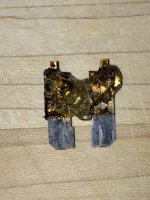
Here's the bugger.
 

Attachments

  • IMG_1333.jpg
    IMG_1333.jpg
    83.6 KB · Views: 808
Bob: tank was more than 3/4's full, I never it let it go below a 1/4 tank, not when you are getting 15 mpg on a 16 gallon tank.

Now that I think about it, truck never stalled per se, just lost all power, immediately pulled onto the shoulder, that's when it died. I highly doubt
its related to ignition switch as the original began to fail about 2 years ago so I replaced. Been fine ever since.

Fuse picture is attached, toasty, can't even tell if the metal is intact.
 
That is certainly a strange way for a fuse to fail. The internal fuseable link should blow long before it gets hot enough to melt the plastic shell. One possibility is that it was running for a long time just below the current level required to blow the link, but high enough to get it really hot.

BTW, there are two relays involved in the fuel pump. The first is the EFI relay. It connects power from the EFI fuse to the fuel pump circuits and other ECU related circuitry. The coil is activated when the ignition switch is turned on.

Downstream from the EFI relay is the Circuit Opening Relay, which actually powers up the fuel pump. It has a dual coil, one run from the start switch to start the fuel pump, and one run from the air flow meter that holds the fuel pump on once the engine is running. If the engine stops, cutting off air flow, the COR cuts off the fuel pump to avoid fire in case of an accident.

You might want to inspect the EFI relay and the Circuit Opening Relay for damage and for proper operation. I'd also measure the resistance of the fuel pump to see if it's in spec.
 
That is certainly a strange way for a fuse to fail. The internal fuseable link should blow long before it gets hot enough to melt the plastic shell. One possibility is that it was running for a long time just below the current level required to blow the link, but high enough to get it really hot.

BTW, there are two relays involved in the fuel pump. The first is the EFI relay. It connects power from the EFI fuse to the fuel pump circuits and other ECU related circuitry. The coil is activated when the ignition switch is turned on.

Downstream from the EFI relay is the Circuit Opening Relay, which actually powers up the fuel pump. It has a dual coil, one run from the start switch to start the fuel pump, and one run from the air flow meter that holds the fuel pump on once the engine is running. If the engine stops, cutting off air flow, the COR cuts off the fuel pump to avoid fire in case of an accident.

You might want to inspect the EFI relay and the Circuit Opening Relay for damage and for proper operation. I'd also measure the resistance of the fuel pump to see if it's in spec.

thanks for the advice, I'm pulling out the FSM this weekend to track down
this relay's and see if I can get this figured out. I sure hope it's a relay and not the stupid fuel pump...
 
Wow, that fuse is scary! You say you can't tell if the metal is intact. But you also stated early the truck runs with that fuse. So it, the fuse, must have continuity correct? Have you checked the fuse for continuity?
I know this seems not much to do with your original question. But, that fuse. At this point there is likely no way to ID its brand but I'd be guessing it's not OEM, BUSS , or whoever makes good fuse these days. I have seen some real crappy fuses out there in budget assortment packs places like HF, WM, hardware and auto parts store bargain tables. I've wondered what could go wrong with a fuse though and all I could come up with is it breakin of in the socket. Thanks, now I know better. think I'll stay away from those. And if I was you I'd be takin a close look at the other fuses in the vehicle as well. I glad there was no fire involved.
In your original question you asked about the distributor. With pointless ignition these days (I know it the last 45 years, I'm old) other than mechanical like the gear that engages the cam snapping or stripping is the Cam Position Senser or CPS, I believe. I never been in one of these distributors and I'm not sure what Toyota calls it. You can research it I do believe you can test it by turning the distributor and check resistance between the correct leads between the distributor and the coil. Again it can bring an electrical component it can as well behave differently under hot, cold, or warm conditions.
But man something melted that fuse. When an electric motor fails or is getting close it will likely draw excess current and blow the fuse or circuit breaker. Something melted that fuse and as far as a know other than the fuel pump the only thing in that EFI circuit that can draw enough current to blow or melt a fuse would be the pump. Electric motor can due that: draw extra current when worn and heavily loaded then go back seemly (though a this point there quite compromised) being fine when cool. I believe that's why is often said fuel pumps don't generally fail outright but give trouble signs first. As do most electric motors.
Good luck and I'd be cautious about throwing any after market electrical comments at it without first being sure not replacing what is not the problem with something that could be a new and another problem. As witness by your fuse a lot of aftermarket quality may well be doubt these days.
 
Thanks, I have already ruled out the ignition, I actually pulled out the Ohm meter and FSM and correctly checked all components, connections, & wires.

Yes, the EFI fuse is completely melted, will try and post a pic later. Once vehicle cooled, started right up. Needless to say, it is not moving from my driveway until I find the culprit.

Two comments, not t4r specific.

1) I don't think you can rule out ignition, as it was working when you checked the ignition parts, yes? If it happens again, I would check for spark going into distributor - pull the coil wire from the distributor, hold near ground, crank over and look for spark. If you have spark there, check the plug wires the same way. Work in the indicated direction based on what you observe. Yeah, I'm betting you know how to do this, no offense intended. I once had spark go into the distributor, but not come out. Nothing visually wrong. I spent the extra $8 and replaced both the cap and rotor - this was a long time ago.

2) I've had a fuse just fail. Looked fine (old style glass BUSS fuse), but headlights went out randomly. Ohmed fine sometimes... Replaced it and the problems went away.

I assume you've replaced the fuse, if not, I'd do so, and carry a few spares. If it was a bad fuse, you have your problem. I'd also look at that fuse pretty often for the next 1000 miles or so. Perhaps when you get gas?

If it happens again, check for spark at the plugs and work backwards as far as you can. You can do this while waiting for AAA... :D


--Soren
 
I think I need to correct what I said two posts up about checking the CPS in the distributor for resistance I believe you check that one with a test lamp (be sure to use the led type for data circuits on today's vehicles). But that's only if you have as suggested several times above already checked for spark and found none.
The next step in trouble shooting if you find spark (when the no-go condition rears its head) would be to pull a plug to check to see if it's wet. Meaning are you getting fuel? Too much fuel? Which is often the first step in trouble shooting an engine that won't run.
If your new at checking for spark you might want to stop by the auto parts mart near you and get a little gadget the goes between plug wire and plug it will tell both spark and intensity of such. They cost only a few bucks.
 
Without going out to my '95 and looking, I'm pretty sure there's an access panel to get to the fuel pump, right under the right rear seat. So, if it's your pump, or you want to check the pump connections and stuff, it shouldn't be too awful to get to it. My last 2nd gen, a '92, had a bad pump and I actually dropped to tank before finding that panel. And really, unless you don't like to play with gas, changing out the fuel pump with that access door should be a breeze. I guess the bad thing is the price of a new pump, but if you can pin your problems on it, that would be great.
 
Here's the bugger.

Based off the color of the fuse it doesn't seem that it is the correct fuse for the EFI circuit. It should be a 15A fuse; your fuse either seems to be a 5A, 20A, or 25A fuse. I would replace the fuse with the correct fuse, that is if you haven't already.
 
Based off the color of the fuse it doesn't seem that it is the correct fuse for the EFI circuit. It should be a 15A fuse; your fuse either seems to be a 5A, 20A, or 25A fuse. I would replace the fuse with the correct fuse, that is if you haven't already.

Good thinking Frank. I wonder, that with 20 or 25a fuse in the circuit rather than the fuse blowing if the power draw was too high for the circuit ( and in this case where the fuse receptacle connections are) caused the overheating and melting?

Also, I'm not certain the pump fits out the access whole ( my 93 is a PU) or if the second gen has one like the first. But that would make if easy to check the wiring for continuity, short to ground, and loose connections anyway.

Short to ground, I meant to mention, a possiable intermittent short could be your issue?

If you do get to opening the tank be careful to avoid any sparking between wires or tools. The battery should probably be disconnected just in case and some like to use brass tools when working on such.
 

Members online

No members online now.

Forum statistics

Threads
278,307
Messages
3,554,050
Members
248,016
Latest member
Advally Service

Trending content

Back
Top