Acceptable ranges of resistance in wiring harness

1bzdvl

Member
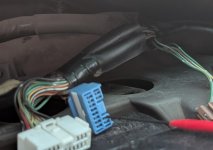
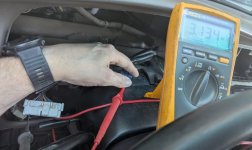
I'm still chasing a p0500. I thought it was the cluster. It's not. I started poking around testing resistance in the wiring and I'm seeing roughly 3 MΩs when testing the resistance between the pins of the different connectors that plug into the combination meter, against the wire that send speed signal to the ECU. I thought I would see infinite resistance, but I'm wondering if I have a short in the harness. I see 0.2 Ω when testing the grounds with the negative battery terminal. So at least the grounds are good.

 

Attachments

  • PXL_20250419_015547905.NIGHT.RAW-01.COVER~2.jpg
    PXL_20250419_015547905.NIGHT.RAW-01.COVER~2.jpg
    110.6 KB · Views: 421
Register to hide this ad
You're testing between the pins of a connector while the other end is still attached to something? You will get a reading because there is something at the other end giving you that reading. The only way to test continuity in a bundle is to disconnect both ends and then use a jumper between 2 wires, take a reading at the other end, move to the next 2 wires and so on.

Or is that what you're doing? I'm not clear on how you are testing. DC is funny in that it flows from a high potential to a low one, not always positive to negative. Any wire connected to a device can give you strange readings so if you want to check a harness you have to disconnect it from everything before taking your reading, so you are testing only the wire and nothing else.
 
You're testing between the pins of a connector while the other end is still attached to something? You will get a reading because there is something at the other end giving you that reading. The only way to test continuity in a bundle is to disconnect both ends and then use a jumper between 2 wires, take a reading at the other end, move to the next 2 wires and so on.

Or is that what you're doing? I'm not clear on how you are testing. DC is funny in that it flows from a high potential to a low one, not always positive to negative. Any wire connected to a device can give you strange readings so if you want to check a harness you have to disconnect it from everything before taking your reading, so you are testing only the wire and nothing else.

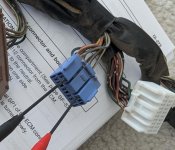
Full transparency. I'm trying to learn how to diagnose electrical problems. I have tested end to end, the orange/green wire that carries the vehicle speed signal to the ECU and recorded 0.6Ω. I tested that same wire to ground and recorded 3.034 MΩ. So then I started testing against other pins in other connectors, and for the most part am getting 3.0ish MΩ. I thought I would see 0L infinite resistance, but I'm not. So now I'll trying to find anything in the FSM to give me guidance. I did see there is a junction block between the cluster and the ECU. So I'm looking for that as well.
 

Attachments

  • PXL_20250421_010551433.RAW-01.MP.COVER~2.jpg
    PXL_20250421_010551433.RAW-01.MP.COVER~2.jpg
    127.7 KB · Views: 372
  • PXL_20250420_191556175.RAW-01.MP.COVER~2.jpg
    PXL_20250420_191556175.RAW-01.MP.COVER~2.jpg
    128.1 KB · Views: 366
3Mohms is basically an open circuit (unless you are doing certain high-precision scientific activities...). The resistance between your two hands (try it!) is under 1Mohm most of the time (varies with conditions).

To put it in perspective, the continuity tester built-in to most multimeters is looking for less than 20-60ohms, in most cases.

Also, without specialized test equipment, anything below about 1.5ohms should be considered a dead short (with a good meter like you have - maybe 2 ohms for cheaper ones).

-Charlie
 
In the pic you seem to be holding the probe point with your finger(s). Don't touch the metal tip of the probe with anything. Besides affecting your reading it can also be a safety hazard, not where your testing now but anytime you're taking a reading on anything ; safety first.

My multimeter is very old. Your Fluke just has a setting for ohms and will give you the actual readout. My old meter has settings for R X 1, 10, 1K and 10K. For resistance I almost always just use R X 10 unless I'm checking components like resisters. Wire has resistance, poor/old/corroded connections have resistance, lots of things have resistance and it can change with the humidity in the air. Charlie is right to ignore the low resistance numbers.

I'm not understanding if you're trying to check the wire in the bundles themselves or to what they're connected to. I think the P0500 is the speed sensor and I've not had that issue; sorry. Have you taken a reading on the sensors? My experience with other things has been rare to have a wiring harness problem. The only one I ever encountered was on an outboard motor with a molded connector; dead short. You know a dead short because the fuse is blown or the wire insulator has melted (and the fuse is blown).

Here's a link I found on the forum. Don't know if you've seen this. He had a bad connector at the wheel sensor.
Code P0500... HELP!!!
 
In the pic you seem to be holding the probe point with your finger(s). Don't touch the metal tip of the probe with anything. Besides affecting your reading it can also be a safety hazard, not where your testing now but anytime you're taking a reading on anything ; safety first.

My multimeter is very old. Your Fluke just has a setting for ohms and will give you the actual readout. My old meter has settings for R X 1, 10, 1K and 10K. For resistance I almost always just use R X 10 unless I'm checking components like resisters. Wire has resistance, poor/old/corroded connections have resistance, lots of things have resistance and it can change with the humidity in the air. Charlie is right to ignore the low resistance numbers.

I'm not understanding if you're trying to check the wire in the bundles themselves or to what they're connected to. I think the P0500 is the speed sensor and I've not had that issue; sorry. Have you taken a reading on the sensors? My experience with other things has been rare to have a wiring harness problem. The only one I ever encountered was on an outboard motor with a molded connector; dead short. You know a dead short because the fuse is blown or the wire insulator has melted (and the fuse is blown).

Here's a link I found on the forum. Don't know if you've seen this. He had a bad connector at the wheel sensor.
Code P0500... HELP!!!

Nothing like a little zap to feel young again. LOL I appreciate the concern. Those lead extensions are insulated up to the very tip.

At this point, I've checked wheel sensors and they seem to be good. I'm getting signal to the combination meter as evidenced by the speedo and tac functioning, with no ABS lights. I did swap out the cluster because I had found two burned resistors on the circuit board that mounts to the back. That didn't fix it. The odds that I replaced a bad cluster with a bad cluster isn't zero, but I'm checking everything downstream. That's why I'm testing the integrity of the harness. Unfortunately, I don't own an oscilloscope, so I can't properly test signal to the ECU. I may buy one. $$$$ I've seen evidence that this code can be due to a failing alternator, so I'm about to go test that. If that's the cause, I'll be relieved, but I'll also throw the alternator into space.

I appreciate the help! Thank you!
 
Nothing like a little zap to feel young again. LOL I appreciate the concern. Those lead extensions are insulated up to the very tip.

I've been zapped by the HEI on an Olds distributor, household wiring and some stuff in the military. It never made me feel young, stupid maybe, but not young. Good that you have the fully insulated probes. Good luck tracking down the problem.
 
I've been zapped by the HEI on an Olds distributor, household wiring and some stuff in the military. It never made me feel young, stupid maybe, but not young. Good that you have the fully insulated probes. Good luck tracking down the problem.

HOLY SHIT! palpitations courtesy of an HEI. Circa 1977 i grabbed the sucka to set timing, and got defibrillated. It'd kill me at this age.
 
HOLY SHIT! palpitations courtesy of an HEI. Circa 1977 i grabbed the sucka to set timing, and got defibrillated. It'd kill me at this age.

I'm of that age too. I've had several jolts in my life so far. I even touched a spark plug on an old lawnmower and and a pretty good jolt. I worked on a 3-way light switch once, cut power and the light went off. I took the switch out and the wife came down the hall and flipped the other switch; zap! All those were in earlier years. I'm a little bit smarter now....a little bit. :-) At least I know not to let your fingers slip down onto the metal of your test probes. :-D
 

Members online

Forum statistics

Threads
278,317
Messages
3,554,128
Members
248,016
Latest member
Advally Service

Trending content

Back
Top