AGM battery charge controller

DiBotKJ.png


Odyssey's warranty card states it best: "For applications where an alternator is present, the alternator must deliver between 14.0V and 14.7V when measured at the Battery’s terminals"

http://www.odysseybattery.com/documents/US-ODY-WS-AA.pdf


By the way, I no longer carry the voltage boosters - they were a limited run since demand is not really that high for a booster that will only work for a 5th gen 4runner.

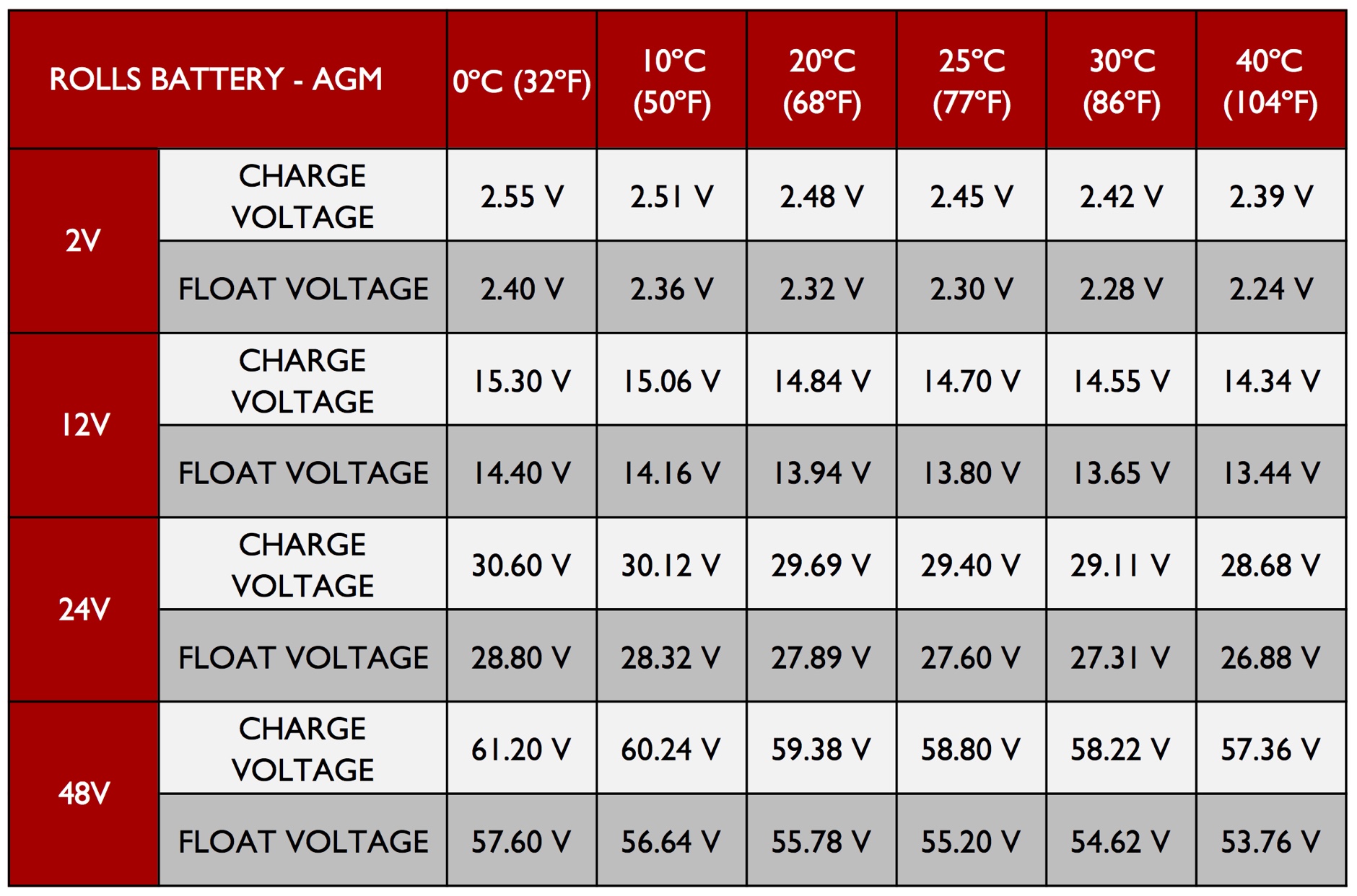
I had never read the Odysseys tech manual till you posted this. This is from the manual "the higher the ambient temperature the lower the charge voltage". I live in the desert where it gets over 115 and seldom below 50 degrees. On the chart that I could not get to copy over it shows much lower voltage needed in warm temps. This is probably why I never had a problem.
 
if you get that consistently it's not surprising you haven't noticed a decrease in performance, but that is not typical for 5th gens. Are you actually watching that while you drive or are you just testing with a voltmeter as a single sampling point? mine would often be about 13.8 shortly after starting up, but then when driving it drops down would stay in the 13.3-13.5 range. If you actually have a consistent 13.9 i probably wouldn't do anything either, it's not quite in spec but i'd bet it's close enough that any reduction in lifespan is marginal, but if you are only taking a single sample i bet your voltage is actually in line with the typical lower observations

I only checked it a few times after coming home from doing some running around with a voltmeter on the battery. I have no way to check it while driving.
 
I only checked it a few times after coming home from doing some running around with a voltmeter on the battery. I have no way to check it while driving.

then don't be surprised if your battery dies prematurely, your voltage is probably inline with the other 5th gen 4runners. you spent a lot of money on the battery, if i spent that much on a battery i'd definitely spend another $30 (or <$5 if you DIY) and get the voltage within spec.

This is a quote from Odyssey from the O&M manual:
Alternators that do not have a regulated charge between 14.0V and 14.7V (no lower than 14.0V and no higher than 14.7V) will cause early failure of the Battery
 
I only checked it a few times after coming home from doing some running around with a voltmeter on the battery. I have no way to check it while driving.

You won't see a problem, until your battery fails prematurely. This doesn't always happen. It's just best practice to maintain your AMG battery. Like mentioned before, if you top off your battery once a month, you will be fine.
 
Now you guys are making me curious about this. I just called Odyssey and discussed the higher voltage concern. The person I spook with said if my 4runner has been working fine then "if it is not broke do not fix it". As I pressed further into the fuse discussed here etc. they said they will need to get a more technical person to talk to me. That person is out today and is supposed to call me tomorrow. If they recommend a higher voltage then I will do it.
 
You won't see a problem, until your battery fails prematurely. This doesn't always happen. It's just best practice to maintain your AMG battery. Like mentioned before, if you top off your battery once a month, you will be fine.

Just guessing here but it seems like if you topped it off to 100% that would be depleted on the first start up.
 
Now you guys are making me curious about this. I just called Odyssey and discussed the higher voltage concern. The person I spook with said if my 4runner has been working fine then "if it is not broke do not fix it". As I pressed further into the fuse discussed here etc. they said they will need to get a more technical person to talk to me. That person is out today and is supposed to call me tomorrow. If they recommend a higher voltage then I will do it.

What is the voltage on your battery after resting for about 6 hours? That'll tell you what you need to do.

Mine is at about 12.6 volts after 6 hours. I contacted Odyssey and got this response:

Odyssey said:
Hello,
Rest assured the battery is not fully charged if the volt meter is accurate. What doesn’t get fully charged properly will sulfate and the longer it remains in the sulfated state, the harder it will be to recover. Alternators are not meant to be deep discharge recovery chargers so at greater than 80% depth of discharge, the battery is discharged enough that the alternator will in all likelihood not fully charge the battery properly. They run at high current for 5-10 minutes before cutting back to a high voltage maintenance charge and only enough current to supply the loads of the vehicle. Also, optimum charging voltage for ODYSSEY batteries is 14.4-14.8V. Most alternators do 14.0-14.2V as a general rule. Low voltage charging a deeply discharged battery is not efficient or effective. This can contribute to a walk down in voltage over time if the vehicle is not considered a daily driver and it sets frequently for 3-5 days in a row. Never getting fully charged properly will sulfate the cell plate material that is not charged. This can lead to premature failure when the battery should have a service life of 2-3 times that of a conventional battery in the same application with the same use with proper charge maintenance.
 
What is the voltage on your battery after resting for about 6 hours? That'll tell you what you need to do.

Mine is at about 12.6 volts after 6 hours. I contacted Odyssey and got this response:

So that makes me wonder if charging it to 100% now and then removes the sulfating?
 
My system is pretty much totally backwards. It's a result of not really planning that far ahead and making purchases as the need arose.

So....up front. Normal lead acid group 27F battery (duracell from batteries +). My old one had died and this one had good reviews plus was just a little greater capacity than the one it replaced.

Then....I got the itch for a fridge. I added 6awg cable from the front to the back to minimize the losses. This worked fine so long as I plugged the vehicle in at night so the Fridge ran off 110V. Shortly thereafter I added a battery charger/maintainer I had laying around "just in case" because I only drive about 40min/day.

Next...realized I wanted more weekend capacity so I added a 2nd battery from an old project (a 2nd normal car battery, not a deep cycle). This worked OK from a capacity perspective but not ideal.

Most recently, I picked up a Noco Genius charger plus an AGM deep cycle (another duracell batteries + purchase). This time I added an isolation relay.

I essentially have 3 modes. At home the truck is plugged in. This runs the fridge on 110VAC and the Noco charger tops off the AGM battery to hopefully prolong its life. On the road with the vehicle on the alternator is charging both batteries (relay connected both in parallel). With the vehicle off, the relay disconnects and the fridge runs on just the AGM "house" battery. So far so good. It's working great for weekend trips where I'm driving every day or every other day. Every time I test either battery with my relatively cheap tester (select AGM, flat plate or normal flooded) it comes back with the battery at 100% charge, about 98% capacity). I'm only about a year in so we'll see how this setup does in the long term.

I've considered the alternator diode mod but I'm afraid this will end up over-charging my front main starter battery. Without something like a CTEK I don't see any way around that. For now the alternator seems to be charging both batteries just fine so long as I have a 30+ minute drive every other day and plug in at night. If I decide to do some parked longer term camping I've got a 50W panel and controller but that's going to just barely keep up with the fridge and wiring losses I think.
 
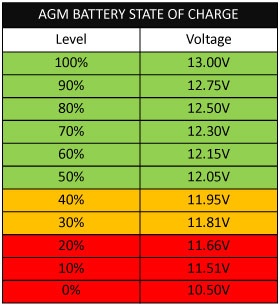
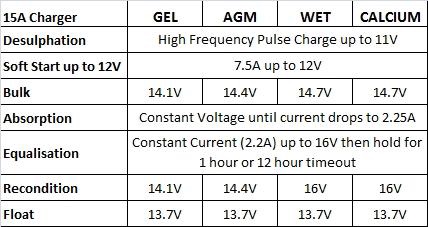
I believe for desulfation you need a pulse charge. See the SOC & AGM charging figures below to determine your AGM health:

daebf2e8726fb3d60fff18d8f57daf21.jpg
75af21861ec7b31a7e5580c91631991b.jpg
40679c82840b23af12e1f0d629abae0a.jpg


Sent from my iPhone using Tapatalk
 
So that makes me wonder if charging it to 100% now and then removes the sulfating?

There's an actual de-sulfation process:

http://www.odysseybattery.com/documents/ODYSSEY_Battery_Reconditioning_Charge_Procedure.pdf

Again, from my emails with Odyssey:

Odyssey said:
If during storage a battery drops due to shelf self discharge, we don’t want the battery to be compromised from the beginning so this is why our owner’s manual recommends charging prior to installation if the battery is at less than 12.65V. Consistent undercharging or being maintained in an undercharged state (on or off charge) will cause premature failure due to sulfation. ODYSSEY Battery Reconditioning Charge Procedure is a link to the reconditioning cycling procedure for de-sulfating a battery that has not become permanently sulfated. It works very well for recovering capacity and therefor cranking amps. It should be performed at least two times to be effective and to maximize the results, it can be performed as many times as it takes for the discharge time to the remain same to the same loaded voltage under the same loads for two consecutive reconditioning cycles.

What you're doing helps but still isn't a best-case scenario.
 
Interesting info here. My Optima battery charger goes into a conditioning mode after charging but I never really understood what that means. I will have to check that out now. Who would have thought a battery swap would be this complex.
 
From my previous post the Odyssey tech called me today. I discussed the 4runner charge voltage with her and she said the 4runner is on the low side. I told her after it has been sitting a while my battery voltage is 12.6 which is the minimum they want to see. After I charged it with my Optima charger it went to 12.8 after setting overnight. I also told her my Optima charger which is designed for AGM batteries never went over 14 volts when I watched the display while charging. After charging the display on my charger showed the battery to be 100% charged. I did not mention the fuse you guys use to increase the 4runner voltage. I then ask her what I should do to increase the 4runner voltage and she did not know. Apparently they never heard of the fuse trick. That being said she told me they have never had problem with 4runners or returns due to the 4runner voltage and it would not be a warranty concern. I ask here about charging it now and then with my Optima charger and she said that would be a good idea since both optima and Odyssey use similar technology. My Optima charger is not on there approved charger list. Ultimately you get an Odyssey charger that has the higher voltage but it would be to high of volts for my atv and waverunner Yuasa sealed batteries. Not sure I want to spend the $180 or so for a charger only for the 4runner. At the end she said I am overthinking this issue and not worry about it. I am sure the fuse trick would not cause a problem but I hate adding non stock things to my electrical system (other than the battery).
 
From my previous post the Odyssey tech called me today. I discussed the 4runner charge voltage with her and she said the 4runner is on the low side. I told her after it has been sitting a while my battery voltage is 12.6 which is the minimum they want to see. After I charged it with my Optima charger it went to 12.8 after setting overnight. I also told her my Optima charger which is designed for AGM batteries never went over 14 volts when I watched the display while charging. After charging the display on my charger showed the battery to be 100% charged. I did not mention the fuse you guys use to increase the 4runner voltage. I then ask her what I should do to increase the 4runner voltage and she did not know. Apparently they never heard of the fuse trick. That being said she told me they have never had problem with 4runners or returns due to the 4runner voltage and it would not be a warranty concern. I ask here about charging it now and then with my Optima charger and she said that would be a good idea since both optima and Odyssey use similar technology. My Optima charger is not on there approved charger list. Ultimately you get an Odyssey charger that has the higher voltage but it would be to high of volts for my atv and waverunner Yuasa sealed batteries. Not sure I want to spend the $180 or so for a charger only for the 4runner. At the end she said I am overthinking this issue and not worry about it. I am sure the fuse trick would not cause a problem but I hate adding non stock things to my electrical system (other than the battery).

Good info, thanks for the update. I started going down the rabbit hole with this when I replaced my stock alternator with the DC Power one. General consenus on the topic seems to be that it's not an ideal situation, but we'll be just fine
 
Not that is would probably apply to anyone here but I was playing with my Optima 400 battery charger. I had been using the Optima battery charge button and it only charged at 13.7 volts. I switched to the standard flooded/agm setting and it charges a 14.7 volts. On the Optima setting it showed full charge on the new setting it only showed 75% charged so I am charging it to 100% on this setting. At least I learned something from all this.

I will check the voltage on the battery in the morning to see if it is higher than 12.8v from the old setting.

Update. Next morning the voltage was 12.8. Same as charging at 13.7 volts.
 
Last edited:
Not that is would probably apply to anyone here but I was playing with my Optima 400 battery charger. I had been using the Optima battery charge button and it only charged at 13.7 volts. I switched to the standard flooded/agm setting and it charges a 14.7 volts. On the Optima setting it showed full charge on the new setting it only showed 75% charged so I am charging it to 100% on this setting. At least I learned something from all this.

I will check the voltage on the battery in the morning to see if it is higher than 12.8v from the old setting.

The battery should never be more than 12.8 volts when resting after a full charge. It just needs the higher voltage to charge properly.

On the Odyssey charge setting, if it showed 12.8 volts after being disconnected and sitting for 6 hours, then it was fully charged.
 
After thinking about this I put my AGM on the charger last night. When new the battery was 12.49v (80%). Resting voltage was 12.68v (85%)after adding the HKB (this is where the stock alt brought it to).

After an hours worth of combined driving with 1-2 starts with the HKB installed, my resting voltage was 12.74v (90%).

Running my charger, it was outputting 13.5-14.5v at 6a on a pulse at first then bulk charge around 14.5v. The float charge was 13.57v.

After the float charge my battery resting voltage was 12.95v (98%).

After another hour of driving with 3 starts, my resting voltage is 12.85 (95%).

If an AGM battery at 100% state of charge is 13v, keeping it close to that will keep the battery healthy longer. The HKB fuse seems to help with this, but I do want to measure after a 30-60 min trip to see if it rests above 12.85v. If it does, I’m happy with maintaining a 95%+ state of charge. Especially when stock was closer to 85%. At stock alternator voltage I would still use an external charger regularly. At 95%+ I won’t bother.


Sent from my iPhone using Tapatalk
 
After thinking about this I put my AGM on the charger last night. When new the battery was 12.49v (80%). Resting voltage was 12.68v (85%)after adding the HKB (this is where the stock alt brought it to).

After an hours worth of combined driving with 1-2 starts with the HKB installed, my resting voltage was 12.74v (90%).

Running my charger, it was outputting 13.5-14.5v at 6a on a pulse at first then bulk charge around 14.5v. The float charge was 13.57v.

After the float charge my battery resting voltage was 12.95v (98%).

After another hour of driving with 3 starts, my resting voltage is 12.85 (95%).

If an AGM battery at 100% state of charge is 13v, keeping it close to that will keep the battery healthy longer. The HKB fuse seems to help with this, but I do want to measure after a 30-60 min trip to see if it rests above 12.85v. If it does, I’m happy with maintaining a 95%+ state of charge. Especially when stock was closer to 85%. At stock alternator voltage I would still use an external charger regularly. At 95%+ I won’t bother.


Sent from my iPhone using Tapatalk

Is this the Fuse you're running?

https://www.hkbelect.com/product/206-mk3-micro-blade-75a-electronic-fuse-version-2017/
 
With the HKB, my battery V has been around 12.8 after a rest following a 30 minute highway drive. This is about 92-93% SOC. Not bad.


Sent from my iPhone using Tapatalk
 

Members online

Forum statistics

Threads
278,306
Messages
3,554,046
Members
248,016
Latest member
Advally Service

Trending content

Back
Top