Airing down for snow - how far is too far?

papapoopski

New member
Looking for opinions own how low to air down to before it becomes problematic.

What PSI are people running?

I do not have beadlocks

We have over 20" of new snow to play in! Yeeehaaaaa!

Edit - yes, I did search
 
Register to hide this ad
with radial tires, and aluminum wheels, you should be able to air to 8psi or so without any issues.

unless the snow is really bad(sugar) then likely you wont need to go below 10-12.


I used to run 2-3 with my bias plies and steel wheels, and would end up spinning the wheel inside the tire. aluminum holds the tire MUCH better.
 
There is a lot of factors to take into account for…

-Wheel width and style
-Tire size and style
-Driving style
-Terrain, etc

Back before I had beadlocks I would comfortably air down to 8psi, but that was with a 12.50 wide tire on a 8.0 wide wheel. And, the wheels were reversed so the safety bead was on the outside. I went as low as 6 psi with that set-up, but it made me nervous and I was careful not to put too much side load on the tire.

With my current beadlocks I usually run between 4-8psi, depending on conditions. I've gone as low as 1psi for spring time conditions, but that's more like snow crawling. I don't even bother running anything above 8psi if there is snow on the ground.

Without knowing more i would start in the 12-15psi range, and go from there. And, it is possible to go too low in pressure (besides for loosing beads), you start to lose ground clearance and the wheels are more prone to damage.
 
Last edited:
This is too much...
tire-air-down-off-rim.jpg


But in all honesty, I can only concur with the above poster. There are many variables, especially to your type of rim and the design of the tires. Weight and other factors must be taken into account as well.
I typically run 35 PSI, and then air down to 10-12 PSI when needed. I don't have beadlocks either.
 
I think conventional wisdom is you don't want to air down for snow at all. You want the tire as narrow as possible to dig down through the snow to hit hard road or make a hard pack under the tire. Airing down is like wider tires - they float over the snow and you go nowhere (I've had cars with wide tires and they don't do well on snow at all), unless you are in hard packed deep snow and need to float (like the Icelanders do over glaciers). Narrow tires make a hard track that provides traction while wider tires (or aired down tires) make a wider track that is not as packed since the weight is distributed over a wider area.
 
Last edited:
I think conventional wisdom is you don't want to air down for snow at all. You want the tire as narrow as possible to dig down through the snow to hit hard road or make a hard pack under the tire. Airing down is like wider tires - they float over the snow and you go nowhere (I've had cars with wide tires and they don't do well on snow at all), unless you are in hard packed deep snow and need to float (like the Icelanders do over glaciers). Narrow tires make a hard track that provides traction while wider tires (or aired down tires) make a wider track that is not as packed since the weight is distributed over a wider area.

That's not the snow out west... Out here if you don't air down, don't bother going out.
 
That's not the snow out west... Out here if you don't air down, don't bother going out.

I have driven in lots of deep snow in the Colorado moutains (lived in Denver for 3 1/2 years) and never aired down. I think that unless you have a couple of feet of powdery mountain snow you want to cut through the snow to something hard.
 
I have driven in lots of deep snow in the Colorado moutains (lived in Denver for 3 1/2 years) and never aired down. I think that unless you have a couple of feet of powdery mountain snow you want to cut through the snow to something hard.

I think that's the most important thing to remember. If the snow is under maybe a foot deep, then airing down may not be necessary. But look at the video that Dirtco just posted in his build thread. Had he not been aired down, we wouldn't have gotten so much awesome footage.

I think the important thing to remember is that you can always take more air out, but unless you have on board air, then you can't put air back in. It's ok to have to take a bit more out several times throughout the drive, than to take too much out and either spin the wheel or pop a bead.
 
I have driven in lots of deep snow in the Colorado moutains (lived in Denver for 3 1/2 years) and never aired down. I think that unless you have a couple of feet of powdery mountain snow you want to cut through the snow to something hard.

if the snow is deeper than the amount of clearance you have, your chance of "hitting the bottom" is slim to none at that point.
its almost always going to be better if you air down.


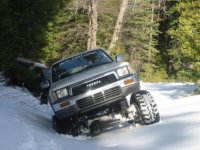
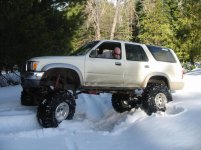
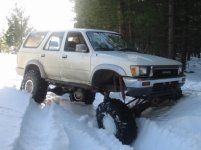
just before that video, I was struggling to move, I dropped the pressure down about 3psi less than where I was, and was able to move again. it may not seem like it, but I was moving pretty good there.
 
Snow is a dynamic thing, snow changes from day to day and hour by hour. If it's fresh, been frozen for a week ect. Air pressure needs to match the conditions and if you are on pavement or off. The other part is the driver, I've seen the best rigs not do worth a shit because the person behind the wheel doesn't know how to read what the snow is doing, air pressure, gearing, throttle. There are a lot of factors to being good in the snow.
 

Attachments

  • chalk bluff 002.jpg
    chalk bluff 002.jpg
    61.4 KB · Views: 3,833
  • chalk bluff 003.jpg
    chalk bluff 003.jpg
    117.5 KB · Views: 4,389
  • chalk bluff 006.jpg
    chalk bluff 006.jpg
    107.4 KB · Views: 3,737
Last edited:
I have driven in lots of deep snow in the Colorado moutains (lived in Denver for 3 1/2 years) and never aired down. I think that unless you have a couple of feet of powdery mountain snow you want to cut through the snow to something hard.

This is true on a road of some sort, but what a lot of people call "snow wheeling" refers to bashing through snow that is deep enough that you're not going to touch the ground surface unless this is your rig

Alaska-0905-1
 
There is a lot of factors to take into account for…

-Wheel width and style
-Tire size and style
-Driving style
-Terrain, etc

Back before I had beadlocks I would comfortably air down to 8psi, but that was with a 12.50 wide tire on a 8.0 wide wheel. And, the wheels were reversed so the safety bead was on the outside. I went as low as 6 psi with that set-up, but it made me nervous and I was careful not to put too much side load on the tire.

With my current beadlocks I usually run between 4-8psi, depending on conditions. I've gone as low as 1psi for spring time conditions, but that's more like snow crawling. I don't even bother running anything above 8psi if there is snow on the ground.

Without knowing more i would start in the 12-15psi range, and go from there. And, it is possible to go too low in pressure (besides for loosing beads), you start to lose ground clearance and the wheels are more prone to damage.

if the snow is deeper than the amount of clearance you have, your chance of "hitting the bottom" is slim to none at that point.
its almost always going to be better if you air down.


just before that video, I was struggling to move, I dropped the pressure down about 3psi less than where I was, and was able to move again. it may not seem like it, but I was moving pretty good there.

Snow is a dynamic thing, snow changes from day to day and hour by hour. If it's fresh, been frozen for a week ect. Air pressure needs to match the conditions and if you are on pavement or off. The other part is the driver, I've seen the best rigs not do worth a shit because the person behind the wheel doesn't know how to read what the snow is doing, air pressure, gearing, throttle. There are a lot of factors to being good in the snow.

The ones I've quoted are the ones to listen to. Airing down in any snow will likely provide more traction. Even under 1 foot of snow. The only thing you will be digging to is a nice patch of ice.

Education:
Maine, 8 years
Cascade Mountains, 18 years.
 
Looking for opinions own how low to air down to before it becomes problematic.

What PSI are people running?

I do not have beadlocks

We have over 20" of new snow to play in! Yeeehaaaaa!

Edit - yes, I did search

I air down to 10psi no problem I have aired down to 8psi before but 10psi is perfect for my rig its a little overweight.....some of my friends with 40's no headlocks and 42's with headlocks air down to 5psi
 
I air down to 15psi usually, 10 if there's good chance of getting stuck. And I totally disagree with cutting down into the snow by wanting a slimmer tire. Even if you have more ground clearance than there is snow, there will (almost always) be snow between your tire and dirt just from it being compressed under the tire. Unless you are spinning your tires like crazy to turn up all the snow and chew down to the base then you aren't really "cutting through".
 
I realize this is an old thread, but I thought I'd share my experience in case someone might stumble upon it...

I just came in from driving my SR5 in around 4 inches of snow on top of an icy bottom layer in Nashville, TN. Tires are at 35 psi -- I didn't air down. I live in a hilly neighborhood and drove very cautiously in 4 high -- no problems at all. I went up a very steep hill in a local park -- dropped to 4 low and enabled ATRAC -- went up the hill from a dead stop like it was nothing.

I did try hitting the brakes at times to test how slippery it was (the roads were very quiet) and did slide quite a bit. So, to me, the trick is to go very slow on the downhill in case you have to stop suddenly, and otherwise take it easy on the flat, and give it a bit of welly on the uphills.
 

Members online

Forum statistics

Threads
278,315
Messages
3,554,104
Members
248,016
Latest member
Advally Service

Trending content

Back
Top