Another tire pressure thread

03v8raleigh

New member
Asking this here because it's relavent to all models: what tire pressure do you run for 100% on-road driving?

I ask this because I just got back from a road trip to Ohio (1000 miles or so) in our Sienna minivan with 4 other 250lb powerlifters. Ran around 35psi (factory spec) in all tires, and ended up blowing out the sidewalls on THREE of the 4 tires. Tires are brand new Goodyear assurance comfortred touring 215/65/16. How in hell is this possible? Only one of the tires went fully flat so we made it back from Ohio on the donut spare, but the other two had to be replaced at JustTires when we got back due to bulged sidewalls. We didn't hit any big potholes or anything since it was a mostly smooth highway drive. The manager at JustTires said I should still only run the recommended 35 despite the heavy loading, which seems stupid to me. May bump it up to 40+ from now on.

What do you run?
 
Register to hide this ad
I like 32. But 28 to 35 wouldn't bother me at all.

That's wild, 3 blown sidewalls.

I had to look it up, without knowing the year or model.

Curb weight - 4615
GVWR - 5995
Base payload- 1210

www.kbb.com/compare-cars/specs/van-minivan

You had 4 250-pounders and you. 1250 pounds plus gas and luggage? I wouldn't think it would be a problem at all.

I haven't heard of anybody blowing 3 tires on one trip since my father was the safety engineer for a major trucking company based out NYC. This was the '50s - bad roads, recaps, etc.
 
What is the weight rating of those tires compared to the ones originally specced for the vehicle? Is the speed rating high enough?

I usually aim for a few PSI over what the door sticker says (and still under the max on the sidewall) to save fuel. I used to load my old Honda Civic with close to 1000lbs and never had a problem (besides lack of space and severe lack of power, but that's why I bought a 4runner). In fact, as far as I know sidewall problems are extremely rare on modern passenger car tires. Maybe you got a bad batch?
 
Door sticker.

Chalk Test

You will be surprised how low of a PSI you need to run to get a good chalk test.
 
Asking this here because it's relavent to all models: what tire pressure do you run for 100% on-road driving?

:thumb:

That is much appreciated.
The good old chalk test is the best way to find the correct pressure for any vehicle/tire/load situation.
 
I like 32. But 28 to 35 wouldn't bother me at all.

That's wild, 3 blown sidewalls.

I had to look it up, without knowing the year or model.

Curb weight - 4615
GVWR - 5995
Base payload- 1210

www.kbb.com/compare-cars/specs/van-minivan

You had 4 250-pounders and you. 1250 pounds plus gas and luggage? I wouldn't think it would be a problem at all.

I haven't heard of anybody blowing 3 tires on one trip since my father was the safety engineer for a major trucking company based out NYC. This was the '50s - bad roads, recaps, etc.

It's a 2004 LE model, so yeah not very heavy and we were about maxing out the payload but it should have been fine. I am amazed that the tires all failed like this. (Happy that only one tire actually blew out though and the others didn't go and leave us stranded in the middle of Ohio.) They are SL load range tires which are recommended for minivans, and I'm pretty sure the van cannot go over their speed rating.

I didn't brush any curbs or hit any potholes other than the typical bad roads and seamed cement up north. I guess my takeaway from this is F*** Goodyear.

Also, while I'm at it: F*** Just Tires too. Dumbest employees just trying to rip you off. (It's my parent's vehicle, otherwise I would go to Discount Tire.) Luckily they purchased the RoadHazard protection which replaced all the tires for free, but in doing so they made us pay for all new RoadHazard plan for the 3 new tires.. seems like that shouldn't be how that works.
 
Function of piss poor tires, not tire pressure - 35 psi should be fine for P rated tire.

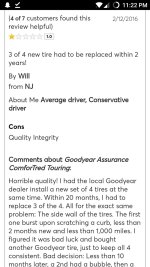
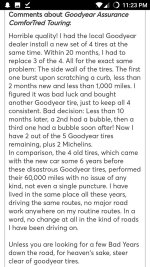
Seems like I'm not the only one who had this problem
 

Attachments

  • Screenshot_20170314-232300.jpg
    Screenshot_20170314-232300.jpg
    130.7 KB · Views: 176
  • Screenshot_20170314-232315.jpg
    Screenshot_20170314-232315.jpg
    147.2 KB · Views: 179
35 is fine, just to let you know you get 2 different readings with cold tire and hot tire. i run Yokohama tires on the camry and it solid.
 
Asking this here because it's relavent to all models: what tire pressure do you run for 100% on-road driving?

I ask this because I just got back from a road trip to Ohio (1000 miles or so) in our Sienna minivan with 4 other 250lb powerlifters. Ran around 35psi (factory spec) in all tires, and ended up blowing out the sidewalls on THREE of the 4 tires. Tires are brand new Goodyear assurance comfortred touring 215/65/16. How in hell is this possible? Only one of the tires went fully flat so we made it back from Ohio on the donut spare, but the other two had to be replaced at JustTires when we got back due to bulged sidewalls. We didn't hit any big potholes or anything since it was a mostly smooth highway drive. The manager at JustTires said I should still only run the recommended 35 despite the heavy loading, which seems stupid to me. May bump it up to 40+ from now on.

What do you run?

You learned a lesson. Buy some decent tires and you won't have problems. Michelins LTX MS2 or something similar.

Tire pressure should be what is inside the door.

For future reference: Every time I am hauling a heavier load (pulling a 5K trailer with 500 lb tongue weight for example) on a long trip, especially when it's hot outside, I do a quick temperature check when I stop for gas. I basically just lay my palm across the tire treads to get a gross temperature check of my tires. Takes just a few seconds while the gas is pumping. You always should be able to leave your hand on the tread, which means the tires are not getting too hot from flex. If you can't leave your hand on the tread because it's too hot, you have a problem and need to check pressures.
 
I like 32. But 28 to 35 wouldn't bother me at all.

That's wild, 3 blown sidewalls.

I had to look it up, without knowing the year or model.

Curb weight - 4615
GVWR - 5995
Base payload- 1210

www.kbb.com/compare-cars/specs/van-minivan

You had 4 250-pounders and you. 1250 pounds plus gas and luggage? I wouldn't think it would be a problem at all.

I haven't heard of anybody blowing 3 tires on one trip since my father was the safety engineer for a major trucking company based out NYC. This was the '50s - bad roads, recaps, etc.

I agree with the 28 to 35 mark. I'm probably just nutty, but the road characteristics of the vehicle at 35 then at 28 seems to be different. I like to be right at 30 (hot or cold), but I'm sure the tire you're running would change this as well.
 
You learned a lesson. Buy some decent tires and you won't have problems. Michelins LTX MS2 or something similar.

Tire pressure should be what is inside the door.

For future reference: Every time I am hauling a heavier load (pulling a 5K trailer with 500 lb tongue weight for example) on a long trip, especially when it's hot outside, I do a quick temperature check when I stop for gas. I basically just lay my palm across the tire treads to get a gross temperature check of my tires. Takes just a few seconds while the gas is pumping. You always should be able to leave your hand on the tread, which means the tires are not getting too hot from flex. If you can't leave your hand on the tread because it's too hot, you have a problem and need to check pressures.

While I agree with you in a general sense, these Goodyear tires are not cheap tires. They also come highly recommended by the tire shop and online for minivans. The set before this never had issues. If it were my car though, I wouldn't be running them anymore after this experience. But it is my parents extra vehicle not mine.

In my 4runner though I've been running 38psi (cold) in my 265/70/17 Goodyear Wrangler Authority. Apparently this is overkill so I'm going to bump it down to 35 for now
 
Also, while I'm at it: F*** Just Tires too. Dumbest employees just trying to rip you off. (It's my parent's vehicle, otherwise I would go to Discount Tire.) Luckily they purchased the RoadHazard protection which replaced all the tires for free, but in doing so they made us pay for all new RoadHazard plan for the 3 new tires.. seems like that shouldn't be how that works.

Normally road hazard plans are a bad deal because although you pay a small amount per tire, the total cost for four ends up being a large fraction of the cost of one replacement tire. Since it's unlikely that you'll damage all four tires, it's a bad deal. You got your money's worth, but really this sounds like something the regular warranty should cover.

Say your tires cost $200 each, and the road hazard plan is $25 per tire. That's $100 total, but chances are you'll only damage one tire not all four. If you have less than a 50% chance of damaging a tire (which I think it true) then you'll come out ahead by just putting away the extra money to pay for a damaged tire if it happens. After 2 sets of tires you'll have enough saved to pay for one damaged tire.

An exception might be if you have an AWD vehicle that is sensitive about the tires being the same diameter. For example a Subaru. In that case damage to one tire might require you to replace all four, so the road hazard plan would be a good deal if it covers that.

Discount Tire rips people off too. When I bought my tires they "made a mistake" recording my odometer which would effectively shorten the warranty. It wasn't just a typo- the last four digits were totally made up. I pointed it out to them, and they said they would fix it, but they never showed me proof it was fixed in their system. I didn't push it because I had just purchased the vehicle, and the miles they recorded were about 7000 less than what's on the title, so I have good proof if I ever need to do a warranty claim. The mandatory TPMS rebuild kit is also a ripoff. Basically $20 for four little valve cores and rubber O-rings. If you have a non-TPMS vehicle they give you new valve stems for free.
 
chalk tests are good to confirm wear but they are not sufficient by themselves to make sure your tires are properly loaded, you still need to check an inflation-load chart
 

Members online

Forum statistics

Threads
278,308
Messages
3,554,057
Members
248,016
Latest member
Advally Service

Trending content

Back
Top