Any idea why no manual transmission in the current 4Runners?

Is there a technical reason for preferring an automatic transmission in an off-road vehicle? Not allowing the driver to control the transfer of torque to the wheels seems counter-intuitive.

 
Register to hide this ad
Maybe the idea of being able to control more torque/power through lockers is Toyota's idea of manual control. I have no idea why the 4th or 5th gens have no manual option either.
 
its because 95%+ of the buyers don't want it. the numbers are just not there to justify selling 500 maybe 1000 per year .
 
First, let me start by saying no one will be able to give you a proper answer short of an R&D engineer or project manager at Toyota Corporate (in Japan). Good luck getting a hold of one, attempting to communicate and getting a straight answer. In the meantime, all we can offer are possible explanations of why; basically, conjecture. I’m going to limit my discussion here to the 4th and 5th gen because they’re really the only ones relevant to your post since they’re the most recent.

In your thread in the 5th gen section (http://www.toyota-4runner.org/5th-gen-t4rs/185161-must-decide-toyota-4runner-vs-highlander.html), KidV gave a good explanation as to why you shouldn’t classify the 4Runner – especially 4th and 5th gens as made for “off-road.” They were designed for the masses (family haulers, mild towing, mall crawlers, etc.) with nods to its off-road heritage. For high volume manufacturers, vehicle development and design pretty much comes down to two things: meeting regulations and making money. In 2014, only 3.7% of all new vehicles sold in the U.S. were manuals and only 1.1% of all “trucks” were manuals (source; table 5.3.1, pg. 80 and table 5.3.3. pg. 82). Here’s an interesting article, written by someone with real life automotive manufacturing experience:Why Manual Transmissions...Are a Challenge. The tl;dr version is this – with today’s regulations and requirements, it’s cheaper and less risky to make a more complex automatic than it is to make a manual for the same vehicle. Knowing the above, would it make sense to spend time and money to make one fit and available in America?

The market here doesn’t stand for manuals the same way it used to. Unless Toyota owns 100% of the BOF, off-road SUV market, it would not make sense to cater to the small crowd who would want a manual $35k to $45k SUV, and the even smaller crowd that would buy a manual $35k to $45k SUV, modify it, and beat it up off road.

Are the 4th and 5th gens capable off road? There are a ton of build threads on this forum that prove just that. Do you absolutely need a manual to control torque to the wheels? No, but even if you did, Toyota wouldn’t make money. You'll find a new manual SUV with Toyota in the FJ (discontinued after 2014 model year). Otherwise you've got a small handful of makes and models to choose from (including the Jeeps, which come with another host of issues).

OA
 
MAMT - Moms Against Manual Toyotas

and on the weekends they put on their Moms Demand Action shirts and bother us even more.
 
There are a lot of "serious" off roaders who prefer autos to manuals for a whole host of reasons.

Manual transmissions are common in countries that don't have a large industrial base because manuals can be repaired in a simple garage, but in the US and Canada where most people prefer automatics, it's easier for a manufacturer to just make consumer-oriented vehicles (as opposed to commercial vehicles) with automatics.

The only companies still offering manual transmissions in body-on-frame SUVs are Toyota (FJC), Jeep (Wrangler) and Nissan (Xterra) AFAIK.

I presume Toyota will still offer the manual transmission in the Tacoma? Or is that being dropped, too? I have not heard good things about the 6m transmission in the V6 Taco although the 5 speed MT in the 4 cyl Taco seems to get pretty good reviews.

It's a shame, I've always been an MT guy and only reluctantly got my first 4runner, a 1999, with an auto so my wife could drive it more easily (and then 3 years later she bought an old YJ with a manual transmission and manual steering, too!) I do have to admit that the 5 speed auto in the 4runner is pretty good, especially for towing. Since my T4R is primarily a towing vehicle, I imagine using a manual transmission to back up a trailer would be a real PITA (or more properly, a PIT left leg.)
 
The tl;dr version is this – with today’s regulations and requirements, it’s cheaper and less risky to make a more complex automatic than it is to make a manual for the same vehicle. Knowing the above, would it make sense to spend time and money to make one fit and available in America?

Thanks, it makes sense and is pretty sad. Two technical issues come to mind though: first, going downhill. When coming down the mountains I'm in 3rd or even 2nd gear. Automatics require that you ride the brakes, correct? That cannot be safe. Second, getting started from a standstill on ice. An automatic with a lot of torque will have its drive wheel slip immediately, where in a manual you have the option of starting in the 2nd or 3rd gear.

Lots of young drivers of sporty cars (GTIs, WRX, Audi, BMW, and all ricers) also prefer stick shift cars, but I recognize that the market is infinitesimal.
 
First, let me start by saying no one will be able to give you a proper answer short of an R&D engineer or project manager at Toyota Corporate (in Japan). Good luck getting a hold of one, attempting to communicate and getting a straight answer. In the meantime, all we can offer are possible explanations of why; basically, conjecture. I’m going to limit my discussion here to the 4th and 5th gen because they’re really the only ones relevant to your post since they’re the most recent.

In your thread in the 5th gen section (http://www.toyota-4runner.org/5th-gen-t4rs/185161-must-decide-toyota-4runner-vs-highlander.html), KidV gave a good explanation as to why you shouldn’t classify the 4Runner – especially 4th and 5th gens as made for “off-road.” They were designed for the masses (family haulers, mild towing, mall crawlers, etc.) with nods to its off-road heritage. For high volume manufacturers, vehicle development and design pretty much comes down to two things: meeting regulations and making money. In 2014, only 3.7% of all new vehicles sold in the U.S. were manuals and only 1.1% of all “trucks” were manuals (source; table 5.3.1, pg. 80 and table 5.3.3. pg. 82). Here’s an interesting article, written by someone with real life automotive manufacturing experience:Why Manual Transmissions...Are a Challenge. The tl;dr version is this – with today’s regulations and requirements, it’s cheaper and less risky to make a more complex automatic than it is to make a manual for the same vehicle. Knowing the above, would it make sense to spend time and money to make one fit and available in America?

The market here doesn’t stand for manuals the same way it used to. Unless Toyota owns 100% of the BOF, off-road SUV market, it would not make sense to cater to the small crowd who would want a manual $35k to $45k SUV, and the even smaller crowd that would buy a manual $35k to $45k SUV, modify it, and beat it up off road.

Are the 4th and 5th gens capable off road? There are a ton of build threads on this forum that prove just that. Do you absolutely need a manual to control torque to the wheels? No, but even if you did, Toyota wouldn’t make money. You'll find a new manual SUV with Toyota in the FJ (discontinued after 2014 model year). Otherwise you've got a small handful of makes and models to choose from (including the Jeeps, which come with another host of issues).

OA

Very good post!
Bottom line is efficiency. Automatics are more efficient than manual transmissions so mpg numbers go up. Take a look at any vehicle that offers both manual and automatic transmissions and look at the mpg numbers.
 
Two technical issues come to mind though: first, going downhill. When coming down the mountains I'm in 3rd or even 2nd gear. Automatics require that you ride the brakes, correct? That cannot be safe. Second, getting started from a standstill on ice. An automatic with a lot of torque will have its drive wheel slip immediately, where in a manual you have the option of starting in the 2nd or 3rd gear.

/QUOTE]

1. Toyota has a "grade logic" feature that will automatically downshift at certain speeds on certain grades. You can also do that manually using the "S" mode shifter.

2. The 4Runner has VSC and TRAC that will outperform any human being in the fact that it can brake individual tires to keep them from spinning or multiple tires and change that immediately. It will also r e t a r d the throttle to keep the vehicle from overpowering a start or a turn. For obvious reasons (getting started on an icy hill where you would want a bit of wheel spin) you have an "off" button that will turn this feature off up to a certain speed.
 
Very good post!
Bottom line is efficiency. Automatics are more efficient than manual transmissions so mpg numbers go up. Take a look at any vehicle that offers both manual and automatic transmissions and look at the mpg numbers.

But isnt there a substantial power and torque loss in the torque converter? Something like 20%?
 
For obvious reasons (getting started on an icy hill where you would want a bit of wheel spin) you have an "off" button that will turn this feature off up to a certain speed.

or you can completely turn it off until your turn off the vehicle. it resets to on after you start it the next time.

I wouldn't recommend turning it off completely unless you have experience driving without it on. the system is still better than 80-90% of time even for me, but there are situations were I can be better.
 
But isnt there a substantial power and torque loss in the torque converter? Something like 20%?

Not really. Any efficiency losses there will be gained by the ECU and TCU engine and shift mapping.
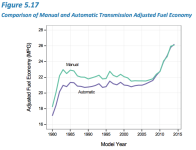
Another nice graph by the EPA (from the same report) to back this up:
Screen Shot 2014-12-30 at 4.49.26 PM.png

OA
 

Attachments

  • Screen Shot 2014-12-30 at 4.49.26 PM.png
    Screen Shot 2014-12-30 at 4.49.26 PM.png
    62.2 KB · Views: 1,982
Here's the answer to "why" Toyota doesn't sell manual 4Runners:

Percent of sales:
1997 Toyota 4Runner - 5 Speed Manual 11.4%
1998 Toyota 4Runner - 5 Speed Manual 8.0%
1999 Toyota 4Runner - 5 Speed Manual 4.5%
2000 Toyota 4Runner - 5 Speed Manual 2.9% (last year offered)

all data from: Toyota 4Runner Data, Info and Specs | GTCarLot.com

Because you, as buyers, bought less and less of them, so Toyota discontinued their sale. Thanks guys. :noidea: It ensures I will never own a 4Runner newer than my current 2000 5-speed. Regardless of what anyone *thinks* is a better transmission, I hate automatics and do not choose to drive them.
 
Here's the answer to "why" Toyota doesn't sell manual 4Runners:

Percent of sales:
1997 Toyota 4Runner - 5 Speed Manual 11.4%
1998 Toyota 4Runner - 5 Speed Manual 8.0%
1999 Toyota 4Runner - 5 Speed Manual 4.5%
2000 Toyota 4Runner - 5 Speed Manual 2.9% (last year offered)

all data from: Toyota 4Runner Data, Info and Specs | GTCarLot.com

Because you, as buyers, bought less and less of them, so Toyota discontinued their sale. Thanks guys. :noidea: It ensures I will never own a 4Runner newer than my current 2000 5-speed. Regardless of what anyone *thinks* is a better transmission, I hate automatics and do not choose to drive them.

That's pretty much it right there. The 4Runner is really a North American vehicle and in the US we don't really like Manuals as much as the Europeans who typically laugh at people for buying Automatics (though that mentality is changing.)

The whole "manuals are better than automatics" is context driven, for the most part Automatics are just better than manuals in many cases that can be proven scientifically, but then again manuals tend to be better than automatics in other cases as well and not just in a subjective manner.

Worst case scenario, you can always do a 6spd manual swap into a newer 4Runner and hope it doesn't fall apart? (lot of issues it seems with that 6spd that goes in the Tacoma and FJ Cruisers, it also feels weird in terms of gearing? Maybe a different differential ratio might help with that?)
 
Worst case scenario, you can always do a 6spd manual swap into a newer 4Runner and hope it doesn't fall apart?

I have come to conclusion that I will probably own my 5-speed 3rd gen for the rest of my life, as the newer ones, in my opinion, step further away from the things I desire in an SUV.

As for automatic transmissions, I don't loose sleep over it anymore. I like the seamless 1-speed (no transmission) and torquey electric drive in our Nissan Leaf more than any transmission automatically shifting through 8 or 9 obsolete gears anyday.
 
I think what some of you guys are missing is the fact that the majority of 4 Runner owners are simply NOT off roader's.

The 4 Runner may be a fantastic truck for off roading. But I highly doubt that the majority of people buying them are using them off road. I think that the SUV has simply replaced the station wagon of the old days. Hell, a lot of people up here in the northeast part of the country buy SUV's due to the winter's we have and then when it snows, they stay home anyway. Doesn't make much sense.

I have ALWAYS been a fan of the manual trans. My 72 Camaro has a Tremec 5 speed trans behind it's big block. My 94 Jeep Wrangler was my daily driver for 18 years. It had a stick and I loved it, but when I went out to buy a new daily driver (my 02 4 Runner Sport) I went automatic. I know I can drive a stick, and I know my Camaro and my Jeep are sticks so I don't really care that my 4 Runner is an automatic.

Here's what I know: We had a very snowy winter in PA last year and my automatic 4 Runner got me to work every time it snowed, several times in 10" plus. I use my automatic 4 Runner to drop my 14' fishing boat into a lot of different lakes up near my vacation home in the Pocono mountains and never once have I had an issue dropping or pulling the boat out of the lake even at times when I'm backed so far into the lake that my exhaust is under water.

I love my 02 Sport. I plan on keeping it until it falls apart. It's serves my purpose well. It's a great daily driver. It has never failed me in the snow, it's been a great tow vehicle for my small boat, and it's very comfortable. Honestly, off roading just isn't my thing so I don't NEED my truck to be a stick. The funny thing is that I'd bet about 90% of other 4 Runner owners don't even use their trucks like I do so they wouldn't even consider a stick.
 
Two technical issues come to mind though: first, going downhill. When coming down the mountains I'm in 3rd or even 2nd gear. Automatics require that you ride the brakes, correct? That cannot be safe. Second, getting started from a standstill on ice. An automatic with a lot of torque will have its drive wheel slip immediately, where in a manual you have the option of starting in the 2nd or 3rd gear.

1. Toyota has a "grade logic" feature that will automatically downshift at certain speeds on certain grades. You can also do that manually using the "S" mode shifter.

2. The 4Runner has VSC and TRAC that will outperform any human being in the fact that it can brake individual tires to keep them from spinning or multiple tires and change that immediately. It will also r e t a r d the throttle to keep the vehicle from overpowering a start or a turn. For obvious reasons (getting started on an icy hill where you would want a bit of wheel spin) you have an "off" button that will turn this feature off up to a certain speed.

Manual gear selection for downshifting is great. One time I drove a Ford something that just had D and L, and if you put it in L it would keep downshifting until your speed was low enough to go to first gear, then you would just crawl along. Useless. Many CVTs just have a D and L setting, but I don't know how it decides how low to go? If I'm downshifting, I might want to maintain my speed, or I might want to slow down. I don't think there is any way to tell the CVT that you want to slow down without using the brakes? Probably depends on which car it is, though.

Instead of starting in 2 or relying on VSC/TRAC, just give it less gas. The nice thing about an automatic is that you can easily move from a stop with any amount of force needed (up to the traction or engine limit) without slipping the clutch or having any risk of stalling. I did some tests in a snowy parking lot, and I can accelerate faster by carefully pressing the gas than by flooring it and letting VSC/TRAC help. You can still get going relying on VSC/TRAC, but I wouldn't exactly call it graceful. On a surface with uneven traction, VSC/TRAC will definitely help and do better than a driver in a vehicle without it. I think you can still have VSC/TRAC with manual transmission since it can still control engine power and braking.

Some automatics let you start in 2 (usually ones labeled 1, 2, D3, D. Ours could be called D1, D2, D3, D4, D going by that pattern), but I can't see why you would ever want to.

One reason automatics have caught up or surpassed manuals in efficiency is that most people don't drive a manual optimally. From what I've seen they shift at a higher RPM than necessary, staying in low gears too long. When cruising at a steady speed, they often pick gears lower than necessary. Most manuals I've looked at the specs for also have lower gearing than the equivalent automatic. I suspect that's because an automatic will cruise in an efficiency gear and downshift as soon as more acceleration is needed, but people driving manual like to leave it in the same gear unless they really want to accelerate hard.

A manual sounds nice for reliability, but I read about as many or more manual transmission problems than automatic transmission problems. Automatics tend to fail completely after too many miles, but manuals seem to have a lot more little things that can go wrong.

I've never been off-roading in a manual, but it seems like it would be really hard on the clutch?
 
Very good post!
Bottom line is efficiency. Automatics are more efficient than manual transmissions so mpg numbers go up. Take a look at any vehicle that offers both manual and automatic transmissions and look at the mpg numbers.

That's incorrect. As an engineer, you should know better. On average, manual transmissions are inherently more efficient (less losses) than an automatic transmission. The primary reason that automatics are often (but not always) rated to return high fuel economy is gearing. Look at how many 8-speed and even 9-speed automatics are available now. Manual transmissions still make due with 6 speeds with the exception of the 7-speed manuals in the new Corvette and Porsche 911.

But to say that automatics are more efficient than manuals is completely wrong. There are zero pumping losses in a manual transmission (always direct drive) and if you've ever heard of a torque converter, than you know that there are losses there any time it's not locked.

Case in point--I own a 6-speed manual Audi. The slushbox version of my car recently got a new 8-speed transmission that bumped the EPA fuel economy numbers higher than my 6-speed manual. But before it got the new 8-speed, my car actually got higher EPA fuel economy rating than the slushbox version. Nothing else on the car changed at all...still the same engine with the same output, etc.... so it's clear that the new 8-speed automatic is what made the difference in fuel economy. Oh, and it also made the car a lot quicker too. My 6-speed manual used to be quicker than the automatic cars, but the new 8-speed automatic is now quicker than the manual transmission cars.

Anyway, as much as I love driving stick, I have to say that these new 8-speed automatics are really fantastic. Anytime you get increased performance and increased fuel economy at the same time, it's a win-win.
 

Members online

No members online now.

Forum statistics

Threads
278,316
Messages
3,554,120
Members
248,016
Latest member
Advally Service

Trending content

Back
Top
